I – II – III – IV – V – VI – VII – VIII – IX – X – XI – XII – XIII – XIV – XV – XVI – XVII – XVIII – XIX – XX – XXI – XXII – XXIII – XXIV – XXV – XXVI – XXVII – XXVIII – XXIX – XXX – XXXI – XXXII – XXXIII – XXXIV – XXXV – XXXVI – XXXVII – XXXVIII – XXXIX – XL – XLI – XLII – XLIII – XLIV – XLV – XLVI
[Separate-page view]
It never made sense to me how people could go through their whole lives without ever giving much thought to religious questions. For instance, this quotation from Steven Levitt (whose work I’m generally a fan of) seems to represent a pretty common attitude toward the subject:
I’m not religious. I don’t think much about God, except when I am in a pinch and need some special favors. I have no particular reason to think he’ll deliver, but I sometimes take a shot anyway. Other than that, I’m just not that interested in God.
Even among people who are religious, this relative lack of concern seems pretty normal; sure, they’ll say that they believe there’s “someone up there” if you ask them – but in truth, it’ll usually just be a casual kind of belief that they don’t really think about that much. Their attention will tend to be more focused on worldly concerns like their careers and hobbies and so on.
Like I said though, this mentality just never made any sense to me. In one sense, of course, I do understand where it’s coming from. There’s no way we can know for sure whether some higher power definitely exists or not, so what’s the point in spending too much time speculating? But just because we can’t know something for sure doesn’t mean that it’s a waste of time to even try to figure out anything about it. After all, a military commander might not know for sure whether an enemy force is planning to drop nuclear bombs on his country, but that doesn’t mean it’s not incumbent upon him to do absolutely everything he can to determine the likelihood of that outcome as best he can and respond accordingly. He may not be able to achieve absolute certainty, but the stakes are so high that the question demands his attention regardless. And the same is true of religious questions. If you think that there’s even a moderate level of uncertainty about whether a God exists or not, the stakes are just so astronomically high (even higher than the commander contemplating a nuclear attack) that the question demands your attention. You may not be able to know for sure whether a God really exists or not; but ultimately, that question is one with a definite yes or no answer. And regardless of what the answer is – whether there’s really a God or not – the implications of that answer are maximally consequential, perhaps more so than any other question.
I mean, imagine if there really were such a thing as God. Imagine if there really were such a thing as an eternal afterlife. If these things were actually real, then the significance of that fact would utterly dwarf everything in this world, everything we puny humans are currently doing with our lives, in the most profound way possible. Someone has just invented a new kind of phone? The stock market has just crashed? Okay, sure, those things are important – but meanwhile, looming over our planet is an all-powerful cosmic being capable of creating and destroying galaxies at whim, who may or may not intend to keep every living soul alive for the rest of eternity, and who may or may not have certain conditions that humans must follow within this arrangement in order to ensure that they spend this eternity in a state of infinite bliss rather than infinite torment. Doesn’t it seem like this might be a bit more important than the other stuff?
Similarly, let’s imagine the opposite scenario – if it turned out that there was actually no such thing as a God or an afterlife after all. For most people, this revelation would be equally earth-shattering. If, let’s say, you were a believer who fully expected to live forever in Heaven, only to find out that your belief was completely false, then wouldn’t that fact be just as much of a game-changer as learning that it was true? I mean, imagine what it would mean to realize for the first time that you weren’t going to live forever. Imagine some hypothetical character (like a wizard or a vampire or something) who was immortal, and who lived their life based on the belief that they were going to live forever – but then one day found out that no, in fact they only had about 30-50 more years before they utterly ceased to exist. That realization would surely feel like an absolute bombshell. It would be like one of us mere mortals thinking that we were going to live for another 30-50 years, but then finding out instead that in fact we were actually going to die within the next two hours. It would be a life-transforming, perspective-redefining shift. It would change everything.
So while it’s true that none of us can know for sure whether there really is some kind of higher power (at least not currently), the point here is just that the question of religion is an unbelievably important one – and the fact that billions of people hold such differing beliefs on the subject means that, no matter how you slice it, billions of people are wrong in some major way. This is a very big deal. After all, if religion were false, it would mean that the vast majority of humankind was living a massive lie – one that affected everything from their views on morality, to their stances on socio-political issues, to their attitudes toward death – and one that has led to countless fatalities over the centuries and could lead to countless more. If religion were false, it would be a bigger scandal than Watergate; it would be bigger than finding out that there were no WMDs in Iraq and that the entire war was based on false intelligence; hell, it would be bigger than finding out that the Holocaust and the Pearl Harbor attack had never happened and that the Axis Powers were the good guys acting in pure self-defense all along. If religion were false, then the sheer weight of that fact would dwarf every other fraud, scandal, conspiracy, and cover-up (real or imaginary) that has ever existed. And conversely, if religion were true – specifically, if a religion like Christianity were confirmed true – then it would be an even bigger deal, because it would mean that billions of our loved ones whom we had thought were dead were actually alive and worshiping joyously in Heaven – or agonizing in Hell – and that every single one of us would ultimately meet one of those two fates ourselves when we died, depending on certain very specific choices that we made (or didn’t make) during our short time on Earth. Not only that, it would mean that our entire earthly way of life would need to be massively overhauled. For instance, if Christianity were confirmed true, then the ideal system of government would certainly not be our current form of democracy; it would be a Christian theocracy that followed the teachings of the biblical law as closely as possible and existed for the sole purpose of serving Yahweh’s will. If Christianity were true, then the only rational use of your time would be to spend every waking moment learning as much about biblical teachings as you possibly could, following them as closely as possible, and trying to convince others to do the same. If Christianity were true, then the only thing that you would ever want occupying your thoughts would be God and his will; the only songs you would ever want to sing would be songs of worship; the only book you would ever want to read would be the Bible; and your most urgent moral obligation would be trying to rescue as many people as possible from the eternal torment that awaited them if you didn’t convert them. No other way of life would make sense.
To say that it matters whether such a religion actually is true, then, is a massive understatement. In fact, even if we ignored all the supernatural implications and were only concerned with how to make the best day-to-day moral decisions (both as individuals and as a society), the religious question would still be an absolutely fundamental one. As Mark Linsenmayer points out in a podcast conversation:
You can’t do the right thing unless you know what the right thing is, and you can’t know what the right this is until you have a conception of what “the right thing” means. You have to do metaethics before you can do ethics; and before you do that you have to know metaphysics […] so you have to know whether there’s a God or not who’s going to be telling you to do stuff – or if there is no God who’s not telling you to do stuff, then is there any sense in which you should do anything or not.
In this light, there’s a good case to be made that the truth of these metaphysical matters and their implications might in fact be the single most important issue in the world – because it’s from the answers to these questions that the answers to practically every other question we care about must emerge. Our ethics, our politics, our social structures – all of these things are downstream of whether we believe in God or not; and if our religious beliefs ever changed, then our attitudes toward all these things would significantly change as well. (I suspect, for instance, that a huge percentage – maybe even a majority – of current Republican voters originally joined the party not because of its economic policies or whatever, but because it better reflected their religious values on issues like abortion, popular culture, etc.; annd if Americans’ levels of religiosity suddenly became more like those of Europe, its political alignments – and therefore its economic and social policies – would start looking a lot more European as well in short order.) Religion is upstream of practically everything.
Having said all this, of course, I can’t help but come back to the conspicuous fact that most people – including even devout religious believers – don’t seem to take these matters nearly as seriously as all this. Aside from a small sliver of the population – the most obsessively fundamentalist monks, nuns, missionaries, and self-proclaimed holy warriors – most people still have lives of their own, outside of their religion, which occupy most of their time and energy. There are plenty of people who claim, for instance, that the Bible is the perfect and literal word of God; yet many of these same people have never actually read the book in its entirety (and likely never will), because they’re busy with other things.
How does that happen? Well, to me it would seem to suggest either that these people don’t actually believe in their religion as completely as they profess to, or that they haven’t fully internalized and thought through the implications of that belief (or both). After all, if you really believed that there was a book on your bookshelf right now that had literally been authored by the most intelligent being that had ever existed – the all-powerful creator and ruler of everything in existence – is there anything in the world that could possibly take priority over rushing to your bookshelf, seizing that book, and staying up all night and day reading it, poring over it, obsessing over it, and parsing every single miniscule detail to try and get as much from it as conceivably possible, then applying that to your life and executing its instructions as thoroughly as possible? I don’t think there could be – not if you really believed it.
At the risk of belaboring the point here, let me give one more analogy. Imagine this scenario: One day, you’re sitting in your living room idly watching reruns, when all of a sudden time freezes – your clocks stop, birds flying past your window are suspended in mid-flight – and a glowing portal opens up in front of you. Through it, you can see a group of alien beings watching everything that’s happening in the world on a giant computer screen – everything from your great-aunt brushing her teeth at home, to world leaders conducting top-secret meetings in undisclosed locations, to your own self staring dumbfounded at the portal – and from what you’re seeing, it’s clear that these alien beings are somehow monitoring and perhaps even controlling all the major events in the world. One of these beings turns toward you, says something in a strange language, and then hands you a thick sheaf of papers, before closing the portal and leaving you alone again in your living room. After a moment of shocked silence, you look down at the sheaf of papers and see some writing on them indicating that their contents explain not only who these alien beings are, but where they come from, what they are doing, what they want, and even the secrets of how they are able to see everything at will. How do you respond to this situation? Do you [A] realize that the significance of what you’ve just seen dwarfs everything you thought you knew about the world, and start obsessively reading through the alien papers and spending the next several hours (or days, or weeks, or months, or years) desperately trying to glean everything you possibly can from them? Or [B] stick the papers on a shelf somewhere and tell yourself you’ll maybe take a look inside them someday, before promptly forgetting about them and going back to your reruns?
I suspect any sane person would pick the former. And yet, the situation with the Bible is claimed by many to be much the same – so we have to ask, then, why aren’t they treating it with the kind of urgency it would seem to deserve? After all, if God actually came down from the sky right now and handed you a sheaf of papers that he had personally hand-written himself, and told you that it contained all the universe’s most important truths and all the instructions that humans needed to follow in order to live forever, would you really just stuff it on your shelf somewhere and forget to ever read it because you needed to mow the lawn or whatever? In other words, would you treat this hypothetical Word of God the same way you treat the actual non-hypothetical Bible in the real world? And if not, what does that say about what you truly believe? It seems like there could be a very serious disconnect there.
I’m not religious nowadays, but I used to be; and I took my faith very seriously – much more seriously than most of my fellow Christians did. I hadn’t quite internalized all of the above reasoning just yet, of course, so I never went so far as to join a religious order and devote every single waking second of my existence to religious pursuits, but at some level I did realize that if this stuff really was true – and I believed it was – then it was a big enough deal that it should be nothing less than the central focus of my life. Accordingly, I was one of those people whose entire identity was defined by their faith – the kind of person who, as Dan Barker puts it, “you would not want to sit next to on a bus.” I practically spent more time at the church than at home; I listened to Christian music almost exclusively; I performed in the church band every week; I daydreamed about going into the ministry constantly; I even wrote a short book of mini-sermons and went around sharing them with whoever would listen. And I wasn’t just doing these things out of some dry sense of duty or obligation, either – I felt the power and beauty of God’s grace in every fiber of my being; it was the force that gave me life and animated my every action. When I prayed, it was just as Evid3nc3 describes in his own testimony:
I [had] a relationship with Jesus, and I spoke to him in my mind; I would pray, and I would feel like I would hear answers from him. And sometimes it felt like it was a voice, sometimes it felt like Jesus was speaking to me through my relationships with other people, or through circumstances, like maybe something happened a certain way in my life and I felt like this was a message from God, from Jesus, speaking back to me, maybe answering my prayers.
Likewise, when I worshiped, it was just the kind of rapturous experience Barker recounts having experienced as a former Christian himself (I didn’t attend a church that did faith healings, but the overall emotional experience was largely the same):
When Kathryn Kuhlman started coming to Los Angeles for her regular faith-healing services at the Shrine Auditorium, our choir formed the initial nucleus of her stage choir. I was there for her first regular visit in the mid ’60s and for two years I hardly missed a meeting, remaining choir librarian as the group grew in size, eventually incorporating singers from dozens of charismatic churches in Southern California.
It was the sound of the organ, more than anything else, that established the mood of the place. With its dramatic sweeps and heady crescendos flooding the huge vaulted building, we felt engulfed by the presence of God’s Holy Spirit, breathing in, breathing out, laughing and crying for joy and worship. Here and there a woman was standing, arms reaching upward, eyes closed, praying in an unknown tongue. Wheelchairs and crutches littered the aisles. Hopeful candidates pressed to find a seat as close to the front as possible; the balconies were standing-room-only.
My responsibilities as librarian did not inhibit me from sensing the intense hopefulness of the occasion. Before Kathryn walked out on stage the building radiated that strange, eager beauty of an orchestra tuning up before a symphony. I would often watch her as she stood backstage, nervous yet determined, possessing a holy mixture of humility and pride, like a Roman or Greek goddess in her flowing gown. The audience was anxious. The Spirit was restless.
The organ crescendo reached a glorious peak as Kathryn regally walked out on stage. Those who could rose to their feet, praising God, weeping, praying. It was electrifying and intensely euphoric. I felt proud to be a witness to such a heavenly visitation.
Kathryn would often deny that she was conducting “healing meetings.” She stated that her only responsibility was obedience to God’s moving; it was His business to heal people, and it didn’t need to happen in every meeting. Of course, the people had come for miracles, and would not be disappointed. She often seemed uncertain how to start. She would pray, talk a little, preach somewhat freely, or just stand silently crying, waiting for God to move. He always moved, of course – but the audience couldn’t stand it, this delay of climax. (It was like the anticipation on Christmas mornings, waiting for Dad to finish reading the biblical nativity story before we could open the presents.)
In those early months, before local ministers began sitting on the stage in front of the choir, we singers were placed directly behind Kathryn in folding chairs. I always sat in the front row, right behind her, about six or eight feet from her center microphone, peering past her down into the sea of eager faces in the audience – the faces of people who had come to be blessed. The choir would often sing quietly behind the healings, “He touched me, yes, he touched me! And, oh, the joy that floods my soul! Something happened and now I know; he touched me and made me whole!” It was rapturous. Ecstatic.
After 20 or 30 preliminary minutes, which included a few choir numbers, the healings would begin. People would be ushered up to Kathryn, one at a time, some sitting in wheelchairs, to receive a “touch from God.” She would face the candidate, touching the forehead, and would either ask the problem or directly discern the need. Often the supplicants were “slain in the spirit,” meaning they fell backwards to the floor under God’s presence, often with arms raised in surrender. I sometimes had to pick up my feet when they fell in my direction. Kathryn had a “catcher,” a short, stocky, redheaded former police officer who would move behind the people and soften the fall. He was often quite busy. People would be dropping all over the stage, even choir members and ushers. He rushed back and forth like a character in a video game, never missing, though it was sometimes quite close.
It didn’t matter that the healings were visually unimpressive. We were in God’s presence and a miracle is a miracle. Sometimes an individual would discard crutches or push Kathryn around the stage in the unneeded wheelchair, things like that. But the healings were usually internal things: “Praise God! The cancer is completely gone!”
One very common cure was deafness. Kathryn would tell the person to cover the good ear (!) and ask if she could be heard. “Can you hear me now? Can you hear me now?” she would ask, speaking louder and louder until the person nodded. Then she would dramatically move away and speak softly to the person, who would jump and say, “I can hear you! I can hear you! Praise God!” The place would fall apart, people screaming and hopping. Miracles do that to people. It was an incredible feeling, an ecstasy beyond description. We felt embraced by the presence of a higher strength, participating in a group worship (hysteria), floating on the omnipresent surges of the organ music, joining in song with heavenly voices.
In one service Kathryn replied to the criticism that some of her healings were purely psychosomatic by saying, “But what if they are merely psychosomatic? Is that not also a miracle? Doctors will tell you that the hardest illnesses to cure are the psychosomatic ones.” God works in mysterious ways.
As I look back on it now, I can see that most of the “miracles” were pretty boring. The excitement was in our minds. I saw people walk up to the side of the stage in search of a healing, before being told by an usher to sit in a wheelchair to be rolled up to Kathryn. When Kathryn quietly told the person to “stand up and walk the rest of the way,” the crowd went wild, assuming that the person couldn’t walk in the first place. I never witnessed any organic healings, restored body parts or levitations. A few crutches and medicine bottles littered the aisles, but no prosthetic devices or glass eyes. The bulk of the “cures” were older women with cancer, arthritis, heart problems, diabetes, “unspoken problems,” etc. There was an occasional exorcism (mental illness?), too. We had come to be blessed and we were not to be cheated, taking the slightest cue to yell, sing and praise God. I think, in retrospect, the organist was the real star of the show, working with Kathryn to manipulate the moods. We were so malleable.
Experiences like that were tremendously affirming. When I was “seeing miracles,” it seemed so real, so powerful, that I wondered who in the world could be so blind to deny the reality of the presence of God. Nonbelievers must be stupid or crazy! Anyone who deliberately doubted such proof certainly deserved hell.
I used to pray and “sing in the spirit” all the time. Riding my bike around Anaheim, I would quietly speak in tongues, exulting in the emotions of talking with Christ and communing with the Holy Spirit. If you have never done it, it is hard to understand what is happening when people speak in tongues. I actually got goose bumps from the joy, my heart and mind transported to another realm. It’s a kind of natural high that I interpreted as a supernatural encounter. I’m certain there are chemicals released to the brain during the experience. (I know this is true of music and the cerebellum, but has anyone studied the brain during glossolalia?) While some of my friends may have been sneaking out behind the proverbial barn to experiment with this or that, I was having a love affair with Jesus. I didn’t think I was “crazy” – I was quite functional and could snap out of it at any moment, like taking off headphones – but I did feel that what I had was special, above the world.
Jesus said that “My kingdom is not of this world,” and I felt like my physical body was just a visitor to planet earth while my soul was getting messages “from home.” It gave me a sense of overwhelming peace and joy, of integration with God and the universe, of being wrapped in the loving arms of my creator. It caused everything to “make sense.” I’m not sure why, but it did. I simply knew from direct personal experience that God was real, and no one at the time would have been able to convince me that I was delusional. I would simply say, “You don’t know.” I had seen miracles. I had talked with God. I knew the truth and the world did not.
It was the same for me. When I was a Christian, the idea that my faith might somehow be false, or that there might be no such thing as God, seemed as absurd as the idea that, I don’t know, there was no such thing as the President of the United States or something (and that all the records and video footage of him had been faked somehow). It simply seemed ridiculous – so much so that it had never even occurred to me to seriously consider it as a possibility. That isn’t to say that my faith was “perfect,” of course – no one’s is. Obviously, if my faith had been completely impenetrable, then I wouldn’t have ultimately stopped believing. But as far as my core beliefs went, my belief in the existence of God was as rock-solid as any belief I’d ever held in my life.

When the first chinks in the armor finally did start to appear, then, they didn’t come in the form of big existential doubts. I knew my beliefs were right, so it wasn’t a matter of not believing strongly enough. Rather, they were more like what I guess you might call implementation issues. I sometimes felt like something wasn’t quite right with the way I was practicing my faith. Like for instance, whenever I was worshiping in a public setting (like at church), I couldn’t help but notice how I would sometimes catch myself making slightly more visible displays of emotion, or exaggerating my body language, when I knew other people were watching – as if I subconsciously imagined that if my fellow worshipers noticed me raising my arms and closing my eyes and singing even more passionately than normal, they’d be that much more impressed with how spiritual I was. Once I realized I was doing this, of course, it really bothered me; I didn’t want to feel like I was worshiping for an audience, but for God alone. But once I became conscious of it, it was hard for me to worship publicly without feeling self-conscious about how much of it was really authentic versus how much of it was “just for show.” Whenever I worshiped, it always felt like something I was having to do consciously. Try as I might to get completely swept away by the Holy Spirit, there was always some small part of my awareness, in the back of my mind, that felt like it was dispassionately monitoring the whole experience from afar and making conscious decisions about performance and execution, like a movie director directing a scene or something. To be sure, worship still felt like the most powerful and beautiful and real thing I had ever experienced – but at some level, it could also feel almost rehearsed at times. Even on those occasions when I did feel myself being swept up in the Spirit, there was always a small nagging sense in the back of my mind that maybe I was subconsciously “playing up” the experience so it would feel more dramatic, as if I were an actor trying to portray a more emotional experience than I was actually having.
This self-consciousness extended into other parts of my religious life too. For example, there were a few times when I attempted to read the Bible cover to cover – but I never managed to get very far; and the reason was because once again, I wasn’t entirely able to disentangle the way I knew I was supposed to feel from the way I actually felt. Deep down, the truth was I wasn’t actually that motivated to read the Bible for its own sake; I didn’t feel compelled to voraciously devour as much of it as possible due to a genuine desire to know what was written there, or an overwhelming conviction that this was the perfect word of God himself. Rather, I was more motivated to read it simply for the “street cred” that I would have gotten from doing so – i.e. for the moral status and the philosophical cachet of being someone who had really done their homework and knew their stuff. What I wanted wasn’t actually to read the Bible; what I wanted was to be a person who had read the Bible – and that was an important difference, even if it was one that was too subtle for me to even be explicitly aware of at the time.
But why was there this difficulty at all? Didn’t I believe that the Bible was, in fact, the perfect and literal word of God? Well, it wasn’t quite so simple. Certainly, I’d taken the Bible literally when I was younger; having grown up on Bible stories, I had always taken it for granted that Adam and Eve were real people, that Noah’s flood had really happened exactly as described, and so forth. But as I aged and became more aware of all the relevant scientific and historical facts that diverged from these stories, I came to recognize that a literal interpretation of the Bible simply wouldn’t be able to accommodate all the facts; so my way of thinking about these issues subtly shifted from an absolute hard-literalist line to a more abstract one. The more I grew and learned, the more I started to realize that, in fact, maybe what I really believed was not that these Old Testament stories were all literally true – maybe that was too simplistic an explanation for such a richly complex God anyway – but that they were metaphorically true, and that what really mattered was not the exact text itself, but the broader underlying message that permeated it. Sure, the universe may have actually been billions of years old and not the 6,000 years old that the Bible suggests – and sure, the creation of life may not have happened exactly as the Book of Genesis describes – but to take these stories literally was to miss the point; a more sophisticated interpretation would recognize that the six biblical “days” of creation were actually metaphors for eons, that Adam and Eve were actually metaphors for humanity in general, etc. At any rate, I still believed that the Bible was divinely inspired, and I still revered it as a holy source of wisdom. But in truth, I think I regarded it as sort of secondary, in a sense. The real focus of my faith was God himself, not the words written about him. My faith wasn’t so much built around the Bible, but around my own personal experiences of God’s love and majesty, and the impact he had on my own life.
Of course, maybe you are one of those believers who takes the Bible literally and considers it to be 100% inerrant. In that case, let me just take a few sections here to explain why I could never quite fully commit to that interpretation myself. A lot of the reasons I’ll be giving here, of course, are things that I wasn’t actually cognizant of while I was still religious, except in a sort of distant, peripheral way; for instance, I didn’t know all the different ways that the Bible contradicted science until after I’d already been a nonbeliever for a while. When I was a Christian, I just had a kind of vague, low-level awareness that there were in fact some discrepancies there (though they didn’t feel important enough to detract from Christianity’s core message). I simply didn’t think enough of them at the time to pay them much mind. But needless to say, those seemingly small details had a way of adding up and, in the end, making a big difference – so hopefully, by detailing some of these issues explicitly here, I’ll be able to give some insight into where the seeds of my eventual deconversion ultimately came from.
I should probably give a disclaimer right up front – if you’re religious, a lot of the things I’m going to be saying here will strongly conflict with some of your most cherished beliefs. I’m going to try not to be needlessly inflammatory, but in some cases it’ll probably just be unavoidable that some of the things I say will really rub you the wrong way. In particular, some of the quotations and video clips I’ll be referencing – and there are a lot of them – go pretty heavy on the anti-religious snark. But for better or worse, the points they make are part of what convinced me to change my beliefs, so I feel like it would be an incomplete account if I didn’t include them. Just know that my goal here isn’t to upset or offend; in fact, I’m not even necessarily trying to deconvert you (at least, that’s not the main purpose of this post). My main goal here is just to explain where I’m coming from – what I believe now, and how I got there – in as clear a manner as I can; and hopefully, that might prove useful to any believer who struggles to understand how anyone in their right mind could lack a belief in God, and who genuinely wants to understand what possible reasoning there even could be for such a stance. I talked in my last post about how I think discussions like this are better served by trying to build bridges of understanding than by trying to score debate points and beat the other side – and in the case of religion specifically, I feel like both sides tend to get a lot more out of trying to understand where their views differ (and why) than they get out of straw-manning each other’s positions and trying to destroy each other (e.g. nonbelievers accusing believers of being empty-headed sheep who believe whatever they’re told, believers accusing nonbelievers of knowing deep down that God is actually real but choosing to reject him anyway out of a selfish desire to live sinfully, etc.). Still though, even if you disagree with me on this approach and are a true diehard – even if your only goal in life is to convert every nonbeliever to Christianity – I daresay you can’t expect to have a solid enough theoretical footing to successfully dissect and refute opposing arguments unless you actually understand those arguments on their own terms – so if nothing else, hopefully this post will at least be able to serve as a partial collection of what the arguments actually are, and what the reasoning behind them is, that you can use as a handy reference.
So all right then – with all the disclaimers out of the way, let’s get down to it.
The first reason why I don’t think the Bible can be considered infallible is because, to put it bluntly, it’s hard to see how such a thing even could be possible, just in basic functional terms. The Bible contains so many contradictions that to say that all of its assertions must be true just seems logically incoherent, like saying that a triangle can have four corners or something. I mean, if you were to read a biography of George Washington that claimed in the first chapter that he was born in in 1732 to parents named Mary and Augustine, but then said in the second chapter that he was born in 1736 to parents named Abigail and William, you might not necessarily know which of these accounts (if either) was the correct one – but what you would know is that the biography itself must be flawed, because it wouldn’t be possible for both accounts to be true at once. And the biography’s imperfection would become even more glaring if it kept making hundreds more such contradictory statements throughout its pages.
Unfortunately for biblical literalists, though, this is exactly what you see with the Bible. It’s chock-full of these kinds of contradictions – and although it’s possible in some cases to squint your eyes and stretch the limits of your credulity to imagine ways that these contradictions might be resolved, in many cases they’re just irreconcilable.
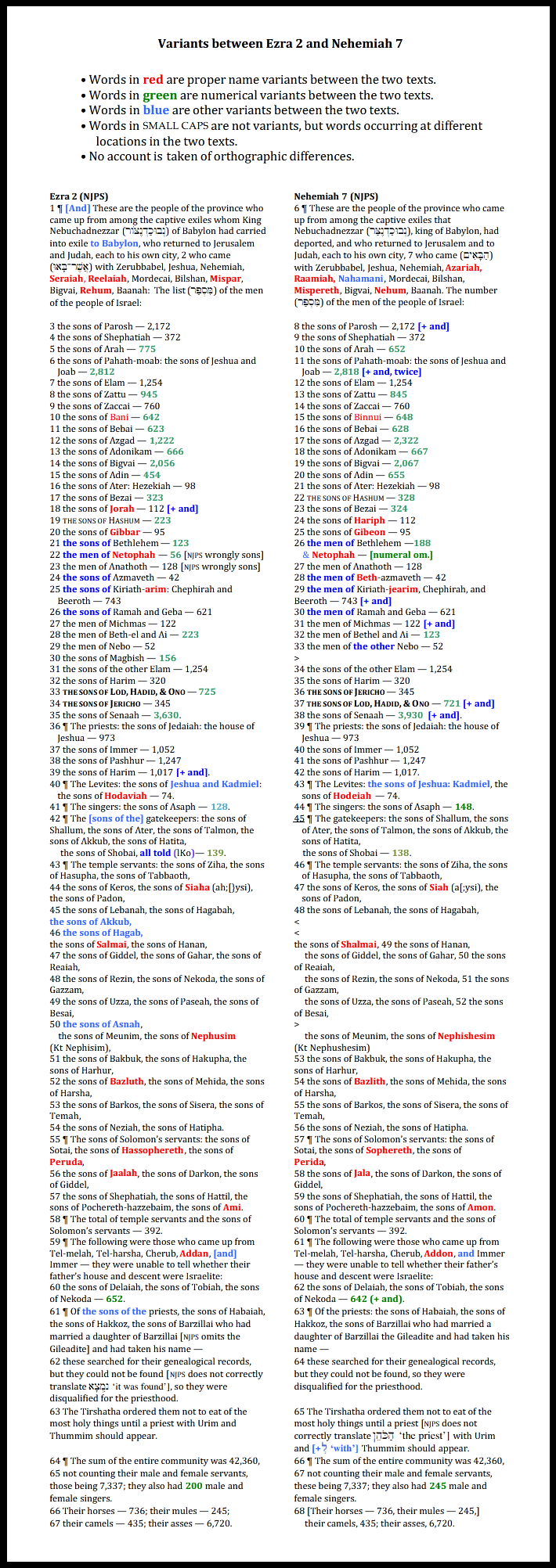
Some of the contradictions, of course, are fairly mundane details that might be easy to miss at first. How old was King Jehoiachin when he began his reign? (According to 2 Chronicles 36:9, he was eight; but according to 2 Kings 24:8, he was eighteen.) Who was Samuel’s firstborn son? (According to 1 Samuel 8:1-2, it was Joel; but according to 1 Chronicles 6:28, it was Vashni.) Where did Josiah die? (According to 2 Kings 23:29-30, he died at Megiddo; but according to 2 Chronicles 35:23-24, he died in Jerusalem.) Was Isaac Abraham’s only son when he was nearly sacrificed? (According to Genesis 22:2 and Hebrews 11:17, he was; but according to Genesis 16:15-16 and Galatians 4:22, Abraham already had another son.) How many members of each Jewish family returned to Judah from their captivity in Babylon? (Ezra 2 and Nehemiah 7 each give detailed lists of how many people there were from each family, but the two accounts contradict each other in over a dozen places.)
Like I said, pretty mundane. But there are other contradictions that are harder to overlook. The creation story, for instance, is the most prominent event in all of Christianity – but the Book of Genesis gives two contradictory descriptions of how it supposedly happened. In Chapter 1, it describes God creating both Adam and Eve at the same time, on the sixth day of creation, after creating all the other animals. In Chapter 2, though, God creates Adam first, then creates the animals so that Adam won’t be alone, then gives Adam the task of going through the entire animal kingdom and naming each creature individually (which realistically would have taken months or years); and it’s only after Adam has completed this project and failed to find a suitable companion that God finally decides to put him to sleep and create Eve out of his rib. These aren’t two complementary accounts of the same sequence of events; they’re two different stories.
Or take the story of Noah’s ark. We all know the classic image of Noah leading all the different species of animals onto his boat, two by two; and sure enough, that’s how events are described in Genesis 6:19, 7:8-9, and 7:14-15 – every species boards the ark in twos (one male and one female). But according to Genesis 7:2-3, there are actually seven of each animal – or fourteen, depending on your translation – loaded onto the ark (except for the unclean ones like pigs and dogs, which are only loaded in twos). This one really threw me for a loop when I first learned of it – who had ever heard of Noah bringing animals onto the ark in sevens? But sure enough, it’s right there in the book; I’d just somehow managed to never see it.
I could keep going here; these kinds of contradictions come up again and again – not just here and there, but hundreds of times – throughout the Bible. I’m only giving a few Old Testament examples right now to demonstrate the general point, but they become even more egregious once you get to the New Testament (as we’ll get into later). The tongue-in-cheek clip below from NonStampCollector does a good job of putting into perspective just how extreme the problem is:
Again, it’s true that some of these contradictions only concern relatively minor details and probably don’t have much bearing on the big-picture questions of existence. (Who really cares how old Jehoiachin was when he became king?) But regardless of how minor these points may be for the broader overarching message of Christianity, they are most definitely not minor for the specific claim that the Bible is inerrant – because if you really want to make that claim, then even a single tiny fault is enough to disconfirm it. If a book contains flaws, then by definition, it’s imperfect.
There are ways of trying to rationalize the contradictions away, of course – and if you think your religion requires you to believe that the Bible is perfect, then it’s only natural that you’ll want to try – but the mental gymnastics you have to put yourself through to come up with some convoluted explanation for every single disparity you encounter (as I tried to do myself for years) just start to feel forced and ridiculous after a while. Bart Ehrman recounts his own experience with this kind of cognitive dissonance during his time in seminary:
A turning point came in my second semester, in a course I was taking with a much revered and pious professor named Cullen Story. The course was on the exegesis of the Gospel of Mark, at the time (and still) my favorite Gospel. For this course we needed to be able to read the Gospel of Mark completely in Greek (I memorized the entire Greek vocabulary of the Gospel the week before the semester began); we were to keep an exegetical notebook on our reflections on the interpretation of key passages; we discussed problems in the interpretation of the text; and we had to write a final term paper on an interpretive crux of our own choosing. I chose a passage in Mark 2, where Jesus is confronted by the Pharisees because his disciples had been walking through a grain field, eating the grain on the Sabbath. Jesus wants to show the Pharisees that “Sabbath was made for humans, not humans for the Sabbath” and so reminds them of what the great King David had done when he and his men were hungry, how they went into the Temple “when Abiathar was the high priest” and ate the show bread, which was only for the priests to eat. One of the well-known problems of the passage is that when one looks at the Old Testament passage that Jesus is citing (1 Sam. 21:1-6), it turns out that David did this not when Abiathar was the high priest, but, in fact, when Abiathar’s father Ahimelech was. In other words, this is one of those passages that have been pointed to in order to show that the Bible is not inerrant at all but contains mistakes.
In my paper for Professor Story, I developed a long and complicated argument to the effect that even though Mark indicates this happened “when Abiathar was the high priest,” it doesn’t really mean that Abiathar was the high priest, but that the event took place in the part of the scriptural text that has Abiathar as one of the main characters. My argument was based on the meaning of the Greek words involved and was a bit convoluted. I was pretty sure Professor Story would appreciate the argument, since I knew him as a good Christian scholar who obviously (like me) would never think there could be anything like a genuine error in the Bible. But at the end of my paper he made a simple one-line comment that for some reason went straight through me. He wrote: “Maybe Mark just made a mistake.” I started thinking about it, considering all the work I had put into the paper, realizing that I had had to do some pretty fancy exegetical footwork to get around the problem, and that my solution was in fact a bit of a stretch. I finally concluded, “Hmm… maybe Mark did make a mistake.”
Once I made that admission, the floodgates opened. For if there could be one little, picayune mistake in Mark 2, maybe there could be mistakes in other places as well. Maybe, when Jesus says later in Mark 4 that the mustard seed is “the smallest of all seeds on the earth,” maybe I don’t need to come up with a fancy explanation for how the mustard seed is the smallest of all seeds when I know full well it isn’t. And maybe these “mistakes” apply to bigger issues. Maybe when Mark says that Jesus was crucified the day after the Passover meal was eaten (Mark 14:12; 15:25) and John says he died the day before it was eaten (John 19:14) – maybe that is a genuine difference. Or when Luke indicates in his account of Jesus’s birth that Joseph and Mary returned to Nazareth just over a month after they had come to Bethlehem (and performed the rites of purification; Luke 2:39), whereas Matthew indicates they instead fled to Egypt (Matt. 2:19-22) – maybe that is a difference. Or when Paul says that after he converted on the way to Damascus he did not go to Jerusalem to see those who were apostles before him (Gal. 1:16-17), whereas the book of Acts says that that was the first thing he did after leaving Damascus (Acts 9:26) – maybe that is a difference.
Nate Gabriel recalls having a similar experience himself:
I used to be a fundamentalist, and it was [Jonah’s] fish that first convinced me there could be mistakes in the Bible. Not because the whale isn’t really a fish, but because the Bible, going back to the earliest documents we have, is inconsistent about its gender. It uses the word three times: The fish (“dag,” masculine) swallowed Jonah, Jonah was inside the fish (“dag’ah,” feminine), and then Jonah was vomited up by the fish (masculine again).
Wikipedia told me that the Orthodox Jewish explanation is that there were multiple fish and Jonah got transferred into a larger and more comfortable one when he gained more faith. I concluded that hey, there can be typos in the Bible after all.
And if you’re really looking for typos, probably the best place in the Bible to find them is the Book of Revelation, which in its original Greek text is so full of basic grammatical errors that it prompted Friedrich Nietzsche to comment, “It is a curious thing that God learned Greek when he wished to turn author – and that he did not learn it better.”
At the end of the day, it seems like the best way to resolve the issue of biblical contradictions is simply to acknowledge the possibility that its authors may in fact have made a few mistakes at various points. That doesn’t necessarily mean that they weren’t divinely inspired – even an imperfect book might have been inspired by God – all it means is that the text of the Bible was transcribed by fallible humans, not directly written firsthand by God himself. And even the Bible itself will openly concede that much; aside from the Ten Commandments, which supposedly were chiseled directly into the stone tablets by the hand of God himself (Exodus 31:18, 32:16; Deuteronomy 9:10), the Bible is quite clear that, for instance, the Pauline epistles (Galatians, Romans, Ephesians, etc.) were written by Paul, the books of Jeremiah and Ezekiel were written by Jeremiah and Ezekiel, and so forth. It wasn’t God who wrote the Bible – it was men. And as verses like Ecclesiastes 7:20 and Romans 3:10 teach, no man is perfect (although, awkwardly enough, the Bible even manages to contradict itself on that particular point – as in verses like Genesis 6:9 and Job 1:1, 1:8, and 2:3, which describe men like Noah and Job (among others) as perfect and blameless).
The fact is, the text that we know today as the Bible wasn’t just handed down from the heavens, in its current form, fully complete. It emerged as the result of a very long and messy process that spanned centuries and involved thousands of people – with lots of edits, revisions, additions, subtractions, translations, and mistranslations along the way.
This whole process is actually pretty fascinating when you get into the historical details. Traditionally, Christianity teaches that the first few books of the Bible – Genesis, Exodus, Leviticus, Numbers, and Deuteronomy – were written by a single author, namely Moses. But the historical and textual record shows that these books weren’t actually written by a single author at all, but were combined from multiple sources over the years. Biblical scholars (a sizable portion of whom are Christians themselves) have a couple different models for breaking down the exact composition – one of which, the Documentary Hypothesis, is illustrated in simplified form by Evid3nc3 below (excerpting from his video here); what they all universally affirm is that the single-author model is untenable.
This would make sense, of course, considering that Deuteronomy describes Moses’s death and burial, along with other events that happened afterward; so clearly (for this and other reasons) Moses couldn’t have written the whole thing himself. (Although if he did, it would add a pretty amusing dimension to verses like Numbers 12:3: “Now Moses was a very humble man, more humble than anyone else on the face of the earth.”)
But the existence of multiple authors also makes sense of a lot of other things, including all those contradictions. It explains, for instance, why the creation story takes the odd form that it does, with two contradictory descriptions of what happened – because it actually was originally two different accounts, and it was only later that they were (somewhat clumsily) combined into the same narrative. As mentioned in the clip above, scholars were able to disentangle these two accounts by noticing certain telltale signs in the text, like the fact that one account always refers to God as “Yahweh” and uses one particular writing style, while the other always refers to God as “Elohim” and uses a noticeably different style. And by tracing these regularities throughout the other books of the Old Testament, these scholars were able to uncover explanations for the other contradictions as well – like the “twos” versus “sevens” contradiction in the Noah story, or the fact that Genesis 6-7 describes Noah assembling the animals and boarding the ark with his family a good three or four times, one right after another, in a manner that would otherwise just seem weirdly redundant.
It’s the same story with all those other incongruities throughout the Old Testament; the reason why so many different parts of the Bible disagree on so many details is because originally, they weren’t part of the same volume at all, so the issue of mutual consistency didn’t really come into play as much. Different sections of what would eventually become the Jewish Torah (AKA the Old Testament) started off as their own independent works, existing separately from one another and floating around the Middle East along with countless other books of supposedly divine scripture. It took centuries of mixing and matching before the Torah started to take shape in its modern form; and even once it did, human editors continued to alter it – adding new passages, removing others, and making various changes as they saw fit.
As for the New Testament books, obviously they were added to the canon much later – but again, they weren’t just handed down from the heavens one day in a single tidy volume. Like the Old Testament, the New Testament was assembled from multiple different sources and extensively revised over the course of several centuries. When the Christian religion first started out, the different churches scattered across the Middle East all had different books of scripture that they considered sacred – some of which were shared by other churches, others of which weren’t. There wasn’t an official biblical canon; every church just used whichever writings about Jesus they liked best at the time. Needless to say, having such a hodgepodge of competing texts tended to muddle things up quite a bit in terms of Christian doctrine – and at times these differences were so pronounced that they caused real tensions to flare up between the various Christian factions. There were sects like the Ebionites and the Adoptionists, for instance, who believed that Jesus was 100% human and only became the Messiah after God adopted him into that role (i.e. he was not equal to God, but was simply God’s instrument) – while other sects, like the Docetics and the Basilideans, believed that Jesus was 100% divine all along and that his physical body was only an illusion (so he was never really crucified, but only appeared to be). There was a sect called Marcionism that rejected the Old Testament scriptures altogether and insisted that Jesus’s mission was to overthrow the angry and vindictive Old Testament God (who was actually a lesser demigod) and reveal the higher God of love and forgiveness instead – the true God. (In fact, Marcion himself was the first person ever to compile a canon of Christian scriptures – a “New Testament” that was separate from the “Old Testament” – for precisely this reason.) There was even a sect called the Carpocratians who (allegedly) believed in reincarnation and taught that in order to finish one’s cycle of reincarnation and ascend to Heaven, one first had to experience everything in life – including committing every possible sin. (You can imagine the kind of debauchery that this would have led to.)
Suffice it to say, for the first few centuries of Christianity’s history, the actual doctrine of the religion was something of a free-for-all. It was only when things finally reached a boiling point in AD 325 that a bunch of the religion’s most prominent leaders decided to convene at Nicaea and hold a series of votes to decide on what the answers to the key theological questions of Christianity (like whether Jesus was human or divine) should actually be. To believers today, of course, it might seem galling to even imagine that the most holy and sacred of truths might be decided by something as prosaic as a show of hands by some random committee hundreds of years after Jesus’s death – but it was only after this meeting (along with a series of other such meetings spanning the next few centuries) that something resembling a sort of official Christian consensus began to emerge. And it was also during this period that the leading figures within the Church finally came to something of a consensus regarding which specific combination of books should serve as the official sacred canon – i.e. the Bible.
This was not a straightforward process, to say the least; there was a lot of politics involved, and there was never really a point where the matter was settled in anywhere near as definitive a manner as you might imagine. Several of the books that we see in our Bibles today, for instance – Titus, 1 and 2 Timothy, etc. – are completely absent from the earliest copies of the Bible. Books like Hebrews, James, 2 and 3 John, 2 Peter, Jude and (especially) Revelation were considered particularly controversial additions that took centuries to finally gain mainstream acceptance into the canon. Some of the most important passages in the Bible – like the story in John 8 where Jesus spares the adulteress with the admonition “Let he who is without sin cast the first stone,” or the line in Luke 23 where he’s dying on the cross and says “Father, forgive them, for they do not know what they are doing,” or even the crucial section at the end of Mark where the resurrected Jesus appears to his followers and then ascends into Heaven – weren’t part of the original text of those books at all, and were only added in by Christians centuries later. Other passages were altered or added to try and cover up obvious contradictions and mistakes (like 2 Samuel 21:19, which says that it was Elhanan, not David, who killed Goliath – and which KJV translators later altered to say that Elhanan killed “the brother of Goliath,” not Goliath himself). And not only that, but there were still other books that originally were included in the earliest versions of the Bible but were later removed – such as the Epistle of Barnabas, 1 and 2 Clement, and The Shepherd of Hermas. As Sam Harris notes, “For centuries [these books were] considered part of the canon, and then [were] later jettisoned as false gospel. Generations of Christians lived and died being guided by gospel that is now deemed both incomplete and mistaken.” The Bible that we know today actually still includes references to a number of these books throughout its pages, often citing them as sacred sources of prophecy and miracle accounts. Needless to say, though, this raises some serious problems for the idea that the modern Bible is God’s perfect word; why would a truly holy book cite a bunch of other books as containing holy knowledge if they were actually false gospel?
But that’s the thing – there are so many inconsistencies in the Bible, and so many thousands of discrepancies between all the different versions of the Bible that have existed throughout history, that even just asking whether the Bible is infallible is a premise that refutes itself. As Ehrman puts it: “When people ask me if the Bible is the word of God, I answer ‘which Bible?’”
To this day, there are multiple competing versions of the Bible, and each has its own different combination of books that it considers canonical. (This is another one of those facts that I somehow managed to go my entire life as a Christian without knowing, but which totally blew my mind when I found out about it years later.) The Catholic Bible, for instance, includes all the books featured in the Protestant Bible, plus several additional ones: 1st and 2nd Maccabees, Baruch, Tobit, Judith, The Wisdom of Solomon, Sirach (AKA Ecclesiasticus), some additional passages in Esther, and some additional passages in Daniel (namely Susanna, the Prayer of Azariah and the Song of the Three Holy Children, and Bel and the Dragon (a story in which, yes, Daniel slays a real-life dragon)). Bibles used by the Orthodox Church – the second-largest Christian denomination after Catholicism – also include all these books (known collectively as the Apocrypha), plus 1st and 2nd Esdras, The Prayer of Manasseh, 3rd Maccabees, and Psalm 151. And in fact, even the original King James Version of the Bible, which most Protestants regard as the definitive version of God’s word, includes these books; it was only around the mid-1800s that Bible publishers quietly started dropping them from most Protestant editions.
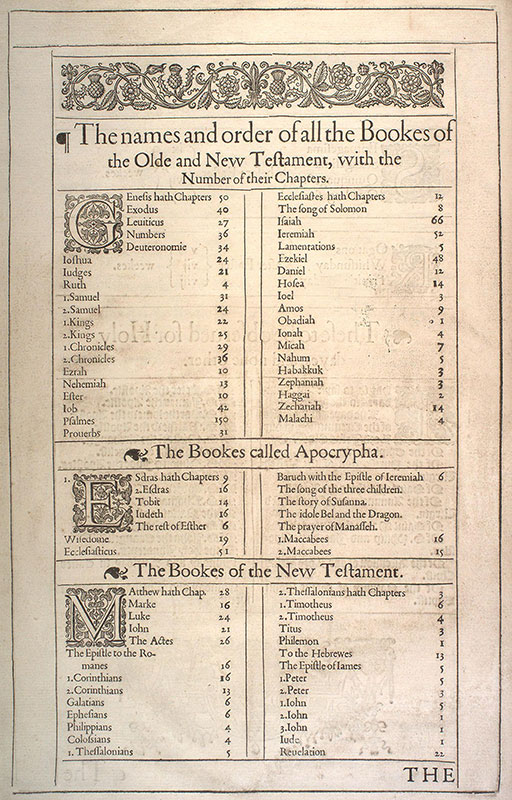
(You might also notice individual verses like John 5:4, Acts 8:37, and 1 John 5:7 missing from your Bible depending on which translation you’re using; that’s because those verses were later interpolations, not part of the original text, so some biblical editors opted to remove them while others left them in.)
So to sum up, then, although it surely would have made things much easier for everyone if God had simply dropped the Bible from the sky in a perfectly finished, self-contained form (as he supposedly did with the Ten Commandments), this isn’t even close to what actually happened. There was never a single volume that we could point to and say, “There, that’s the original Bible.” What actually existed were a bunch of manuscripts, written by a wide range of different authors, that sometimes contradicted each other and sometimes made mistakes. None of those original manuscripts survived to the present day, so we don’t have them on hand to use as a reference. All we have are copies of copies of translations of copies of translations of copies, that were passed along from person to person over the course of centuries – accumulating mistranslations, editorial additions, redactions, and other alterations and mistakes along the way, like a game of telephone.
Even professional Christian apologists, if backed into a corner, will acknowledge that all this human error is to blame for many of the Bible’s faults. When faced with the “how old was Jehoiachin when he became king” contradiction, for instance, the prominent apologist Matt Slick concedes, “The discrepancy in ages is probably due to a copyist error.” He quickly follows it up, of course, with “Does this mean the Bible is not trustworthy? Not at all. Inspiration is ascribed to the original writings and not to the copies.” But the problem, like I said, is that we don’t have any of the original writings. So even if you assert that those lost scriptures – the original ones – were inerrant, that doesn’t do you much good if you also want to claim that the Bible today should be followed because it’s inerrant – because the only Bibles people are following today, i.e. the only Bibles that still exist, are the faulty copies. Ehrman asks the crucial question: “If God inspired the Bible without error, why hadn’t he preserved the Bible without error? I couldn’t think of a good answer then, and I still can’t think of a good answer now.”
No matter how you slice it, there’s just no way around the fact that the book we know today as the Bible is an imperfect one. The humans who wrote, compiled, and edited it may have been doing the best they could with the information they had at the time – or they may have been hopelessly biased – but either way, at the end of the day, they were only human. They still made mistakes; they still made faulty assumptions; and they still leapt to false conclusions at times. This is why the Bible contains the contradictions that it does – and it’s also why it contains so many other mistakes as well.
After all, the Bible doesn’t just contain internal inconsistencies, in which it disagrees with itself; it also contains external inconsistencies, in which it disagrees with realities of the outside world. Some of these errors are pretty minor (albeit still problematic for the claim that the Bible is perfectly inerrant); for instance, Leviticus 11 says that hares “chew the cud,” and that bats are a type of bird, and that beetles and grasshoppers only have four legs (none of which is true, obviously). But a lot of the scientific and historical mistakes are much more significant.
Just to take one example, consider the Tower of Babel story in Genesis 11. According to the story, all the humans on Earth originally shared a single common language – but one day, about 4,000 years ago, they decided to build a tower tall enough to reach Heaven itself, and God responded by cursing them so that they would all start speaking different languages and would therefore be unable to finish their task; and that’s why we have all the different languages around the world that we have today. But leaving aside some of the obvious questions here, like why this story considers Heaven to be a literal physical location in the sky, or why God would feel threatened by a species that was able to coordinate well enough to build such a tall tower, the central flaw of this story is the fact that it simply isn’t how all the world’s different languages came to exist. The story is just factually false. Different languages didn’t abruptly appear one day out of nowhere; they evolved and branched into different variations over the course of thousands of years. Everything that has ever been written reflects this – if you look at something written by Shakespeare, for instance, the English he uses is noticeably different from the English we use today; if you go back even further and look at something written by Chaucer, the language becomes even less recognizable as English; and if you go back further still and read Beowulf, you can’t even tell that it’s English at all. You can even trace linguistic evolution in this way using old translations of the Bible; the Middle English used in Wycliffe’s Bible is starkly different from the English used in modern translations. And you can do this for every other language too, not just English – you can trace their evolution through literary works, backtrack etymology, compare their grammar and syntax with those of other languages, and so on. The entire field of historical linguistics consists of cataloguing where these languages came from and how they evolved; and the verdict is conclusive – languages didn’t just appear all at once some 4,000 years ago. The Tower of Babel story isn’t a historical one. At best, it’s a convoluted metaphor. More realistically, it’s just a legend, handed down from a time when such legends were ubiquitous. Maybe it was loosely based on some real event, like the construction of the 300-foot Etemenanki ziggurat in Babylon, which was interrupted at around the same time as a general decline in literacy in the region due to Babylon’s fall. But if that’s the case, then the Tower of Babel story can only be called “true” in the same sense that Game of Thrones (which is loosely based on the historical Wars of the Roses) can be called “true.” There was no divine intervention there; it was just a normal historical event that happened in the same way that historical events normally happen.


And the same applies to nearly all of the Bible’s other key stories; whatever their value as allegory might be, a literal reading of them just isn’t tenable. Let’s take a few minutes to look at the story of Noah’s flood, for instance – which supposedly happened about a hundred years before the Tower of Babel. Already, this chronology should be raising some red flags; are we to believe that the mere three fertile couples who survived the flood (Noah’s sons and their wives) were able to repopulate the entire earth in only a hundred years? According to Genesis 10, there were apparently enough people just three generations after the flood not only to build a tower to Heaven, but to populate the cities of Erech, Accad, Calneh, Ninevah, Rehoboth, Calah, Resen, Sidon, Gerar, Sodom, Gomorrah, Admah, Zeboim, Lasha, Mesha, and Sephar – despite the fact that Noah’s family tree of descendants only consisted of a few dozen people.

Leaving aside that particular plot hole, though, the other problems with the flood story are so numerous that it’s hard to even know where to begin. For starters, there are just all the logistical impossibilities. A wooden ship the size of Noah’s ark (450 feet) would have been unable to remain afloat, because the flexural strength of wood just isn’t sufficient to prevent separation between the seams at that scale. Various attempts have been made to build seaworthy recreations of Noah’s ark using only the materials mentioned in the story, but all have failed; the only wooden ships in history that have even come close to 450 feet have required metal reinforcement and constant use of mechanical pumps to keep their hulls from flooding.
What’s more, even if Noah had somehow been able to fell tens of thousands of massive timber-quality trees, haul all that lumber to a construction site (about 7,400,000 pounds worth), build a 450-foot ark, and ensure that it was perfectly watertight – all by himself, and all at the age of 600 (as Genesis 6 describes) – that still leaves the question of how on earth he could have gathered a pair (or seven) of every single animal in the world and fit them all onto that one boat. After all, 450 feet might be very large for a vessel made of wood, but it’s still pretty small in absolute terms – only about half the size of the Titanic (maximum capacity: 3,547) – and the number of animal species on Earth is literally in the millions. To put that into perspective, below is a picture of one million dots. (Keep in mind, this is only a fraction of the total number of animal species estimated to exist – even the most conservative estimates put the total at several million – but just for simplicity’s sake (and because a lot of them are insects that don’t take up much space), we’ll stick with a measly one million here.) Imagine that each of these dots is a different kind of animal. Now mentally double (or septuple) that image in your mind, since there was supposedly a pair (or seven) of each animal brought onto the ark. And now consider not only that Noah would have had to fit this many animals onto a single boat, but that each of them would have required enough food and fresh water to last them an entire year. Just one pair of those dots – the elephants alone – would have required 300,000 pounds of food and 30,000 gallons of water; two giraffes would require 50,000 pounds of food; two lions would require 15,000 pounds of meat (which, even with the best preservation techniques available at the time, would have gone bad barely a quarter of the way into the voyage); and so forth. On top of all this, each of these animals would have produced a commensurate amount of waste, which would have had to be disposed of somehow. Does it really seem plausible, then, that Noah would have not only been able to fit this many animals and provisions onto a single boat, but that all the necessary food, water, veterinary care, and waste disposal could have been delivered to every one of these animals, every day, for an entire year, by just eight people?










Faced with the obvious logistical impossibilities here, some biblical literalists will try to reconcile them by suggesting that the definition of “two of every kind” might not actually mean two of every species, but two of some broader taxonomic category, like family or order – i.e. two cat-like animals, two dog-like animals, two deer-like animals, etc. So instead of having reindeer and white-tailed deer and Chinese water deer and pudús, you’d just have one pair of reindeer; instead of having gazelles and impalas and oryxes and ibexes, you’d just have one pair of gazelles; and so on. (All the other species would be killed in the flood but would re-emerge later.) But as Mark Isaak points out, that doesn’t seem to fit with what the Bible itself describes:
The Biblical “kind,” according to most interpretations, implies reproductive separateness. On the ark, the purpose of gathering different kinds [in male-female pairs] was to preserve them by later reproduction. Species, by definition, is the level at which animals are reproductively distinct.
In response to this, then, some literalists will say that it wasn’t just that Noah only took one species from each family or order, but that there was only one species of each family or order that even existed back in Noah’s time – so that instead of there being (for instance) lions and tigers and leopards, there would have just been one generic species of proto-cat, from which all modern varieties of cat would eventually descend (and only one species of proto-dog, and only one species of proto-deer, and so on).
But by trying to rationalize that there must have been fewer “kinds” of animals at the time (or that some of them went extinct and re-emerged later), literalists paint themselves into a corner – because by saying that there were originally only a handful of species, they’re also forcing themselves to conclude that the animals, after leaving the ark, must have undergone extraordinarily rapid evolution and speciation in order to account for the existence of the millions of species we know today. And this isn’t just ironic because literalists are so anti-evolution in general – it’s also flatly indefensible in light of everything we know about biology and genetics. There simply wouldn’t have been enough time for such a small handful of species, in a mere couple thousand years, to accumulate enough mutations to account for the vast genetic diversity we see today; animals’ reproductive cycles are just too long for that.
Besides, regardless of biology, the “fewer species” explanation is a non-starter simply because we know from ancient texts, sculptures, and artwork that a wide range of different species of the same “kind” have been here all along – before, during, and after the time frame given for the flood. Cave paintings from 30,000 years ago depict lions, leopards, and other feline species, along with different varieties of horses, deer, bison, and other herd animals; carvings and sculptures from ancient Egypt (pre- and post-flood) depict still more varieties of cats, birds, and other animals; and so on.



So no matter how you frame it, getting all those animals onto the ark still would have presented a logistically unworkable problem, just in terms of sheer numbers. But on top of that, it would have been unworkable in practically every other sense as well. Getting every kind of animal onto the ark would have meant assembling animals from every corner of the planet, most of them separated by thousands of miles. How would the penguins and elephant seals have gotten from Antarctica all the way to the Middle East? How would the koalas and echidnas have gotten there from Australia? How would the sloths and snails of the Amazon have traveled all the way there by foot – a trip that, given how slowly these animals move, would have taken longer than their natural lifespans? How could they have crossed thousands of miles of treeless deserts and saltwater oceans with nothing around to eat or drink? And for that matter, how could these animals have even survived once they actually reached the ark? Arctic species often require a cold environment to survive, desert reptiles require a hot environment, tropical species require a humid environment, and so on. What’s more, a lot of animals can only eat very specific kinds of food found exclusively in their native parts of the world – koalas, for instance, subsist entirely on eucalyptus plants that can only be found in Australia – and if they try to leave those habitats where their food grows, they starve to death. How would these animals have managed? And once they disembarked, how would they have so precisely found their way back to their home habitats, such that all the marsupials would end up back in Australia, all the lemurs would end up in Madagascar, all the species native to the Galapagos Islands would return straight there and nowhere else, and not a single one of these species would leave even the slightest trace of evidence that they had migrated to or from the Middle East (or anywhere else outside their native habitats) during the time frame in question?
There’s also the issue of Noah supposedly taking one male and one female of every species onto the ark. Aside from the fact that this would result in most species becoming so horrendously inbred that they would immediately go extinct (the minimum viable population size for most vertebrates is about 4,000 individuals), there are a number of animal species that don’t even reproduce sexually, so bringing one male and one female wouldn’t even make sense. Several species of lizard, for instance, are all-female and reproduce parthenogenically – so it wouldn’t have been possible to bring one male onto the ark, because males don’t exist. Other species, like earthworms, snails, and slugs, are hermaphroditic – meaning that each individual has both male and female characteristics and can serve either role in reproduction – so again, it wouldn’t have been possible for Noah to collect one male and one female of each of these species, because different sexes don’t exist for them.
Similarly, there’s the question of eusocial species like bees, ants, and termites, for whom just having one queen and one male drone wouldn’t constitute a viable hive or colony; those species need the entire nest to survive. And speaking of invertebrates, what about those species with extremely short lifespans? As Isaak points out, “Adult mayflies on the ark would have died in a few days, and the larvae of many mayflies require shallow fresh running water. Many other insects would face similar problems.”
We haven’t even mentioned all the world’s aquatic species, which would face some of the biggest problems of all. If the whole world flooded, then all the salt water would mix with all the fresh water, and the result would be a brackish mixture in which most fish would be unable to survive. Aside from a few rare species that can withstand rapid changes in salinity, freshwater fish can’t tolerate salt water, and saltwater fish can’t tolerate fresh water. The Bible doesn’t seem at all concerned with the survival of these species; it seems the authors of Genesis either assumed that they’d be fine in any kind of water, or they simply failed to account for them. But if Noah’s flood had actually happened, the aquatic animals would have met the same fate as those still on land – mass eradication.
And this leads to one of the biggest problems of all with the flood story: the fact that it leaves no room for any life outside of the ark to have survived the deluge. Genesis 6:17, 7:4, and 7:23 all make it exceptionally clear that “every living substance” outside the ark was utterly destroyed, with no survivors of any species. If that was the case, though, then what would have happened once the animals that were on the ark finally disembarked and went out into the world again? There would have been nothing but ravaged wasteland stretching across the entire globe – so what, for instance, would the carnivores have eaten? Would they have just eaten all the herbivores that had just gotten off the ark, and then turned on each other once they ran out of those? The herbivores themselves wouldn’t have been any better off in terms of food supply; if the world really had been underwater for an entire year, with the water level reaching five and a half miles high (high enough to cover even the highest mountains, as the Bible claims), plant life would have been utterly wiped out. In theory, it might have been possible for the seeds of a few coastal species like mangroves and coconuts to survive a year-long global flood, but that wouldn’t have counted for much if every other living substance on Earth truly was destroyed. And it certainly would have been – not only would the extreme turbulence, high salinity of the water, and avalanches of sediment have killed and buried all the plants on Earth (not to mention ruining the soil), the sheer depth of the waters would have made it impossible for any life-sustaining sunlight to reach them even if they somehow did survive everything else. In fact, as Charles Templeton points out, if there had been enough water “to cover the entire globe to a height more than five and a half miles high, the weight of it would [have collapsed] the surface of the earth.”
The biblical authors couldn’t have known all this, of course – which is why Genesis 8:10 describes Noah sending out a dove after the floodwaters recede and having it return to him with an olive leaf in its beak, as if there wasn’t even an issue. The authors had probably experienced plenty of small local floods before in which the trees and bushes had survived just fine – so why should a global mega-flood be any different? There would have been no reason for them to think that the world’s olive trees couldn’t have survived the flood perfectly intact. But for us who know better, this plot hole requires an actual explanation – as do all the other plot holes in the flood story (including many that we haven’t even mentioned here, like how anyone aboard the ark could have survived at all at an altitude of five and a half miles, where the air is too thin to be survivable for more than a day or two).
In light of all these problems, then, a lot of biblical literalists will just bite the bullet and admit that there’s no practical way these things could have all been accomplished by normal means – but then they’ll add that no practical explanation is necessary anyway, because God could have just performed miracles to solve all these problems. The way that all the animals could have gotten to the ark is that God could have just miraculously transported them there; the way that they could have all fit on board is that God could have just miraculously expanded the ark’s interior dimensions; the way they could have survived the voyage is that God could have miraculously sustained them; and so on. But if you’re just going to hand-wave away every problem in the story by saying that God could have solved it with miracles, then what would have been the point of flooding the earth in the first place? Why bother with the whole ordeal of gathering every animal species onto a boat, causing it to rain for 40 days, waiting for the floodwaters to dry up, and so on, when God could have just as easily snapped his fingers and miraculously caused all the evil people in the world to instantly vanish, accomplishing the same goal without any fuss?
Maybe God would have had his reasons, who knows. But such speculations are a moot point regardless – because practical logistics aside, the biggest reason why we know Noah’s flood never happened (and when I say “know,” obviously I don’t mean 100% certainty – that’s impossible – I just mean “know” to the extent that we can reasonably say we know anything) is because every piece of physical evidence we have shows that it never happened. As Ken Feder points out, if there actually had been a global flood, “the archaeological record of 5,000 years ago would be replete with Pompeii-style ruins – the remains of thousands of towns, villages and cities, all wiped out by flood waters, simultaneously.” If every civilization on Earth had been simultaneously eradicated and only eight people were left to restart the human race from scratch, the archaeological record would show a massive discontinuity in cultural development. But instead, as Feder notes, “it would appear that the near annihilation of the human race, if it happened, left no imprint on the archaeological record anywhere.”
According to the literalist biblical chronology, Noah’s flood destroyed all life on Earth in 2348 BC. But if this was the case, then apparently nobody told the Egyptians, or the Akkadians, or any of the other thriving civilizations of the time. Around 2348 BC, the Egyptians were busily constructing a pyramid for the pharaoh Unas and inscribing it with hundreds of ritual texts and spells (keep in mind, this is a full century before the Tower of Babel story says that the Egyptian language should have even begun to exist) – and they would keep right on constructing it until it was finished and Unas himself was buried there, after which his successor Teti would take over and continue to rule. At no point in that timeline did any great flood obliterate the entire civilization.

Likewise, in 2348 BC Sargon the Great was ruling over the Akkadian Empire, conquering cities, building temples and statues, and inscribing them with cuneiform script in his own culture’s language (which, again, shouldn’t have existed for another century according to the Tower of Babel story) – and he too would keep right on doing so until his son Rimush took over for him, around 2280 BC. None of them were wiped out by any massive world-destroying flood either. And neither was the Indus Valley Civilization, as it perfected its urban sanitation systems in trade cities like Harappa and Mohenjo-daro; neither was the Shijiahe culture in China, as it went on crafting its jade artifacts; neither were the tribal Europeans, as they continually constructed new additions to Stonehenge. None of these civilizations experienced any interruption in their cultural continuity that would suggest anything close to a mass extinction event; they all just kept right on existing the whole time. And we have detailed records of all of it – not just the written records that these civilizations kept themselves, but all the archaeological evidence independently corroborating those written records.
On top of those lines of evidence, there’s also the geological record, which provides some of the best evidence of all. As Hal Hackett and AronRa point out:
If there was a worldwide flood, salt flats would dot the continental basins, most of which would then be unusable for centuries. Large sections of them would remain unusable, and all of them would share geochemical traces. None of them would have natural soil horizons. The biblical authors didn’t know that, because they didn’t know how any of these things work. [And although literalists may say] that we have no idea what a global flood would look like, we actually do. There are some megaflood deposits in eastern Washington State – ripple marks hundreds of meters long. They happened when an ice dam broke at a nearby glacial lake. Strange, then, that such landforms are not typical on every continent. With water catastrophically washing all over the earth from the oceans, surely these megaripples should mark their progress. Unfortunately for flood geology, megaripples only happen when glacial lakes break, and megafloods are not broadly responsible for Earth’s landforms.
Isaak raises more questions that would need to be answered if the flood had really happened:
Why is there no evidence of a flood in ice core series? Ice cores from Greenland have been dated back more than 40,000 years by counting annual layers. [Johnsen et al, 1992,; Alley et al, 1993] A worldwide flood would be expected to leave a layer of sediments, noticeable changes in salinity and oxygen isotope ratios, fractures from buoyancy and thermal stresses, a hiatus in trapped air bubbles, and probably other evidence. Why doesn’t such evidence show up?
How are the polar ice caps even possible? Such a mass of water as the Flood would have provided sufficient buoyancy to float the polar caps off their beds and break them up. They wouldn’t regrow quickly. In fact, the Greenland ice cap would not regrow under modern (last 10 ky) climatic conditions.
Why did the Flood not leave traces on the sea floors? A year long flood should be recognizable in sea bottom cores by (1) an uncharacteristic amount of terrestrial detritus, (2) different grain size distributions in the sediment, (3) a shift in oxygen isotope ratios (rain has a different isotopic composition from seawater), (4) a massive extinction, and (n) other characters. Why do none of these show up?
Why is there no evidence of a flood in tree ring dating? Tree ring records go back more than 10,000 years, with no evidence of a catastrophe during that time. [Becker & Kromer, 1993; Becker et al, 1991; Stuiver et al, 1986]
This last question raises still another interesting point against the idea that a global flood wiped out all life on the planet 4,400 years ago: namely, that we actually have organisms alive today – trees, sea sponges, and others – that are considerably older than that. There are bristlecone pine trees in California and Nevada that are 5,000 years old – meaning they would have already been hundreds of years old at the time of Noah’s flood. There are clonal trees like quaking aspens and Norway spruce trees that are over 9,000 years old. There are even glass sponges estimated to be over 10,000 years old (although determining their exact age is trickier than with the trees). If Noah’s flood had wiped out all life on Earth 4,400 years ago, then none of these organisms should exist today – but they’re all right here for us to see for ourselves.
There’s also evidence against the flood in the genetic codes of certain modern terrestrial animals. Take cheetahs, for instance. The global cheetah population went through a severe population bottleneck about 10,000 years ago, in which their numbers were so dramatically reduced that the species almost went extinct. It didn’t get quite as low as just two individuals, of course, but it was still bad enough that the species was forced to carry on with only a handful of mating adults – and as a result, today’s cheetah population is highly inbred. With such a small gene pool, the genetic variability within the cheetah population became far lower than among other big cat species; so consequently, cheetahs suffer from things like lower sperm quality, birth defects, dental problems, and greater vulnerability to infectious diseases. Now, if there had been a worldwide flood that had reduced every species’ population to just one male and one female, this is the kind of thing we might expect to see. But the thing is, we wouldn’t just see it in the cheetah population; we would see every species suffering from the same lack of genetic diversity, because every species would have gone through the same population bottleneck. And it wouldn’t just be as severe as in the cheetahs’ case; it would be much worse, since it would have happened more recently and with far fewer individuals of each species. Again, this isn’t something that the biblical authors could have known when they wrote the flood story, since they had no knowledge of population genetics. But that’s the whole point – what may have seemed plausible at the time just doesn’t hold up anymore given what we now know about the world.
It’s sort of like how the flood story purports to explain the existence of rainbows. According to Genesis 9, God invented the rainbow in the aftermath of the flood as a token of goodwill, to symbolize his promise not to destroy the world again. From then on, God promised, he would put a rainbow in the sky whenever it was cloudy, to remind humanity of his pledge. But yet again, we know that this just isn’t the factually correct explanation. The reason why rainbows exist is because they’re a necessary result of water in the air (whether it be rainwater or mist from a waterfall or whatever) refracting light from the sun at a certain angle. They existed for billions of years before humanity ever existed, and they’ll continue to exist long after we go extinct – because they weren’t just invented by God 4,000 years ago to symbolize his goodwill toward us; they’re a byproduct of the irrevocable laws of physics. For the biblical authors to say that the rainbow was a symbol of God’s covenant was like some other ancient religion saying that thunder was the sound of the gods warring with each other in the sky – it was just a legend that was made up to explain concepts that weren’t understood by science yet.
Of course, none of this is to say that the flood story, like the Tower of Babel story, couldn’t have actually been based on some lesser real-life event. As Bob Riggins writes:
There is genuine archaeological evidence of one or more real, catastrophic floods in the valleys of the Fertile Crescent (where the myth originated). To tribes who thought Sumeria was pretty much the whole world – or all of it that mattered – it would have seemed that their whole world was indeed flooded.
Recently, another possible source of the legend has been recognized. Thousands of years ago a sort of natural dam at the Bosporus gave way, allowing seawater to rapidly pour into a huge basin and lake north of Turkey (the region near Ararat! hmm…), flooding out thousands of square miles of fertile land, villages, and cities. The result is the Black Sea, where even now marine archaeologists are finding the drowned communities on the former lake shore.
Take some legends of the day their world ended, brought by Black Sea refugees, add to them a horrific flood or two from the Tigris-Euphrates region, conflate it with some exaggerated tales of the guy who saved some of his goats on a raft – and you’ve got the “Genesis Flood.” Many myths have those ingredients: some probable but untraceable basis in fact, exaggeration, combination with other tales, adoption and adaptation by other tribes with other gods. In that sense, Noah is in the same boat as Odysseus.
And in fact, we can be even more specific about the literary origins of the Noah story if we look at the other Middle Eastern flood legends that were popular at the time. The best evidence suggests that the Noah story was based largely on Mesopotamian stories like the Epic of Gilgamesh, the legends of Atra-Hasis and Ziusudra, and others – all of which predate Genesis by a millennium – which describe angry gods flooding the earth and destroying humankind, but not before instructing one of their followers to save himself by building a boat and riding out the deluge. The similarities between these myths and the Genesis narrative are too numerous to be coincidental; as B.A. Robinson writes:
In both the Genesis and Gilgamesh stories:
- The Genesis story describes how mankind had become obnoxious to God; they were hopelessly sinful and wicked. In the Babylonian story, they were too numerous and noisy.
- The gods (or God) decided to send a worldwide flood. This would have drowned all men, women, children, babies and infants, as well as eliminate all of the land animals and birds.
- God (or one of the gods) knew of one righteous man, Ut-Napishtim or Noah.
- One of the gods (or God) ordered the hero to build a multi-story wooden ark (called a chest or box in the original Hebrew).
- The ark would be sealed with pitch.
- The ark would have many internal compartments.
- It would have a single door.
- It would have at least one window.
- The ark was built and loaded with the hero, a few other humans, and samples from all species of other land animals.
- A great rain covered the land with water.
- The mountains were submerged under water.
- The ark landed on a mountain in the Middle East.
- The hero sent out birds at regular intervals to find if any dry land was in the vicinity.
- The first two birds returned to the ark. The third bird apparently found dry land because it did not return.
- The hero and his family left the ark, ritually killed an animal, offered it as a sacrifice.
- God (or the gods in the Epic of Gilgamesh) smelled the roasted meat of the sacrifice.
- The hero was blessed.
- The Babylonian gods seemed genuinely sorry for the genocide that they had created. The God of Noah appears to have regretted his actions as well, because he promised never to do it again.
So in all likelihood, the story of Noah’s flood was derived from this earlier legend, not from an actual world-destroying flood. The legend may have reflected a widespread cultural memory of some less extreme event that did actually happen – but whatever that event may have been, it didn’t happen as described in the Bible. The Genesis account of God wiping out all life on Earth in a massive flood, metaphorically resonant as it might be, is just historically untrue.
What’s more, this isn’t just the case for biblical stories like Noah’s flood and the Tower of Babel; it’s also the case for even the most historically-themed stories in the Old Testament – ones you’d think would surely have to be based on actual historical events. For instance, we all know the story of Exodus, in which Moses leads the Jews out of slavery in Egypt. This narrative is arguably the most essential part of the history of the Jewish people, as the Jewish and Christian religions describe it. Given how central it is, then, you’d think that the historical evidence and documentation of its effects would be overwhelming. But the Exodus story suffers from the same problems as the flood story. It describes God laying utter waste to the Egyptian civilization – destroying all their crops, killing all their livestock, turning all their water into blood, and ultimately killing the firstborn of every Egyptian family directly (both children and livestock); and then, when Pharaoh and his army pursue the fleeing Israelites on horseback, God wipes them all out as well, crushing them beneath the Red Sea. But aside from the host of internal contradictions and practical impossibilities that once again arise with this story (How could there have been any firstborn livestock left to kill, or any horses in Pharaoh’s army, if God had already wiped them all out with an earlier plague? How could there have been any surviving Egyptians at that point, for that matter, if God had long since taken away all their food, water, and transportation?), the most glaring flaw here is that if God ever actually did decimate the Egyptian civilization as thoroughly he did in the Exodus narrative, then the Egyptians themselves were never aware of it. The historical and archaeological records show that at the time of the supposed Exodus, the Egyptians weren’t struggling to survive amidst a series of plagues that threatened to wipe out their very existence; they were just building their pyramids, conquering their enemies, creating their artwork, and maintaining their records the same as they’d always done, without any kind of civilization-scale disruption ever interrupting them. The pharaoh of the story – generally claimed to have been Ramses II – wasn’t destroyed with his army in the Red Sea; he lived to the ripe old age of 90, and in fact you can still go see his preserved body to this day at the Egyptian Museum. Needless to say, if the events of Exodus had actually occurred as described, it would have been impossible for such an apocalyptic-scale series of events to have gone unrecorded, and for no evidence of their effects to have been left behind. But that’s exactly what we see – there’s not even the slightest trace of evidence that anything even close to the Exodus story actually happened, either in the historical records of the Egyptians themselves, or in the records of their regional rivals (who would have been eager to claim credit for the Egyptians’ downfall for their own gods).
In fact, it’s even worse than that, because not only is there no evidence of the Israelites’ exodus from Egypt, there’s no evidence that the Israelites were ever even in Egypt in the first place – not a single campsite, or scrap of parchment, or fragment of pottery, or any sign at all that they ever lived in Egypt, crossed the Red Sea, camped at Mount Sinai, or wandered through the wilderness for 40 years in search of the Promised Land. It’s not just that there’s some evidence but that it’s incomplete or ambiguous – there is literally zero trace of the Israelites ever having any presence in ancient Egypt whatsoever, much less being enslaved in the millions as Exodus claims. What’s more, there’s nothing to indicate that Moses in particular ever existed as a real person, much less that he did everything that the Bible claims. The decisive consensus among scholars is that Moses (along with other biblical patriarchs like Noah, Abraham, Isaac, and Jacob) was a figure of legend, like King Arthur or Robin Hood – that his existence as a real flesh-and-blood person, just like the Exodus story as a whole, has no basis in actual history.
This is also the case for the Bible’s account of how the Israelites, after wandering in the desert for 40 years, subsequently conquered the land of Canaan. You might remember the story from the Book of Joshua about how the Israelite army marched around the city of Jericho, blew their trumpets, and miraculously caused the city’s walls to come tumbling down. But once again, archaeologists and historians are virtually unanimous that the Battle of Jericho, and the Canaanite conquest more generally, never actually happened. As Thom Stark writes:
The archaeological record also contradicts many of the battle accounts in Joshua, and several key battles in the Transjordan found in Numbers and Deuteronomy. The city of Jericho had long been uninhabited by the time of the alleged conquest. Moreover, there is no destruction level at Jericho in either of the proposed dates for the conquest. That is to say, Jericho was destroyed in 1550 BCE (confirmed again recently by radiocarbon-dating), well over a hundred years before the conservative dating of the conquest, and three hundred years before the consensus dating. There is no evidence that it was occupied again until Iron II. In short, there were no walls to come a-tumblin’ down in either of the proposed conquest periods.
[…]
The account of the battle of Ai is similarly problematic. Joseph Callaway, a conservative Evangelical archaeologist went to the Ai dig site et-Tell in the 1960s in the hopes of confirming the biblical account, against the earlier findings of Judith Marquet-Krause. What he found, instead, was that the archaeological record unequivocally contradicts the biblical picture. He found an Iron I city, with no fortifications, and directly beneath it an Early Bronze settlement. In other words, the city of Ai was uninhabited from 2400 BCE to between 1200 and 1000 BCE (a period of twelve to fourteen hundred years). And again, there were no fortifications. This should not be surprising, since the word Ai means “ruin.” The site’s modern name, et-Tell, also means “the ruin.” The fact that the city is known by no other name in the Bible than “ruin” suggests that that’s how it was first known to the Israelites before they built their city upon it in Iron I (the period of the Judges). Scholars have concluded that the story of Ai in Joshua is an etiological narrative (a narrative created to explain why something is the way it is). So the “ruin” that was Ai came to be explained in folk tradition by reference to a Joshua-conquest legend.
There are numerous other examples where the stories in Numbers, Deuteronomy and Joshua of Israel’s migration through the desert into the Transjordan and then into the Promised Land are anachronistic. For instance, in Num 20:14-21 the text states that the Israelites are refused passage by the “king of Edom,” but Edom did not achieve statehood until the seventh century BCE, about 600 years after the events depicted in Numbers! There was no king of Edom to deny them access. Num 21:1-3 narrates that Israel destroyed all the cities in the region of Arad, including the city of Arad. But Arad wasn’t founded until the tenth century BCE, more than 300 years after the time of the conquest. Israel apparently attacked a city that wasn’t there.
The account in Numbers 21 and Deuteronomy 2 of Israel’s destruction of the Amorite city of Heshbon is also anachronistic. Heshbon didn’t exist until the Iron II period, at the earliest 250 years later than the purported events of the conquest.
The account in Num 21:30 of Israel’s siege of the Moabite city of Dibon tells the same story. Dibon was a minor city in the ninth century BCE, 400 years after the alleged conquest. There were no Late Bronze Age residues there. (And this site was excavated by a group of conservative Southern Baptists who were hoping to prove the Bible accurate. They were forced to concede otherwise.)
The account of the Gibeonites in Joshua 9 is also anachronistic. Another devout Christian, James Pritchard, excavated there and found nothing but residues from the eighth century BCE (500 years after the conquest). Gibeon did not exist at the time of the conquest. The story of the Gibeonites was another etiological narrative which served to justify the fact that the Gibeonites were slaves in Judah at the time these narratives were written.
That’s just the tip of the iceberg. What all this shows is that the conquest narratives were written by someone with a geographical perspective from about the seventh century BCE. The geography described in these accounts didn’t exist until much later than the time the conquest supposedly took place.
As the Wikipedia citation of Robert Coote’s work on the subject summarizes it, “The story of Jericho, and the conquest generally, probably represents the nationalist propaganda of the kings of Judah and their claims to the territory of the Kingdom of Israel after 722 BCE.” And this makes sense; the story’s claims suddenly seem a lot more understandable once you stop thinking about them in terms of their historical accuracy and start thinking of them instead in terms of their propaganda value. After all, modern archaeological techniques didn’t exist back when these accounts were written, so there was no way to confirm whether or not their claims were actually true. If people wanted to promote their tribe’s most impressive legends – especially if those legends concerned events that had happened centuries earlier – then how could they be refuted? Those legends could even include claims of massive, civilization-destroying miracles, and there would be no way for anyone to challenge them.
But of course, our ability to verify such claims has vastly improved since then, to say the least – and now that we actually do have access to all the relevant historical and archaeological findings, we can in fact refute these claims. When religious stories assert that a particular city (or nation, or entire global population) was destroyed during a particular time frame – and we can see all the evidence showing that no, in fact, it most definitely wasn’t (and if it had been, the world would look significantly different from how it looks today) – then we can safely conclude that the stories just aren’t historically factual ones. Or if a religious story claims that some earth-shatteringly extraordinary event occurred which would have affected an entire region or even the entire planet – and yet there’s no trace of it anywhere in the historical or archaeological records – then we can confidently say that the most likely explanation here is that the event in question just never actually happened as described.
If you’re a Christian, you probably already apply this logic to every other area in your life aside from your religion. If you see a news story about someone being accused of a crime, but then you find out that there’s security footage showing that the suspect was in a completely different country at the time, then you probably have no trouble determining that the suspect is most likely innocent. Or if you have a friend who makes some wild claim that, say, America was first discovered in 1870 by Chinese explorers or something, then you probably have no trouble dismissing the claim in light of all the evidence to the contrary. Even for religious claims – as long as it’s not your own religion – it’s perfectly easy to see the flaws in historically inaccurate narratives and overly-ambitious miracle stories. When the Muslim Quran claims, for instance, that Muhammad once split the moon in half – as it does in verses 54:1-2 – you can rightly point out that this obviously couldn’t have literally happened, or else at least one or two other people on the planet would have, you know, noticed that the freaking moon had been split in half, and made a note of it.
But the Bible stories that are so central to Christianity suffer from the same problems. And in fact, even the Canaanite conquest story itself includes an astronomy-based miracle that’s more over-the-top than splitting the moon in half. In Joshua 10, the Bible describes God stopping the sun and moon in the middle of the sky for a full 24 hours, so that Joshua could massacre the Amorites in broad daylight. Obviously, this raises some significant astronomical questions, like how the sun could have been stopped in the sky at all unless it was orbiting the earth and not the other way around. (This, incidentally, is one of the reasons why there was so much religious backlash against Copernicus’s idea that the Earth-centric model of the solar system was wrong and that the earth actually orbited the sun.) Or alternatively, if you try to account for heliocentrism, you then have to explain how the rotation of the earth could have abruptly stopped (giving the illusion of a stopped sun) without killing everyone and everything on its surface. But aside from these questions, you also have to explain why, if the sun really did stop in the sky for 24 hours, not a single person noticed it at the time and documented it, and it was only centuries later than the author of Joshua thought it might be worth making a note of. If this event had actually happened, then don’t you think that every single one of the other world religions at the time would have been scrambling to put their spin on it and attribute it to their own gods? Don’t you think that at least one of them might have at least noticed it? Or is it more likely that the story is, as with all these other stories, just another religious legend handed down from a time when such legends were ubiquitous?
Speaking of cosmology, though, I’d be remiss if I didn’t talk about the most important biblical story of all – the Genesis creation story – and spend a section delving into the whole question of creationism versus evolution. According to the literal reading of the Bible, the universe (along with all the living creatures in it) was created over the course of six days, about 6,000 years ago. (This date was most famously calculated by Archbishop James Ussher in 1650, by adding up the ages and birthdates of all the biblical patriarchs, and tracing them all the way back from Jesus to Adam. Others have crunched these same numbers and come up with the same result.) But to say that this figure contradicts everything science has been able to determine about the age of the universe is an understatement, to say the least.
All of the scientific evidence shows that the universe is, in fact, about 13.8 billion years old, that the earth itself is about 4.6 billion years old, that life first began to emerge about 4 billion years ago, that the first hominins appeared about 7 million years ago, and that modern Homo sapiens first appeared around 300,000 years ago. It also shows that this process was anything but a quick six-day event; the way we actually got here was through a series of extremely long and gradual physical processes, including the process of biological evolution.
The concept of evolution can be a hard one to swallow for a lot of religious believers, not just because their religions require them to reject the idea, but just because intuitively it seems too strange to imagine that one type of creature could turn into a completely different type of creature given enough time. Still, even the most ardent creationists acknowledge the reality of, for instance, dog breeding – the fact that ancient humans domesticated wild wolves, selected the ones with the most desirable traits, and continued doing that for generation after generation until eventually they ended up with Dalmatians and Chihuahuas and Saint Bernards and so on. And really, that’s all evolution is. We all recognize the reality that parent organisms pass along physical traits to their offspring – that’s why children tend to look like their parents. We also recognize that sometimes there are variations in these inherited traits – that’s why children of the same parents don’t all look or act exactly alike. And we recognize that through processes like selective breeding, certain traits can become exaggerated in later generations – that’s why greyhound breeders have been able to produce faster greyhounds over the years, why bulldog breeders have been able to produce squattier bulldogs, and so forth. Human intervention isn’t the only factor that can affect a species’ breeding pool, of course; as QualiaSoup points out, “If a greyhound breeder selects only the fastest dogs for breeding stock, and in the wild only the fastest gazelles outrun their predators and survive to reproduce, then both nature and the greyhound breeder are favoring certain individuals for reproducing offspring and passing on their genetic information to the next generation.” (His video below is a must-watch.) But once you accept all of these self-evidently true statements, then that’s it – you’ve accepted evolution. “Descent with modification” is literally all evolution is. True, the variations between one generation and the next will always be relatively minor in the short term – a wild wolf will never give birth to a dachshund, just like a wild ape will never give birth to a human – but over millions of years (or less if the evolution is human-guided), tiny incremental changes can and do add up; and with enough time, you can go from one primitive parent species to an extraordinarily rich and diverse family tree. You can even go from simple microscopic organisms to all the complex biological diversity we see today. And as all the evidence from every relevant scientific field shows us, this is exactly what has been happening on Earth over the last 4 billion years.
Some of the best evidence for evolution comes from instances in which we can actually see the evolutionary process happening directly. The classic example always given in biology classrooms (and briefly alluded to in QualiaSoup’s video) is that of the peppered moth, which was common in Britain around the time of the Industrial Revolution. As the Butterfly Conservation website explains:
Peppered Moths are normally white with black speckles across the wings, giving it its name. This patterning makes it well camouflaged against lichen-covered tree trunks when it rests on them during the day. There is also a naturally occurring genetic mutation which causes some moths to have almost black wings. These black forms (called ‘melanic’) are not as well camouflaged on the lichen as normal ‘peppered’ forms and so they are more likely to be eaten by birds and other predators. This means that fewer black forms survive to breed and so they are less common in the population than the paler peppered forms. This is the normal situation observed in the countryside of Britain and Ireland.
However, in the nineteenth century it was noticed that in towns and cities it was actually the black form of the moth that was more common than the pale peppered form. Industrialisation and domestic coal fires had caused sooty air pollution which had killed off lichens and blackened urban tree trunks and walls. So now it was the pale form of the moth that was more obvious to predators, while the melanic form was better camouflaged and more likely to survive and produce offspring. As a result, over successive generations, the black moths came to outnumber the pale forms in our towns and cities. Since moths are short-lived, this evolution by natural selection happened quite quickly. For example, the first black Peppered Moth was recorded in Manchester in 1848 and by 1895 98% of Peppered Moths in the city were black.
In the mid-twentieth century controls were introduced to reduce air pollution and as the air quality improved tree trunks became cleaner and lichen growth increased. Once again the normal pale Peppered Moths were camouflaged and the black forms were more noticeable. Now the situation in urban areas has again become the same as in the countryside, with normal pale Peppered Moths being far more common than the black forms. So natural selection has been seen to work in both directions, always favouring the moth that is best suited to the environmental conditions. The same thing has been observed throughout Europe and the USA.

Another good piece of evidence that we can directly observe for ourselves is the existence of “ring species.” Occasionally, a particular species will spread across such a large geographic area that the population at one end of the distribution will find itself in a completely different habitat from the population at the other end, and will accordingly evolve different traits; then, when the different populations continue spreading until they eventually converge again, they’ll have become so different by that point that they’ll be reproductively isolated from each other and will no longer interbreed. They’ll have evolved into two different species, despite still being linked by a continuous chain of populations of the same species that they can and do still interbreed with. In other words, they’ll represent a real-life branching of the evolutionary tree. Potholer54 explains:
Creationists will often concede that evolution does happen on the “micro” scale within species, but then deny that it can create new species on the “macro” scale. But the example of ring species shows just how illusory this distinction actually is. All macroevolution is, really, is just a bunch of accumulated microevolutions.
And there are still more ways in which we can see the branching of the evolutionary tree directly. In short-lived species like insects and bacteria, their rapid reproductive cycles allow them to accumulate so many changes over such a short period that we can actually see them evolving in real time (as opposed to larger species, where evolution typically takes millions of years). Scientists have been able to observe insect speciation in laboratories (i.e. one population of interbreeding insects evolving into two populations with different characteristics that can no longer interbreed) on dozens of occasions; and you could even recreate their results yourself if you really had a mind to. Then again, you’ve probably already had quite a few firsthand encounters with evolution in rapidly-reproducing species; after all, it’s the reason why you have to get a new flu shot every year. The strain of influenza that threatens to make you sick in any given year never stays the same – it’s always evolving – so by the time the next year rolls around, the old shots don’t work on it anymore, and you need to get a newer version.
To take another example of ultra-rapid microbial evolution: There was a bacterium discovered in 1975 that subsisted on manmade nylon byproducts – something no other bacterium was capable of doing. This might not have seemed particularly remarkable, except for the fact that nylon is completely synthetic and wasn’t even invented until 1935 – so the only way this bacterium could have come into existence is if it had evolved sometime after that date. Sure enough, when scientists tested the theory by putting a totally different species of bacterium in the same kind of nylon-rich environment with no other source of nutrients, it evolved the same mutation. And using similar techniques, they’ve been able to observe the process of speciation in other kinds of bacteria as well, as VoysovReason discusses:
Another well-known study is the long-term evolution experiment led by Dr. Richard Lenski, using E. coli bacteria. Since bacteria reproduce very quickly, they provide an accelerated way to observe evolution. Since 1988 – and continuing to this day – Lenski has been tracking genetic changes in 12 initially identical populations of E. coli. As of 2014, each of the 12 isolated populations have reproduced for 58,000 generations. The researchers have observed a wide array of genetic changes. Some evolutionary adaptations have occurred in all 12 populations, while others have only appeared in one or a few populations. One particularly striking adaptation was the evolution of a strain of E. coli that was able to use citric acid as a carbon source in an oxygen-rich environment – a completely new trait. This clearly demonstrates how evolution produces new species. Of course, the descendants of the bacteria are still bacteria, as creationists like to point out – but they’re a new kind of bacteria; and that is how evolution always works. Mammals are a special kind of tetrapod. Primates are a special kind of mammal. Apes are a special kind of primate. And humans are a special kind of ape. Animals never entirely stop being what their ancestors were; they just change into new versions of that animal. It generally takes large spans of time before the differences outnumber the similarities and the new animals are considered a new species.
This last point is underscored by the fact that we can so often see examples of species that are still in the middle of a particularly conspicuous evolutionary transition, defying the idea of well-defined biblical “kinds.” For instance, the most iconic image that pops into everyone’s heads when they imagine “evolution in action” is that of a prehistoric fish species gradually gaining the ability to crawl onto land and breathe air. It’s an idea that creationists will sometimes scoff at – but the thing is, there are actually species of fish alive today, like lungfish and mudskippers, that can crawl onto land and breathe air. If we’re going to deny that any kind of transition between fish and land creatures is even possible, then what are we to make of these species?
Similarly, if we take seriously the biblical idea that lizards naturally have legs but snakes don’t (since God cursed the serpent in the Garden of Eden), then what are we to make of the lizard species existing today whose legs are in the process of growing progressively smaller (beyond the point of being functional) and in some cases have disappeared entirely? Or for that matter, what about the snake species that still retain tiny nubs where their legs haven’t completely finished disappearing yet?

It isn’t just a handful of species that raise these kinds of questions, mind you – every species displays some remnant of its earlier evolutionary stages within its modern-day anatomy. It’s just that certain cases (like snake legs) are more obvious than others because the anatomical remnants in question are no longer serving a useful purpose – they’re just leftover redundancies, which biologists refer to as vestigial features.
Some of the best examples of vestigiality can be found in aquatic mammals like whales, dolphins, and manatees, which originally evolved from four-legged land-dwelling species. Like snakes, they have rudimentary pelvises and hind leg bones that have been so reduced from their ancestral form that they can no longer be used for their original function. (The pelvic bones, at least, do still serve as anchors for the muscles of the sex organs; but there’s no functional purpose for the femur bones connecting to them via ball-and-socket joints.)

Their forelimbs also show evidence of their ancestry; instead of having paddle-like fin bones (like fish and sharks do), the bones forming their fins take the form of “hands” that have simply been repurposed for swimming – with each forelimb having a clearly defined proximal bone (humerus), two distal bones (radius and ulna), carpals (wrist bones), metacarpals (palm bones) and phalanges (fingers). You might easily mistake the image below for an ape’s hand, but it actually belongs to a dolphin:

In fact, this basic skeletal structure is shared by all classes of tetrapods (from amphibians to mammals) with varying degrees of modification, since they all descended from the same common ancestor. They’ve all just evolved variations on this common skeletal blueprint to fit their different evolutionary niches; so what started off as one basic ancestral limb has evolved to serve all kinds of different functions in different descendent species.
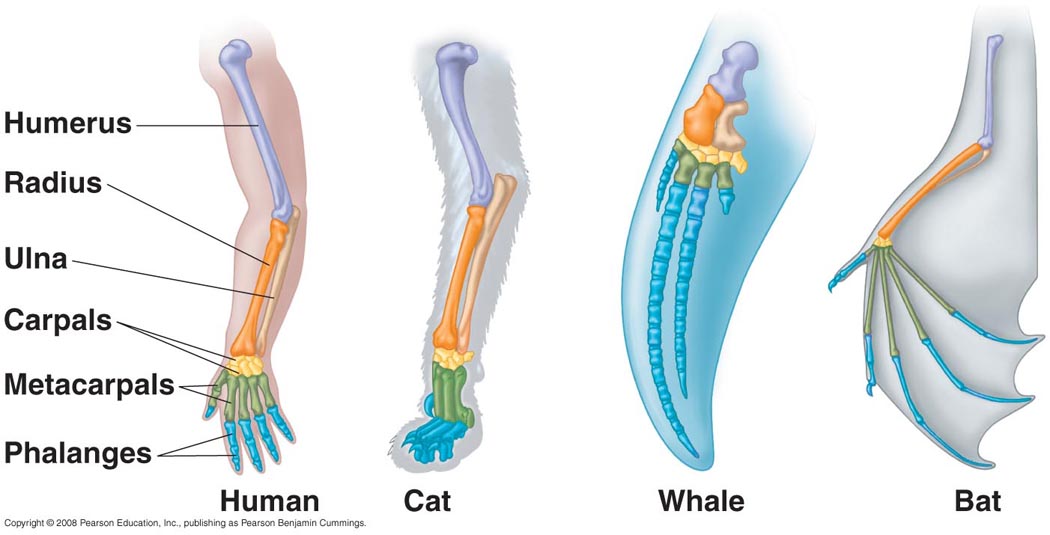
This also explains why manatees can often be found with elephant-like toenails at the end of their flippers – they’re evolutionary leftovers from a time when the manatees’ land-dwelling ancestors actually had toes.

And evolution accounts for other such features as well, like the fact that whales still have trace amounts of body hair despite having no use for it – or the fact that, for that matter, they still have lungs rather than gills and have to come up for air every half hour or so (or in the case of dolphins, every ten minutes) despite living their whole lives underwater. (Sad fact: When a whale or dolphin dies of “natural causes,” it’s because it has gotten so old that it no longer has the strength to resurface and simply runs out of oxygen.)

We don’t have to stop at manatees and whales, though; vestigiality can be found everywhere. There are blind rodents that still have eyes, but their eyes no longer function and are covered with a layer of skin, because the rodents live underground and have no need for sight. Evolution is still in the middle of a millennia-long process of eliminating their eyes; it just hasn’t finished with them yet. (There are also cave-dwelling fish and salamanders undergoing the same process themselves.) Similarly, there are flightless beetles that still retain wings beneath their shells that they are incapable of using; and there are flightless birds with wings that have likewise ceased to serve any valuable function. Many of these flightless birds also have the added trouble of dealing with bones that are still hollow – perfect for flight, but a liability on the ground where they’re more likely to break. And in bats, the reverse is true – they still retain the solid bones of their land-dwelling ancestors, so flight is more difficult than it needs to be. In all of these cases, such “design flaws” only make sense in the context of evolution. These animals weren’t deliberately designed with these flaws at all; they just inherited them.
One of the most glaring examples worth mentioning here is the recurrent laryngeal nerve of the giraffe. This nerve, found in all vertebrate species with necks, connects the brain to the larynx – a trip that, in theory, should only take a few inches. But due to a weird evolutionary fluke, the nerve instead travels all the way down the giraffe’s neck, loops around the aortic arch of the heart, and then travels all the way back up the neck to reach its destination – an unnecessary detour of about 15 feet. As the Wikipedia article explains:
The nerve’s route would have been direct in the fish-like ancestors of modern tetrapods, traveling from the brain, past the heart, to the gills (as it does in modern fish). Over the course of evolution, as the neck extended and the heart became lower in the body, the laryngeal nerve was caught on the wrong side of the heart. Natural selection gradually lengthened the nerve by tiny increments to accommodate, resulting in the circuitous route now observed.
This particular design flaw is one that shows up in humans as well (albeit not quite as dramatically as with giraffes). And it’s not the only one. I’ve only been talking about non-human animals up to this point, but it’s also worth talking about some examples where evolution has left its mark on our own species. Ever wonder, for instance, why we get goosebumps when we’re cold or scared? As it turns out, this is a vestigial leftover from a time when our ancestors were covered in thick coats of hair, and getting goosebumps was a way to raise those hairs and “fluff themselves up” to keep themselves warm in the winter or make themselves appear larger and scare off predators. Similarly, we also have muscles connected to our ears which, eons ago, allowed our ancestors to swivel their ears around like antennae (in the same way that horses and rabbits can), but which have since lost that function and are no longer useful. There’s also the fact that we grow wisdom teeth – which would have been useful in our larger-mouthed ancestors, but which now only cause unnecessary complications and often have to be painfully removed. There’s the fact that our legs, feet, and spines haven’t fully adapted yet to supporting the weight of an upright, two-legged posture – so that as we age we often experience hip and knee pain, lower back pain, collapsed arches in our feet, and other such issues that four-legged animals don’t typically have to deal with. There’s the fact that the male urinary tract runs directly through the prostate gland, so that when the prostate becomes swollen (as it does for most men later in life), it creates needless and sometimes dangerous urinary problems. There’s the fact that the female pelvis is too small to easily give birth to the large-headed newborns of our species – a feature that wouldn’t have been an issue in our smaller-headed ancestors, but which leads to immense suffering for mothers everywhere today (and in millions of cases, leads to complications and even death). There’s the fact that our respiratory and gastrointestinal tracts (i.e. the windpipe and the esophagus) share the same tube – so that we often accidentally choke to death – rather than using two separate tubes as they do in dolphins. There’s the fact that the blood vessels in our eyes run across the front of the retina rather than beneath it, leading in many cases to vision loss – as well as the fact that our photoreceptors are inefficiently oriented backwards, resulting in a blind spot in the middle of our vision (a flaw that’s absent in animals like octopuses and squid, whose photoreceptors are more sensibly oriented forwards). And the list goes on.
Speaking of eyes, there’s an argument that creationists often make against evolution, which asks, “how could something as complex as the eye have simply come into existence on its own?” But the answer is that the eye didn’t just pop up out of nowhere (something like that really would be too implausible to believe); rather, it developed very gradually, one small step at a time. Originally, the eye started off as nothing more than a patch of light-sensitive cells on some prehistoric organism (like the light-sensitive spot on a modern-day euglena). This patch of cells wouldn’t have allowed for true vision, of course, but it would have allowed the organism to distinguish between light and dark, giving it a small evolutionary edge and making it more likely to survive and pass on this feature to its offspring. Later on, some of this species’ descendants would be born with slight depressions in their light-sensitive patches, giving their primitive eyespots a cuplike shape and enabling them to distinguish not only whether it was light or dark, but which direction the light was coming from (like in the eyespots of a modern-day planarian). Generations after that, the opening of this cup would narrow to form a small aperture, like a pinhole camera, allowing light to enter and produce a dim, fuzzy image (like in the eyes of a nautilus). Later still, a transparent cover would form over the opening, allowing it to fill with fluid and sharpening the image resolution considerably (like in abalone eyes). And finally, the eye would assume the “finished” form that we currently see in mammals. Every step in this process was gradual – there were no sudden leaps between a primitive form and a much more complex one – but as the old saying goes, a journey of a thousand miles begins with a single step. And that’s how it works with evolution.

Returning to the topic of vestigiality, though, there’s another phenomenon that’s closely related and provides a similar kind of evidence for evolution – the existence of atavisms. In the same way that vestigial traits are anatomical features left over from earlier ancestors, atavisms are basically leftover genes. Underlings explains:
These are dead genes that occasionally mutate and switch back on, resulting in an individual growing a feature no longer expressed by typical members of the species. For example, one in 500 whales is born with external rear leg remnants, sometimes even possessing feet and toes. Horses have only one toe per leg, but occasionally some are born with up to three toes, just like their extinct relatives. Sometimes humans are born with functioning tails, just like monkeys. It’s even possible to cause chickens to develop teeth-like structures by providing a single missing protein to otherwise dead genes. These degenerating leftover genes are what we might expect to find if whales evolved from a land mammal, horses evolved from a three-toed ancestor, humans evolved from a tailed primate, and birds evolved from dinosaurs with teeth – but what sense do they make if all species were instead unique creations by a perfect God?

The creationist response to this question may be that, well, since the same God created birds and mammals and reptiles and everything else, it’s no surprise that he gave them all the same varieties of genes. The fact that dead genes sometimes get accidentally activated proves nothing about how organisms are related, because God used the same genetic blueprint for all of them anyway. But the thing is, atavisms only appear in organisms that are ancestrally related on the evolutionary tree; in other words, mammals and birds may both display atavisms from reptiles (because they both evolved from reptiles), but you’ll never see mammals displaying atavisms from birds, or vice-versa, because neither mammals nor birds evolved from each other. And it’s the same way with vestigial features, as the Cassiopeia Project explains:
There are no vestigial structures that were not previously functional in an ancestor. All vestigial organs make sense only in the framework of evolution; and of course we do not find vestigial organs that argue against evolution. No nipples in amphibians, or vestigial feathers on mammals; no primates carry vestigial horns or degenerate wings; we do not find arthropods with leftover backbones; no snakes have wing parts; and no humans have gizzards.
The patterns in which atavisms and vestigial features appear don’t just show that organisms are interrelated; they show how they’re related, and how they evolved from each other. They point to one very specific evolutionary tree – and evidence for this tree can be found in other fields as well, like embryology. Underlings continues (starting at the 10:45 mark):
That last line is blunt, but it raises a fair point. If we take it for granted that all life on Earth really was consciously designed by a perfect, all-knowing creator, then it’s exceptionally hard to explain why there are so many flaws and redundancies in the designs (aside from just hand-waving it away with the rationalization that God must have had his reasons). If we turn to the evolutionary explanation, though, it all makes perfect sense. And in fact, we don’t even have to wonder where all these imperfect anatomical features came from, because in most cases we can trace these species’ full family histories back through the fossil record and see exactly where they came from, how they evolved, and how long the process took.
In the case of whales, for instance, we can examine fossils of their most immediate ancestors and see that they’re almost identical to their modern form. Then if we dig deeper into the fossil record, we can see that their ancestors slightly before that were still similar, but had more developed hind limbs, blowholes that were further toward the front of their skulls, and so on. Dig further still, and these differences become more and more pronounced, with the legs becoming larger, the nasal openings migrating closer to the front of the snout, etc. – until eventually you can trace the whales’ ancestry all the way back to hippo-like animals with four fully-developed legs rather than flippers, regular nostrils instead of blowholes, and all the other adaptations necessary for life on land.

Similarly, we can trace back the lineage of modern horses, from the large modern species with their single-hoofed feet, to their much smaller ancestors with multiple toes on each foot, in a smooth, continuous timeline of fossil specimens, each of which is just a slightly modified version of its predecessor.
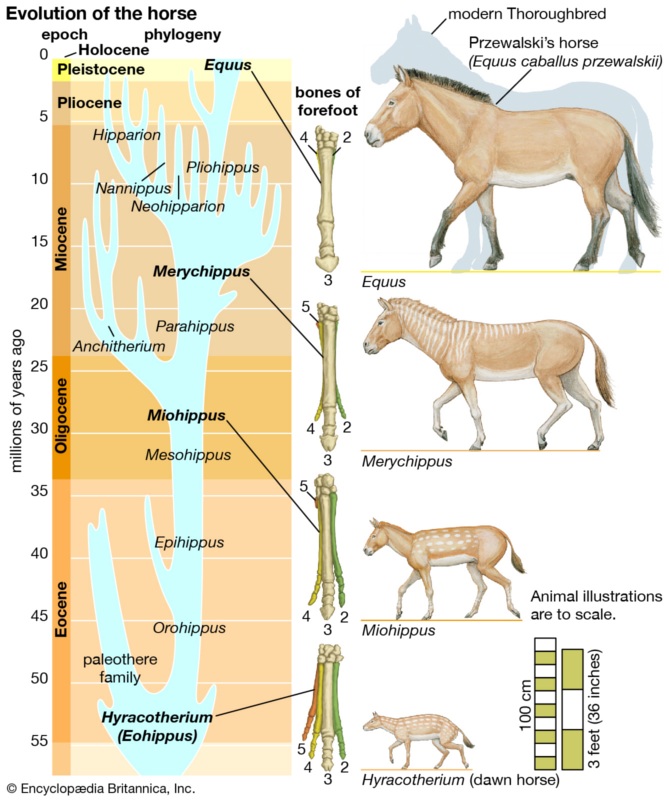
And we can do this with countless other species as well. Probably the most famous transitional fossil of all is Archaeopteryx, a creature halfway between a dinosaur and a modern-day bird. Discovered just two years after Darwin published his book On the Origin of Species and predicted that such transitional fossils ought to exist (even though none had yet been discovered), Archaeopteryx was notable for having the clawed fingers, bony tail, toothed jaws and snout of a theropod dinosaur, and the wings, flight feathers, and hollow bones (including a wishbone) of a bird. It was the perfect illustration of an evolutionary transition between one “kind” of animal and another; and as the years passed and more transitional fossils were discovered, the ancestral chain between dinosaurs and their bird descendants has – once again – been filled in with a smooth, continuous progression of intermediate steps.
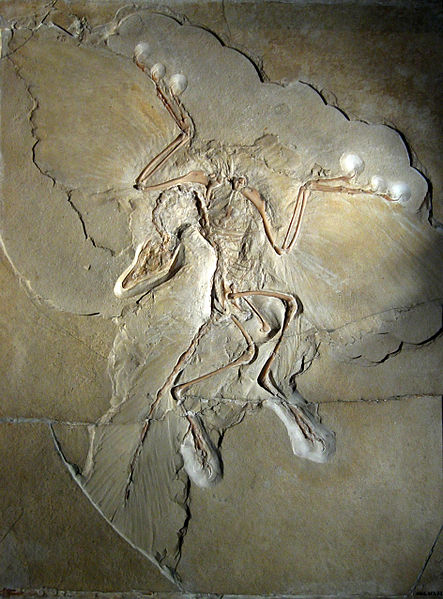

A crucial point to mention here is that these progressions of transitional fossils always occur in a very specific geological order. The earth’s crust is made up of different strata (i.e. layers) of rock, with the oldest layers at the bottom and more recent layers on top (which makes sense, considering that the newer layers wouldn’t have been able to accumulate on top of anything if there weren’t already older layers beneath them). Scientists have confirmed that the lower layers are older using a variety of dating methods, which we’ll get into momentarily; and you can see the layers for yourself when you look at the Grand Canyon or some other geographic feature where there’s a natural cutaway view of the rock.

The relevance of this, in terms of evolution, is that when you excavate fossils from these different layers, the more primitive organisms are always found exclusively in the older layers, while the more recently-evolved organisms are always found exclusively in the younger layers. There are never any fossils of recently-evolved organisms found in the lowest strata of the geologic column, nor are there ever any fossils of the most primitive organisms found in the highest strata. If creationism were true, then this wouldn’t make any sense; we would see trilobite fossils, dinosaur fossils, and giraffe fossils all buried in the same layers of rock, since they were all created at once and they all lived together at the same time. But we never see that kind of simultaneity; it’s always the case that the more primitive an organism is, the older and deeper its fossils are.
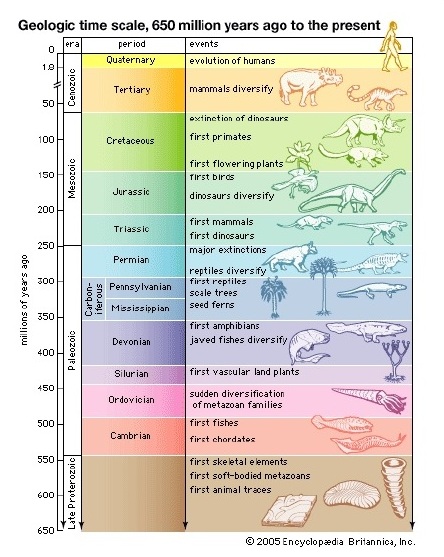
In fact, this pattern is so consistent that scientists have actually been able to use it to successfully predict where the fossils of new transitional species will be found and what they’ll look like. Underlings explains (from 2:21-3:31):
This kind of thing simply shouldn’t be possible if creationism were true. But like Underlings says, it has proven so reliable that we can now trace the evolutionary ancestry not only of all these various animal species, but even of our own species as well.
It used to be common for creationists to talk about “the missing link” between humans and earlier primates – to say that if humans really did evolve from apes, then there should be fossil evidence of species that were halfway between them, and that no such fossil evidence existed. For a while, this was a fair point; but then scientists actually did start discovering those missing fossils – the most famous of them being an Australopithecus afarensis nicknamed “Lucy” in 1974 – and they kept discovering even more in the ensuing decades. As it stands today, scientists have pieced together such a smooth progression of transitional species that the biggest problem is trying to differentiate exactly where one species ends and the next one begins – the fossil record is that comprehensive. You can go all the way back to the point about 7 million years ago when humans and chimpanzees first diverged, and from there you can trace the hominin family tree up through species like Sahelanthropus tchadensis, Ardipithecus kadabba, Ardipithecus ramidus, Australopithecus anamensis, Australopithecus afarensis, Australopithecus africanus, Kenyanthropus platyops, Homo habilis, Homo erectus, Homo heidelbergensis, and more, all the way up to the branch that would ultimately become Homo sapiens.
(Just as a side note, by the way, Neanderthals aren’t directly included in this ancestral chain – they’re more like our distant cousins than our direct predecessors – but Neanderthals did do a bit of interbreeding with early human populations, so all their modern descendants (i.e. anyone who’s not African) now have genomes that are about 1-4% Neanderthal.)
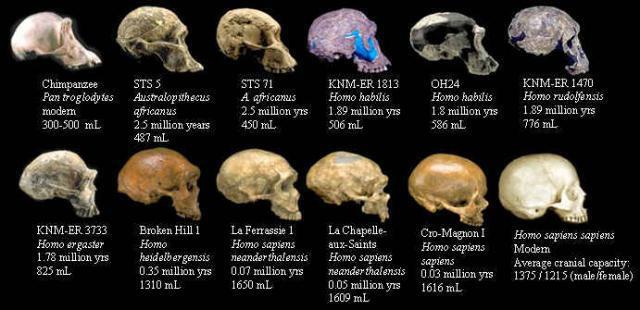
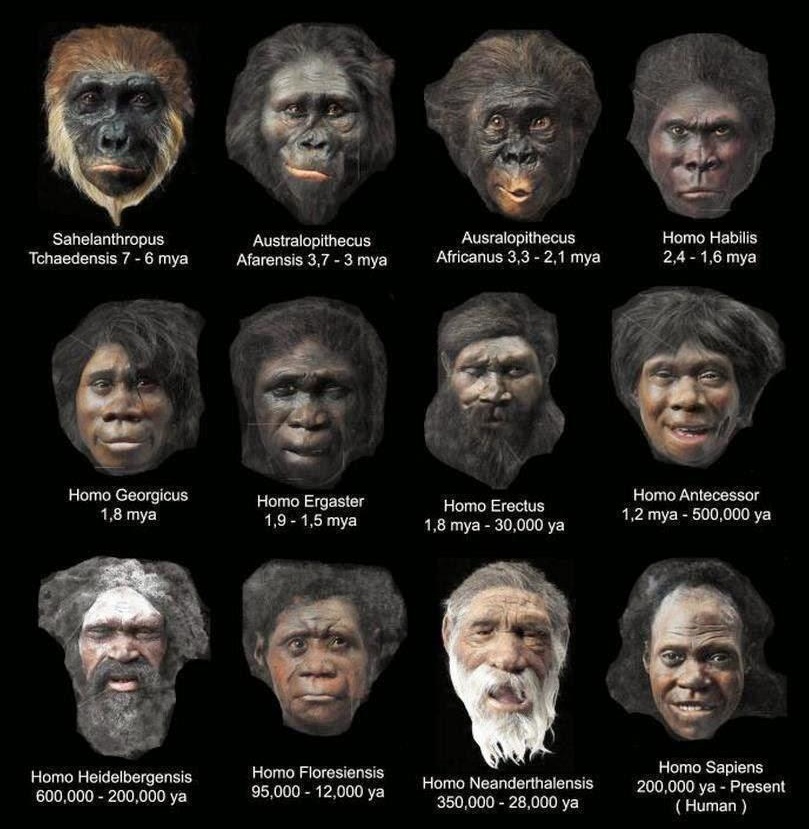
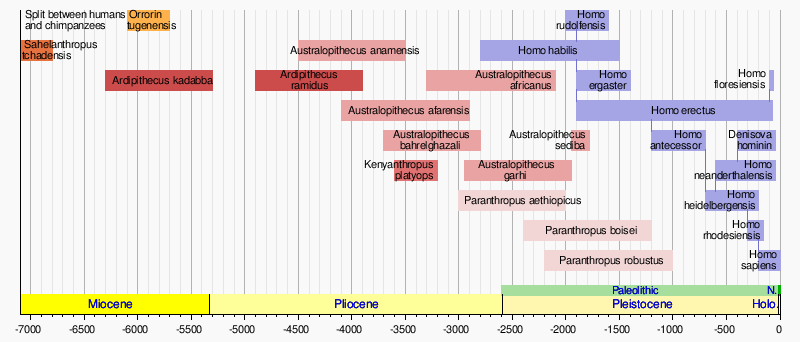
If we were detectives, trying to solve “the case of the missing link” as if it were a classic missing persons case, our job would be insultingly easy; we have the victims’ remains right here in front of us. And not only that – like any open-and-shut detective case, we have DNA confirmation as well. This is yet another line of evidence through which we can trace the evolutionary histories of different species; in the same way that we can use DNA analysis in criminal investigations, paternity tests, and family ancestry, we can use it to discover our deeper evolutionary ancestry too. The Cassiopeia Project explains:
Like fingerprints, the patterns recognizable in [certain sections of DNA] are unique to individuals. They are similar in relatives, and less similar in distant relatives. This is the basis of DNA fingerprinting. And since these sequences are passed down from parent to child, finding the same sequence in the same place in two different organisms is direct evidence that the two organisms have a common ancestor. Biologists have used this idea to demonstrate exactly how different species are genetically related.
And Underlings elaborates:
If all life is genetically related, then species that are closer to humans on the evolutionary tree (based on physical characteristics) should also share a higher percentage of DNA compared with species that are less similar. Sure enough, we now know that humans share approximately 99.5% of genes with other humans, 98% of genes with chimpanzees, 93% with monkeys, 92% with mice, 90% with cats, 84% with dogs, 80% with cows, 60% with chickens, 44% with fruit flies, 26% with yeast, 18% with plants, and 7% with bacteria. Creationism couldn’t have predicted that we would share any genes with other species, much less that the percentage of shared genes would align with the evolutionary tree.
[…]
Not only that, but in recent decades, we have discovered that DNA mutates at a predictable rate, and we can use the differences in DNA between any two species to determine how long ago those two species diverged from a common ancestor. The results of this molecular clock closely match the evolutionary tree and the radiometric dating of the fossil record. Again, there is no way creationism could ever predict this, but it is exactly what you would expect to see if evolution is true.
[…]
Another piece of evidence from DNA is the existence of pseudogenes, otherwise known as dead genes. These are genes that have become deactivated, usually because the species no longer needs them in order to survive, and so they are no longer selected for. For example, all primates lack the ability to produce vitamin C. This likely occurred because there was plenty of vitamin C in our ancestral diet, and thus the gene to construct it offered no survival advantage, which allowed it to accumulate damaging mutations. All primates still have the DNA sequence to make vitamin C, but it is missing a vital enzyme which has caused the gene to become inactive. Similarly, dolphins have genes for detecting odors in both water and air; however, since they are no longer land animals, they have little use for detecting odors in air, and now 80% of those genes have become deactivated. Also, only the most primitive mammals – the platypus and spiny anteater – lay eggs, but all other mammals contain dead genes for producing a yolk sack. Human embryos, for example, have a vestigial yolk sack that detaches in the second month of pregnancy and is reabsorbed by the body. If all species were original, perfect creations, the existence of these dead genes from ancient ancestors would make no sense. Their existence is thus evidence against a perfect creator. Pseudogenes only make sense in the light of evolution, where nature carries ancestral genetic baggage.
Yet another piece of evidence from DNA comes from another type of dead gene called endogenous retroviruses, or ERVs. Retroviruses reproduce by inserting their DNA into the DNA of a host’s cells. On rare occasions, they can leave dead genes in the host’s sex cells, which are then passed on to all future descendants of that host. Those dead genes act like an identifying bar code, so if two different species possess the same ERVs in the same locations in their genome, it indicates that the two species share a common ancestor that was infected prior to becoming two separate species. For example, the human genome contains more than half a dozen ERVs that are also shared by chimpanzees, which only makes sense if we once shared a common ancestor. This is another example of nature carrying ancestral baggage that we would expect to see if evolution is true. Creationism, on the other hand, would predict that such connections should not exist, and it has no credible explanation for ERVs.
There are two clips in particular that I highly recommend for understanding just how compelling the genetic evidence is. The first is from the Cassiopeia Project, and briefly discusses pseudogenes before presenting an especially insightful illustration of how ERVs confirm evolution:
The second one, from Ken Miller, demonstrates one last piece of genetic evidence for evolution – chromosomal fusion. This one, for me, was the final nail in the coffin when I first learned about it:
What this clip really drives home is the way in which evolutionary science doesn’t just explain the facts that are already there. It can actually make testable, falsifiable predictions about what else would have to be factual if evolution were true; and in every single case, those predictions have proven to be right. There’s no way that a creationist theory of biology would have been able to predict chromosomal fusion, or the exact location of the Tiktaalik fossil, or any of the countless other things evolutionary theory has successfully predicted. But time and time again, evolution points the way to new discoveries like these, not just in one narrow subspecialty of biology, but in every area of the field.
And that’s the other crucial point here: The scientific consensus around evolution isn’t just a product of a single line of evidence – it’s a convergence of evidence from multiple different fields (also known as consilience). If even just one of these lines of evidence pointed to evolution, then that alone would be enough to conclude with extremely high confidence that evolution was true. But in theory, there’s no reason why the evidence from genetics should necessarily match the evidence from the fossil record; they’re two completely different domains, and the age of a fossil in the ground is totally independent of the ordering of nucleotides in a genome. Yet these separate lines of evidence all agree with each other perfectly, down to the last detail; the distribution of vestigial organs and other such anatomical traits perfectly matches the distribution of mutations in the genetic code, which perfectly coincides with the chronology of the rock layers in which the fossils are found, which perfectly corresponds with the different species’ modern geographical distribution, and so on. Genetics, molecular biology, paleontology, geology, biogeography, comparative anatomy, comparative physiology – all of these fields are independent of each other, but they all point to the same evolutionary story: not just a tree of common ancestry, but the exact same tree of common ancestry. To suggest that all these different lines of inquiry could, by sheer coincidence, somehow produce the exact same answers to millions of different questions, completely independently of each another, beggars belief. If you were a detective trying to solve a crime, you might not trust the testimony of one eyewitness alone – but if there were multiple eyewitnesses, and phone records, and DNA testing, and video surveillance, and a hundred other things that all pointed to the same conclusion, you’d have no choice in the matter. And the same is true of the evidence for evolution; there’s just no word for the staggering confluence of evidence here other than “conclusive.”
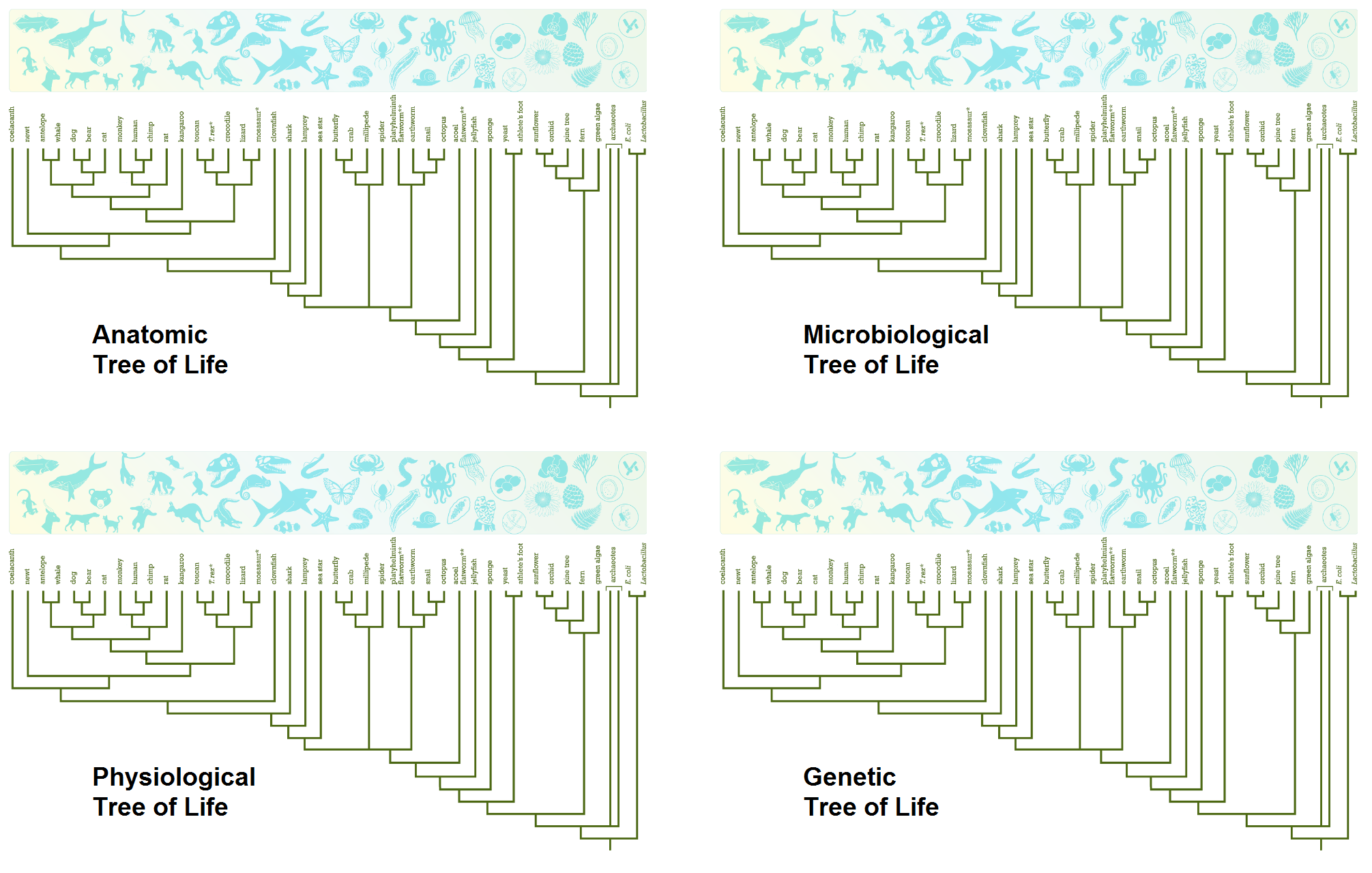
Now of course, creationism insists that evolution is “just a theory.” But as QualiaSoup mentioned in his video earlier, this is based on a misunderstanding of how the scientific use of the word “theory” differs from the colloquial use of the word. Commenter DirtySketel reiterates the point:
In normal everyday language, we usually use ‘theory’ to mean ‘guess’ or ‘hypothesis’. In scientific terms, the theory is an explanation of the observable facts. A body of knowledge, if you will. For instance, ‘music theory’ is the body of knowledge surrounding musical composition. ‘Germ theory’ is the body of knowledge that explains illness and disease. ‘Cell theory’ is the theory that explains that all life is made of cells. ‘The theory of gravity’ is the study of gravity, and the explanations for the facts (or even laws) of gravity that we see in nature. The theory of evolution is no different. Evolution is a scientific, observable, fact, just like cells, germs, and gravity. The ‘theory of evolution’ is the study and explanation of these facts. If you’ve ever heard a creationist say ‘evolution is still only a theory’ or ‘evolution is not yet a law’ or ‘they’re still trying to prove the theory of evolution’, then they are simply wrong, and misunderstanding the scientific meaning of the word ‘theory.’
In other words, scientific theories don’t become facts when they’re proven true; they contain facts that have already been proven true, and explain why they’re true. The fact that evolution does occur is an inescapable reality of the world we live in. Evolutionary theory helps us understand how and why it occurs. At this point, there’s just no way to properly comprehend the living world without it. As the (Christian) evolutionary biologist Theodosius Dobzhansky famously put it, “Nothing in biology makes sense except in light of evolution.”
So all right, let’s grant that evolution really is true, and that every living thing really did descend from one ancient common ancestor. In that case, then, how did that original ancestor come to exist in the first place? Life didn’t just pop up out of nowhere, did it?
This is a point that a lot of people get hung up on, because they’re imagining “the first organism” as some kind of plankton-like creature that surely would have been too complex to have just spontaneously emerged from a bunch of non-living molecules. Surely a divine creator must have been necessary to have designed something so complicated, right?
But a bit of reframing is in order here, because the first single-celled organism wasn’t actually as complex as you might imagine. In fact, “a bunch of non-living molecules” is basically all it was. At the most basic level, the only trait an organic system needs in order to be subject to the forces of natural selection is the ability to reproduce itself in a way that allows for modifications with each new generation – and even something as simple as a large molecule can do that. Well, a large molecule is all DNA actually is. It’s admittedly a pretty complex one, but it is still just a big molecule – and it’s one that naturally reproduces itself not through any conscious action, but simply through its automatic chemical interactions with the other molecules around it. So even if all you have is a large molecule like DNA or RNA (or some simpler polymer) that naturally reproduces itself – plus maybe some lipids forming a spherical membrane around it (as they naturally tend to do) – then that’s it; that’s all you need for your first self-replicating proto-cell. Once you add the final ingredient to the mix – the fact that the replication process will inevitably include occasional errors (i.e. genetic mutations) – then the proto-cells that develop advantageous mutations and become better at reproducing themselves will start outcompeting those that are worse at reproducing themselves. From there, the process of natural selection will begin; and then it’s off to the races.

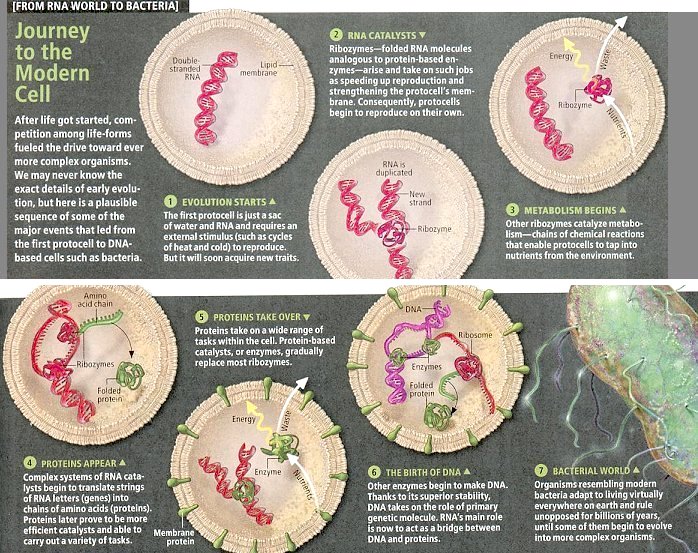
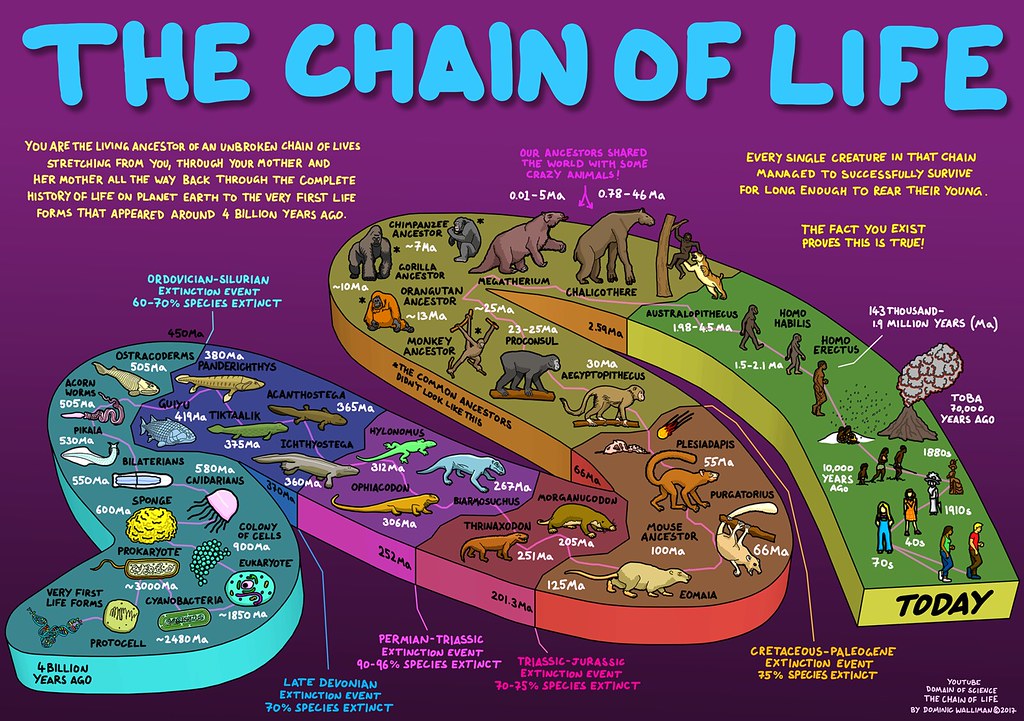
I don’t want to oversimplify things too much here, of course, so it’s worth noting that scientists are still in the process of uncovering all the details of exactly how this process first happened. For instance, there are still multiple plausible explanations for how the first organic molecules might have bonded to form the first polymers – they might have been catalyzed by montmorillonite clay, they might have spontaneously self-assembled near deep-sea hydrothermal vents, etc. – so scientists are still trying to determine which scenario was the one that actually occurred. (Potholer54 provides a quick outline of the first one in his video below.) The point here, though, is not that scientists can’t come up with any explanation for how life could have originated from non-life; it’s that there are too many plausible ways it could have happened, and they’re still trying to narrow down exactly which one it was. That’s a far cry from the creationist claim that life could only have been the result of divine intervention, or that the spontaneous emergence of organic matter would have been “as improbable as a tornado blowing through a junkyard and assembling a fully-functional Boeing 747.” If the emergence of life was as straightforward as having some simple molecules bond together and form some larger molecules that were capable of self-replication, then under the right environmental conditions, life would have been nothing less than a chemical inevitability. All that would have been necessary to produce life on Earth – with all the richness and diversity we now see across its millions of species – was the formation of a single self-replicating cell. Evolution would have taken care of the rest. And although you might find it hard to believe that something as simple as a single cell could ultimately, over the course of four billion years, give rise to something as complex as a human being, don’t forget what J.B.S. Haldane pointed out: You underwent that whole process yourself in just nine months!
Biblical literalism, of course, insists that the earth is only 6,000 years old, not 4.6 billion – so, naturally, it’s understandable that someone who thinks the world is that young might have an especially hard time believing that such dramatic evolutionary change could occur over such a short time frame. It’s one thing to imagine that humans could have evolved over the course of four billion years, but it’s another thing entirely to imagine such a process taking place in just 6,000 years. That being said, though, this is no reason to think that evolution must therefore be false; on the contrary, it’s all the more reason to think that the Bible and its estimation of the earth’s age must be mistaken.
And sure enough, when we look at all the available evidence, that’s what we see. As with evolution, every relevant scientific finding indicates that the earth is most definitely not as young as the Bible suggests – and as with evolution, the evidence comes from multiple independent lines of inquiry within multiple different fields (geology, physics, astronomy, etc.), all of which corroborate each other perfectly and point to the exact same 4.6 billion year timeline.
Potholer54 provides another useful clip here, with a quick summary of the most relevant evidence:
And Underlings gives a few more additions to boot (starting at the 9:33 mark):
The evidence against a 6,000-year timeline becomes even more overwhelming if we expand our inquiry to include not just the age of the earth (4.6 billion years), but the age of the rest of the universe as well (13.8 billion years). As NASA’s website explains:
Astronomers estimate the age of the universe in two ways: 1) by looking for the oldest stars; and 2) by measuring the rate of expansion of the universe and extrapolating back to the Big Bang; just as crime detectives can trace the origin of a bullet from the holes in a wall.
[…]
Astronomers can place a lower limit to the age of the universe by studying globular clusters. Globular clusters are a dense collection of roughly a million stars. Stellar densities near the center of the globular cluster are enormous. If we lived near the center of one, there would be several hundred thousand stars closer to us than Proxima Centauri, the star nearest to the Sun.
The life cycle of a star depends upon its mass. High mass stars are much brighter than low mass stars, thus they rapidly burn through their supply of hydrogen fuel. A star like the Sun has enough fuel in its core to burn at its current brightness for approximately 9 billion years. A star that is twice as massive as the Sun will burn through its fuel supply in only 800 million years. A 10 solar mass star, a star that is 10 times more massive than the Sun, burns nearly a thousand times brighter and has only a 20 million year fuel supply. Conversely, a star that is half as massive as the Sun burns slowly enough for its fuel to last more than 20 billion years.
All of the stars in a globular cluster formed at roughly the same time, thus they can serve as cosmic clocks. If a globular cluster is more than 20 million years old, then all of its hydrogen burning stars will be less massive than 10 solar masses. This implies that no individual hydrogen burning star will be more than 1000 times brighter than the Sun. If a globular cluster is more than 2 billion years old, then there will be no hydrogen-burning star more massive than 2 solar masses.
The oldest globular clusters contain only stars less massive than 0.7 solar masses. These low mass stars are much dimmer than the Sun. This observation suggests that the oldest globular clusters are between 11 and 18 billion years old.
[…]
Measurements by the WMAP satellite can [also] help determine the age of the universe. The detailed structure of the cosmic microwave background fluctuations depends on the current density of the universe, the composition of the universe and its expansion rate. As of 2013, WMAP determined these parameters with an accuracy of better than 1.5%. In turn, knowing the composition with this precision, we can estimate the age of the universe to about 0.4%: 13.77 ± 0.059 billion years!
How does WMAP data enable us to determine the age of the universe is 13.77 billion years, with an uncertainty of only 0.4%? The key to this is that by knowing the composition of matter and energy density in the universe, we can use Einstein’s General Relativity to compute how fast the universe has been expanding in the past. With that information, we can turn the clock back and determine when the universe had “zero” size, according to Einstein. The time between then and now is the age of the universe.
[…]
The expansion age measured by WMAP is larger than the oldest globular clusters, so the Big Bang theory has passed an important test using data independent of the type collected by WMAP. If the expansion age measured by WMAP had been smaller than the oldest globular clusters, then there would have been something fundamentally wrong about either the Big Bang theory or the theory of stellar evolution. Either way, astronomers would have needed to rethink many of their cherished ideas. But our current estimate of age fits well with what we know from other kinds of measurements.
And on top of these measurements, there are still more astronomical features that wouldn’t even be able to exist unless the universe was more than 6,000 years old. When certain stars die, for instance, they shed their outer layers (forming nebulae) and leave behind ultra-hot cores, which are called white dwarfs. Because these white dwarfs no longer have a source of nuclear fuel, they gradually radiate away the remainder of their energy and cool down. But because their surface area is so small, this process is extremely slow and gradual, taking billions of years to finish. By seeing how far along in this process a particular white dwarf is, scientists can determine its age – and as it turns out, there are a number of white dwarfs that are so far into their cooling cycles that they could only have arrived there after billions of years. (To use an analogy, it’s like having a piece of steel that has cooled down to room temperature. You might not have been there when it was forged, but you know that it must not have been forged within the last thirty seconds, because otherwise it would still be red-hot; therefore, you can correctly deduce that it must have existed for longer than thirty seconds.)
Similarly, there are certain types of high-energy astronomical bodies, like pulsars and quasars, that emit massive streams of ionized matter called astrophysical jets. These jets can stretch up to a million light years across – and because nothing can travel faster than the speed of light, that means that even if they were moving as fast as it’s possible for anything to move, it would have taken these jets at least a million years to have gotten from their sources (the quasars and pulsars) to where we see them today. Unless these celestial objects are somehow older than the universe itself, the universe can’t be less than a million years old.
And in that same vein, the fact that we even see distant stars and galaxies at all means that the universe must be billions of years old, because so many of these celestial objects are themselves billions of light years away from Earth – meaning that the light they emit takes billions of years to reach our eyes. When we look at a distant star or galaxy, what we’re seeing isn’t actually how that star or galaxy currently looks, but how it looked billions of years ago, when it originally emitted that light. The light had to travel across billions of light years to get from its source to Earth, and at the speed that light moves, that means that the universe has to have existed for billions of years in order to make such a trip possible in the first place.
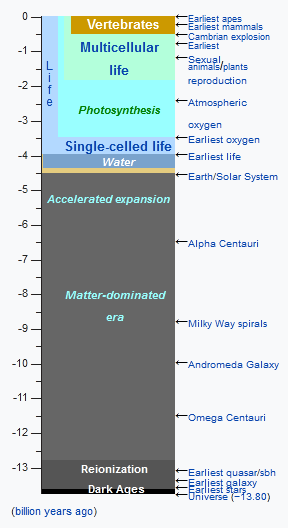
The evidence doesn’t stop there; if you’re interested, RationalWiki has a whole long list you can check out. Underlings also has a great video compilation of everything mentioned here and more. The question remains, though – if the Big Bang really does explain the origin of the universe, then how did it actually happen? How is it possible that all the matter in the universe could have just spontaneously appeared out of nowhere? One of the most popular arguments against the Big Bang is that it’s impossible for something to simply “pop into existence” out of nothing – at least not without divine intervention.
But believe it or not, such a thing actually happens all the time; it just happens at the quantum scale (i.e. smaller than the smallest fundamental particles), so we never see it with our naked eyes. Explaining how this happens is complicated and involves a lot of math (and I’m not a physicist, so take everything I say on the subject with a grain of salt because I could be explaining it wrong) – but the basic idea is that an empty void isn’t actually an inherently stable state; as explained by Heisenberg’s uncertainty principle, there are always infinitesimal energy fluctuations at the quantum level. This means that certain special types of particles (they aren’t really particles in the classical sense, but they’re still called that for simplicity’s sake) can – and do – spontaneously pop into existence out of nowhere, and scientists can measure their effects. But how is this possible? The key is that when one of these particles does appear, it’s always accompanied by a matching antiparticle – i.e. a particle with opposite physical charges – that cancels it out, so to speak, so the net amount of “stuff” within the system (including energy and charge and so on) remains at zero. (The particle and antiparticle quickly annihilate each other and disappear again, usually.) This might sound weird, but think of it this way: Imagine you have an equation like “zero equals positive ten plus negative ten.” How can there be such a thing as a “positive ten” in there, when the other side of the equation is zero? How can a positive quantity come out of nothing? But the answer is obvious, because that positive quantity is canceled out by a negative one of the same value, so the total is still zero. In the same way, a positive amount of matter or energy can come into existence, on a quantum scale of time and space, as long as it’s accompanied by an equal negative amount of matter or energy offsetting it. (I’m using matter and energy interchangeably here, because as Einstein’s famous E=mc2 equation shows, they’re actually just two different manifestations of the same thing, so under certain conditions one can be readily converted into the other.) When the Big Bang happened, then, it really would have been possible for quantum fluctuations to cause particles and antiparticles to appear out of nowhere. And from there, according to what’s called the cosmological inflation model, it would have been possible for an exponential expansion of space to occur in an infinitesimal fraction of a second. This instant of inflation (which is thought to have been triggered by the phase transition of the strong nuclear force separating from the other elementary forces in a near-instantaneous decay process), would have amplified those tiny quantum fluctuations to a classical scale, forming the seeds of all the matter and energy we see in the universe today. And time would have taken care of the rest; galaxies would have coalesced, planets would have formed, organisms would have evolved, and eventually intelligent beings would have emerged – all from the tiniest quantum fluctuations.
(Remarkably enough, we can actually still see the imprint of these quantum fluctuations today, in the cosmic microwave background radiation – the radiation left over from the Big Bang. When you turn on an old TV and see a bunch of static, what you’re seeing is actually (in part) the afterglow of the Big Bang itself!)
Again, this is an explanation of the origin of the universe that would only be possible if the total net mass/energy of the universe (positive energy plus negative energy) was zero. And up until recently, we didn’t know for sure whether the universe actually did have zero net energy or not; the evidence just wasn’t there yet. There were still some numbers that didn’t quite match up, some pieces of the puzzle that didn’t quite fit. But just twenty years ago, that changed; scientists discovered that the expansion of the universe was accelerating, and that the amount of energy needed to produce the detected rate of acceleration was – lo and behold – precisely the amount of energy that would bring the disparate numbers perfectly into line and put the net energy level of the universe at exactly zero. With that discovery, the pieces fell seamlessly into place; and we now have just the evidence we need to show that all the matter in the universe could, in fact, have spontaneously “appeared out of nowhere.” Lawrence Krauss gives a good summary of the whole venture here:
Of course, this isn’t quite the end of the story. After all, even if all the matter in the universe came from fluctuations in quantum fields stretching across spacetime, that still leaves the question of where spacetime itself came from. What happened before the Big Bang that caused time and space themselves to come into existence? Well, that’s actually a bit of a trick question – because the very concept of “before” is one that requires time to already exist. That’s why, according to cosmologists like Stephen Hawking, the question of “what came before the Big Bang?” doesn’t even make sense; it’s like asking what’s north of the North Pole. As Hawking puts it, time and space didn’t precede the Big Bang, they were themselves products of the Big Bang. There was no “moment before the Big Bang,” because the Big Bang itself was the first moment. Sean Carroll explains in slightly more depth:
The idea of the universe having a beginning – whether time is fundamental or emergent – suggests to some people that there must be something that brought it into being, and typically that something is identified with God. This intuition is codified in the cosmological argument for God’s existence, an idea that traces its lineage back at least as far as Plato and Aristotle. In recent years it has been championed by theologian William Lane Craig, who puts it in the form of a syllogism:
- Whatever begins to exist, has a cause.
- The Universe begins to exist.
- Therefore, the Universe had a cause.
[The] second premise of the argument may or may not be correct; we simply don’t know, as our current scientific understanding isn’t up to the task. The first premise is false. Talking about “causes” is not the right vocabulary to use when thinking about how the universe works at a deep level. We need to be asking ourselves not whether the universe had a cause but whether having a first moment in time is compatible with the laws of nature.
As we go through our lives, we don’t see random objects popping into existence. It might be forgivable to think that, at least with a high degree of credence, the universe itself shouldn’t simply pop into existence. But there are two very substantial mistakes lurking beneath that innocent-sounding idea.
The first mistake is that saying that the universe had a beginning is not the same as saying it popped into existence. The latter formulation, which is natural from an everyday point of view, leans heavily on a certain way of thinking about time. For something to pop into existence implies that at an earlier moment it was not there, and at a later moment it was. But when we’re talking about the universe, that “earlier” moment simply does not exist. There is not a moment in time where there is no universe, and another moment in time where there is; all moments in time are necessarily associated with an existing universe. The question is whether there can be a first such moment, an instant of time prior to which there were no other instants. That’s a question our intuitions just aren’t up to addressing.
Said another way: even if the universe has a first moment of time, it’s wrong to say that it “comes from nothing.” That formulation places into our mind the idea that there was a state of being, called “nothing,” which then transformed into the universe. That’s not right; there is no state of being called “nothing,” and before time began, there is no such thing as “transforming.” What there is, simply, is a moment of time before which there were no other moments.
The second mistake is to assert that things don’t simply pop into existence, rather than asking why that doesn’t happen in the world we experience [at least not at the macroscopic scale of everyday objects]. What makes me think that, despite my best wishes, a bowl of ice cream is not going to pop into existence right in front of me? The answer is that it would violate the laws of physics. Those include conservation laws, which say certain things remain constant over time, such as momentum and energy and electric charge. I can be fairly confident that a bowl of ice cream isn’t going to materialize in front of me because that would violate the conservation of energy.
Along those lines, it seems reasonable to believe that the universe can’t simply begin to exist, because it’s full of stuff, and that stuff has to come from somewhere. Translating that into physics-speak, the universe has energy, and energy is conserved – it’s neither created nor destroyed.
Which brings us to the important realization that makes it completely plausible that the universe could have had a beginning: as far as we can tell, every conserved quantity characterizing the universe (energy, momentum, charge) is exactly zero.
It’s not surprising that the electric charge of the universe is zero. Protons have a positive charge, electrons have an equal but opposite negative charge, and there seem to be equal numbers of them in the universe, adding up to a total charge of zero. But claiming that the energy of the universe is zero is something else entirely. There are clearly many things in the universe that have positive energy. So to have zero energy overall, there would have to be something with negative energy – what is that?
The answer is “gravity.” In general relativity, there is a formula for the energy of the whole universe at once. And it turns out that a uniform universe – one in which matter is spread evenly through space on very large scales – has precisely zero energy. The energy of “stuff” like matter and radiation is positive, but the energy associated with the gravitational field (the curvature of spacetime) is negative, and exactly enough to cancel the positive energy in the stuff.
If the universe had a nonzero amount of some conserved quantity like energy or charge, it couldn’t have an earliest moment in time – not without violating the laws of physics. The first moment of such a universe would be one in which energy or charge existed without any previous existence, which is against the rules. But as far as we know, our universe isn’t like that. There seems to be no obstacle in principle to a universe like ours simply beginning to exist.
Mind you, this isn’t to say that this explanation has been definitively proven, or that there’s no room for other possibilities. Scientists still take seriously the possibility that time and space might have existed before the Big Bang – because although we can safely say that the Big Bang was the beginning of our universe, that doesn’t necessarily mean it was the beginning of everything in existence. It’s possible, for instance, that our universe might actually be a smaller “bubble” amidst a larger multitude of universes. It’s possible that it was born from a black hole inside another universe. It’s even possible that the Big Bang really might have been initiated by a higher intelligence, like some alien programmer with a universe-simulating machine, or some other ultra-powerful being that we might consider godlike. That still wouldn’t solve the problem of where existence itself came from, mind you – you’d still have to somehow explain the origins of whichever realm the creator(s) resided in – but it’s at least a theoretical possibility.
All this is just to say, then, that the current scientific understanding of the Big Bang isn’t a totally finished one – not by a long shot. (If science had the perfect final answer to every question already, it would no longer have anything to do!) Science is a process, not a fixed set of answers – so although we know that the Big Bang happened, and we know when, there’s a lot that’s still being discovered about exactly how and why it happened (and whether inflation happened as we understand it, etc.). There are still plenty of exciting questions out there for scientists to discover the answers to, and the process is an ongoing one. But that’s the whole beauty of science; when it encounters interesting new questions, it doesn’t just assert whichever answer feels the most right and then refuse to ever change it – it goes out and tries to find out what the real answer is, and it keeps updating its knowledge base on a continual basis as new evidence is discovered.
This is in stark contrast to the religious approach. According to religious dogma, God has already told us everything we need to know about our origins – the answers are already set in stone – so there’s no good way of updating it to incorporate new information. If new facts come to light that appear to contradict the biblical account, all you can do is deny them.
If you’re a biblical literalist, then, the only way to make sense of all the scientific and historical evidence is to say that God must have somehow falsified all of it (or allowed the devil to do so) in order to test our faith or something. Naturally, there are a few problems with this idea – not least being the fact that an omniscient God would already know everything and would have no use for such a test. But more importantly, the idea of such a deceitful God flatly contradicts the message so insistently promoted by the Bible itself, that God wants humans to know he exists and wants to do everything in his power to ensure that the maximum number of people come to know him personally. (After all, isn’t that supposedly the whole reason why the Bible exists in the first place?)
In truth, the reason why the Bible doesn’t provide any good explanation for all these scientific facts is because its authors simply didn’t anticipate them. It’s not that the biblical narrative tries to make sense of the scientific evidence by suggesting a deceitful God – nor does it try to explain the evidence in any other way, for that matter – it just shows no awareness that such evidence could exist. To the biblical authors, there would have been no reason not to believe that everything in the universe was created 6,000 years ago; how could they have known any better?
But of course, now that we do know better – now that we know that the earth has been around for billions of years, that modern humans have been around for hundreds of thousands of years, and that the way we got here was through gradual natural processes – we can see just how far off the mark the biblical 6,000-year timeline really is. Richard Dawkins puts it succinctly: “To get an idea of the scale of this error, it is equivalent to believing that the distance from New York to San Francisco is 7.8 yards.”
To put things in perspective even further, if the biblical timeline were true, it would mean that Adam (who, according to the Bible, lived to age 930), would have been alive for the first one-sixth of the universe’s existence – and that Noah (who was supposedly born shortly after Adam’s death and lived to 950) would have been alive for the second one-sixth. So if you played out the entire history of the universe – from the birth of the first galaxies, to the formation of Earth’s oceans and mountain ranges, to the age of the dinosaurs, to the invention of the internet – by the time you were one-third of the way through that timeline, you would only have gotten through two people’s lifetimes.
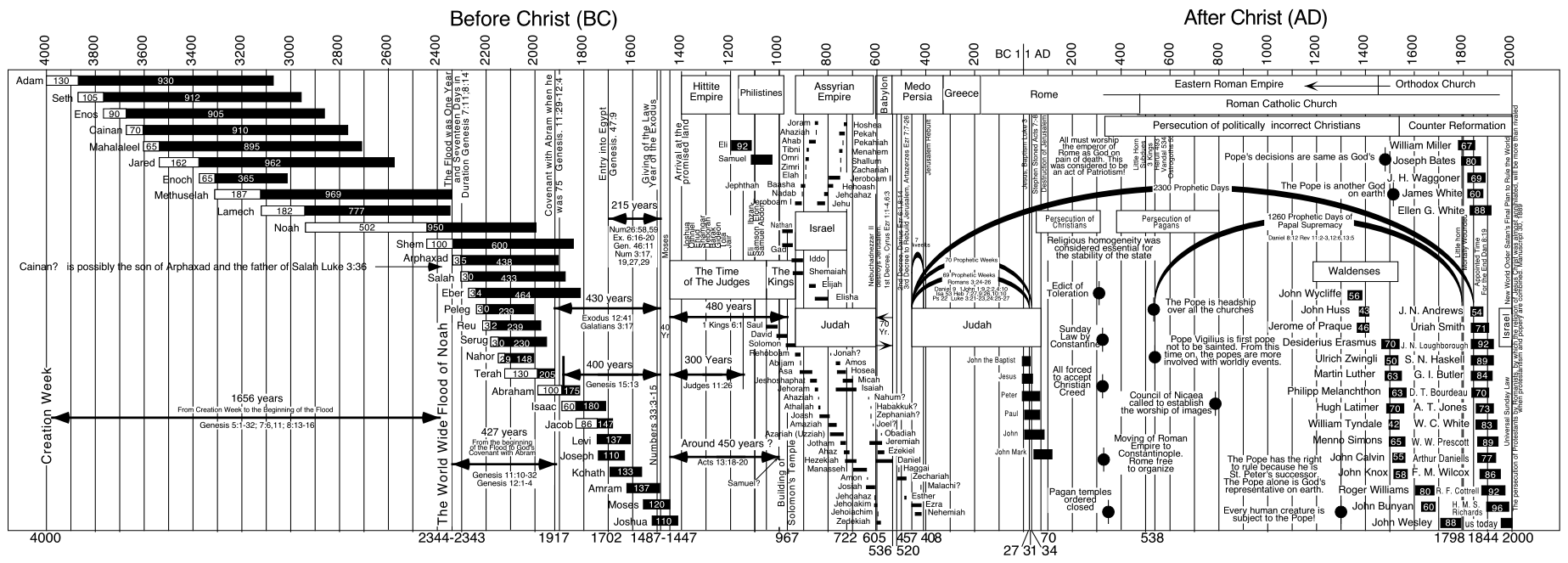
To say that the biblical story strains scientific and historical credibility, then, is putting it mildly. A 6,000-year timeline would place the beginning of the universe about 7,000 years after the Natufians built their first brewery, 10,000 years after the Jōmon invented cord-marked ceramics, and 20,000 years after the Gravettians carved their Venus figurines.
What’s more, aside from all the historical and scientific faults in the 6,000-year biblical chronology, the Genesis creation story just doesn’t hold up in terms of basic logical consistency. If the Bible were true, then it would mean that God created an entire world just for human beings… and then covered 70% of it in undrinkable salt water. And then turned most of the remaining landmass into uninhabitable deserts, mountains, tundra, etc. And then made most of the plants inedible and/or poisonous. And then made it so the world’s only source of light would give its inhabitants cancer. And then made it so the only way many animal species could survive was by violently killing other species (including humans). And then created deadly diseases and natural disasters that would kill millions more each year. And so on. Does this really seem like a world made just for us?
There is a biblical literalist response to this, of course, which is to say that all these flaws in God’s creation were actually the consequence of Adam and Eve falling into sin and causing the (previously perfect) world to become corrupted. But the story of Adam and Eve’s fall just introduces a whole new set of problems, as TheraminTrees points out:
In the Book of Genesis, the first humans – Adam and Eve – were expelled from the paradise of Eden for eating fruit from the tree of the knowledge of good and evil. But if they didn’t know good from bad until after they ate the fruit, how could they be blamed for eating it? Yahweh seemed to accept that they were manipulated into eating it by the serpent, who told them it was okay – so why punish them?
The Adam and Eve story also said they heard Yahweh walking through the Garden of Eden. But I’d been told [as a child that] Yahweh was everywhere. How could you walk and be everywhere at the same time?
And why punish all of humanity for Adam and Eve’s actions? You didn’t jail the children of bank robbers for their parents’ crimes.
Commenter seabass341 adds:
God must have known that Adam and Eve would disobey him because he is all knowing, and it’s kind of obvious that they would disobey him since they didn’t understand the difference between right and wrong to begin with.
God was setting Adam and Eve up to fail and he must have known it, yet he punishes humanity for their failure which he has caused.
The equivalent is leaving a toddler in a room full of power tools and telling them not to touch any of them. Obviously the toddler would not understand your instructors or know how dangerous the tools are. However, it’s obvious that putting the toddler in that situation would yield negative results. If the toddler hurt himself who would be blamed? The toddler, or the person who put them in a situation where they knew the toddler would get hurt?
Each question just leads to more questions. Why would God have created a tree of knowledge in the first place, much less placed it right in the middle of the Garden where Adam and Eve would have had easy access to it, if he didn’t want them to eat from it? Why, given his omniscience, did he have such a hard time finding them after they hid from him? And why, once he found them, was he so surprised and upset at their disobedience? For that matter, why was God so adamant that the knowledge of good and evil be kept from humankind at all? What’s so wicked about knowing the difference between right and wrong? Did God just want humans to remain blissfully ignorant, like mindless dolls? Mind you, it isn’t just that God forbids Adam and Eve from eating the fruit; in Genesis 2:17, he also tells them that if they do eat it, they will die that same day – which is just an outright lie. Adam eats the fruit, and as previously mentioned, goes on to live another 900 years. So when the serpent approaches the humans in Genesis 3, his great transgression isn’t that he deceives them – all he does is tell them the truth, that they won’t in fact die from eating the fruit, but will gain the knowledge of good and evil. Why is knowledge such an awful crime in this story? Why is truth such a terrible crime that God doesn’t just punish the serpent, and doesn’t just punish Adam and Eve, but punishes everyone who will ever live? If you were all-knowing and all-powerful yourself, would you have done things this way?
(Incidentally, when I listed all those early Christian sects a few sections ago, I left out the Ophites – but they might have actually been the most interesting Christian sect of all. To them, there was only one reading of this story that made sense; they believed that it was actually the serpent who was the real hero of the Bible, since he was the one who first gave humans the gift of wisdom that God would have otherwise kept from them (sort of like how Prometheus, in Greek mythology, heroically stole fire from the gods and gave it to humankind, enabling progress and civilization).)
Either way though – and I don’t want to sound too denigrating here, but it’s hard to avoid it – a story that features a talking snake is frankly just not one that we should look to for scientific knowledge and historical accuracy. Talking snakes are the kind of thing you see in fictional stories, not in real life. Sure, maybe you can get some allegorical value out of the Garden of Eden story if you treat the serpent as a metaphor for the devil rather than as a literal snake. But Genesis itself never suggests anything to that effect; it describes the serpent as just being a regular snake, and it describes God punishing him as a regular snake. The interpretation that the serpent must have been the devil in disguise was only invented by Christians later on – possibly because they were a bit embarrassed by the literal reading of the story. But the biblical writers themselves clearly shared no such reluctance; they had no trouble believing that a snake with vocal cords and human-level intelligence was something that really could exist. This is the same reason why the Bible describes so many other mythical creatures as actually existing – from dragons (Psalm 74:13, 91:13; Isaiah 13:22, 34:13, 35:7, 43:20, 51:9; Jeremiah 9:11, 10:22, 14:6, 49:33, 51:37; Micah 1:8; Malachi 1:3) to sea monsters (Job 3:8, 26:12-13, 41:1-34; Psalm 74:13-14, 104:26; Isaiah 27:1) to unicorns (Numbers 23:22, 24:8; Deuteronomy 33:17; Job 39:9-10; Psalm 22:21, 29:6, 92:10; Isaiah 34:7) to half-divine giants (Genesis 6:4; Numbers 13:33; Deuteronomy 2:11, 2:20, 3:11; Joshua 12:4, 13:12, 17:15, 18:16; 1 Samuel 17:4; Amos 2:9) to satyrs (Isaiah 13:21, 34:14) to behemoths (Job 40:15-24) to cockatrices (Isaiah 11:8, 14:29) to fiery flying serpents (Deuteronomy 8:15; Isaiah 14:29, 30:6). In the ancient world, people genuinely believed in stuff like this – every culture had its tales of centaurs and hydras and griffins and gorgons and so on – and the biblical authors were no exception. Just as the ancient Chinese had a story of humankind being formed out of mud from a riverbank by the snake goddess Nüwa because she was lonely, and the Norse had a story of humankind being formed from the armpit sweat of the frost giant Ymir, and the Inuit had a story of a raven god filling the earth with pea pods and one of them bursting open to reveal the first human, the ancient Hebrew story of humankind being formed out of dirt in a garden with a magical tree and a talking snake was pretty much par for the course. The tribal societies of the time just didn’t have an adequate understanding of things like genetics and radiometric dating – nor could they have – so instead they relied on their own native legends to make sense of the world and provide an explanation for why things were the way they were. We know better now – which means that anyone who still follows these religious traditions has to come up with rationalizations for why these stories are actually metaphorical rather than literal – but the people who actually wrote these stories didn’t know better, and accordingly they really did believe that the legends were literally true. They were simply mistaken.
You’ll notice that I keep coming back to this theme – that ancient people simply weren’t as advanced in their knowledge as we are today, so a lot of their writings ended up being badly misguided. Up to this point, I’ve mostly been discussing this in terms of their understanding of the physical world; but now I want to shift gears and turn to a different area in which the biblical authors’ limited worldview led them to believe things that we now recognize as badly outdated: namely, their approach to morality.
Now, don’t get me wrong, a lot of what the Bible has to say really is deeply inspiring and valuable. Passages like “love thy neighbor” and 1 Corinthians 13 are a couple of the better-known examples, but there are plenty more where those came from. There are also, of course, plenty of parts that are basically morally neutral – all the long genealogies and so on. What can’t be overlooked, though, is that in addition to these good and neutral parts, there’s also a sizable proportion of the Bible that contains a shocking amount of bigotry and brutality – the kind of thing that may have seemed normal at the time it was written, but would get a person sent to prison if practiced today. So while it’s true that there are some genuine diamonds in the rough, the “rough” that they’re buried in is really rough; and I consider this to be yet another very good reason not to take the Bible’s teachings entirely literally.
Let me give you some examples of what I’m talking about. To start off, you probably already know how commonplace slavery was when the Bible was written, what with the Exodus story of the Israelites’ escape from bondage in Egypt and all. What a lot of Christians aren’t as aware of, though, is the fact that the Bible never actually condemns slavery itself as an institution – only the fact that the Israelites were the ones being enslaved at the moment. Aside from that one exception, the Bible is actually unambiguous in its support for slavery, even going so far as to give specific instructions for how to buy and sell slaves (Exodus 21:2-9, 22:3; Leviticus 25:44-46; Deuteronomy 15:12), how to mark them as your property (Exodus 21:6; Deuteronomy 15:17), how to beat them (Exodus 21:20-21), and so on. New Testament passages like Ephesians 6:5, Colossians 3:22, 1 Timothy 6:1-2, Titus 2:9-10, and 1 Peter 2:18 admonish slaves to obey their masters with respect and fear, and Luke 12:46-48 suggests that if an unruly slave were to act out, there’d be nothing particularly outrageous about his master torturing him or even chopping him into pieces. Genesis 16:6-9 tells the story of a slave running away from her abusive master, only for God to send an angel to stop her and turn her back, telling her that she must submit to the one who abused her so harshly. And Exodus 21:7-11 even goes so far as to provide instructions for how to sell your own daughter into slavery; apparently this was such a common practice among God’s followers that it warranted its own section.
None of this ever raised any eyebrows among early biblical readers – because the Bible’s target audience was adult Israelite men, and as was typical for civilizations of the era, the concept of moral equality for anyone outside that narrow circle just hadn’t really been established yet. This meant that anyone who wasn’t an adult Israelite man got the short end of the stick – and that included not only non-Israelites, who were routinely enslaved, but also women and children (both Israelite and not), who were generally regarded as little more than property themselves.
Exodus 21 is one of the places where this oppressive stance is most overt; in addition to the verses mentioned above, Exodus 21:4 adds that if a master gives one of his slaves a wife and she bears him children, then if that slave is later freed, neither the wife nor the children may join him, because they still belong to the master (never mind their personal happiness and the sanctity of the family).
But the attitude that women and children must always be subservient to men goes well beyond explicit cases of slavery. Right from the beginning, Genesis 3:16 establishes that the role of the husband is to rule over his wife, and the role of the wife is to submit to her husband. The New Testament echoes this sentiment, with Ephesians 5:22-24, Colossians 3:18, Titus 2:4-5, and 1 Peter 3:1-6 commanding wives to obey their husbands in all things, and 1 Timothy 2:12 even saying outright that a woman must never be allowed to teach or hold any kind of authority over a man, but must instead remain silent, contributing value to her community only by bearing children. 1 Corinthians goes further still, saying not only that women must never be allowed to speak in church (1 Corinthians 14:34-35), but also that they must keep their heads veiled due to their inherently subordinate nature (1 Corinthians 11:1-13). And according to Numbers 30:3-16, a woman can’t even make a vow or pledge to do something unless her husband or father permits it (forget about entering into contracts).
Templeton elaborates on the role of women according to the Bible:
An unmarried woman was regarded as the property of her father or of a brother. A father could, at his option, give her away or, indeed, sell her to a prospective husband. He could also sell her as a slave and she had no say in the transaction. A prospective groom paid what was called a “bride price,” in part because the bride had some value around the house and in the bedroom and because if she bore him children they would be the property of the husband. If a man seduced a virgin he was required to pay her father a bride price and do so even if the father refused to give her to the seducer in marriage.
Married, the woman remained a chattel. If her husband died before she bore him a son she was not permitted to marry anyone outside the family. Her husband’s brother was required to take her as his wife and the first-born son of that marriage bore the name of the dead husband.
A man could offer his daughter as a prize. King Saul offered his eldest daughter to the man who would bring down Goliath, and his youngest daughter to the man who would bring him the foreskins of one hundred Philistines.
How’s that for status!
And this attitude becomes especially manifest when it comes to the issue of adultery. Templeton continues:
Adultery was defined as “lying with another man’s wife” and was viewed from the male perspective only. If a man committed adultery he was regarded as having transgressed, not against his wife, but against the husband of the woman with whom he had the illicit relationship.
Really, by the Bible’s logic, it wouldn’t even have made sense to accuse a man of “transgressing against his wife” by taking on another woman; after all, as Templeton notes, “a man was free to have as many wives and concubines as he could support.” (Abraham, Moses, Joshua, and David all had multiple wives, and Solomon famously had hundreds.) It was only when he slept with a woman who had already been claimed by someone else – infringing on another man’s marital property – that any wrongdoing was considered to have occurred. But by the Bible’s reckoning, such a transgression against another man really was a serious offense; any such infringement constituted a capital crime.
The Bible’s penalty for adultery, according to Leviticus 20:10, was death for both the man and the woman. If a man even so much as suspected his wife of committing adultery, he could take her to a priest and make her drink a special potion which, if she was guilty, would cause her womb to miscarry – God’s version of a forced abortion (Numbers 5:11-31). After that “trial,” she would have to face the consequences of her sin: a painful execution.
Similarly, if a man married a woman and then (after sleeping with her) became suspicious that she might not have still been a virgin when she married him, Deuteronomy 22:13-21 says that her family had to produce evidence of her virginity – otherwise, the men of her city were commanded to drag her to her father’s doorstep and stone her to death. Leviticus 21:9 adds that if any priest’s daughter were unchaste, she likewise had to be killed – burned to death by fire. (What about unchaste sons? There’s no mention of any penalty for them at all.)
The running theme here is that the Bible only considers a woman’s life to have value if she’s sexually “pure.” If she has slept with any man other than her husband, then her life is forfeit. Horrifyingly enough, this even applies to cases of rape; if a woman is betrothed to be married to one man but then is raped by another man in her city, then Deuteronomy 22:23-24 says that she should be killed outright – the rationale being that if she had really “not wanted it,” she could have cried out more loudly for someone to come rescue her. In the case of unmarried virgins, it’s slightly different; if the woman is not betrothed to anyone at the time of her rape, then there’s no death penalty for either herself or the rapist – rather, the only penalty is that the rapist must pay her father 50 shekels of silver and then take her as his wife (since, after all, she’s “damaged goods” now, and her father won’t be able to marry her off to anyone else, but can at least sell her to the rapist himself and still have it count as her having “never slept with anyone other than her husband”) (Deuteronomy 22:28-29). Never mind whether the woman herself has any desire to marry the man who raped her; the only thing that matters is that her father be reimbursed for his financial loss (sort of a “you break it, you buy it” policy). In fact, the Bible has so little regard for women’s welfare that in several places it flat-out encourages rape. Deuteronomy 21:10-14 says that if you’ve conquered a rival tribe and find an attractive woman among the prisoners you’ve captured, you should take her home, rape her, and force her to be your wife. According to Judges 5:30, it’s your right as a conqueror; women are included among the spoils of war just like livestock or any other kind of property.
This brutal reality, that women are so deeply deprived of their autonomy in the Bible – not even able to choose who they want to marry, much less what their husbands do to them afterwards – adds an especially dark dimension to the aforementioned law that adultery be punishable by death. As Tom Robbins points out:
Virtually all marriages [from biblical times through] the Middle Ages were arranged between strangers, and the Church disallowed divorce. Therefore, romantic love was almost exclusively a function of adultery. It was for adulterers that troubadours sang their courtly ballads, it was for the attention of another fellow’s wife that the jouster risked the lance.
By making adultery punishable by death, then, the Bible was often making romantic love itself a capital crime. This might seem almost cartoonishly fiendish to us today, but the men who wrote the Bible weren’t exactly the romantic type. According to 1 Corinthians 7, even getting married at all was considered to be less than ideal; if at all possible, it was preferable for everyone to remain chaste and unmarried for life. As Jason Curry puts it (quoting 1 Corinthians 7:9), marriage was regarded as “a lesser-of-two-evils compromise for Christians too weak to resist their sexual urges, ‘for it is better to marry than to burn.’” The idea that a more humane or respectful attitude toward gender relations might be possible – much less a genuinely warm and loving one – doesn’t seem to have even occurred to the biblical writers.
Having said all this about the biblical laws regarding relationships between men and women, though, the laws might be even worse when it comes to the relationships between parents and their children. Leviticus 27:3-7 actually places a dollar value on human life, and makes it clear that the life of a woman is worth about half that of a man, and that the life of a child (one month to five years old) is worth one-tenth of that of an adult (age 20-50). The lives of babies less than one month old aren’t assigned any value at all.
And the parenting advice offered up by the Bible affirms this low valuation of children’s lives. Proverbs 13:24, 22:15, 23:13-15, and 29:15 repeatedly stress the importance of regularly beating your children to keep them in line, and Deuteronomy 21:18-21 says that if they’re particularly disobedient, you must bring them out into the town square and stone them to death. This commandment is echoed in Exodus 21:17 and Leviticus 20:9, which say that anyone who curses their parents must be put to death; and Jesus himself affirms it in Matthew 15:4 and Mark 7:10. Just for good measure, Proverbs 30:17 adds that anyone who disobeys their parents will have their eyes plucked out by ravens and devoured by eagles.
So far, then, the pattern here seems to be that the most vulnerable groups – slaves, women, children – are the ones that the biblical God has the least moral regard for. But his vindictiveness doesn’t stop with just them; in Leviticus 21:16-23, he expresses his contempt for the disabled as well, forbidding everyone with physical “defects” – i.e. everyone who has a blemish, or is blind, or is lame, or has a flat nose, or has broken hands or feet, or has a crooked back, or is a dwarf, or has an eye defect, or has scurvy or scabs, or has damaged testicles – from even approaching his altar, lest they “desecrate” it with their imperfection (never mind that he was the one who gave many of those people their traits in the first place). He reiterates himself in Deuteronomy 23:1-6, saying that no eunuch may be permitted to enter the congregation of the Lord, and adds that no one born out of wedlock (nor their descendants) may be allowed in either. He even forbids certain races – the Ammonites, the Moabites, and their descendants – from ever entering his congregation; so we’ve got racism too along with everything else. How does this square with the idea that he loves everyone and wants everyone to come to him?
Continuing the list of people on God’s blacklist, you probably already know that the Bible condemns homosexuality as a sin. This is most famously expressed in Leviticus 18:22, which calls it an “abomination;” but it’s also reaffirmed in the New Testament – as in 1 Corinthians 6:9-10, which says that no man who is gay (or even “effeminate”) can go to Heaven, as well as Romans 1:26-32, which calls homosexuality “vile” and “worthy of death.” But the Bible doesn’t just instruct us to rebuke homosexuality as being worthy of death; as in the case of adulterers, non-virgin brides, and disobedient children, it insists that our duty is to actually drag gay people out into the street wherever we find them and execute them for their crime (Leviticus 20:13).
Likewise, if we encounter anyone who blasphemes God’s name with a curse (Leviticus 24:10-16), anyone who’s a witch or wizard (Exodus 22:18; Leviticus 20:27) – remember, this was back when people still believed that witches and wizards really existed – or anyone who does any kind of work on the seventh day of the week (Exodus 31:14-15, 35:2), the Bible says we must put them to death as well. It might seem insane to us today to kill another person in cold blood just for, say, working on a Sunday (would a modern-day version of this law still apply to ambulance drivers and firefighters?), but according to Deuteronomy 17:12, you’re not allowed to question it; questioning the commands of a priest is itself a crime that’s punishable by death. And if anyone should become so repulsed by all this killing that they decide that they’d rather worship a more merciful god instead, then not only must these nonbelievers themselves be killed (Exodus 22:20; Deuteronomy 17:2-5; 2 Chronicles 15:13), but according to Deuteronomy 13:6-18, you must find out where they live and burn their entire city to the ground, slaughtering every man, woman, and child you find there. Even if it’s “your very own brother, or your son or daughter, or the wife you love, or your closest friend […] you shall not yield to him or listen to him; and your eye shall not pity him, nor shall you spare or conceal him. But you shall surely kill him; your hand shall be first against him to put him to death.” If there’s one thing that the biblical God finds utterly unacceptable, it’s the idea of religious tolerance.
The thought that so many people have actually taken such commandments seriously over the centuries is horrifying (or at least it should be). But the Bible itself, when explaining how God’s followers obeyed even the most vicious of his commandments, describes these incidents with nothing but admiration, celebrating their pious obedience at every turn.
The most famous example of this glorification of blind obedience, of course, is the story of Abraham and Isaac, as told in Genesis 22. Dawkins summarizes it:
God ordered Abraham to make a burnt offering of his longed-for son. Abraham built an altar, put firewood upon it, and trussed Isaac up on top of the wood. His murdering knife was already in his hand when an angel dramatically intervened with the news of a last-minute change of plan: God was only joking after all, ‘tempting’ Abraham, and testing his faith. A modern moralist cannot help but wonder how a child could ever recover from such psychological trauma. By the standards of modern morality, this disgraceful story is an example simultaneously of child abuse, bullying in two asymmetrical power relationships, and the first recorded use of the Nuremberg defence: ‘I was only obeying orders.’ Yet the legend is one of the great foundational myths of all three monotheistic religions.
NonStampCollector’s satirical dramatization of the event really drives home just how deeply messed up the story is at its core:
The central point of Genesis 22 is not that you should always do what’s good and kind because that’s God’s will; the point is that you must obey God no matter what, even if what he’s commanding you to do is maximally cruel and arbitrary.
It might be tempting to excuse this particular example on the grounds that God called it off at the last second and spared Isaac from actually being killed (although incidentally, there’s some evidence to suggest that in the original version of the Abraham story, he actually did kill Isaac, and it’s only because later editors found this idea so repugnant that they changed the ending to have an angel intervene and stop him). But even if we grant that God spared Isaac in this one particular story, then what about the story of Jephthah (Judges 11:29-40), which follows the same structure, but ends with the sacrifice actually being carried out? Dawkins continues:
In Judges, chapter 11, the military leader Jephthah made a bargain with God that, if God would guarantee Jephthah’s victory over the Ammonites, Jephthah would, without fail, sacrifice as a burnt offering ‘whatsoever cometh forth of the doors of my house to meet me, when I return’. Jephthah did indeed defeat the Ammonites (‘with a very great slaughter’, as is par for the course in the book of Judges) and he returned home victorious. Not surprisingly, his daughter, his only child, came out of the house to greet him (with timbrels and dances) and – alas – she was the first living thing to do so. Understandably Jephthah rent his clothes, but there was nothing he could do about it. God was obviously looking forward to the promised burnt offering, and in the circumstances the daughter very decently agreed to be sacrificed. She asked only that she should be allowed to go into the mountains for two months to bewail her virginity. At the end of this time she meekly returned, and Jephthah cooked her. God did not see fit to intervene on this occasion.
Regardless of the expected outcome, then, the ultimate message is clear: If God tells you to kill, you kill. Even if the killing is completely gratuitous – even if the victim has done nothing to harm anyone – God’s commands must be obeyed.
This lesson is repeated again and again throughout the Bible. Sometimes it’s in the context of an isolated incident, in which God only demands the killing of one specific person. In Numbers 15:32-36, for instance, the Bible tells the story of the Israelites coming across a man gathering firewood on the Sabbath. They go to God for guidance, and God demands that the man be stoned to death for his crime – so the Israelites dutifully stone him to death. In that particular incident, the only victim is that one unfortunate man. Most of the time, though, the rape, pillage, and slaughter ordered by God are carried out on a much more massive scale. In keeping with the “kill all nonbelievers” commandment mentioned a moment ago, Deuteronomy 20:10-17 orders that if you march on a city in some distant nation and they refuse to become your slaves, then you must besiege that city, kill every last man therein, and keep the women, children, and livestock for yourself as a reward. If the city is part of a nearby civilization, you can’t even leave the women, children, or livestock alive – you must kill everything that breathes. Nothing short of total genocide will do, as Deuteronomy 7 underscores:
When the LORD thy God shall deliver them before thee; thou shalt smite them, and utterly destroy them; thou shalt make no covenant with them, nor shew mercy unto them […] Ye shall destroy their altars, and break down their images, and cut down their groves, and burn their graven images with fire […] Thou shalt consume all the people which the LORD thy God shall deliver thee; thine eye shall have no pity upon them […] The LORD thy God shall deliver them unto thee, and shall destroy them with a mighty destruction, until they be destroyed. And he shall deliver their kings into thine hand, and thou shalt destroy their name from under heaven: there shall no man be able to stand before thee, until thou have destroyed them.
The Bible then goes on to provide still more examples – practically an unending litany – of God ordering such total scorched-earth genocide, and his followers proudly carrying out those orders. We’ve already mentioned the story of the destruction of Jericho; as Joshua 6:21-24 describes it:
[The Israelites] utterly destroyed all that was in the city, both man and woman, young and old, and ox, and sheep, and ass, with the edge of the sword […] And they burnt the city with fire, and all that was therein: only the silver, and the gold, and the vessels of brass and of iron, they put into the treasury of the house of the LORD.
Two chapters later, in Joshua 8, they massacre 12,000 more people:
And the LORD said unto Joshua, Fear not, neither be thou dismayed: take all the people of war with thee, and arise, go up to Ai: see, I have given into thy hand the king of Ai, and his people, and his city, and his land: And thou shalt do to Ai and her king as thou didst unto Jericho and her king: only the spoil thereof, and the cattle thereof, shall ye take for a prey unto yourselves: lay thee an ambush for the city behind it.
[…]
And it came to pass, when Israel had made an end of slaying all the inhabitants of Ai in the field, in the wilderness wherein they chased them, and when they were all fallen on the edge of the sword, until they were consumed, that all the Israelites returned unto Ai, and smote it with the edge of the sword. And so it was, that all that fell that day, both of men and women, were twelve thousand, even all the men of Ai. For Joshua drew not his hand back, wherewith he stretched out the spear, until he had utterly destroyed all the inhabitants of Ai. Only the cattle and the spoil of that city Israel took for a prey unto themselves, according unto the word of the LORD which he commanded Joshua. And Joshua burnt Ai, and made it an heap for ever, even a desolation unto this day. And the king of Ai he hanged on a tree until eventide.
There’s also the slaughter of the Aradites (Numbers 21:1-3)…
Israel vowed a vow unto the LORD, and said, If thou wilt indeed deliver this people into my hand, then I will utterly destroy their cities. And the LORD hearkened to the voice of Israel, and delivered up the Canaanites; and they utterly destroyed them and their cities.
…and the Amorites (Deuteronomy 2:33-34)…
And we took all his cities at that time, and utterly destroyed the men, and the women, and the little ones, of every city, we left none to remain.
…and the Midianites (Numbers 31:1-18) – which, along with the usual violence, adds some sex slavery to boot, as Steven Pinker summarizes:
Following orders from God, [the Israelites] slay the males, burn their city, plunder the livestock, and take the women and children captive. When they return to Moses, he is enraged because they spared the women, some of whom had led the Israelites to worship rival gods. So he tells his soldiers to complete the genocide and to reward themselves with nubile sex slaves they may rape at their pleasure: “Now therefore kill every male among the little ones, and kill every woman that hath known man by lying with him. But all the women children, that have not known a man by lying with him, keep alive for yourselves.”
(This wasn’t the only instance of God’s holy warriors forcibly seizing women for their personal use in this way, either. Judges 21, for instance, describes how the Israelites – more specifically, “the most valiant” of the Israelites – kill “the inhabitants of Jabeshgilead with the edge of the sword, with the women and the children […] utterly destroy[ing] every male, and every woman that hath lain by man,” solely in order to kidnap all the virgin women and force them into marriage.)
And the list goes on. To give some idea of the scale of these atrocities, in Deuteronomy 3:3-6, Moses boasts about how the Israelites, with God’s help, were able to kill every man, woman, and child in the kingdom of Og in Bashan – a kingdom comprising 60 cities altogether. That figure – 60 entire cities’ worth of men, women, and children – is a staggering death toll in itself, but that’s just one kingdom; according to Joshua 12, there were 32 more kingdoms, each with its own collection of cities, that the Israelites wiped out along with that one. Pretty much the entire Book of Joshua, in fact, is just genocide after genocide, bragging at every turn about how God’s people left no one alive. After rattling of a long list of kingdoms that Joshua’s army wiped out, Joshua 10:40 summarizes:
Joshua smote all the country of the hills, and of the south, and of the vale, and of the springs, and all their kings: he left none remaining, but utterly destroyed all that breathed, as the LORD God of Israel commanded.
And the carnage doesn’t stop in the Book of Joshua; it stretches all the way from Genesis to Revelation. Altogether, the number of people killed by God and his followers in the Bible reaches well into the millions – 25 million or so, according to one estimate. (One of the more surreal chapters in the Bible is Psalm 136, which gives a partial list of people God has killed, and after each verse repeats the line, “His mercy endureth for ever.”) How does the Bible justify these genocides? It doesn’t even try to pretend that they were genuine acts of self-defense or anything like that. On the contrary, the biblical God seems eager to order gratuitous killings for even the most trivial offenses, often for no apparent reason other than to show off. In 1 Kings 20:28-30, for instance, he hears some Syrians saying that he is a god of the hills, but not a god of the valleys – and in retaliation he has the Israelites slaughter 100,000 of them in one day (27,000 more escape, but God causes a wall to fall on them and kill them as well). In 1 Samuel 18:25-28, he helps David kill 200 men just so he can use their foreskins as a wedding dowry. In 1 Kings 13:1-2 and 2 Kings 23:20-25, he has Josiah execute the priests of a rival religion on their own altars, then burn the bodies in order to desecrate them, as a tribute to God. In Joshua 11:6 and 2 Samuel 8:4, just to add some animal cruelty to the mix, he has Joshua and David cripple thousands of horses by slashing their hamstrings. (Thousands of other animals, of course, are simply killed outright.) And in one of the Bible’s proudest moment of mass murder (Judges 16:27-30), God has Samson kill 3,000 people in a suicide attack on the Philistines’ house of worship – roughly the same number of people who died in the 9/11 suicide attacks. (This comes shortly after Judges 14:10-19, in which the spirit of God comes into Samson and compels him to murder 30 random people and steal their clothes in order to settle a bet with his friends.) And on and on it goes.
Biblical literalists might try to argue that as brutal as all this killing was, it was nevertheless a necessary evil. If these rival tribes and kingdoms were choosing to rebel against God, after all, then they deserved whatever destruction ultimately befell them. But in a lot of these cases, God’s victims weren’t even trying to rebel against him at all – they just happened to be in the Israelites’ way. In Joshua 19:47, for instance, the Israelites killed everyone in Leshem for no reason other than that they wanted the land they were living on. In Judges 18:27-29, the Bible describes how the people of Laish were peacefully minding their own business, and the Israelites destroyed them all anyway, just so they could take over their city. Worse still, in a lot of cases, the people “rebelling against God” never even had any innate desire to resist in the first place, but God took over their minds and made them rebel, simply so he would have a reason to exterminate them. Here’s Joshua 11:20, for instance:
For Yahweh had ordained that the hearts of these men should be stubborn enough to fight against Israel, so that they might be mercilessly delivered over to the ban and be wiped out, as Yahweh had ordered Moses.
And here’s Deuteronomy 2:30-34:
Sihon king of Heshbon would not let us pass by him: for the LORD thy God hardened his spirit, and made his heart obstinate, that he might deliver him into thy hand, as appeareth this day. And the LORD said unto me, Behold, I have begun to give Sihon and his land before thee: begin to possess, that thou mayest inherit his land. Then Sihon came out against us, he and all his people, to fight at Jahaz. And the LORD our God delivered him before us; and we smote him, and his sons, and all his people. And we took all his cities at that time, and utterly destroyed the men, and the women, and the little ones, of every city, we left none to remain.
So although most modern believers would say that they worship a god of infinite mercy and compassion, that simply isn’t the god described by the Bible. 1 Samuel 15 actually goes so far as to raise the possibility of compassion directly, only in order to have God reject it. First, God orders Saul to “go and smite Amalek, and utterly destroy all that they have, and spare them not; but slay both man and woman, infant and suckling, ox and sheep, camel and ass” (1 Samuel 15:3). Saul does as he’s told, killing everyone from grandparents to pregnant mothers to newborn infants, but he manages to capture King Agag alive, and he leaves some of the animals alive as well. For this display of mercy, God is furious with Saul. He commands Samuel to finish the job – and despite Agag pleading for an end to all the bloodshed, Samuel kills him with gusto, cruelly taunting him as he cuts him down (1 Samuel 15:32-33):
Then said Samuel, Bring ye hither to me Agag the king of the Amalekites. And Agag came unto him delicately. And Agag said, Surely the bitterness of death is past. And Samuel said, As the sword hath made women childless, so shall thy mother be childless among women. And Samuel hewed Agag in pieces before the LORD in Gilgal.
Mercy and compassion, then, would seem to be the last things on God’s mind during these killings. And if all the above examples aren’t enough to show it, he even makes it explicit in Jeremiah 48:10, expressly condemning anyone who hesitates to kill other people in his name:
Cursed be he who does the Lord’s work remissly; cursed he who holds back his sword from blood.
In light of all this, it doesn’t seem unfair at all to use the word “bloodthirsty” to describe the biblical God. Contrary to the modern conception of Yahweh as a god of peace and love, Exodus 15:3 declares in no uncertain terms that “the LORD is a man of war.” And God speaks of himself in the same terms; here he is in Deuteronomy 32:39-43:
Behold: I am He and there is no God beside me. It is I who kills and makes alive. I wound and I heal. When I have whetted my glittering sword, I will take vengeance on my adversaries. I will make my arrows drunk with blood. My sword shall feed on flesh, on the blood of the wounded and the captives.
And here he is in Ezekiel 8:18:
Therefore will I also deal in fury: mine eye shall not spare, neither will I have pity: and though they cry in mine ears with a loud voice, yet will I not hear them.
Leviticus 26:14-39 is just an extended passage of God furiously ranting about all the horrific things he intends to do to those who don’t adequately worship him. Here’s a partial sample:
If ye will not hearken unto me, and will not do all these commandments […] I will appoint over you terror, consumption, and the burning ague, that shall consume the eyes, and cause sorrow of heart: and ye shall sow your seed in vain, for your enemies shall eat it […] and ye shall be slain before your enemies: they that hate you shall reign over you […] I will bring seven times more plagues upon you […] I will also send wild beasts among you, which shall rob you of your children , and destroy your cattle, and make you few in number […] And I will bring a sword upon you […] I will send the pestilence among you; and ye shall be delivered into the hand of the enemy. […] And when I have broken the staff of your bread, ten women shall bake your bread in one oven, and they shall deliver you your bread again by weight: and ye shall eat, and not be satisfied. […] And ye shall eat the flesh of your sons, and the flesh of your daughters shall ye eat. And I will destroy your high places, and cut down your images, and cast your carcases upon the carcases of your idols, and my soul shall abhor you. And I will make your cities waste, and bring your sanctuaries unto desolation […] And I will bring the land into desolation […] And I will scatter you among the heathen, and will draw out a sword after you: and your land shall be desolate, and your cities waste. […] And ye shall perish among the heathen, and the land of your enemies shall eat you up.
And Deuteronomy 28:15-68 keeps going (and going, and going) with more of the same:
The Lord shall make the pestilence cleave unto thee, until he have consumed thee from off the land, whither thou goest to possess it. The Lord shall smite thee with a consumption, and with a fever, and with an inflammation, and with an extreme burning, and with the sword, and with blasting, and with mildew; and they shall pursue thee until thou perish. And thy heaven that is over thy head shall be brass, and the earth that is under thee shall be iron. The Lord shall make the rain of thy land powder and dust: from heaven shall it come down upon thee, until thou be destroyed. The Lord shall cause thee to be smitten before thine enemies: thou shalt go out one way against them, and flee seven ways before them: and shalt be removed into all the kingdoms of the earth. And thy carcase shall be meat unto all fowls of the air, and unto the beasts of the earth, and no man shall fray them away. The Lord will smite thee with the botch of Egypt, and with the emerods, and with the scab, and with the itch, whereof thou canst not be healed. The Lord shall smite thee with madness, and blindness, and astonishment of heart: And thou shalt grope at noonday, as the blind gropeth in darkness, and thou shalt not prosper in thy ways: and thou shalt be only oppressed and spoiled evermore, and no man shall save thee. Thou shalt betroth a wife, and another man shall lie with her: thou shalt build an house, and thou shalt not dwell therein: thou shalt plant a vineyard, and shalt not gather the grapes thereof. Thine ox shall be slain before thine eyes, and thou shalt not eat thereof: thine ass shall be violently taken away from before thy face, and shall not be restored to thee: thy sheep shall be given unto thine enemies, and thou shalt have none to rescue them. Thy sons and thy daughters shall be given unto another people, and thine eyes shall look, and fail with longing for them all the day long; and there shall be no might in thine hand. The fruit of thy land, and all thy labours, shall a nation which thou knowest not eat up; and thou shalt be only oppressed and crushed alway: So that thou shalt be mad for the sight of thine eyes which thou shalt see. The Lord shall smite thee in the knees, and in the legs, with a sore botch that cannot be healed, from the sole of thy foot unto the top of thy head. The Lord shall bring thee, and thy king which thou shalt set over thee, unto a nation which neither thou nor thy fathers have known; and there shalt thou serve other gods, wood and stone. And thou shalt become an astonishment, a proverb, and a byword, among all nations whither the Lord shall lead thee. Thou shalt carry much seed out into the field, and shalt gather but little in; for the locust shall consume it. Thou shalt plant vineyards, and dress them, but shalt neither drink of the wine, nor gather the grapes; for the worms shall eat them. Thou shalt have olive trees throughout all thy coasts, but thou shalt not anoint thyself with the oil; for thine olive shall cast his fruit. Thou shalt beget sons and daughters, but thou shalt not enjoy them; for they shall go into captivity. All thy trees and fruit of thy land shall the locust consume. The stranger that is within thee shall get up above thee very high; and thou shalt come down very low. He shall lend to thee, and thou shalt not lend to him: he shall be the head, and thou shalt be the tail. Moreover all these curses shall come upon thee, and shall pursue thee, and overtake thee, till thou be destroyed; because thou hearkenedst not unto the voice of the Lord thy God, to keep his commandments and his statutes which he commanded thee: And they shall be upon thee for a sign and for a wonder, and upon thy seed for ever. Because thou servedst not the Lord thy God with joyfulness, and with gladness of heart, for the abundance of all things; Therefore shalt thou serve thine enemies which the Lord shall send against thee, in hunger, and in thirst, and in nakedness, and in want of all things: and he shall put a yoke of iron upon thy neck, until he have destroyed thee. The Lord shall bring a nation against thee from far, from the end of the earth, as swift as the eagle flieth; a nation whose tongue thou shalt not understand; A nation of fierce countenance, which shall not regard the person of the old, nor shew favour to the young: And he shall eat the fruit of thy cattle, and the fruit of thy land, until thou be destroyed: which also shall not leave thee either corn, wine, or oil, or the increase of thy kine, or flocks of thy sheep, until he have destroyed thee. And he shall besiege thee in all thy gates, until thy high and fenced walls come down, wherein thou trustedst, throughout all thy land: and he shall besiege thee in all thy gates throughout all thy land, which the Lord thy God hath given thee. And thou shalt eat the fruit of thine own body, the flesh of thy sons and of thy daughters, which the Lord thy God hath given thee, in the siege, and in the straitness, wherewith thine enemies shall distress thee: So that the man that is tender among you, and very delicate, his eye shall be evil toward his brother, and toward the wife of his bosom, and toward the remnant of his children which he shall leave: So that he will not give to any of them of the flesh of his children whom he shall eat: because he hath nothing left him in the siege, and in the straitness, wherewith thine enemies shall distress thee in all thy gates. The tender and delicate woman among you, which would not adventure to set the sole of her foot upon the ground for delicateness and tenderness, her eye shall be evil toward the husband of her bosom, and toward her son, and toward her daughter, And toward her young one that cometh out from between her feet, and toward her children which she shall bear: for she shall eat them for want of all things secretly in the siege and straitness, wherewith thine enemy shall distress thee in thy gates. If thou wilt not observe to do all the words of this law that are written in this book, that thou mayest fear this glorious and fearful name, The Lord Thy God; Then the Lord will make thy plagues wonderful, and the plagues of thy seed, even great plagues, and of long continuance, and sore sicknesses, and of long continuance. Moreover he will bring upon thee all the diseases of Egypt, which thou wast afraid of; and they shall cleave unto thee. Also every sickness, and every plague, which is not written in the book of this law, them will the Lord bring upon thee, until thou be destroyed. And ye shall be left few in number, whereas ye were as the stars of heaven for multitude; because thou wouldest not obey the voice of the Lord thy God. And it shall come to pass, that as the Lord rejoiced over you to do you good, and to multiply you; so the Lord will rejoice over you to destroy you, and to bring you to nought; and ye shall be plucked from off the land whither thou goest to possess it. And the Lord shall scatter thee among all people, from the one end of the earth even unto the other; and there thou shalt serve other gods, which neither thou nor thy fathers have known, even wood and stone. And among these nations shalt thou find no ease, neither shall the sole of thy foot have rest: but the Lord shall give thee there a trembling heart, and failing of eyes, and sorrow of mind: And thy life shall hang in doubt before thee; and thou shalt fear day and night, and shalt have none assurance of thy life: In the morning thou shalt say, Would God it were even! and at even thou shalt say, Would God it were morning! for the fear of thine heart wherewith thou shalt fear, and for the sight of thine eyes which thou shalt see. And the Lord shall bring thee into Egypt again with ships, by the way whereof I spake unto thee, Thou shalt see it no more again: and there ye shall be sold unto your enemies for bondmen and bondwomen, and no man shall buy you.
Are these the words of an all-loving, all-merciful God? What about these, from Isaiah 13?
Howl ye; for the day of the LORD is at hand; it shall come as a destruction from the Almighty. Therefore shall all hands be faint, and every man’s heart shall melt: And they shall be afraid: pangs and sorrows shall take hold of them; they shall be in pain as a woman that travaileth: they shall be amazed one at another; their faces shall be as flames. Behold, the day of the LORD cometh, cruel both with wrath and fierce anger, to lay the land desolate […] Every one that is found shall be thrust through; and every one that is joined unto them shall fall by the sword. Their children also shall be dashed to pieces before their eyes; their houses shall be spoiled, and their wives ravished. Behold, I will stir up the Medes against them, which shall not regard silver; and as for gold, they shall not delight in it. Their bows also shall dash the young men to pieces; and they shall have no pity on the fruit of the womb; their eyes shall not spare children.
There’s a seemingly endless supply of these kinds of passages in the Bible. In Ezekiel 35, God vows to fill the mountains (and hills, and valleys, and rivers) with the bodies of those he’s killed. In Numbers 25:4, he demands that people’s corpses be publicly hung up in order to satisfy him. In 2 Kings 10, one of his followers gathers all the followers of another religion together in their church, telling them that he wants to worship peacefully alongside them, but instead he slaughters them all – pleasing God so immensely that he says, “Because thou hast done well in executing that which is right in mine eyes, and hast done unto the house of Ahab according to all that was in mine heart, thy children of the fourth generation shall sit on the throne of Israel.”
If these passages seem jarring or disturbing… well, it gets worse. You’ve surely noticed by now, for instance, how many of the above verses involve the killing of innocent children; in particular, those lines about smashing people’s children into pieces before their eyes, and forcing parents to eat the flesh of their own children, are hard to read without feeling some measure of horror (which, after all, was their original intent). But there’s plenty more where that came from; for example, Hosea 13:16 says that God’s victims “shall fall by the sword: their infants shall be dashed in pieces, and their women with child shall be ripped up.” Psalm 137:9 adds: “Blessed is he who seizes your infants and dashes them against the rocks.” And in Jeremiah 19:9 and Ezekiel 5:10, God vows (once again) that he will force his victims to eat the flesh of their own children, as well as their parents and friends.
It might seem unjust to us nowadays to target innocent children for the sins of their parents – but the Bible regards it as perfectly just. All throughout the Bible, God makes a point of killing and punishing children and adults alike for things that their fathers, grandfathers, and more distant ancestors did. He asserts this as his official policy in Exodus 34:7; Deuteronomy 5:9, 23:2, 28:15-18; Numbers 14:18; Jeremiah 16:10-11, 32:18; and Isaiah 14:21 – and he even includes it in the Ten Commandments (Exodus 20:5): “I the LORD thy God am a jealous God, visiting the iniquity of the fathers upon the children unto the third and fourth generation.” In 2 Samuel 12:14-18, David upsets God, so he kills David’s innocent newborn child in retaliation. In 1 Kings 14:10-18 and 15:29-30, he does the same thing to Jeroboam’s sons (most of whom he kills slowly and violently, but one of whom he kills quickly because he likes him). In 1 Kings 21:29, Ahab upsets God, but instead of punishing him, God punishes his son instead: “Because he humbleth himself before me, I will not bring the evil in his days: but in his son’s days will I bring the evil upon his house.” In Joshua 7, Achan takes a forbidden object for himself, so God has the Israelites stone and burn him to death along with his sons and daughters. And in 2 Kings 5:20-27, Gehazi dishonestly tricks someone into giving him two sets of clothes and two talents of silver, so God curses him and all of his descendants with leprosy forever. The original case of God punishing people for things they didn’t do, of course, is in Genesis, where God condemns of all of humanity for the fact that Adam and Eve mistakenly ate the wrong piece of fruit. But collective punishments for other people’s crimes – not to mention cruelties that are totally indiscriminate and seem to lack any justification at all – are routine throughout the Bible.
Biblical literalists will sometimes try to excuse a lot of these atrocities by saying that God himself wasn’t actually to blame for them, but that his followers were just acting on their own, and that God would have been just as horrified by their savagery as we are today. But aside from the fact that the Bible explicitly describes so many of these incidents as being directly ordered by God himself, there’s also the fact that in most biblical killings, human perpetrators aren’t even involved at all – God himself is the one doing the killing directly.
In some cases, the mass slaughter is part of a premeditated genocide. But just as often, it comes off as little more than a spur-of-the-moment temper tantrum, with God making a spontaneous snap judgment against anyone who just happens to unwittingly offend him in some way. For instance, Barker cites a story from 1 Samuel 25:
An industrious man named Nabal refused to hand his produce over to David and his troops who were passing through the area. “Shall I then take my bread, and my water, and my flesh that I have killed for my shearers, and give it unto men, whom I know not whence they be?” That is not an unreasonable complaint. Nabal had a moral obligation to his workers. In punishment for protecting what he rightfully owned, “the Lord smote Nabal, that he died.”
Similarly, in Acts 4:32–5:11, God establishes an economic policy of (for lack of a better term) absolute communism among his followers – and then, when a married couple fails to completely submit to it and instead tries to keep some private property for themselves, he promptly kills them for it. There’s also Genesis 38:6-10, in which God kills a man named Er, orders his brother Onan to impregnate Er’s widow, and then, when Onan refuses, kills him as well. There’s 2 Kings 2:23-24, in which God’s prophet Elisha encounters a group of children who poke fun at him for being bald, and rather than chuckling at their youthful cheekiness or responding with a good-humored quip of his own, Elisha calls down a deadly curse upon them, whereupon God sends two wild bears to tear the terrified children to bloody shreds. And in a similar variation on the same method, God sends lions to kill his victims on multiple occasions. For instance, in 1 Kings 20:35-36, one of God’s prophets asks his neighbor to hit him, and the neighbor peacefully declines, so God sends a lion to tear the neighbor apart. In 1 Kings 13:1-24, God sends a lion to kill one of his followers for eating some food rather than fasting. (The victim had thought that the person offering him the food had been told to do so by God.) And in 2 Kings 17:25-26, God even sends lions to kill some foreigners in Samaria for the crime of not yet knowing about him and therefore not being able to worship him properly.
That last offense is the one for which God commits most of his killings; if there’s one thing that’s guaranteed to get you on God’s blacklist, it’s the misfortune of being born in a region where they happen to worship a different god. In 2 Kings 1:9-12, God rains down fire from Heaven and burns 102 people to death in order to demonstrate that his prophet Elijah is “a man of God” and that the local rival god, Baal-Zebub, is inferior. (Baal-Zebub’s name, of course, would later be changed to “Beelzebub” by the Israelites and Christians and used as a name for the devil.) Similarly, in Joshua 10:11, God wipes out an entire army with giant hailstones for the crime of trying to protect themselves and their families from enslavement or death at the hands of the invading Israelites. In 2 Kings 19:35 and Isaiah 37:36, he kills 185,000 Assyrians in one night. And obviously there are all the other genocides I’ve already mentioned (as well as plenty I haven’t gotten to).
The most famous example of God wiping out a foreign enemy, naturally, is the Exodus story, in which he obliterates practically all of Egypt. You remember how the story goes: God tells Moses to convince Pharaoh to free the enslaved Israelites, Pharaoh refuses to cooperate, and in response God strikes Egypt with a succession of plagues until he finally submits. What’s typically left out of retellings of this story, though (despite being repeatedly emphasized in the story itself), is the fact that God was actually playing both sides of the fence all along. According to Exodus 4:21, 7:3, 7:13, 9:12, 10:1, 10:20, 10:27, 11:10, 14:4, 14:8, and 14:17-18, “the LORD hardened Pharaoh’s heart, so that he would not let the children of Israel go.” In other words, Pharaoh might have otherwise been willing to free the Israelites, but God wanted an excuse to show off his power, so he intervened specifically to prevent Pharaoh from doing so. This wouldn’t be the first or the last time God would do something like this – I’ve already mentioned Deuteronomy 2:30-34 and Joshua 11:20, and there’s also 2 Thessalonians 2:11-12 (in which God causes people to believe false ideas just so that he can condemn them for it), as well as Ezekiel 14:9 (in which he deceives would-be prophets into spreading false messages just so that he can punish them for it). But regardless of the coercive nature of the situation, God is all too happy to use Pharaoh’s “hard-heartedness” as a justification for punishing innocent Egyptians en masse – and once he has that excuse, he starts slaughtering them with abandon. He destroys all of their crops and kills all of their livestock (so they have nothing to eat), turns all of their water into blood (so they have nothing to drink), afflicts them with a plague of festering boils, rains down a firestorm of hailstones that kills everyone who hasn’t taken cover, and then finally goes door to door and kills all their firstborn children directly. None of this was necessary, of course – if God had wanted to, he could have just as easily teleported the Israelites out of Egypt with a snap of his fingers – but he wanted to make a show of how powerful he was, so countless innocent people and animals had to die horribly. (Just to add insult to injury, God also orders the Israelites to steal the surviving Egyptians’ belongings on their way out (Exodus 3:32, 11:2, 12:35-36) – never mind the idea of “thou shalt not steal.”)
Considering this and all the other stories of God mercilessly massacring non-Israelites, then, it’s hard to maintain the belief that this is a god who loves all of his children equally and wants them all to lead peaceful and happy lives. He seems much more like all the other provincial tribal gods of the time, who (as Templeton puts it) could best be described as “intensely parochial: they hate every people but their own.” In fact, Deuteronomy 7:6 explicitly confirms that God considers all other races to be inferior to the Israelites; and in multiple passages, he openly proclaims his hatred of those he considers to have turned away from him, which includes entire races of people (Leviticus 20:23).
But actually, it’s even worse than that – because as it turns out, the God of the Bible is just as quick to punish and kill his own people, for even the slightest of annoyances, as he is to punish and kill his enemies. Take the Book of Numbers, for instance. After the Israelites have escaped from Egypt and are wandering in the desert, the hardship finally becomes too much for some of them to bear, and they start lamenting their situation – but rather than coming to their aid, God responds by blasting their camp with fire and burning them to death for daring to complain (Numbers 11:1-3). When some of the survivors continue to despair – not only shaken by the sudden massacre of their friends and family members but also by their lack of food – God hears their weeping and punishes them by covering their entire camp with a mountain of dead quails (about three trillion of them, by one estimate), and then when they start eating the quails, he angrily strikes them dead with a massive plague (Numbers 11:4-35). It keeps going like this throughout their pilgrimage; at one point, when some of the Israelites start questioning Moses amidst all the death and hardship, God causes the earth to open up and bury them alive along with their families, then he burns 250 more of them to death with fire (Numbers 16:1-40). The next day, when the remaining Israelites start panicking about how many of his own people God is killing, God punishes them too by killing 14,700 with a plague (Numbers 16:41-50). A few chapters later, the Israelites are still despairing, so God sends a horde of “fiery serpents” to bite them to death (Numbers 21:5-6); and a few chapters after that, he kills 24,000 more of them with yet another plague – stopping only because one of his followers takes it upon himself to murder an interfaith couple (an Israelite man and a woman from another tribe), impressing God with his gesture of loyalty (Numbers 25:6-18).
Later on, despite having made such a big show earlier of freeing the Israelites from slavery in Egypt, God reverses himself and sells them right back into slavery again, repeatedly. As Barker explains:
God sold the Israelites to the king of Mesopotamia for eight years (Judges 3:8). It doesn’t say what God did with the money. He also sold them to the Moabites for 18 years (3:14), to Canaan for 20 years (4:2-3), to the Midianites for seven years (6:1), to the Philistines for 40 years (13:1) and to the Babylonians for 70 years. That’s more than a century and a half of slavery – more than twice as long as slavery existed in the United States.
Fast forward to 2 Samuel 6:6-7, and the Israelites have built a holy relic for God – the Ark of the Covenant – and are doing their best to please him with it. Unfortunately though, as they’re trying to transport it one day, one of them tries to steady it and keep it from being jostled – and God responds in his usual manner:
And when they came to Nachon’s threshingfloor, Uzzah put forth his hand to the ark of God, and took hold of it; for the oxen shook it. And the anger of the LORD was kindled against Uzzah; and God smote him there for his error; and there he died by the ark of God.
In another incident, the Israelites make the mistake of actually opening the ark, and God’s reaction is even more extreme, as Barker describes:
In I Samuel 6, the ark of the Lord was being transported across country and five farmers of Bethshemesh “rejoiced to see it.” They opened the box and made a burnt offering to the Lord, and for this terrible sin God “smote the men of Bethshemesh, because they had looked into the ark of the Lord, even he smote of the people fifty thousand and threescore and ten men: and the people lamented, because the Lord had smitten many of the people with a great slaughter.” Is it moral to kill 50,000 people for a petty offense? And exactly what was the crime? These men were trying to worship this very god, in their own way. Wouldn’t a God of mercy understand their innocent mistake? What if one of my children gave me a birthday card with the words “Daddy, I luv you” and I punished them for spelling the word wrong? (By the way, is it reasonable to think there was a settlement of more than 50,000 at that time in history?)
Similarly, in Leviticus 10:1-2, Aaron and his two sons are preparing their offerings for God, but the sons slip up and use the wrong incense – so God burns them alive. The next few verses are heartbreaking; you can imagine what must have been going through Aaron’s head as he watched God burn his sons to death before his eyes, but Moses warns him that he must not show any sign of grief or anguish, lest God kill him and the rest of the congregation as well – so Aaron, like an abused housewife, has no choice but to remain silent.
The story of Lot’s family strikes some of the same tragic chords: God decides to destroy the cities of Sodom and Gomorrah along with all of its inhabitants (men, women, children, and animals) and tells Lot to take his family and flee. As they’re running away from the firestorm, though, Lot’s wife lets her guard down for a moment and looks back over her shoulder at the carnage – and in his unwillingness to forgive this all-too-human reflex, God kills her where she stands by turning her into a pillar of salt (Genesis 19:24-26). Later on, having lost their only means of continuing the family line, Lot’s daughters (whom he had earlier offered up to a clamoring mob to freely rape, so that the mob would stop harassing the two angels who were visiting him) decide that their only choice is to get Lot blackout drunk and rape him so that they can bear his children (Genesis 19:30-38). Was this all part of God’s plan? In the story God voices no objection.
This fits the standard pattern throughout the Bible: God’s sense of justice is fundamentally capricious. At times he’ll permit or even command the most heinous atrocities, but at other times he’ll punish and kill people for no good reason at all. Sometimes, as in the case of Sodom and Gomorrah, God will justify his genocide by claiming that he’s punishing evildoers; but other times, his mass killings just seem completely arbitrary, as in 2 Samuel 24:13, where God kills 70,000 innocent people in order to punish David for taking a census – despite the fact that he was the one who told David to do so (2 Samuel 24:1), and despite the fact that the 70,000 people being killed had no involvement in the matter at all. (Later on, the New Testament would seemingly notice the insanity here and try to pin the blame on Satan (1 Chronicles 21:1), but in the original story itself, the only explanation given is that God was angry and wanted an excuse to kill some Israelites. No explanation is ever given at all for why taking a census would have been such an unforgiveable sin in the first place; but that almost seems beside the point from the Bible’s perspective.)
Likewise, the Book of Job illustrates the same point on a more personal scale. In this story, God makes a bet with Satan that he can torture an innocent man as much as he wants to, and destroy everything that he holds dear in life, and that the man will nevertheless continue to worship God. The Bible makes it extremely clear that Job is not being punished for any kind of wrongdoing; he is “perfect and upright,” and deserves none of the agony that befalls him – that’s the whole point of the story. But regardless of his innocence, God tells Satan to destroy Job’s life as utterly as he can (short of outright killing him), and Satan faithfully obeys. He kills all of Job’s children, along with his slaves and livestock. (Whether these innocent bystanders’ lives might have had any value in themselves is never even considered.) He afflicts Job with painful boils, forcing him to sit among the ashes of a dung hill outside the town and scrape his sores with a shard of broken pottery. He turns Job’s wife and his friends against him; despite his rightful protestations of innocence, they insist that he must have been secretly wicked all along to have brought such punishment upon himself. And under the weight of it all, Job is driven to the edge of insanity, cursing the day he was born and longing for death. Just as he reaches his breaking point, God appears before him – but not to comfort him or offer him relief. Instead, God furiously tears into him for daring to wonder why he was being tormented so mercilessly. As Templeton recounts:
Speaking from a whirlwind, [Yahweh] establishes an all-time high in sarcasm: “What do you know?” he says to Job. “Where were you when I laid the foundations of the earth? Have you commanded the mornings? Have the gates of death been revealed to you? Tell me if you know: who has cleft a channel for the torrential rain and a passage for the thunderbolt? Tell me: has the rain a father? From whose womb did the ice come? Can you dispatch the lightnings that they may announce, ‘Here we are’? Do you give the horse his strength? Is it by your wisdom that the hawk soars? …”
The tirade continues until, at long last, Yahweh says: “Does a faultfinder dare to contend with the Almighty? You! You who would argue with God … Answer!”
Job responds, “Behold, I am of little account; how can I answer God? I cover my mouth with my hand.”
Whereupon God has at him again: “Have you an arm like God? Can you thunder with a voice like his, see the proud and abase him, tread on the wicked where they are? Who can stand before me? … You know nothing of how God works.”
Then comes the clincher: “Do you really want me to reverse my judgement and thus put me, Yahweh, in the wrong and you in the right?”
Job yields. “I have been holding forth on matters I do not understand,” he says. “But now, having seen you with my own eyes, I retract all I have said and in dust and ashes I repent.”
It’s only after God has completely broken Job’s spirit, leaving nothing left of the faithful man but an utterly ruined shell of a human being, that he finally restores Job’s property and allows him to have more children to replace those who’d died. The Bible acts like this is supposed to make up for everything; Job may have lost his children, but he gets more to replace them, so no harm done, right? But this attitude says more about how little the Bible values the lives of children than it does about God’s mercy and beneficence. I doubt that many people with children of their own would consider Job’s experience an enviable one.
Again, it’s worth stressing that Job deserved none of what he got; the Book of Job emphasizes this repeatedly. The whole point of God’s rant in Job 38-41 is that God doesn’t have to justify himself in terms of justice or desert; God is all-powerful, so therefore he’s entitled to do whatever he wants, even if that includes torturing and killing innocent people for no good reason. Might makes right. Our job as humans is to continue praising him anyway, regardless of how much agony he inflicts on us.
But can you imagine a man who treated his wife or child the same way God treats Job? What would you think of a man who destroyed his wife or child’s body, murdered their loved ones, took everything they held dear, and then berated them for not praising him enough? Is it even possible to imagine a more abusive relationship? (This is not a rhetorical question; is it actually possible?)
Either way, as dreadful as Job’s story is, it only involves one person and his household. In terms of sheer wholesale carnage, neither the Book of Job nor any of the other incidents mentioned here even come close to the biggest example – by far – of God crushing his own creations. That honor would go to the worldwide extinction event of Genesis 6-9 – the global flood.
We’ve already talked about the practical issues with the flood – the historical record, the geological record, etc. But there are also the moral issues to consider. The way the story is introduced, it has God feeling dissatisfied with his creation and wanting to start over. (You know what they say: If at first you don’t succeed, kill everyone in the world.) It then tries to justify the slaughter by saying that the people had become wicked in their ways, and that therefore the only way to solve the problem was genocide. But again, if God were truly omnipotent, then none of these deaths would have been at all necessary. As Riggins writes:
Why would God need a lengthy Flood to destroy miscreant humans? Why destroy billions upon billions of other living things? Why not simply snap His fingers and make all the bad people disappear?
He continues:
Did ALL those people deserve brutal and terrifying deaths? The children? The two-year-old little girls? The newborn infants? The unborn fetuses? Why don’t creationists get all exercised about the murder of those unborn?
And just to add to this point: What about the billions of animals, too? What did they do to deserve such awful deaths? Again, imagine if it were a human being killing all these creatures; how would you react if you found out that, say, one of your co-workers had drowned a puppy? What about if you found a long-lost passage in the Bible that described Jesus himself drowning a puppy? Would you feel any better if it turned out that he’d actually drowned every puppy in the world, plus millions more animals of other species, plus millions of humans on top of that?
You can run this thought experiment for all the other biblical atrocities mentioned above as well. If you go back and re-read the passages about smashing babies’ heads against rocks, burning people alive, and ripping open the stomachs of pregnant women, can you imagine Jesus himself committing these acts? Can you imagine Jesus himself stalking through the streets of Egypt, dagger in hand, and going door-to-door killing the firstborn of every family? The Christian religion, after all, teaches that Jesus is God. It also teaches that God is love (1 John 4:8, 4:16). But how is it possible to reconcile the statement “God is love” with all of these stories in the Bible? How can a god who so readily kills and tortures his own children, for no apparent reason other than “for his own greater glory,” be considered an all-loving or all-merciful god? It hardly seems unreasonable to say that any other being who would willingly inflict so much gratuitous suffering on others, solely to glorify himself, would be considered psychopathic. But somehow, believers (including myself, back when I was a Christian) manage to avoid reaching this conclusion for the God of the Bible. NonStampCollector once again drives home the disparity:
Incidentally, believers have no problem whatsoever recognizing the repugnance of these passages when they think it’s some other religion that’s responsible for them. In the clip below, Dutch pranksters go around asking people about bigoted or violent verses from a book that appears to be a Quran but actually turns out to be a disguised Bible:
When the respondents think the things they’re hearing are coming from the Quran, their reactions are all the same – unreserved, unambiguous shock and disgust. The gentle and loving God that they worship would never approve of such savagery. But of course, the whole point of the prank is that the God of the Bible does approve of these passages, and that any honest reading of them – i.e. any reading that’s unconstrained by the bias of needing to defend one’s own religion – can recognize how terrible they are without any trouble at all. Modern Christians don’t have the benefit of that detached outside perspective, of course, so when they do encounter nasty passages that they know actually are from the Bible, they have to try to figure out some way of justifying those passages’ ugliness in a way that makes them seem acceptable by modern-day ethical standards. But at the time the Bible was written, no such rationalization was necessary, because its lesson was perfectly clear: Anyone who annoyed or offended God in even the most trivial way deserved to die horribly, and that’s all there was to it. The earliest followers of the Bible didn’t need to come up with benign “alternative interpretations” of these commandments, because to them, the obvious literal meanings made perfect sense. Torturing and killing people who deviated even slightly from their tribes’ religious customs was perfectly commonplace and acceptable back then. It might be hard to imagine that anyone truly claiming to be a follower of God could have ever believed such things, even in more cutthroat pre-modern times, but it shouldn’t be that hard to imagine at all – because after all, there are people today claiming to be followers of God who believe (and practice) exactly the same things; we just know them by names like “ISIS” and “the Taliban.” If it’s possible for people in the twenty-first century to genuinely believe that they have a holy duty to kill apostates and homosexuals, why is it so hard to believe that people in the same part of the world thousands of years ago might have genuinely believed the same thing, or that they might have written these beliefs down in a holy book?
I realize I’m probably ruffling some feathers here by comparing the teachings of the Bible to the practices of the Taliban; from the Christian perspective, it undoubtedly comes off as a needlessly inflammatory comparison. But think about what you’d be required to do if you actually followed the laws of the Bible as they’re written. If your teenage daughter talked back to you too much, you’d have to beat her to death, in accordance with biblical law. If a lifelong friend confided in you that he was gay, you’d have to kill him as well. If it turned out that the friendly Japanese couple next door were practicing Buddhists, you’d have to murder them both for their unholy blasphemy. If you went to any place of business on a Sunday and found that they were open, you’d have to kill everyone there for working on the Sabbath. And so on. Frankly, a strictly literalist approach to the Bible would actually make the Taliban look relatively tame by comparison.
Maybe I’m being unfair here by only focusing on the ugliest parts of the Bible. After all, when Christians talk about living according to the Bible’s teachings, they aren’t thinking of laws like those mentioned above; they’re thinking about things like, say, the Ten Commandments. Surely there’s nothing wrong with that part of the Bible, right?
But even the story of the Ten Commandments has its problems. For one thing, it’s not as straightforward as the story most people are familiar with, where Moses goes up to the mountaintop, receives two stone tablets from God with the Ten Commandments engraved on them, and then (after a false start where he breaks the tablets and has to replace them) comes back down and presents them to the people. The way the story actually goes, Moses does go up the mountain, and he does receive an list of commandments from God (Exodus 19-20) – but the list doesn’t just include the commandments that we know today as the Ten Commandments; it also includes commandments like “kill witches” (Exodus 22:18) and “kill disrespectful children” (Exodus 21:17) and many of the other nasty laws we’ve already mentioned. What’s more, none of these laws are engraved on stone tablets or referred to explicitly as “the Ten Commandments.” That part doesn’t come until later, when Moses goes up the mountain a second time. At that point, God gives him a bunch of other laws – like “kill animals every day” (Exodus 29) and “kill anyone who works on the Sabbath” (Exodus 31:14-15) – and finally does give him some sacred stone tablets with the ten most important of these rules engraved on them. Again, though, the rules engraved on those tablets aren’t the ten rules that we currently know as the Ten Commandments. The actual Ten Commandments, according to Exodus 34, are:
- Be careful not to make a treaty with those who live in the land where you are going, or they will be a snare among you. Break down their altars, smash their sacred stones and cut down their Asherah poles. Do not worship any other god, for the LORD, whose name is Jealous, is a jealous God. Be careful not to make a treaty with those who live in the land; for when they prostitute themselves to their gods and sacrifice to them, they will invite you and you will eat their sacrifices. And when you choose some of their daughters as wives for your sons and those daughters prostitute themselves to their gods, they will lead your sons to do the same.
- Do not make cast idols.
- Celebrate the Feast of Unleavened Bread. For seven days eat bread made without yeast, as I commanded you. Do this at the appointed time in the month of Abib, for in that month you came out of Egypt.
- The first offspring of every womb belongs to me, including all the firstborn males of your livestock, whether from herd or flock. Redeem the firstborn donkey with a lamb, but if you do not redeem it, break its neck. Redeem all your firstborn sons. No one is to appear before me empty-handed.
- Six days you shall labor, but on the seventh day you shall rest; even during the plowing season and harvest you must rest.
- Celebrate the Feast of Weeks with the firstfruits of the wheat harvest, and the Feast of Ingathering at the turn of the year.
- Three times a year all your men are to appear before the Sovereign LORD, the God of Israel. I will drive out nations before you and enlarge your territory, and no one will covet your land when you go up three times each year to appear before the LORD your God.
- Do not offer the blood of a sacrifice to me along with anything containing yeast, and do not let any of the sacrifice from the Passover Feast remain until morning.
- Bring the best of the firstfruits of your soil to the house of the LORD your God.
- Do not cook a young goat in its mother’s milk.
These are the ten laws that God apparently considers of the utmost importance. It’s these ten laws that are the cornerstone of God’s sacred covenant with Israel, and it’s only these ten laws that the Book of Exodus actually refers to as “the Ten Commandments.” (It’s only in later writings that Jews and Christians start referring to those other ones as the Ten Commandments.)
If these true Ten Commandments seem a bit… underwhelming, well, it’s hard to argue with that impression; it does seem bizarre that the supreme cosmic ruler of all space and time should be so preoccupied with things like whether his followers are offering him bread with yeast in it, or whether they’re boiling their goats in the right milk. But in context, it shouldn’t be that surprising at all. The Bible is full of rules like this – rules which come off as arbitrary or just totally nonsensical, but which God seems to really care about for some reason. When it’s not going on about who to kill and who to enslave and so forth, the Bible is often spending page after page stipulating that (for instance) eating regular fish is fine but eating shellfish is an abomination (Leviticus 11:10-12; Deuteronomy 14:9-10), or that wearing clothes made from blended fabrics is a sin (Deuteronomy 22:11), or that you must never eat fruit from a tree less than five years old (Leviticus 19:23-25), or that you must never trim the corners of your beard (Leviticus 19:27), etc.
Even so, that doesn’t mean that the story of the Ten Commandments is just one of silly trivialities. Even here, there’s bloodshed on a massive scale – not just in the commandments themselves, with their sacrificial requirements and orders to make war against God’s enemies, but even in the way the commandments are delivered to the people. That’s the other part of the story that typically goes unmentioned in modern retellings. You might remember that when Moses returns from the mountaintop with his stone tablets, he finds that the Israelites have started worshiping a golden calf, and that he angrily smashes his tablets on the ground and has to go back for replacements. But what you might not remember is that in response to their blasphemy, God promptly forces Moses and his men to start killing their family members, friends, and neighbors, until 3,000 of them are dead (Exodus 32:26-28). At first God actually wants to kill all of them, but Moses talks him out of it (Exodus 32:9-14); it’s only when Moses sees their idolatry for himself that he agrees to assemble his men and start cutting people down.
Why the Israelites would have started worshiping a golden calf in the first place – despite being in direct communication with a god who they knew for a fact was real – is never adequately explained. (There’s actually a historical reason for it, which we’ll get to later, but it’s not one that makes God look particularly good.) Nor is it explained why a supposedly omniscient God would be so shocked and upset by their infidelity – much less why a perfect and unchanging God would have to be talked down from his initial outburst of anger and, duly chastened by Moses, “repent of the evil which he thought to do unto his people,” like some moody child who has to be reminded to control his temper.
But then again, it’s not like this was the first time Moses had to deal with God’s mood swings; in Exodus 4:24-26, as God is preparing Moses to go into Egypt to free the Israelites, he abruptly snaps for no discernable reason and tries to kill Moses – only stopping after Moses’s wife takes a sharp stone, cuts off her son’s foreskin, and throws it at Moses’s feet. You can imagine how terrifying and excruciating this must have been for the son (no anesthetic, no scalpel, just a sharp piece of rock), but apparently this act of seizing an innocent boy and sawing off a bloody piece of his genitalia was all God needed to pacify his wrath.
This wasn’t the last time that God would let his anger get away from him despite his own better judgment, either – nor was it the last time he’d impulsively make a bad decision and come to regret it later. In Genesis 6:6-7, for instance, he regrets his decision to make sinful human beings, and decides to kill them all. In 1 Samuel 15:11 and 15:35, he regrets his decision to make Saul king. In Isaiah 38:1-5, he vows to kill Hezekiah, but then changes his mind after Hezekiah tearfully begs for his life. And so on. Despite verses like Malachi 3:6 and James 1:17 which claim that God is constant and unchanging, the rest of the Bible portrays him as emotionally volatile, thin-skinned, and prone to all-too-human emotions like pettiness, jealousy, and indecision – in other words, much the same as the other gods of the time (the Greek gods, the pagan gods, etc.).
At any rate, maybe none of this matters. If all you want to focus on are the Ten Commandments themselves (the ones from Exodus 20, not the ones from Exodus 34), maybe all these issues surrounding their dubious origins can be overlooked. I can understand wanting to focus on the positive; the commandments like “thou shalt not kill” and “thou shalt not steal” really are among the best that the Bible has to offer (regardless of how often God and his followers disregard them), so this is one instance where I’m certainly happy to give the Bible credit where it’s due.
Still though, it’s hard to give the Bible too much credit here, because it’s not like it was the first to come up with these laws. Rules against murder and theft are pretty much the most obvious, lowest-hanging fruit you can possibly get in terms of moral laws; so prohibitions against theft and murder were commonplace at the time (e.g. the Code of Hammurabi, which predated the Ten Commandments by centuries). It wouldn’t exactly have taken an extraordinary stroke of divine insight to have realized that things like lying and covetousness were morally harmful, either, so it’s hard to accord the Bible any kind of special credit on those counts. And among the commandments that are left, most of them are just variations on the rule that you must worship Yahweh, honor him, and shun all other gods.
Taken as a whole, then, the Ten Commandments just don’t seem all that unique in their insight, considering everything you’d think an all-knowing and all-powerful being might have been able to come up with (which is probably why they weren’t originally given any kind of special distinction or referred to as “the Ten Commandments” at all). And in fact, some of the commandments are just flat-out poorly conceived. A blanket rule like “honor thy father and thy mother,” for instance, while good advice in general, would have been actively harmful in situations where a child was being abused by their parents (which, considering how firmly the Bible supports corporal punishment, would have been all too common). Similarly, the second commandment – “thou shalt not make unto thee any graven image, or any likeness of any thing that is in heaven above, or that is in the earth beneath, or that is in the water under the earth” – essentially bans art, for the same reasons that the modern Taliban ban art. (The following verse – “thou shalt not bow down thyself to them, nor serve them” – seemingly fails to realize that artistic creations could ever serve any purpose other than idol-worship.) The first four commandments, of course, are flat-out negations of the constitutional right to freedom of religion – which, in fairness, would make sense if it really were true that the biblical God existed and was as jealous and vengeful as he claimed to be – but still, it makes it a bit strange when, for instance, modern-day politicians try to get displays of the Ten Commandments installed in front of public courthouses (which are supposed to be neutral with respect to religion). Arguably the most glaring problem with the Ten Commandments, though, is what they leave out; there’s no mention of rape, abuse, bigotry, slavery, or many of humankind’s other most harmful sins. Well, actually that’s not true – there is one mention of slavery in the tenth commandment – but it’s only in the context of “thou shalt not covet thy neighbor’s slaves.” Owning them yourself is no problem.
Considering the Bible’s embrace of slavery, then – along with its frequent endorsement of misogyny, homophobia, child abuse, prejudice, animal cruelty, and every manner of murderous violence imaginable – we can now circle all the way back around to our original question. The question we have to answer isn’t just, “In spite of all the bad things, are there nevertheless a lot of good things that can also be taken from this book?” Obviously there are. The real question is: Is this book not only a useful moral guide, but literally the single best possible moral guide that could ever have been written? Is the only inescapable conclusion here that this book must truly be the perfect and inerrant word of God?
Thomas Paine, the activist philosopher whose writing sparked the American Revolution, asked himself the same question. He deeply believed in a just and loving God – but ultimately, it was precisely because of that belief that he was unable to bring himself to believe that the Bible was God’s perfect word. Recounting all the Bible’s atrocities – all the murders and genocides, all the heinous commandments ordered by Yahweh – he asks frankly:
Are we sure that the Creator of man commissioned those things to be done? Are we sure that the books that tell us so were written by his authority?
He answers his own question:
To believe […] the Bible to be true, we must unbelieve all our belief in the moral justice of God; […] And to read the Bible without horror, we must undo everything that is tender, sympathizing, and benevolent in the heart of man. Speaking for myself, if I had no other evidence that the Bible is fabulous than the sacrifice I must make to believe it to be true, that alone would be sufficient to determine my choice.
Incidentally, Paine wasn’t the only founding father who felt this way. Thomas Jefferson likewise considered the Bible to contain a lot of wisdom that was worth holding onto, but couldn’t accept that the entire package must have been divinely inspired. He felt so strongly about this, in fact, that he actually took it upon himself to alter his own Bible by hand, using a razor and glue to cut out the most immoral and implausible passages and only preserve the good parts. In the end, this resulted in a 46-page book that was essentially just a compilation of Jesus’s most laudable teachings from the New Testament (and not much else) which he called The Life and Morals of Jesus of Nazareth. He praised these excerpts as “the most sublime and benevolent code of morals which has ever been offered to man” – but added that the process of trying to cherry-pick the good parts out of the Bible, while avoiding the bad ones, was like trying to pick diamonds out of a dunghill. Admittedly, this may not have been the most tactful way of making his point, but it does relate back to our central question in an important way. If we really did believe that the Bible was divine and inerrant – that it was the most perfect book ever written – does that mean that there would be no possible way for us to improve it in any way? Is the Bible literally the absolute best we can do?
As Harris points out, the answer should be obvious. If we wanted to improve the Bible, we could do so in an instant, simply by (say) removing the passage that demands death for non-virgin brides. Even if we left the rest of the Bible completely untouched, just removing that single passage would leave us with a better book than what we currently have. Or if we thought the moral issues were too complicated to mess with, we could just correct one of the empirical claims that are wrong, like that verse in Leviticus 11 that says hares chew the cud. Instantly, just by changing that one verse, we would have a better and more accurate book than the Bible that currently exists.
The conclusion here, then, is hard to avoid; just by recognizing that even the most minor improvements to the Bible are actually possible, we’re implicitly recognizing that the book isn’t perfect or inerrant. By definition, the fact that it has flaws means that it’s not flawless. Again, that doesn’t necessarily mean that it’s all garbage, or even that parts of it weren’t in fact the result of some singular inspiration. But it does mean that we can’t just automatically regard the Bible as the ultimate, unquestionable source of truth – we have to evaluate its claims on their own merits. And once we acknowledge that, it introduces a whole slew of additional questions we have to ask.
Personally, my own experience with the Bible was, for a long time, essentially a process of never quite managing to confront those questions. Unlike Jefferson, I never took the time to go through the Bible point-by-point and figure out exactly which parts I agreed with and which parts I didn’t. It wasn’t necessarily that I consciously avoided it – I was happy to spend hours obsessing over the parts of the Bible that I genuinely found valuable and inspiring – but when it came to the less-than-wonderful parts, I just sort of kept my beliefs vague and never really focused on them too much. Sure, I may have had some kind of distant peripheral awareness in the back of my mind that certain parts of the Bible were historically or scientifically inaccurate, or that some of the stories had a lot of bloodshed – but these concerns were never really anywhere near the front and center of my attention, where they might have been fully subjected to the spotlight of scrutiny; they just kind of lingered on some hazy subconscious level, never quite fully formed. When I thought about the story of Noah’s flood, for instance, I didn’t think about it in terms of millions of terrified families desperately trying to keep their heads above water until they inevitably ran out of strength and drowned horribly; I thought about it as that fun story from the colorful picture books I had as a kid, with all the cute animals in it. When I thought about God killing all the firstborn Egyptians, I didn’t think about it in terms of all the grieving mothers whose beloved children were mercilessly taken from them; I thought about it in the same way I thought about Luke Skywalker blowing up the Death Star in Star Wars – i.e. the fact that countless people were being violently murdered didn’t register with me on a visceral level; it was just, “Hooray, the good guys beat the bad guys!”
In retrospect, of course, I’m horrified by the fact that I wasn’t able to see these things for what they were. But I think my experience is pretty common among people who were raised religious. If you’ve known these stories your whole life, you never really stop to think about them critically in the same way that you would if you were hearing them for the first time as an adult; you just take them for granted as part of your baseline of knowledge. To draw a non-religious analogy: Do you remember that nursery rhyme, “’Twas the Night Before Christmas”? (I realize this is a pretty random example, but it’s one I just came across recently, so it’s still fresh in my mind). This is a story that most of us have heard a million times and could probably recite large portions of by heart. If asked, you could probably give a pretty good description of Santa Claus just based on lines from the original text. (His eyes – how they twinkled! his dimples, how merry! / His cheeks were like roses, his nose like a cherry! […] He had a broad face and a little round belly / That shook when he laughed, like a bowl full of jelly.) It turns out, though, the version of Santa Claus that we imagine in this story differs from the version that actually appears in the story in a surprisingly significant way that few of us ever notice. In the original text of the poem, Santa Claus does have all the usual features that we expect of him – white beard, round belly, etc. – except that he’s not described as a full-sized man; he’s a tiny little elf-person. That’s why he drives “a miniature sleigh [with] eight tiny reindeer.” It’s why he’s able to fit through the chimney so easily. The poem even explicitly says he’s an elf – “a right jolly old elf.” And yet somehow, despite it being literally spelled out for us right on the page, our brains never consciously register this fact, because our preconception of Santa as a full-sized man is so firmly rooted in our minds that we never even consider that it could be any different. We see the illustrations in our childhood picture books depicting him as a full-sized man, we internalize that image, and then, having internalized it, it never occurs to us to go back and question it again as adults. The text of the story is so familiar to us by then that we don’t even consider the words themselves anymore, just the ideas and images that we associate with them – even if those ideas don’t actually match what the text says. And in the same way, most Christians never manage to register the horror of the Bible’s worst stories, like the flood or the Exodus, because they’ve so deeply internalized the fun, colorful, picture-book versions that it never even occurs to them to step outside of their familiar mental model and examine the stories with fresh eyes.
If you’d really forced the issue, and pushed me to give some kind of defense of the Bible’s worst teachings, I probably would have said something like, “Well, you have to look at these passages in context; a lot of those commandments might seem immoral to us today, but they were appropriate to the era in which they were written, and they were especially appropriate to the circumstances that the Israelites were in at the time. Those commandments to kill adulterers and unbelievers and so forth weren’t intended for everyone, for all time; they were just being directed specifically at the Israelites and the particular situation that they were in.” I also might have added that as bad as things were back then, all the most brutal laws of the Old Testament were ultimately superseded by Jesus and his message of love and mercy, so at some level, they weren’t necessarily as applicable anymore. Mind you, I wouldn’t have been so blunt as to just say “We can completely ignore the Old Testament laws now because Jesus overruled them” – I would have at least paid lip service to the contextual validity of the Old Testament laws – but in effect, it would have amounted to the same thing. By focusing on the New Testament, I was essentially giving myself permission to hand-wave away all the barbarity of the Old. (As it happens, there’s actually a whole movement of Christians, called “Red Letter Christians,” who do the same thing, only more explicitly – they ignore pretty much everything in the Old Testament, and just base their beliefs on the words of Jesus alone, which were originally printed in red ink). The way I saw it, the stories and teachings of the Old Testament were important, but they just weren’t as central to the core of my faith as God’s love and Jesus’s sacrifice were. The stories of the Old Testament were… well, not expendable, exactly, but it just wasn’t as crucial to have perfect justifications for them.
Similarly, if you’d asked me to explain the parts of the Bible that were historically or scientifically inaccurate – Noah’s flood, the Tower of Babel, the six-day creation story, etc. – I might have initially tried to defend them as being literally true (and for a while, this was my preferred approach – I had a whole bunch of intelligent-sounding arguments for why evolution was impossible, why the flood could have really happened, etc.); but if really challenged, I ultimately would have hand-waved away the inaccuracies in those stories as well by saying something like, “Well, they might or might not be literally true, but that doesn’t mean that they aren’t still metaphorically true. We’re not supposed to take everything in the Bible 100% literally – Jesus used parables all the time – so why wouldn’t God use them in the Bible too?” It wasn’t much of a stretch, after all, to believe that (for instance) even if evolution did happen, that didn’t mean that God wasn’t involved; maybe evolution was just another one of God’s creative mechanisms for developing his creations. Maybe the whole process of evolution was simply being guided by the hand of God. Likewise, I had little trouble talking myself into the explanation that although Moses and the Israelites might not have literally parted the Red Sea and walked across it, there might simply have been a translation error; maybe it was actually the Reed Sea that they walked across (i.e. a nearby body of water called the Sea of Reeds, which theoretically would have been passable at low tide). Explanations like these are fairly common among Christian apologists, and for a while I was pretty satisfied with them.
The problem, though, was that I still had this nagging subconscious awareness in the back of my mind that when these stories were written, they weren’t intended to be metaphorical at all – they really were intended to be literal accounts. I’ve mentioned this a couple of times already, but it’s worth stressing again: If these stories had been intended metaphorically, they wouldn’t have included the key points that they do. If the story of Moses parting the Red Sea, for instance, had just been a matter of the Israelites walking across some shallow marsh or lagoon at low tide, then why would it have been described as such a spectacular miracle? Why even mention it at all if there was no miracle there? And for that matter, if Moses didn’t actually part the Red Sea, how could Pharaoh’s entire army have been crushed under its mass? It seems obvious that the whole point of the story is to illustrate God’s power – to claim that he really did cause the Red Sea to miraculously split in two, and that he really did bring it crashing back down again on the heads of his enemies. A metaphorical interpretation, in which the Israelites simply walked across some shallow lagoon, totally defeats that purpose.
Likewise, if the story of Adam and Eve had only been intended metaphorically, then the Bible wouldn’t repeatedly refer to it in other places as having happened literally. In Exodus 20:9-11, for instance, it explains that the commandment to rest on the Sabbath day is based on the belief that God created the world in six literal days and rested on the seventh. In 1 Timothy 2:13-14, it refers to Adam and Eve as real historical people; and in Romans 5:12-19, it explains that the whole reason why Jesus had to die in the first place was because of the sin committed by Adam, which was passed down his bloodline “from Adam to Moses” and ultimately to “all men.” This concept of original sin depends on Adam having been a literal person who really did commit a sin in the Garden of Eden and subsequently passed it down to his descendants. And the Bible’s emphasis on direct familial descent is reaffirmed by its constant inclusion of passages meticulously cataloguing the genealogies of all its most important figures; Genesis 5 traces the precise family tree of Adam’s descendants all the way through Noah, Genesis 10 and 11 continue that genealogy from Noah to Abraham, and 1 Chronicles outlines the whole ancestral history all the way from Adam up through David and beyond. Luke 3:23-38 even does the same thing for Jesus, tracing the ancestry of his earthly father Joseph back through David, Abraham, Noah, and finally all the way back to Adam himself. If Adam was just a metaphor, then would that mean that all these other biblical figures – including Jesus himself – were just metaphors too? Or is the more likely explanation just that the men who so obsessively wrote out all these genealogies really meant them to be interpreted as the literal family trees of real people?
Here’s a better way of asking the question. In probability theory and statistics, there’s a theorem for logical reasoning called Bayes’s Rule, which says that if you’re trying to determine whether a particular piece of new information supports your belief or contradicts it, you should imagine two alternate universes – one in which your belief is true, and one in which it’s false. Then, if you find that you’d be more likely to encounter this piece of evidence in the universe where your belief is true than in the universe where your belief is false, you should feel more confident that your belief really is true. Conversely, if the evidence is more likely to appear in the universe where your belief is false, then you should take it as a piece of evidence against your belief.
Applying Bayes’s Rule to our interpretation of the Bible, we have to ask what’s more likely: that a hypothetical universe in which the biblical authors intended their words to be read literally would phrase them using the wording that we see in the Bible? Or that a hypothetical universe where the authors intended them to be read metaphorically would use that same wording? Mind you, this isn’t asking which universe would be more likely to exist in the first place – it’s asking whether, if they both existed, we would be more likely to find these passages about post-Adam genealogies, Red Sea crossings, etc. in the former than in the latter.
Considered in this light, the content of the Bible makes for strong evidence that its authors really did mean what they wrote, and that they weren’t just writing metaphorically. But honestly, we didn’t need Bayes’s Rule to tell us that; it’s clear from even the most cursory study of the historical setting that people back then actually believed this stuff literally. Like I said before, in the days before genetics and evolutionary theory, they had little reason not to believe the story that God had created humans and animals in their current forms. In the days before modern physics, they had little trouble believing that the rainbow was a symbol of God’s favor, or that thunder was a sign of his anger. Just like the ancient Greeks believed that the gods really did live on the peak of Mount Olympus – an actual physical location in the real world – the ancient Israelites believed that God really did live in a physical location in the sky (Heaven) and that it was possible to reach it if, say, you built a tall enough tower (as in the Tower of Babel story). Of course, having invented airplanes and satellites since then, we now know that this belief is false – there’s nobody living up in the clouds – but it would be disingenuous to pretend that humans have always known that, just like it would be disingenuous to pretend that humans have always known that the earth is round, or that it orbits the sun. Scientists like Darwin and Galileo didn’t get in trouble with the Church for no reason; people back then really did believe in a literal biblical cosmology that had the earth at the center of the universe. They believed the earth was only a few thousand years old. And they believed that it all started with two people named Adam and Eve in the Garden of Eden. If you’d gone back in a time machine and tried to talk to the biblical authors about the “true” metaphorical interpretation of their words, they would have looked at you like you were crazy (and/or gotten annoyed with you for misrepresenting them so badly). It’s only recently that the “it’s just metaphorical” interpretation has become popular – and that’s not because it’s actually indicated by the Bible itself; it’s because all the facts we keep discovering that contradict the Bible have forced believers to retreat to the “it’s just metaphorical” interpretation in order to preserve their belief in the Bible’s inerrancy.
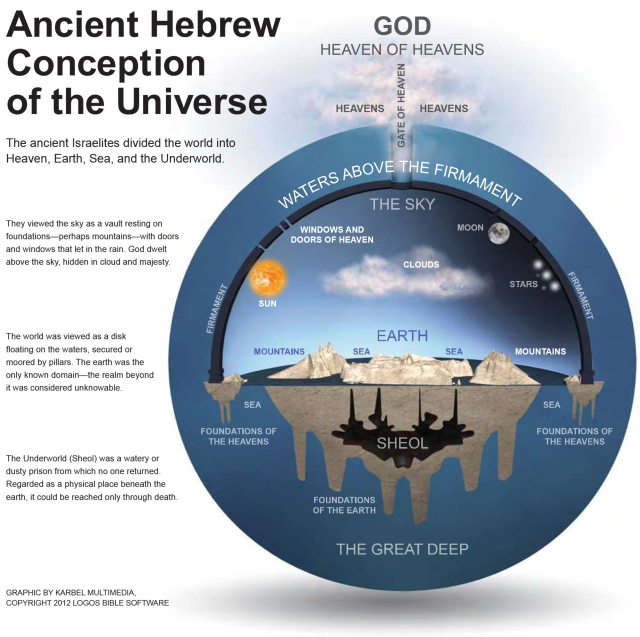
The same thing applies to the Bible’s ethical teachings. You might try to argue that all the abominable practices prescribed by the Bible were “right at the time,” or that they were ethically justifiable in the Israelites’ specific context; but this is scarcely better than arguing that the belief in a 6,000-year-old geocentric universe was “right at the time,” or that it was “right in that context.” Those beliefs are wrong in any historical context – it’s just that the Israelites didn’t know that yet, because their ethical sensibilities, like their scientific sensibilities, hadn’t yet reached the more humane level that we’ve attained in modern times. As far as they were concerned, stoning people to death for trivial offenses made perfect sense. We just know better than that nowadays.
Besides, if you try to argue that the worst commandments in the Bible are no longer applicable because they were just contextual – i.e. they were directed specifically at the Israelites rather than at future readers – then that could apply just as easily to all the good parts, and would disqualify them as well. When God issues the Ten Commandments, for instance, he prefaces them by saying, “I am the LORD thy God, which have brought thee out of the land of Egypt, out of the house of bondage” (Exodus 20:1-2). Clearly, he’s not talking about modern readers, since none of us were ever slaves in Egypt – so should this introductory statement therefore be interpreted to mean that his subsequent commandments were solely directed at the Israelites, and not intended for universal use? If you’re using a consistent standard here, it’s hard to throw out the bad without also throwing out the good.
And there are similar problems with the argument that we can disregard the worst Old Testament laws because Jesus overruled them. For one thing, there are verses like Deuteronomy 4:2, Deuteronomy 12:32, Proverbs 30:5-6, 2 Timothy 3:16, and Revelation 22:18-19 which explicitly stipulate that holy scripture is sacred and that it’s forbidden to alter or overrule it in any way. There are also verses like Deuteronomy 7:9, 1 Chronicles 16:15, Psalm 119:151-52, and Psalm 119:160, which reaffirm that God’s laws are not temporary but remain in force forever. But more to the point, there’s also the fact that Jesus himself goes out of his way to confirm the laws’ validity in Matthew 5:17-19, making sure to do so in the most decisive possible terms:
Do not think that I have come to abolish the Law [the first five books of the Old Testament] or the Prophets [the dozen or so Old Testament books of prophecy]; I have not come to abolish them but to fulfill them. For truly I tell you, until heaven and earth disappear, not the smallest letter, not the least stroke of a pen, will by any means disappear from the Law until everything is accomplished. Therefore anyone who sets aside one of the least of these commands and teaches others accordingly will be called least in the kingdom of heaven, but whoever practices and teaches these commands will be called great in the kingdom of heaven.
He reiterates this in Luke 16:17 – “It is easier for heaven and earth to pass away than for the smallest part of the letter of the law to become invalid” – and makes the point again in Matthew 15:3-9, Mark 7:6-10, and John 7:19 when he chastises onlookers for not adhering to the Old Testament laws. In fact, the strongest example of Jesus going against the Old Testament law is probably the story in John 8 where he stops an angry mob from stoning an adulteress by telling them, “Let he who is without sin cast the first stone” – but again, recall that that passage was never in the original text of the Bible; it was only added centuries later. (Most likely, it was added by Christians who were wrestling with the same issue we’re discussing now; they recognized the barbarity of the Old Testament laws, but they had trouble finding good examples of Jesus contravening them, so they supplied one themselves.) This impulse from Christian moderates to want to annul (or at least soften) the harshest parts of the Old Testament goes back all the way to the beginnings of the Christian Church; even Paul himself implies in Romans (3:28, 6:14, 7:4-6, 10:4) and Galatians (3:13, 3:24-25, 5:18) that he doesn’t think the old laws should remain valid anymore for Christians. But if we’re strictly going by what Jesus himself supposedly said, it’s hard to justify throwing out the Old Testament laws as fully as we might wish to. By and large, if we do decide to disregard them, we’re essentially doing so based on our own cherry-picking moral judgment, not on strict scriptural literalism. In other words, as Harris points out, when “moderate Christianity” is practiced nowadays, it’s not so much a result of its adherents finding that the Bible itself compels them to take a moderate approach to its content – it’s more a matter of them just deciding on their own to selectively ignore the worst parts of it outright:
It is only by ignoring such barbarisms that the Good Book can be reconciled with life in the modern world. This is a problem for “moderation” in religion: it has nothing underwriting it other than the unacknowledged neglect of the letter of the divine law.
The only reason anyone is “moderate” in matters of faith these days is that he has assimilated some of the fruits of the last two thousand years of human thought (democratic politics, scientific advancement on every front, concern for human rights, an end to cultural and geographic isolation, etc.). The doors leading out of scriptural literalism do not open from the inside. The moderation we see among nonfundamentalists is not some sign that faith itself has evolved; it is, rather, the product of the many hammer blows of modernity that have exposed certain tenets of faith to doubt.
Of course, actually admitting to yourself that you selectively ignore certain parts of the Bible (even if it’s clear that every Christian does this to some degree or another) opens up a whole new can of worms. Once you’ve decided that there’s some outside basis on which you can legitimately reject certain portions of your holy scriptures while retaining others, the question inevitably becomes: Where exactly do you draw that line? Which parts of the Bible – specifically – are God’s truth, and which are false gospel? And how do you make that determination? If you’re no longer content to just give the Bible a blanket endorsement and have that be the entirety of your belief, then what are your beliefs? If you had to go through the Bible, chapter by chapter, and write out a full list of which stories and teachings you accepted and which ones you rejected, what would that list look like?
These are dangerous questions for believers. The trick here, then, is not just to ignore all the most troublesome problems with the Bible, but to never even allow yourself to realize that you’re ignoring them. If you don’t even allow yourself to become consciously aware of these issues, you don’t have to wrestle with them. Sure, those verses where Jesus endorses the whole of the Old Testament law might be tough to deal with if you’re the kind of person who wants to reject the Old Testament while embracing the New – but if you never allow yourself to internalize (or even learn about) those verses in the first place, it’s a whole lot easier. If you just keep your center of attention on Jesus and his love for you, rather than on the literal words of the Bible themselves, then you can keep right on believing that the Bible says whatever you want it to say, rather than dealing with what it actually says. You just have to avoid scrutinizing things too closely; or to borrow a photography term, you just have to keep things “soft focus.”
Like I was saying before, for a long time this was the kind of mindset that I subconsciously maintained as a Christian. As George Bernard Shaw once said, “No man ever believes that the Bible means what it says; he is always convinced that it says what he means.” That was basically me. I never consciously realized that this was what I was doing, of course, so for quite a while I was able to sustain it with relatively little mental discomfort. Gradually, though, some of the things I’d been ignoring became harder and harder to ignore. The Bible’s scientific and historical inaccuracies became more and more glaring as I learned more about science and history. The immorality of biblical law came into sharper focus as social issues like gay marriage started to become a bigger part of the national conversation. I started noticing that a lot of the problems that plagued the Old Testament, like internal contradictions and practical implausibilities, kept cropping up in the New Testament too (more on that later). And the more of these nagging issues I ran into, the more of a strain I started to feel on my beliefs.
I had always had occasional doubts, of course. Every Christian does, to some extent. (Maybe I wouldn’t have called them “doubts” at the time – probably more like “divine mysteries that my mortal mind doesn’t fully understand yet” – but still, every now and then I would find myself feeling a twinge of niggling uncertainty whenever some aspect of my religion didn’t seem to be adding up quite as beautifully and effortlessly as I felt like it should have been.) But whenever these uncertainties would arise, I would push them aside. Instead of confronting them head-on, I would try to “grow past them.” In practice, this basically meant suppressing them. The way I saw it, though, there was no need to try and resolve them directly – because after all, since Christianity was clearly true, that meant there must have been valid explanations for all of my concerns, even if I couldn’t quite put my finger on them at the moment. There was no need for me to selfishly demand a concrete answer to every little question I had; all I had to do was to just have faith that the answers did exist out there somewhere.
Commenter Sophocles does a good job summing up the kind of mindset I had at the time:
[The reason why true believers don’t question their religious beliefs in the same way that they question other things is] because they think they have the inside scoop.
Imagine you’re a homicide detective. Most of the time you don’t know who the killer is, so every piece of evidence is a valuable clue that might lead you to the truth and you are going to weigh it carefully.
But let’s say on one case, you already know who the killer is, and all you’re trying to do is gather enough evidence to convict. (Let’s say you witnessed the crime firsthand, but your testimony is inadmissible for some reason.) Now your standard for evaluating evidence is completely different. You aren’t trying to find out the truth – you already know it – you are just trying to find enough evidence to corroborate it.
In most things true believers are like the rest of us. They don’t know the truth ahead of time and must rely on a critical evaluation of evidence to tease it out. But when it comes to religion, they think they already know the truth. They think they have witnessed firsthand the answers that everyone else is groping in the dark to find. So they aren’t judging the church against the evidence for and against it. Rather, the evidence is judged according to whether it supports what they already know to be true.
I already discussed this kind of mentality quite a bit in my last post, but I want to dig into it again here because I think it’s really important. (If you’ve already read that last post, I apologize in advance for repeating myself in these next few sections; but this played such a major role in my religious experience that I’d be remiss if I just glossed over it.)
See, what Sophocles says is right: When you’re in this kind of mental mode, you don’t try to come up with answers to hard questions – because as far as you’re concerned, you already know the answer in advance. You’re not on some open-ended search for truth – you already have the truth – so there’s no need to account for (or even recognize the existence of) any new facts you encounter that might point elsewhere. If you do encounter some new fact that happens to conflict with your beliefs, you can’t necessarily just accept it on its own terms; you first have to make sure it fits into your already-held belief system – even if that means blurring, skewing, and massaging it a little bit in order to make it fit – and it’s only then that can you accept it as true. To repeat a Bill Clinton quotation from my last post:
The problem with any ideology is that it gives the answer before you look at the evidence. So you have to mold the evidence to get the answer that you’ve already decided you’ve got to have.
And to add another one from Arthur Conan Doyle, delivered by his character Sherlock Holmes:
It is a capital mistake to theorize before one has data. Insensibly one begins to twist facts to suit theories instead of theories to suit facts.
As Sophocles points out, in most areas of our lives, we have no problem altering our views to fit the facts instead of the other way around. If (say) you start off believing that the capital of Michigan is Detroit, but then find out it’s actually Lansing, you can just say “Oops, my mistake,” update your mental map, and move on without issue. With religion, though, it’s different. New facts no longer serve as avenues toward discovery, re-evaluation, and improvement of your worldview; either they’re compatible with what you already believe (in which case they can be readily accepted), or they’re just obstacles to try and get past, in service of the greater goal of preserving and reinforcing what you already believe without any changes. In other words, you aren’t trying to find the truth; you’re trying to find a truth – one truth specifically. You already have in mind the conclusion that you’re aiming for, and you must always find a way to steer yourself back toward that conclusion even if it means rationalizing away anything that might conflict with it along the way. As James Harvey Robinson puts it:
We like to continue to believe what we have been accustomed to accept as true, and the resentment aroused when doubt is cast upon any of our assumptions leads us to seek every manner of excuse for clinging to it. The result is that most of our so-called reasoning consists in finding arguments for going on believing as we already do.
John Trever also illustrates the idea in comic strip form:
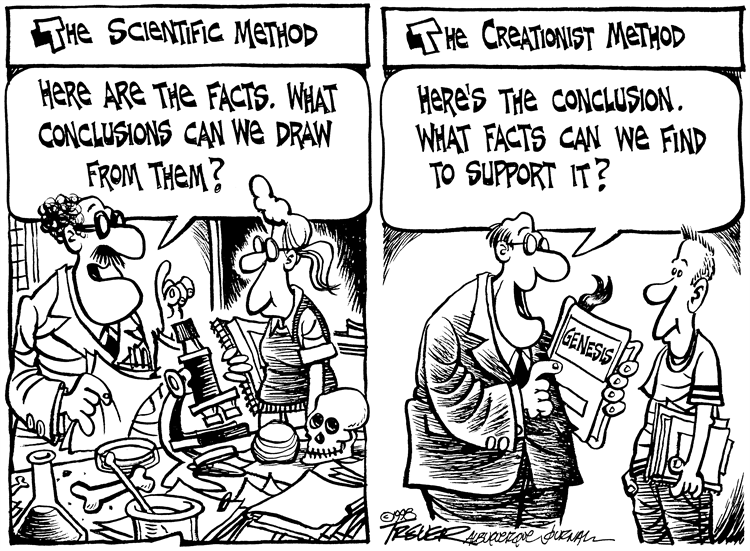
In an ideal world, all of us would think more like scientists. A belief wouldn’t be something that you’d feel like you could choose, per se; it’d be more like a condition that was imposed on you by the facts you perceived. When you encountered new facts, your beliefs would have to automatically change to accommodate them, regardless of whether those facts contradicted what you might prefer to be true.
In reality, though, having a religious mindset means that you don’t think so much like a scientist (willing to examine all of the facts and then honestly follow them toward whichever truth they might point to); you think more like a lawyer (taking a side first, and then embracing only those facts which reinforce your side’s case, while ignoring, denying, or rationalizing away the facts that seem to undermine it). Chris Mooney elaborates on this analogy a bit:
Consider a person who has heard about a scientific discovery that deeply challenges her belief in divine creation – a new hominid, say, that confirms our evolutionary origins. What happens next, explains political scientist Charles Taber of Stony Brook University, is a subconscious negative response to the new information – and that response, in turn, guides the type of memories and associations formed in the conscious mind. “They retrieve thoughts that are consistent with their previous beliefs,” says Taber, “and that will lead them to build an argument and challenge what they’re hearing.”
In other words, when we think we’re reasoning, we may instead be rationalizing. Or to use an analogy offered by University of Virginia psychologist Jonathan Haidt: We may think we’re being scientists, but we’re actually being lawyers (PDF). Our “reasoning” is a means to a predetermined end – winning our “case” – and is shot through with biases. They include “confirmation bias,” in which we give greater heed to evidence and arguments that bolster our beliefs, and “disconfirmation bias,” in which we expend disproportionate energy trying to debunk or refute views and arguments that we find uncongenial.
That’s a lot of jargon, but we all understand these mechanisms when it comes to interpersonal relationships. If I don’t want to believe that my spouse is being unfaithful, or that my child is a bully, I can go to great lengths to explain away behavior that seems obvious to everybody else – everybody who isn’t too emotionally invested to accept it, anyway. That’s not to suggest that we aren’t also motivated to perceive the world accurately – we are. Or that we never change our minds – we do. It’s just that we have other important goals besides accuracy – including identity affirmation and protecting one’s sense of self – and often those make us highly resistant to changing our beliefs when the facts say we should.
Haidt himself provides more insight on the topic:
The social psychologist Tom Gilovich studies the cognitive mechanisms of strange beliefs. His simple formulation is that when we want to believe something, we ask ourselves, “Can I believe it?” Then (as [Deanna] Kuhn and [David] Perkins found), we search for supporting evidence, and if we find even a single piece of pseudo-evidence, we can stop thinking. We now have permission to believe. We have a justification, in case anyone asks.
In contrast, when we don’t want to believe something, we ask ourselves, “Must I believe it?” Then we search for contrary evidence, and if we find a single reason to doubt the claim, we can dismiss it.
You only need one key to unlock the handcuffs of must.
Psychologists now have file cabinets full of findings on “motivated reasoning,” showing the many tricks people use to reach the conclusions they want to reach. When subjects are told that an intelligence test gave them a low score, they choose to read articles criticizing (rather than supporting) the validity of IQ tests. When people read a (fictitious) scientific study that reports a link between caffeine consumption and breast cancer, women who are heavy coffee drinkers find more flaws in the study than do men and less caffeinated women. Pete Ditto, at the University of California at Irvine, asked subjects to lick a strip of paper to determine whether they have a serious enzyme deficiency. He found that people wait longer for the paper to change color (which it never does) when a color change is desirable than when it indicates a deficiency, and those who get the undesirable prognosis find more reasons why the test might not be accurate (for example, “My mouth was unusually dry today”).
The difference between a mind asking “Must I believe it?” versus “Can I believe it?” is so profound that it even influences visual perception. Subjects who thought that they’d get something good if a computer flashed up a letter rather than a number were more likely to see the ambiguous figure [below] as the letter B, rather than as the number 13.
If people can literally see what they want to see – given a bit of ambiguity – is it any wonder that scientific studies often fail to persuade the general public? Scientists are really good at finding flaws in studies that contradict their own views, but it sometimes happens that evidence accumulates across many studies to the point where scientists must change their minds. I’ve seen this happen in my colleagues (and myself) many times, and it’s part of the accountability system of science – you’d look foolish clinging to discredited theories. But for nonscientists, there is no such thing as a study you must believe. It’s always possible to question the methods, find an alternative interpretation of the data, or, if all else fails, question the honesty or ideology of the researchers.
And now that we all have access to search engines on our cell phones, we can call up a team of supportive scientists for almost any conclusion twenty-four hours a day. Whatever you want to believe about the causes of global warming or whether a fetus can feel pain, just Google your belief. You’ll find partisan websites summarizing and sometimes distorting relevant scientific studies. Science is a smorgasbord, and Google will guide you to the study that’s right for you.

As Kevin Simler sums it up:
When we have [strong] incentives to believe something, we stack the deck in its favor. Or to use another metaphor, we put our thumbs on the scale as we weigh the evidence. Blind faith – religious, political, or otherwise – is simply “benefit of the doubt” taken to its logical extreme.
These quotations together do a pretty good job describing my own experience as a Christian. Having already decided in advance what my worldview was going to be (Christianity), whenever I encountered new facts my main goal was to rationalize them to fit that worldview. Rather than doing the intellectually honest thing, which would have been to follow the facts wherever they might have led, regardless of whether the ultimate end agreed with my preferred conclusion, I started off by assuming that the ultimate end was my preferred conclusion, and then I worked backwards from there. When I was faced with biblical contradictions or absurdities, I would often come up with explanations out of thin air – not because there was any biblical, historical, or scientific basis for my explanations, but simply because of my desire to see the biblical conflicts reconciled without issue. And when I was faced with evidence that seemed to contradict Christianity outright – well, I would just turn around and look for evidence that suggested otherwise. As commenter tired_of_nonsense puts it, my approach was like “taking your car to 100 mechanics before you get to one that tells you your brakes are working just fine [… or like] going to 100 doctors before you find the one that tells you your cholesterol level is healthy.” It might not have been intellectually honest in retrospect, but at the time, it seemed like it was perfectly reasonable – because after all, it was allowing me to preserve my belief in what was true – Christianity.
Looking back, it’s hard to believe that I was able to sustain this for so long. But then again, it’s not like my case was a particularly unusual one; instances of motivated reasoning are everywhere, even outside the realm of religion. As Mooney points out, you can see it all the time in interpersonal relationships, where emotional investments are particularly high. And you can also see it a lot in other ideologically charged areas, like politics; as soon as someone aligns themselves with a particular political ideology, they immediately develop a kind of “brand loyalty” that makes them more inclined to embrace anything that bolsters their side and to repudiate anything that doesn’t. Regardless of the context, though, this inclination to want to maintain the party line at all costs can have some major effects on a person’s psychology. Just knowing that there’s a “correct” answer to any ideological question you might be asked – a specific answer that you’re supposed to give – can mean that in a lot of cases you’ll end up feeling like you have to forcibly override your own thought processes in favor of those required by your religion or political ideology. Eliezer Yudkowsky provides an analogy:
Depending on how your childhood went, you may remember a time period when you first began to doubt Santa Claus’s existence, but you still believed that you were supposed to believe in Santa Claus, so you tried to deny the doubts.
Belief in Santa is a relatively trivial example, of course; but the parallels with religion are clear (and not just because they both involve bearded, all-seeing beings who judge your behavior and reward you if you’re good). When your religious belief is embedded deeply enough, you might find yourself being faced with arguments that are essentially irrefutable (e.g. arguments for evolution), and yet you still can’t allow yourself to be convinced by them because your religion forbids it. Dawkins describes one especially overt instance of this:
Fundamentalist religion […] teaches us not to change our minds, and not to want to know exciting things that are available to be known. It subverts science and saps the intellect. The saddest example I know is that of the American geologist Kurt Wise, who now directs the Center for Origins Research at Bryan College, Dayton, Tennessee. It is no accident that Bryan College is named after William Jennings Bryan, prosecutor of the science teacher John Scopes in the Dayton “Monkey Trial” of 1923. Wise could have fulfilled his boyhood ambition to become a professor of geology at a real university, a university whose motto might have been “Think critically” rather than the oxymoronic one displayed on the Bryan website: “Think critically and biblically.” Indeed, he obtained a real degree in geology at the University of Chicago, followed by two higher degrees in geology and paleontology at Harvard (no less) where he studied under Stephen Jay Gould (no less). He was a highly qualified and genuinely promising young scientist, well on his way to achieving his dream of teaching science and doing research at a proper university.
Then tragedy struck. It came, not from outside but from within his own mind, a mind fatally subverted and weakened by a fundamentalist religious upbringing that required him to believe that the Earth – the subject of his Chicago and Harvard geological education – was less than ten thousand years old. He was too intelligent not to recognize the head-on collision between his religion and his science, and the conflict in his mind made him increasingly uneasy. One day, he could hear the strain no more, and he clinched the matter with a pair of scissors. He took a bible and went right through it, literally cutting out every verse that would have to go if the scientific world-view were true. At the end of this ruthlessly honest labor-intensive exercise, there was so little left of his bible that
try as I might, and even with the benefit of intact margins throughout the pages of Scripture, I found it impossible pick up the Bible without it being rent in two. I had to make a decision between evolution and Scripture. Either the Scripture was true and evolution was wrong or evolution was true and I must toss out the Bible . . . It was there that night that I accepted the Word of God and rejected all that would ever counter it, including evolution. With that, in great sorrow, I tossed into the fire all my dreams and hopes in science.
I find that terribly sad. […] The wound, to his career and his life’s happiness, was self-inflicted, so unnecessary, so easy to escape. All he had to do was toss out the bible. Or interpret it symbolically, or allegorically, as the theologians do. Instead, he did the fundamentalist thing and tossed out evidence and reason, along with all his dreams and hopes.
Perhaps uniquely among fundamentalists, Kurt Wise is honest – devastatingly, painfully, shockingly honest. […] Wise brings to the surface what is secretly going on underneath, in the minds of fundamentalists generally, when they encounter scientific evidence that contradicts their beliefs. Listen to his peroration:
Although there are scientific reasons for accepting a young earth, I am a young-age creationist because that is my understanding of the Scripture. As I shared with my professors years ago when I was in college, if all the evidence in the universe turns against creationism, I would be the first to admit it, but I would still be a creationist because that is what the Word of God seems to indicate. Here I must stand.
He seems to be quoting Luther as he nailed his theses to the door of the church in Wittenberg, but poor Kurt Wise reminds me more of Winston Smith in 1984 – struggling desperately to believe that two plus two equals five if Big Brother says it does.
Dawkins’s mention of George Orwell’s 1984 is fitting, because it was there that Orwell himself gave one of the best descriptions of this kind of motivated reasoning. He was describing how people in the world of 1984 would rid themselves of any thoughts or ideas that contradicted their party’s ideology, but his explanation works just as well as a description of how religious faith can constrict genuine freedom of thought:
Crimestop means the faculty of stopping short, as though by instinct, at the threshold of any dangerous thought. It includes the power of not grasping analogies, of failing to perceive logical errors, of misunderstanding the simplest arguments […] and of being bored or repelled by any train of thought which is capable of leading in a heretical direction. Crimestop, in short, means protective stupidity.
To put it even more succinctly, as Frater Ravus says: “Faith does not give you the answers – it only stops you from asking the questions.”
There’s an old story about how Galileo, after discovering that the Church’s model of the solar system was fundamentally flawed, asked a representative of the pope to look through his telescope at the newly-discovered moons of Jupiter – and the clergyman responded, “I refuse to look at something which my religion tells me cannot exist.” This story is probably exaggerated – it seems unlikely that the clergyman would have used those exact words, anyway – but apparently it’s at least loosely based on true events. Michael Shermer explains:
According to Aristotelian cosmology – the Catholic Church’s final and indisputable authority of Truth on matters heavenly – all objects in space must be perfectly round, perfectly smooth, and revolve around Earth in perfectly circular orbits. Yet when Galileo looked for himself through his tiny tube with a refracting lens on one end and an enlarging eyepiece on the other he saw mountains on the moon, spots on the sun, phases of Venus, moons orbiting Jupiter, and a strange object around Saturn. Galileo’s eminent astronomer colleague at the University of Padua, Cesare Cremonini, was so committed to Aristotelian cosmology that he refused to even look through the tube, proclaiming: “I don’t believe that anyone but he saw them, and besides, looking through glasses would make me dizzy.” Those who did look through Galileo’s tube could not believe their eyes – literally. One of Galileo’s colleagues reported that the instrument worked for terrestrial viewing but not celestial, because “I tested this instrument of Galileo’s in a thousand ways, both on things here below and on those above. Below, it works wonderfully; in the sky it deceives one.” A professor of mathematics at the Collegio Romano was convinced that Galileo had put the four moons of Jupiter inside the tube. Galileo was apoplectic: “As I wished to show the satellites of Jupiter to the Professors in Florence, they would see neither them nor the telescope. These people believe there is no truth to seek in nature, but only in the comparison of texts.”
Four centuries later, our telescopes have improved immensely – but human psychology is still the same as it ever was. (Harris notes a similar story from modern times: “When the members of the ‘Heaven’s Gate’ cult failed to spot the spacecraft they knew must be trailing the comet Hale-Bopp, they returned the $4,000 telescope they had bought for this purpose, believing it to be defective.”) And in fact, even outside of such cosmically significant religious contexts, our ability to shut out unwelcome facts for ideological reasons is practically limitless. Even if the cost of changing our views is relatively low, and even if the evidence against us is not just a single “possibly flawed” telescope but an entire field of science, we can often still find a way to write it off if we’re ideologically motivated enough. Here’s David McRaney:
Geoffrey Munro at the University of California and Peter Ditto at Kent State University concocted a series of fake scientific studies in 1997. One set of studies said homosexuality was probably a mental illness. The other set suggested homosexuality was normal and natural. They then separated subjects into two groups; one group said they believed homosexuality was a mental illness and one did not. Each group then read the fake studies full of pretend facts and figures suggesting their worldview was wrong. On either side of the issue, after reading studies which did not support their beliefs, most people didn’t report an epiphany, a realization they’ve been wrong all these years. Instead, they said the issue was something science couldn’t understand. When asked about other topics later on, like spanking or astrology, these same people said they no longer trusted research to determine the truth. Rather than shed their belief and face facts, they rejected science altogether.
To quote John Kenneth Galbraith, “Faced with the choice between changing one’s mind and proving that there is no need to do so, almost everyone gets busy on the proof.” And considering the lengths that people will go to in order to protect even the most minor of their beliefs, is it any surprise that people will resist that much more strongly when the belief under threat isn’t a minor one at all, but one that forms a cornerstone of their identity and defines their most fundamental values? As Gary Klein points out:
The more central [a] belief is to our thinking, the harder it is to give up. These core beliefs anchor our understanding. We use them to make sense of events, to inquire, and to arrive at judgments about other ideas. And so we are much more likely to explain away any anomalies rather than revise our beliefs in the face of them.
Imagine, let’s say, a person who had spent their entire life trying to track down the Loch Ness Monster – reading all the magazines, moving out to Scotland to set up their own Nessie-hunting operation, etc. – only to discover one day that scientists had conducted a full sonar sweep of the lake and determined once and for all that there was definitely no monster there. How do you think this person would respond? Would their first reaction be to just say “Oh, well I guess that’s that” and promptly drop their life’s work? Or would they be more inclined to start coming up with ad hoc explanations for why the sonar sweep must have been flawed or incomplete in some way? If there was even a 0.01% chance that the sweep might have been flawed, do you think they’d recognize the remoteness of that possibility and admit that the weight of the evidence did seem to suggest that their belief was wrong – or do you think they’d seize on that tiny sliver of doubt as proof that their belief was still absolutely true and there was no need to change it? More importantly – do you think that they’d be right to do so? Do you think they’d be justified in continuing to act like their belief was true, simply on the basis that it was still possible for it to be true?
Maybe you wouldn’t have any problem saying what the more rational approach would be in that specific situation – nor should you – but these kinds of things are always easier to evaluate from an outside perspective, when you don’t have any personal attachment to the issue at stake. It’s one thing to imagine how you might respond if you were in that situation yourself – but you probably don’t have a very strong investment in the belief that the Loch Ness Monster exists, so it’s not hard to imagine giving that belief up. It’s another thing altogether when your own core beliefs are the ones being challenged.
Just to take one more example – I mentioned a moment ago how the Heaven’s Gate cultists refused to give up their beliefs even when their telescope showed that they were wrong. Mooney recounts how the members of another cult dealt with a similar experience of their own:
[Leon] Festinger and several of his colleagues had infiltrated the Seekers, a small Chicago-area cult whose members thought they were communicating with aliens – including one, “Sananda,” who they believed was the astral incarnation of Jesus Christ. The group was led by Dorothy Martin, a Dianetics devotee who transcribed the interstellar messages through automatic writing.
Through her, the aliens had given the precise date of an Earth-rending cataclysm: December 21, 1954. Some of Martin’s followers quit their jobs and sold their property, expecting to be rescued by a flying saucer when the continent split asunder and a new sea swallowed much of the United States. The disciples even went so far as to remove brassieres and rip zippers out of their trousers – the metal, they believed, would pose a danger on the spacecraft.
Festinger and his team were with the cult when the prophecy failed. First, the “boys upstairs” (as the aliens were sometimes called) did not show up and rescue the Seekers. Then December 21 arrived without incident. It was the moment Festinger had been waiting for: How would people so emotionally invested in a belief system react, now that it had been soundly refuted?
At first, the group struggled for an explanation. But then rationalization set in. A new message arrived, announcing that they’d all been spared at the last minute. Festinger summarized the extraterrestrials’ new pronouncement: “The little group, sitting all night long, had spread so much light that God had saved the world from destruction.” Their willingness to believe in the prophecy had saved Earth from the prophecy!
From that day forward, the Seekers, previously shy of the press and indifferent toward evangelizing, began to proselytize. “Their sense of urgency was enormous,” wrote Festinger. The devastation of all they had believed had made them even more certain of their beliefs.
In the annals of denial, it doesn’t get much more extreme than the Seekers. They lost their jobs, the press mocked them, and there were efforts to keep them away from impressionable young minds. But while Martin’s space cult might lie at on the far end of the spectrum of human self-delusion, there’s plenty to go around.
As it happens, a number of Christian doomsday prophets have also made predictions about the end of the world. Time after time, these prophecies have failed spectacularly. And yet, time after time, that failure has seemed to do absolutely nothing to budge the believers’ confidence that their faith is 100% correct. When it comes to religious belief – more so even than aliens or the Loch Ness Monster or anything else – people’s personal conviction that their beliefs just have to be true can outweigh even the most definitive evidence to the contrary. And that applies not only to belief in false doomsday prophecies, but also to more common beliefs like belief in the Bible’s historically untenable legends, belief in its flawed cosmology, and so on. When you’ve got a worldview that you’re convinced explains everything, which you’ve built up over the course of an entire lifetime, the prospect of simply scrapping the whole thing and starting over from scratch isn’t something you even consider as an option. At most, you might make a few minor tweaks around the edges. But a person doesn’t just casually change their entire life philosophy overnight, as if it were as simple as picking out a new haircut or something. A religious worldview is more like a giant 20-bedroom mansion that you’ve spent an entire decade building by hand, one brick at a time. If you happen to go down into the basement of that mansion one day, and out of the corner of your eye, you glimpse some dark lines on the wall that you hadn’t noticed before – which might just be innocent shadows, or might be cracks in the foundation that would require you to tear down the entire house and spend another whole decade building a new one from the ground up – then wouldn’t it be understandable if your natural response was just to say, “I’m going to pretend I didn’t see that,” and not give those dark lines a second look? Wouldn’t it be understandable if you tried to assume the best-case scenario (“Those were just shadows”), not because it was necessarily more likely to be true, but simply out of a fear of what the worst-case scenario might entail?
Based on my own experience, this impulse to want to “overlook” or “neglect to notice” certain potentially difficult or threatening facts is the most natural thing in the world. It’s the same reason why people will often refuse to go to the doctor, even when they’re experiencing noticeable symptoms, and choose to believe that their health problem will “go away on its own” instead. If you never have to actually hear your doctor tell you that you have an extremely severe condition, you can still believe that there’s nothing to worry about. By never actually confronting the question of whether your beliefs are right or wrong, you can keep right on telling yourself that it’s an open question, and that there’s therefore a possibility that your preferred beliefs remain totally justified. As Robert M. Price puts it: “The controlling presupposition seems to be, ‘If [your preferred belief] cannot be absolutely debunked beyond the shadow of a doubt, if it still might possibly be true, then [you] are within [your] rights to continue to believe it.’”
For me though, needless to say, that approach only got me so far. As much as I was able to rationalize away individual problems within the Bible and Christianity on a one-at-a-time basis – i.e. maybe the six “days” of creation were actually metaphors for eons; maybe the different “kinds” of animals on the ark were actually different animal families rather than different species; etc. – over time those rationalizations started to pile up, to the point that their accumulation eventually became painfully glaring. Even though I was able to convince myself that each of these explanations made sense on its own, when I stepped back and considered the likelihood that they all just conveniently happened to be true – that the wildly counterintuitive explanation just happened to be the correct one in every single one of these instances – it started feeling like a lot more of a stretch. To go back to an earlier analogy, it was like those medieval astronomers, back in the days before Copernicus and Kepler, trying to maintain the old model that the other planets and the sun must have all orbited the earth in perfectly circular orbits. Even though it seemed to them like the geocentric model was the “simplest” and “most elegant” one, their preferred belief kept failing to match up with reality; the planets had this odd tendency to slow down, speed up, and occasionally change directions relative to the earth in ways that the geocentric model wouldn’t have predicted. The astronomers kept having to add orbits within orbits to explain the disparities – what they called “epicycles” – and to an extent, their ad-hoc, kludgy additions actually kind of worked for a while, at least if you squinted a bit and were willing to overlook some slight inaccuracies. But the more inaccuracies they discovered, the more epicycles they had kept having to add – until eventually those clumsy, tacked-on additions had become so numerous that they overwhelmed the rest of the model, and what had started off seeming “simple” and “elegant” was now too convoluted to hold up under its own weight.
I’m oversimplifying things a bit here, but you get the point I’m trying to make. When I looked at how many rationalizations I kept having to add to my biblical worldview just to keep it intact and maintain its basic appearance of reasonableness, it started to feel a bit like that; more and more, it started to feel like I was just adding epicycles. My justifications for my biblical worldview started to feel increasingly forced. I kept running into things that were clearly and demonstrably true, but which my religion required me to dismiss as false (or vice-versa). I started to feel more and more bothered by that nagging sense of cognitive dissonance – the recognition that the facts I was facing were inescapable yet at the same time could not be accepted. And gradually, I started to notice that there was a continual sense of underlying tension in my mind between what I believed, and what I believed. There were the things that I’d convinced myself I believed were true (because my faith required it), and then there were the things that my deep-down mental model of reality actually regarded as true. There were the beliefs that I’d professed my allegiance to, because they were tenets of my religion, and then there were the beliefs that the operational parts of my brain actually used when controlling my real-world thoughts and actions, because I subconsciously considered them to be the more accurate ones (even if I was unable to admit it to myself). The goal of faith, I suppose, is to convince yourself that these two levels of belief – what you believe and what you believe – are one and the same. But in my case, once I noticed that I was compartmentalizing my beliefs in this way, it was impossible for me to un-notice it. Once I realized that my belief in biblical stories like Genesis and Exodus somehow wasn’t quite the same as my belief that the earth orbited the sun or that Christopher Columbus sailed in 1492, it created a kind of mental itch that I just couldn’t leave alone. It felt like I was one of those sports fans who claimed to be 100% certain that their team was going to win the big game, but then when actually challenged to put money on it, suddenly became a lot less sure of themselves. Did I really believe what I thought I did? Were the beliefs that I was outwardly professing the same as the beliefs I was keeping hidden in the privacy of my own mind, concealed even from my own conscious awareness?
I suppose it’s possible that, at some level, I had always been aware that my beliefs didn’t necessarily match up perfectly with the claims of Christianity. But I had spent most of my time as a believer not allowing myself to consider that directly; like I said before, my approach was just to keep those more questionable beliefs vague and “soft focus.” Still though, I was coming to realize that if these matters really were as important as I claimed they were, just maintaining a kind of vague, hand-wavy belief wasn’t going to cut it. These questions about the nature of God, the origins of life and the universe, and the foundations of morality were the most important things in existence – so I couldn’t just shrug my shoulders and ignore them. I needed to nail down exactly where I stood on this stuff. Not only did I owe it to myself to figure out what my beliefs actually were; I owed it to God. After all, as an evangelical Christian, I considered it my sacred duty to win as many people to Christ as possible; and if the only defense of Christianity I could give was a kind of wishy-washy beating around the bush, that wasn’t going to convert anybody. I needed to have a formulation of my beliefs that was solid enough to actually convince people. As 1 Peter 3:15 instructed, I needed to be able to give a defense of my faith to anyone who asked. And that meant I had to fully come to terms with exactly what I believed and why I believed it – whether that coincided with the literalist interpretation of the Bible, the metaphorical interpretation, or some other approach entirely.
Admittedly, subjecting my beliefs to such intense scrutiny was terrifyingly new territory for me. Forcing myself to look at my doubts straight on, after years of only glancing at them out of the corner of my eye, was like staring into the sun. Whenever I’d had doubts before, they’d always been accompanied by a paralyzing feeling of guilt; I knew I wasn’t supposed to be having such thoughts, and I knew that God, being omniscient, would have been able to see into my mind and know that I was having them – so the mere fact that I was having these forbidden thoughts at all felt like an act of treason. It wasn’t a safe feeling – and it certainly wasn’t a comfortable one – so whenever any trace of doubt would enter my mind, I would immediately try to suppress it. The thing that finally changed my perspective, though, was the realization that because God was omniscient, and because he could see into my thoughts, there was no point in trying to hide them or ignore them, because God already knew what was in my heart even better than I did. I wasn’t fooling anyone. God would have been perfectly aware of the questions that still lingered beneath the surface of my mind. More reassuringly, though, the fact that he knew everything also meant that he would have been aware of the fact that my doubts weren’t coming from a place of malicious rebellion against his will; they were coming from a place of genuine uncertainty and a desire to understand his truth, whatever that was. God would have known that I was still a faithful believer despite my lingering questions; he would have known that even if I doubted some parts of Christian doctrine – or even if I rejected certain parts of it outright – this wasn’t because I was rejecting God himself, but simply because I didn’t think that some of the things that had been written or claimed about him were adequate reflections of his perfect nature. He would have known that deep down, at the core of my being, I still believed in him and wanted to follow his will; and he would have known that even if I wasn’t always on board with everything the Church did or everything the Bible said, I was still a Christ-follower. He would have known what was in my heart. So really, there was nothing to be afraid of after all; I didn’t have to keep feeling guilty and trying to suppress my doubts. I could actually confront them, wrestle with them, and dissect them. I could ask the questions I’d kept bottled up for so long, and I could push for answers. I could venture outside of my comfort zone, and God wouldn’t condemn me for it. On the contrary, once I finally sorted out what I believed, it would make my conviction stronger than ever, because I wouldn’t have to deal with all those paralyzing doubts and uncertainties anymore. I’d actually have a belief system that was fully fleshed out, with justifications for every point – and because of that, I’d be able to give a full account of my beliefs to anyone who asked, and would accordingly have a much better chance of winning them over to the truth as I knew it.
As Ehrman says, it’s better to have an informed faith – one that knows what its principles are based on and where they came from – than an ignorant faith – one that feels satisfactory on a superficial level but can’t actually support any conceptual weight once you dig into it. The Bible itself told me to seek truth and understanding (Proverbs 2:3-5, 14:15; Matthew 7:7-8; 1 Thessalonians 5:21); so that’s what I would do.
Having resolved all this, then, I became much more willing to immerse myself in the parts of history, science, and philosophy that I’d tended to shy away from before. I became more willing to grapple with the most questionable parts of the Bible; and I also became more willing to introspect – to ask myself questions, and to actually insist on answers, rather than just shrugging off the hardest subjects. One of the most important things I did was to actually try to itemize my beliefs explicitly – that is, instead of just holding a nebulous cloud of half-formed ideas in my head, I tried to actually list out exactly where I stood on each individual question, and why. Did I believe that God created the universe? Did I believe he did it in six literal days? Did I believe that God the Father was the same being as Jesus? Did I believe that Jesus rose from the dead as a physical body, or in spiritual form, or neither? Did I believe that Noah’s flood happened exactly as described in the Bible? Did I believe that the apocalypse would happen exactly as described in Revelation? And so on.
And crucially, as I was doing all this, I made a concerted effort to be as brutally honest with myself as possible, even if I didn’t like the result. Having realized that God knew my true deep-down beliefs even better than I did, I decided that the most important thing was to try and get on the same page as him – to know what I really believed, rather than just what I told myself I believed. And that meant unflinching honesty. So when I’d ask myself whether I believed something, I wasn’t just asking myself, “Is this something I’d endorse as a belief in the abstract?” but rather, “If someone hooked me up to a lie detector and held a gun to my head, is this something that I’d honestly be able to say I actually believed was true?”
Once I started taking this kind of critical approach, a weird thing happened: For the first time, I found that I was able to step back and see the Bible’s claims “from the outside.” I was able to sort of step outside all the internalized assumptions about my religion that I’d always taken for granted, and see things with fresh eyes. Instead of working from the body of received wisdom that I’d been taught as a child (and had never thought to go back and question again), I imagined seeing these Bible stories for the first time as an adult, and asked myself how I’d respond to them if they hadn’t already been inculcated in my mind at a young age. Knowing all that I know now about science and history and so on, which of these stories would I uncritically accept if I’d just heard them for the first time today?
There’s a clip from Bill Maher’s film Religulous where he asks, “If they told you Jack and the Beanstalk was religion, and that a man who lived in a whale was in a fairy-tale book, do you think when you got to be an adult, you’d be defending the one instead of the other?” I don’t usually like it when people use the term “fairy tales” when discussing religious beliefs – most of the time it just seems needlessly condescending – but in this case, I think Maher’s question is actually a reasonable one to ask. I’d always just taken it as a given that the story of Jonah and the whale was true, and that talking snakes actually existed, and so on – but if I came across these stories for the first time today, as an adult, wouldn’t I just assume that the book containing them was fictional (like Aesop’s Fables or The Lord of the Rings or something), as opposed to being a historical or scientific account of the real world?
The funny thing here, incidentally, is that there aren’t actually any elements of the Jack and the Beanstalk story that aren’t in the Bible. It’s got giants (Nephilim), supernatural beings living in the clouds (God and his angels), and even a massive structure tall enough to reach that heavenly realm (the Tower of Babel). Is it really that hard to believe, then, that someone who had never read or heard of the Bible before would find its contents unbelievable, or even just outright silly?
The more I forced myself to reconsider these stories – and the more I reconsidered all the arbitrary, bigoted, and brutal moral teachings in the Bible – the more I had to come to terms with the fact that, inconvenient as it was to admit, my own beliefs and values just did not always match up with them. I still believed in God, of course. And I still believed in Jesus with all my heart. In fact, my faith in him was as strong as ever. But in spite of (or perhaps because of) my faith in him, I was starting to feel like the God I worshiped was too grand and all-consuming to fit within the narrow confines of the parochial biblical worldview. Despite still considering myself a die-hard follower of Christ, I no longer felt compelled to keep my faith walled up within the formal confines of organized religion. I felt that my God was bigger than that. As Bishop John Shelby Spong puts it:
Every church I know claims that “we are the True Church,” that they have some “ultimate authority” – we have the infallible Pope, we have the inerrant Bible. The idea that the truth of God can be bound in any human system, by any human creed, by any human book, is almost beyond imagination for me. God is not a Christian. God is not a Jew, or a Muslim, or a Hindu, a Buddhist. All of those are human systems, which human beings have created, to try to help us walk into the mystery of God. I honor my tradition. I walk through my tradition. But I don’t believe my tradition defines God. I think it only points me to God.
More and more, I was starting to realize that I agreed with this. The dogma wasn’t what really mattered to me – God was what mattered. So although I was keeping my faith, you might say I was moving away from my religion. I was remaining committed to Christ, but I wasn’t necessarily remaining confined to Christianity. I was moving away from organized religion, and toward a more personal kind of faith – one without constraining labels – one that was between me and God.
And as it would turn out, this new approach to my faith actually proved to be much more rewarding than my old pattern of forcing myself to stay within the lines of what the Church dictated I believe. I was quickly discovering the reason why so many people described themselves as “spiritual but not religious” – not only was it becoming increasingly apparent to me that religion and God were two wholly separable things; they were, in fact, often directly at odds with one another. God himself may have been perfect and unchanging – but the men who led his Church were all too human; and just because they claimed to be working and speaking on God’s behalf didn’t mean that I should regard them as being synonymous with him. More to the point, just because some of these men happened to write down some of their ideas a long time ago – like the idea that we should execute gay people and non-virgin brides – and just because some other men later selected some of their writings and compiled them into a book, didn’t mean that the loving and merciful God that I knew was responsible for such teachings, nor that he would have ever endorsed them. The dogma and the deity were not the same thing. The pillars of my faith, like truth and love, didn’t come from any particular book or building or organization. They came from God himself; so as long as I believed in him, accepted his sacrifice of Jesus, and wanted to follow him and do his will, everything else was secondary. And that meant that there was no requirement that I had to restrict myself to the confines of the Church or the Bible; I could simply believe whatever God had shown me to be true, and define my beliefs purely within those lines – whether they fit within the formal religious framework of Christianity or not.
This realization was a pretty major turning point for me. My whole life, I’d been locked into this mindset that Christianity and the Church and the Bible and all the dogmatic baggage that came with them were some kind of all-or-nothing package deal – that if I believed in God and Jesus, then I necessarily had to believe that evolution was false, and that Noah’s flood was true, and that sexual desire was a sin, and that different languages were God’s punishment for human ambition, and all the rest of it. And in fairness, I think this is how most believers think of religious belief – they don’t typically pick out which beliefs they find plausible on an individual basis; they instead just pick a pre-assembled bundle of beliefs (i.e. a “religion” or an “ideology”), and then subscribe to it on a wholesale basis.
When you think about it, though, this is a really bizarre way of determining what you believe. There are literally thousands of different questions that religion tries to answer – everything from the origins of the universe, to the nature of morality, to the existence of angels and demons, to the possibility of an afterlife – and with billions of people living on the planet, you’d think there would be billions of different combinations of answers to these questions. You’d think that everyone would have their own unique combination of beliefs, and that no two people’s combinations of beliefs would be exactly alike. Instead, though, what we see is this weird consensus that there are basically only about five or six possible combinations of religious beliefs that a person can reasonably hold; you must either subscribe to the specific bundle of beliefs known as “Christianity,” the specific bundle of beliefs known as “Islam,” the bundle known as “Judaism,” the one called “Hinduism,” or the one called “Buddhism” (or you may just not believe in the divine at all – “atheism”). Does that really mean that there are only five or six possible ways of seeing the world? Obviously that’s not true – and yet the way most people think about religion (or at least the way that the most devout believers think about it) doesn’t allow for any ideological space outside of those few pre-packaged worldviews. If you self-identify as a Christian, for example, you might not actually be all that comfortable with the idea that homosexuality is a sin or that the earth is only 6,000 years old or what have you – but within this kind of all-or-nothing paradigm, it’s simply not considered possible to reject those ideas while still considering yourself a follower of Jesus at the same time. Religions are considered to be package deals; if you choose to follow a particular religion, you’re prohibited from acknowledging that certain parts of that religion might not always necessarily correspond with your own personal views. In fact, there’s no room for having personal views of your own at all if they conflict with your religion; if your religion says something’s true, then that’s what you believe as well, end of story. In other words, the question of religion is not a free-response, essay-style question – it’s multiple-choice. You don’t come up with your own worldview, seeking out answers to all the different questions about life and the universe and then cobbling them together into your own unique perspective; you’re presented with five or six pre-assembled worldviews, each of which has already decided all of the answers in advance, and you choose one of those.
Again, it’s actually a lot like how party politics works. The same kind of black-and-white thinking operates there; despite the fact that there are thousands of political issues, and despite the fact that so many of them are completely unrelated to one another, the prevailing attitude is that everyone should somehow distill all of their thousands of opinions on these issues down into one of just two flavors – Republican or Democrat. These are considered to be the only two possible combinations of views that a person can reasonably hold; they’re the only two possible answers to any problem a person might encounter. As Orson Scott Card writes:
We are fully polarized – if you accept one idea that sounds like it belongs to either the blue or the red, you are assumed – nay, required – to espouse the entire rest of the package, even though there is no reason why supporting the war against terrorism should imply you’re in favor of banning all abortions and against restricting the availability of firearms; no reason why being in favor of keeping government-imposed limits on the free market should imply you also are in favor of giving legal status to homosexual couples and against building nuclear reactors. These issues are not remotely related, and yet if you hold any of one group’s views, you are hated by the other group as if you believed them all; and if you hold most of one group’s views, but not all, you are treated as if you were a traitor for deviating even slightly from the party line.
There’s no reason why anyone should have to force themselves into this black-and-white binary, of course. In fact, as John Cheese points out, it’s probably the case for most people that if they “had never heard a single thing about Republicans or Democrats, and they were asked a hundred questions about their personal beliefs, morals, economic views … you couldn’t place them securely into one side or the other because they’d share large chunks of beliefs and values from both parties.” Nevertheless, rather than actually figuring out what their own unique worldview is and charting it out for themselves, most people seem content to just slot themselves into one of the two pre-constructed ideologies that already exist, and say “There, whatever that ideology says is what I believe.” And the result is that, in a lot of cases, they practically forget that they’re even able to have their own independent views at all, separate from the ideology that they’ve aligned themselves with. As Carol Tavris and Eliot Aronson write:
Once people form a political [or religious] identity, usually in young adulthood, the identity does their thinking for them. That is, most people do not choose a party [or religion] because it reflects their views; rather, once they choose a party [or religion], its policies [or doctrines] become their views.
This is how you end up with cases like the one mentioned by Balioc, where he describes “a self-identified libertarian asking ‘can a libertarian believe X?’ rather than just figuring out whether X is a reasonable thing to believe.” Or to give a religious example, I remember hearing about a Jewish man who casually mentioned one day that he didn’t believe in Hell anymore, and when asked why, replied that he found out that Judaism doesn’t include a belief in Hell, so since he was Jewish, then that wasn’t a part of what he believed anymore. Similarly, you might know Catholics who have reversed their opposition to evolution after finding out that the Vatican accepted it as true.
But this kind of approach gets it exactly backward. Your beliefs should determine which ideology you subscribe to, not the other way around – and on a more basic level, the facts you perceive should determine your beliefs, not the other way around. If the Bible said 2+2=5, would you believe it? Maybe being able to identify yourself as a Christian is so important to you that you actually would at least try to force yourself to believe it. But assuming you weren’t able to (which seems like a safe bet), does that mean you’d no longer be able to consider yourself a Christian? Or would it mean that you were a Christian who just didn’t necessarily believe every single word of the Bible? Or would it mean that you were someone who had their own beliefs, most of which matched up with Christianity, but not all of which did? How many parts of the Bible would have to differ from your own worldview before you considered the “Christian” label no longer applicable to you? Or would you ultimately just decide that the label didn’t really matter, and that the beliefs themselves were what mattered in the end?

The thing is, most religions – like most political ideologies – aren’t just one belief that you either subscribe to or don’t; they’re complex webs of thousands of different beliefs that interconnect and overlap with each other. So it’s perfectly possible to accept certain nodes within a particular belief-web without buying into the whole thing; and it’s perfectly possible to have a worldview whose nodes stretch across multiple different belief-webs and connect in ways that differ from the most popular mainstream clusters. In the same way that it’s possible to self-identify as a Republican or a Democrat without necessarily agreeing 100% with every single point in the party platform, it’s possible to self-identify as a Christian or a Muslim even if you don’t share 100% of your beliefs with every other person in the world who uses that same label. It’s even possible to forgo the labels altogether and just believe what you believe. You don’t have to pigeonhole yourself fully into one category or another; you can have your own set of beliefs, which takes ideas from any number of sources and combines them into something new and unique. You don’t have to just pick one pre-assembled worldview from the menu; you can choose the buffet, so to speak, and assemble your own. And although some Christians might reject this kind of buffet-style approach as “cafeteria Christianity,” RationalWiki points out that basically every believer cherry-picks their beliefs to some degree or another; if they didn’t, they’d be in jail for trying to stone people to death or some other such thing.
It can be argued that cafeteria Christianity is not only commonplace, but actually required in order for the believer to remain a functional member of society.
[…]
According to A. J. Jacobs, a writer for Esquire who wrote a book called The Year of Living Biblically about his attempt to follow every rule in the Bible (no matter how obscure or outlandish) to the letter [here is a TED talk he gave about the subject], pretty much every religious person is a cafeteria Christian/Jew/Muslim of some kind no matter how fundamentalist they claim to be, and cafeteria faith is really the only tenable kind.
The truth is, the ability to take good ideas from different ideologies and cobble them together into your own unique combination of beliefs isn’t a sign of spiritual weakness or ignorance; on the contrary, it’s a sign that you’re able to think for yourself and have your own worldview. By contrast, I’ve actually encountered people whose first impulse, when asked about tricky theological questions, is to hesitate and say “I’ll have to ask my pastor and get back to you on that,” because they aren’t sure what their religion requires them to believe. Doesn’t that seem bizarre, that you’d have to go to someone else to find out what your beliefs are? The question, after all, isn’t what your religion says you ought to believe – it’s what you believe yourself!
But that’s the whole point I’m trying to make here. What I finally realized, as a Christian, was that I didn’t have to force my own beliefs to be completely identical to anyone else’s; I could modify or lose some of the beliefs that fit under the traditional “Christian” label without losing my identity as a Christ-follower. I didn’t have to constrain myself to any pre-defined label or pre-constructed ideology at all; I could assemble my own ideology, based simply on what I thought was actually true. In the same way that I could be “post-partisan” in politics by adopting the best beliefs wherever I found them, regardless of which party they came from, I could be “post-denominational” in religion. Maybe my beliefs actually would end up matching perfectly with one of the pre-constructed religious ideologies that already existed – maybe it would turn out that there actually was some denomination out there that described my beliefs perfectly – and if so, great. But if not, that was okay too. I was no longer fixated solely on whether my beliefs were sufficiently biblical or whether they matched a certain label; instead, I just wanted to base them on whether I actually believed them. Truth, as they say, is non-denominational. So I would be too.
Once I realized that I could actually define my own beliefs in this way, it opened a lot of new mental doors for me. It gave me the freedom to approach certain questions that I’d always considered to be off-limits, and to really look at them closely for the first time. I ultimately realized that I couldn’t truly make myself accept the Old Testament as wholly sacred – there were just too many mistakes, contradictions, and immoralities to overlook there. Having finally come to terms with this, then, I was able to enjoy a kind of happy equilibrium for a while as a kind of Red Letter Christian – only paying attention to Jesus and his teachings in the New Testament, and no longer having to concern myself with the flaws of the Old. Still though, even that equilibrium couldn’t last forever – because eventually, I started finding those same kinds of flaws in the New Testament. And that’s where things really started to become challenging for me.
There was one topic in particular that really forced me to take a good hard look at my beliefs: the concept of Hell. A lot of people don’t realize it, but Hell doesn’t even exist in the Old Testament (hence the “Jews don’t believe in Hell” anecdote from a few paragraphs ago); it was only introduced when Jesus came on the scene and started talking about the afterlife. Today, of course, everybody likes to emphasize the more positive part of the afterlife concept – the prospect of eternal happiness in Heaven as a reward for following Jesus – but the other side of that coin is eternal suffering as a punishment for not following him. According to the New Testament (Matthew 5:22, 13:41-42, 18:8-9, 18:34-35, 22:14, 25:41-46; Mark 9:43-48, 16:16; Luke 12:5, 16:22-26; John 5:28-29; 2 Thessalonians 1:7-9; James 3:6; Jude 1:7; Revelation 14:10-11, 20:10-15, 21:8), God’s plan for non-Christians is to cast them “into hell, into the fire that never shall be quenched: Where their worm dieth not, and the fire is not quenched,” where they “shall be tormented day and night for ever and ever,” and “there shall be wailing and gnashing of teeth;” “the Lord Jesus shall be revealed from heaven with his mighty angels, In flaming fire taking vengeance on them that know not God, and that obey not the gospel of our Lord Jesus Christ: Who shall be punished with everlasting destruction.”
We’ve already seen that the Old Testament has its share of brutality and sadism – killing and maiming people for the most trivial of crimes – but not even the Old Testament reaches this level of cruelty. The Old Testament God, if nothing else, at least stops torturing his victims after he kills them. In the New Testament, though, God keeps them alive even after death, solely so that they can continue to suffer for the rest of time.
The concept of infinite suffering can be hard to wrap your head around – but if you want to understand just how unspeakably nightmarish it really is, The Thinking Atheist’s clip below does a good job giving a tiny glimpse of the sheer horror of it. I should warn you that the clip is extremely graphic and disturbing – that’s the entire point of it. But if you don’t want to see images of people who’ve had their flesh burned off, there’s also this short comic strip from Dylan Spencer, or Part II of this book chapter from Scott Alexander (both of which are still super-disturbing in their own right, but at least don’t feature quite such graphic visuals). Or alternatively, if you’re feeling extra-bold and prefer to understand things first-hand, you might try, say, lighting a match and holding the flame against your own skin for a moment, just to appreciate how much it really hurts (or if you don’t want to actually do that, at least just imagine it as vividly as you can) – then imagine having that flame cover every inch of your body, and never being able to remove it, and having it remain there forever.
To me, the thing that really pushes Hell into the realm of unimaginable horror is not just the extreme nature of the agony being inflicted – it’s the fact that this agony never ends. In Hell, the suffering goes on for all eternity. To try and understand the utter scale of this, QualiaSoup gives an analogy:
I can’t imagine eternity – I don’t think the human brain can – but I’ve heard several variations on the following description, which attempts to give a glimpse of what that unimaginable length of time would feel like: Picture a solid bronze planet as big as the Sun. Every century, a bird flies past, brushing its wing once against the planet as it does so. When the bird’s wing has eventually worn the planet down to nothing, that will be the end of just the first day of eternity. Now that first day sounds long enough to spend in torment to me.
The traditional argument in defense of Hell is that justice demands some kind of punishment for wrongdoing – that in the same way that people who do good should be rewarded (by going to Heaven), people who do evil should be punished (by going to Hell). But the idea of imposing infinite punishment for finite crimes – even the most repugnant of finite crimes – makes a complete mockery of justice, because justice is based on the principle of proportionality. The severity of the punishment has to be proportional to the severity of crime in order to be called just – we don’t send people to the electric chair just for jaywalking, for instance – and when that sense of proportionality is violated, it’s a perversion of justice, not a righteous enforcement of it.
(Personally, I would go so far as to argue that any punishment imposed purely for retributive reasons is unjust in itself; the purpose of punishment should be things like restoration, rehabilitation, prevention of future harm, etc. – not retribution for its own sake.)
But this is something of a moot point anyway – because according to the standard Christian doctrine, damnation isn’t actually based on your “crimes” in the first place. Whether you go to Heaven or Hell isn’t a matter of which sins you commit, or how good or evil you are during your lifetime; it’s just a matter of whether you’re a Christian or not. After all, the foundational premise of Christianity isn’t just that particularly wicked people deserve infinite suffering in Hell – it’s that everyone deserves infinite suffering in Hell, because everyone is sinful and unworthy – and that it’s only via the loophole of allowing someone else (namely Jesus) to be punished in their place that God is even willing to spare anyone at all. Someone who lives a life full of kindness and charity, but commits one or two minor sins along the way (e.g. doing a bit of housework on the Sabbath, or lying to their grandmother by telling her that her cooking is delicious), is considered to be just as deserving of Hell as a dictator who tortures and kills millions. And if the dictator happens to convert to Christianity at some point, while the kind person lives in a part of the world where Christianity isn’t widely practiced and therefore never gets the chance to learn about it, then it’s the dictator who gets rewarded with eternal happiness, while the kind person is punished with eternal agony. All that matters is whether someone’s been saved or not; if they have, they go to Heaven, and if not, they go to Hell.
Contrary to the idea that Christianity judges people based on their morality, then, what it actually does is render morality irrelevant. According to Christianity, Mahatma Gandhi – who freed hundreds of millions of people using the power of nonviolence and compassion, and who also happened to be a Hindu – must burn in Hell for all time; whereas Jeffrey Dahmer – the cannibalistic serial killer and child rapist who converted to Christianity after his arrest – will be there to greet his victims’ friends and relatives upon their arrival in Heaven (assuming they’re Christian; if not, they’ll go to Hell themselves).
It’s a twisted kind of game; if your life circumstances are such that you’re able to successfully figure out the correct religion within the short span of time allotted to you on Earth, then you win everything – but if you aren’t able to figure it out in time, then you lose your chance to ever experience anything other than agony for the rest of time. And there’s not even any room for honest mistakes; as Larry Short puts it:
At the moment of death, the curtain drops and your fate is sealed. […] Even if (when confronted with the majestic God who created you, in judgment) you fell to your knees and said, “I’m sorry I didn’t believe in you and receive you earlier! I now understand the error of my ways. I believe in your now. Please forgive me, cover my sins with the blood of Christ!” God would shake His head and say, “Nope. Too late. Your fate is sealed, you will be tormented in hell forever for not taking this position 10 minutes earlier.”
In addition to the flat-out cruelty of this game, it’s shocking just how haphazard its design is. You have to wonder, for instance, about the fate of people whose lifespans on Earth are extremely short. Isn’t it unfair to give them such a short window of time to figure things out, while others are given much more time? And for that matter, what about babies who die before they’re even capable of considering theological questions at all? Do they just go straight to Hell since they haven’t been saved? It obviously seems more humane that they should go to Heaven – but then wouldn’t this only create further problems, since it would mean that the best thing for newborn babies would be to kill them all before they could grow old enough to potentially lose their guaranteed ticket to Heaven?
There are similar issues regarding people with mental disabilities who never reach the level of cognitive capacity required to understand the concept of salvation. Do they go to Hell since they can never be saved? And such issues also arise for people who live in extremely remote parts of the world, like the tribes living deep in the Amazon jungle where they never have any exposure to Christianity and so are never even aware that such a religion exists. Does God still send these people to Hell despite the fact that they never have the opportunity to accept or reject Christianity in the first place? Or if he gives them a pass and allows them into Heaven, then wouldn’t it mean that Christian missionaries, despite being convinced that they’re doing good work by spreading God’s word to cultures that have never heard it before, are actually bringing mortal danger to those cultures by introducing the opportunity for potential damnation where none had previously existed? If we looked back at the history of Christianity’s spread, would we be forced to conclude that European explorers like Christopher Columbus actually doomed the Native American population to mass damnation when they came to America and started spreading Christianity (since most of the Native Americans didn’t convert)? Or was the Native American population already being systematically funneled into Hell long before then?
And speaking of people who would never have been able to know anything about Jesus’s life, what about those who lived before he was even born? They obviously wouldn’t have had any awareness of Jesus’s sacrifice, since it hadn’t happened yet – but then how could any of them have been saved? Did they all just go to Hell? Maybe God could have used a different standard of judgment for these people living before Jesus’s era – like maybe he could have actually judged them based on whether they lived a moral life or not, rather than whether they’d been saved. But if that were the case, then why would he withdraw this virtue-based option after Jesus came to Earth? Why would he suddenly decide that everyone now deserved Hell by default, regardless of their virtue, and that there would no longer be anything non-Christians could do to escape it?
Of course, a lot of modern-day Christians prefer to believe that the virtue-based standard still is the one that God uses for everyone, even today, and that salvation is only based on whether a person lives a good life or not, not on what religion they belong to. (The Bible, naturally, offers contradictory verses here; there are some passages saying people are judged by their works, while others insist that people are saved by their faith alone.) But even if God opted solely for this virtue-based approach to Heaven and Hell, there would still be all kinds of problems with it, as Alexander points out in this fictional dialogue:
“But it makes no sense!” Ana had said to me one night over burgers and fries in a Palo Alto cafeteria. “Suppose that in [normal circumstances], 5% of Canadians would have been dreadful sinners, and gone to Hell. And suppose that thanks to [a] campaign to promote sinfulness [in Canada, waged by a bunch of demons], a full 50% of Canadians ended up that bad. That’s ten million extra damnations. They’re not being punished for their innate virtue or lack thereof – in some sense that’s the same whether the demons took over Canada or not. They’re being punished for being in the wrong place at the wrong time, for being in a land controlled by demons rather than one controlled by good people trying to promote virtue or at least somebody morally neutral. How is that just?”
“I thought we’d already agreed things generally aren’t,” I said.
“Right, they generally aren’t, but this is cosmic justice we’re talking about. The whole question of who goes to Heaven versus to Hell. If there were anything at all that was going to be just, it would be that. And yet we have people being sentenced to eternal punishment for what is obviously a contingent problem that isn’t their fault!”
“In the end, it was their decision to sin, no matter how many incentives [the demons] dangled in front of them.”
“Yes, but – if they wouldn’t have sinned without the incentive, and now they did sin, then it’s the presence or absence of the incentive that determines whether they’re in Hell or not! It doesn’t make sense!”
“Maybe there’s a special clause in Divine Law that says that if you were coaxed into a sin by a demon who’s really good at behavioral economics, then it doesn’t count.”
“But it’s not just the demons! Yes, they open lead factories on purpose in order to turn nearby people into criminals. But we opened lead factories because we wanted products made of lead, and people became criminals by accident. Whether any given person is good or evil depends a lot on factors out of their control, both in terms of things like lead and in terms of things like what values society inculcates in them, and in whether they even need to be evil. You know, rich people are a lot less likely than poor people to steal, just because they’re not tempted to do so.”
“So maybe God grades on a curve. You take a reference human, perform the necessary adjustments, and say ‘if this person were in the same situation as the reference human, how sinful would they be?’”
“But then what’s the point of actually living your life, if God’s going to throw out all the data and judge you by a simulation of how you would perform in a totally different situation instead?”
And these aren’t the only problems. There’s also the fact that even if God were basing his judgments solely on virtue rather than belief, the Heaven-and-Hell system would still be a binary one, with no room for any level of morality in between absolute good and absolute evil. As TheraminTrees describes his own reflections, back when he was transitioning away from his belief in Hell:
Any just system should judge everyone fairly on their individual deeds. But that was incompatible with a binary system like Heaven and Hell. You couldn’t divide people into either good or bad. Human morality was a spectrum, with folks stretching across every part it. I imagined everyone who’d ever existed standing in a row from good to bad, with the person on the right marginally more good, [and] the person on the left fractionally more bad. How could you draw a dividing line – a cut-off point between the two sides, where one side went to Hell, the other to Heaven? It was absurd. Wherever you drew the line, it would be between two people with a virtually identical moral score. The difference between them might be a single deed. And yet one would be destined for eternal torture and the other eternal paradise. The irony was that many of my fellow Christians had spoken of Hell has the ultimate justice for those who escaped it in the earthly life. But Hell was about the most pathetic parody of justice imaginable. Yahweh should’ve been a moral genius. But the dichotomy of Hell and Heaven displayed the black-and-white thinking of an infant.
The idea of Hell also raises another uncomfortable point about God’s moral knowledge. If God really does know all things – past, present, and future – then that would mean that he’s continually creating billions of people whom he already knows full well will live and die without getting saved, and will therefore be destined for Hell. He knows the course of their entire lives in advance – so he knows that by creating them, he’ll be dooming them to infinite torture – and yet he keeps on creating them anyway. Why would an all-loving God do this?
Believers will sometimes act like the mass damnation of billions of people is a tragedy that God would like to avoid, but that he just can’t; his hands are somehow tied. Even though he wants everyone to join him in Heaven, his perfect nature just doesn’t allow for anyone to be in his presence unless their sin has been taken away by Jesus first. But aside from how narcissistic this makes God seem (he supposedly loves his children just as they are, but he also refuses to allow them to even exist near him if they’re flawed in any way), this argument also just doesn’t make sense in purely practical terms. If God is omnipotent, after all, he can do whatever he wants; he wouldn’t need anybody’s permission to take all the damned souls from Hell and instantly teleport them into Heaven. In fact, if he really wanted everyone to be saved, he could just as easily snap his fingers and make Hell disappear altogether. Verses like 1 Timothy 2:3-4 and 2 Peter 3:9 suggest that God does want everyone to be saved; but for an omnipotent being, does it really seem like he’s doing everything in his power to keep people from going to Hell? Just the fact that Hell continues to exist indicates otherwise. If anyone at all is burning in Hell, it can only be because at some ultimate level, God wants them there. His unconditional love, in other words, comes with conditions.
One common response to this is to say that although God does allow people to burn in Hell, that’s only because he has a good reason for it – namely, that he’s respecting their free will. If some humans choose to reject him and live in an afterlife without him, then the only way to respect their dignity is to accept their choice and give them what they want. In that sense, then, it’s not really God who’s sending them to Hell at all – they’re sending themselves there.
But God making it so that the consequence of rejecting him is an eternity of fiery torment is about as far from “respecting people’s free will” and “upholding their dignity” as it’s possible to get. If he really respected people’s freedom of choice, there’s no reason why he couldn’t just allow the people who rejected him to go to some other comfortable afterlife of their choosing after they died (even if their choice could never be as perfect as Heaven). But by making it so that their only alternative to serving him is Hell – a place where, ironically, their freedom will be permanently and irrevocably annihilated – God isn’t really offering them a true “choice” at all. It’s more like an armed robber offering his victim the “choice” of either giving him all their money or getting their head blown off. Sure, in theory the victim would have the “freedom” to choose either option, but would that mean that the robber would bear no moral responsibility for killing them if they tried to resist? If he went to trial and said, “I didn’t send that person to their death, Your Honor – they sent themselves there by rejecting my demands,” would that argument really hold up? In God’s case, it’s actually even worse than that; as commenter Flexo1 points out, “It’s more like a random lunatic walking into a room and killing anyone that didn’t know his name.” Would it make sense in that scenario, then, to argue that the killer was morally blameless, since his victims could have used their free will to learn his name ahead of time but didn’t, so therefore they must have been freely choosing to be killed? Or would it make more sense just to acknowledge that the “choice” was never a truly free or fair one? NonStampCollector once again illustrates the point well:
Even if you buy the argument that the “choice” between obedience and doom is genuinely free, it would be intellectually dishonest to argue that someone’s “choice” to go to Hell could ever be a legitimately informed one. By definition, Hell would be the maximally negative choice for anyone who truly understood what it was and what they were choosing by going there. As QualiaSoup notes, “No one would choose eternal torture. No one would choose the most extreme suffering imaginable.” In reality, the only reason why anyone actually does choose to reject Christianity is because they think it’s false – and because they think Christianity is false, that means that they specifically don’t think they’re choosing Hell by rejecting it. It’s like if someone disobeyed our hypothetical gunman’s demands because they thought his gun was fake. They might have been wrong in their belief, but that’s not the same thing as choosing to be killed; the choice they thought they were making was to keep their money and their life. Here’s Underlings:
It’s a common Christian apologist claim that God doesn’t send people to Hell to be tortured for all eternity, but that we send ourselves there by not choosing to believe in and follow God. But that’s not how religious beliefs work. People are normally raised to believe the religion of the culture in which they are raised, and that is largely determined by geography, not by choice. They almost never choose to reject the God of the Bible – they are simply raised to believe in different religions with different gods (or no religion with no gods at all). Many of these people are only vaguely aware of Christianity and have never read the Bible; and even when they are exposed to Christianity, why should they believe any of it is true, especially when it contradicts what they have always been taught? This should be easy for Christian apologists to understand, just by asking themselves how much they know about Hinduism or Islam or Buddhism or Sikhism or any of the thousands of other religions practiced around the world. Very few Christian apologists have ever read the holy scriptures of other religions, nor are they interested in doing so. They were raised to believe that their particular denomination of Christianity is the only true religion, and that every other religion is simply false. Do they believe in Vishnu or Odin or the Flying Spaghetti Monster, but choose to reject them? No. They simply never had any reason to believe those gods exist, and thus they don’t care about what other religions say about any afterlife. Well, that’s exactly the reaction non-Christians have toward Christianity. To them, Christianity is just another false religion in a sea of false religions. Thus a Christian accusing (say) a Muslim of sending himself to Hell by rejecting the Christian version of God is no different than that Muslim accusing the Christian of sending himself to Hell by rejecting the Muslim version of God. So if the Christian God exists, people don’t send themselves to Hell for not believing in him. God sends them to Hell simply for not believing he exists.
As TheoreticalBullshit puts it, most people who get condemned to Hell under the Christian system of judgment are people who “would have been happy to worship God and accept his sacrifice, had they only known that Christianity wasn’t like every other false religion in the world.” The fact that they’re marked for damnation under this system is simply the result of them not realizing that Hell might actually exist and pose a genuine threat.
So all right, maybe people don’t freely choose to send themselves to Hell. But maybe God isn’t really the one to blame here – maybe it’s Satan. Maybe people go to Hell because Satan misleads and manipulates them into it. Again, though, this raises the issue of God’s omnipotence. If God really were all-powerful, then the only way Satan would be able to do anything – for that matter, the only way he would be able to exist in the first place – would be if God permitted it. Everything that happened would, by definition, be happening with God’s consent; so if Satan existed at all, it could only be in the capacity of an agent of God’s will, not as a being that could somehow thwart it.
Interestingly enough, if you look back at the early history of the Bible, it turns out that this was exactly the role that the biblical authors originally described Satan playing. In the earliest books in which the Hebrew word “Satan” appears, it’s not even used as a proper name at all, but as a title – “adversary” – assigned to one of God’s angels whose duty is to test people’s faith, in a kind of prosecutorial role, on God’s behalf – tempting them, subjecting them to difficult trials, and so forth (sort of like how the modern-day military uses ultra-strict drill instructors to test the mettle of its new recruits). In Numbers 22, for instance, God sends a “Satan” (adversary) to obstruct Balaam’s path; similarly, in the Book of Job, he has the adversary bombard Job with as many obstacles as he can in order to test the poor man’s faith.
The important thing to note here is that the Satan of these stories is markedly limited in his powers, and he’s only able to use them after getting God’s permission first. It was only centuries later that the biblical authors and editors, in response to what T.J. Wray and Gregory Mobley describe as “the growing existential frustration of a monotheistic people who [were finding] it difficult to accept a God who [was] the author of both good and evil,” started depicting Satan as the powerful, scheming nemesis of God that we all know him as today. 43alley gives an interesting overview of the whole process here:
Despite believers’ best efforts to get God off the hook for all the world’s evil and suffering by deflecting the blame onto Satan instead, there’s no escaping the fact that (if Christianity is true) the ultimate responsibility for the existence of Hell still has to rest with God. He’s the one who took it upon himself to create a realm of infinite fiery torment, after all, and he certainly wasn’t doing it as a thoughtful favor to those who didn’t worship him; he was doing it for purely punitive reasons. That’s the real reason for Hell – not human choice or satanic deception in defiance of God’s will, but the simple fact that God himself wanted certain people to be mercilessly punished. It’s not a very uplifting thought, to be sure, but it’s the conclusion necessitated by the biblical worldview. And it’s affirmed in several different passages; 2 Thessalonians 2:11-12, for instance, talks about how God deliberately plants false beliefs into people’s minds just so that he can condemn those people to Hell. Proverbs 16:4 asserts that God makes everything to serve his own ends, even wicked people, so that he can ultimately bring them to punishment. Romans 9:18 defiantly reiterates that it’s God’s prerogative to harden the hearts of anyone he doesn’t want to show mercy to. And John 12:39-40 describes how even some of those who witnessed Jesus’s miracles firsthand rejected him anyway because God had “blinded their eyes” and “hardened their hearts” to keep them from being converted.
We have to ask, then – why would an all-loving and all-merciful God be willing to let anyone to slip through the cracks into Hell, much less deliberately arrange things so that billions of people would end up there? The whole point of Christianity, after all, is that people don’t have to be sent to Hell. Christianity’s most celebrated doctrine – the Good News itself – is that God has provided humanity with a way to escape his judgment, in the form of Jesus’s sacrifice. But considering that a person has to be a Christian in order to be covered by this sacrifice, and considering that the vast majority of people who have ever lived are not Christian (usually due simply to being born in a place where Christianity is not widely practiced), that means that the vast majority of humans who have ever lived will still spend eternity in Hell. The fact that Jesus died for your sins might be Good News for you if you do happen to be a Christian, of course. But from the outside, it’s not exactly saying much if, as NonStampCollector puts it, “the best you could say of God’s alleged mercy is that he changed his mind about torturing all of mankind for eternity [and] because of Jesus, he’s now going to only torture most of mankind for eternity.”
Suffice it to say, then, that it’s not exactly easy to reconcile the belief “God is love” with the belief “God deliberately condemns most of his beloved children to an eternity of infinite torture.” In fact, it’s frankly hard to imagine a scheme that could be further from the virtues of love and mercy. Not to put too fine a point on it here, but if you were trying to imagine a hypothetical god that was explicitly malevolent – in other words, if you took some hyper-narcissistic, sadistic psychopath like Ted Bundy or Patrick Bateman from American Psycho and imagined what he’d do if he had divine control over the afterlives of all mortals – it would be genuinely difficult to come up with a more sinister plan than “Everyone must agree to become my servants and spend the rest of eternity worshiping me and telling me how perfect I am, and anyone who doesn’t agree (even if they simply aren’t aware of my existence) must be condemned to an eternity of infinite torment.” I suppose you could make it worse by stipulating that everyone must go to Hell and no one can to Heaven; but if all you can say in defense of God’s plan is that at least it’s not maximally evil, that doesn’t exactly make it good.
It seems like the only way you can make sense of all this, if you’re a biblical literalist, is to believe that humans really are so inherently sinful and vile and worthless that whatever suffering God wants to inflict upon us is perfectly justifiable, because none of us deserves anything less than infinite torture. This belief, in fact, is the cornerstone of a lot of Christian teaching; countless churches across the country make it a central point of practically every sermon, that human beings are wretched, loathsome creatures who deserve nothing but the harshest punishment, and that it’s only because God is so merciful that he’s willing to overlook our depravity and treat us with love rather than wrath (provided, of course, that we first pledge our immortal souls to him). This message is drummed into the heads even of congregants who suffer from anxiety, depression, and dangerously low levels of self-esteem. It’s impressed upon young children without a second thought. The most vulnerable and mentally fragile people are told, week in and week out, that they deserve to be tortured in fire and brimstone for all eternity, because they really are just that bad.
But this kind of teaching is, to put it bluntly, abhorrent. It’s literally the least humane belief that it’s possible to hold towards one’s fellow humans; there’s nothing you could teach a person that would be less benevolent than the belief that everyone is evil and deserves maximum suffering. In any non-religious context, it would be considered psychologically abusive to teach a child that they deserved to be tortured because of how inherently terrible they were. But this is what Christians have to believe in order to believe in Hell.
I realize that terms like “psychologically abusive” shouldn’t be thrown around lightly; and it’s not my intention to do so here. But to return to an earlier analogy, just think about what these teachings would look like in any kind of relationship other than the “relationship with God” that Christians claim as the foundation of their faith. Imagine a relationship between a husband and wife, for instance, that had the same dynamics as the biblical relationship between God and humankind. The husband tells his wife that he loves her even though she’s repulsive and doesn’t deserve his love. What she deserves instead, he says, is merciless, unending abuse, of the most horrific variety imaginable. But because he loves her so much, and because he’s such a wonderful guy, he has decided not to subject her to that abuse – so long as she swears to love him back, treat him with absolute deference, and obey his will for the rest of her life. If she ever does leave him, of course, he makes it clear that he won’t just let her go – he’ll hunt her down and make sure that she receives her punishment – and there’s nothing she’ll be able to do to escape it. But as long as she remains loyal to him, he’ll treat her well, and he’ll withhold her punishment. Well, he won’t withhold it, exactly – after all, he has to abuse someone – but because he’s such a great guy, he won’t abuse her. Instead, he’ll find someone totally blameless and abuse them instead; specifically, he’ll target their young son. He’ll take out his wrath on the innocent boy, and all will be right with the world. All he requires in exchange is that his wife spend the rest of her days praising him for his infinite love and mercy.
Does this sound like a healthy relationship? Does it sound like a relationship based on love and respect? If you knew a couple whose relationship was like this, would you envy the wife’s situation? Would you admire the husband for his compassion? Or would you call the police?
Biblical apologists sometimes argue that God’s perfect nature simply doesn’t allow him to tolerate any imperfection. Because any crime against an infinitely perfect being must be, by definition, an infinitely heinous crime (according to this argument), even the slightest sin must therefore receive infinite punishment. But this is another after-the-fact rationalization that no one would even consider if they weren’t trying to come up with some explanation for why Hell must be moral. (If we lived in an alternate universe in which God punished everyone’s sins in some more reasonable way – like in proportion to the sins’ severity – no one would think to ask, “But wait, wouldn’t it be more just and righteous if God just gave everyone the maximum punishment?” The idea of justifying infinite torture on the basis that God was an infinite being would just seem nonsensical.) If anything, it would make more sense to argue that any crime against an infinite and omnipotent being should actually be infinitely negligible to him, because after all, there’s no way that he could ever suffer any real harm from any crime against him (unless he wanted to). For an omnipotent being, nothing would constitute a “crime against him” at all unless he decided that it should; again, he’s the one making all the rules here, so there’s nothing forcing him to take personal offense at anything.
The fact is, even we lowly human beings are perfectly capable of forgiving each other’s mistakes and accepting each other despite all our flaws. People do this every day. Are we really to believe that an infinitely more powerful and loving deity should somehow be incapable of it, and should have to inflict infinite torture upon anyone who didn’t worship him? Is this really the best possible definition of “perfect justice” that we can come up with?
It’s not hard to argue that even an average, flawed human has more room for compassion in their conscience than the biblical God does. If you took an average person (assuming they had no prior knowledge of Christianity) and told them that they would get to go to Heaven after they died, but that billions of other people – including many of their loved ones – would have to go to Hell, I don’t think their response would be one of total whole-hearted glee; I think they would feel some genuine anguish toward the suffering of their fellow human beings (and rightly so). As TheoreticalBullshit explains in his message to biblical literalists:
If I spend an eternity in Heaven, with the knowledge that there are those I cherish – good people, loving people – who are suffering infinite torment because they failed to believe the propositions that I did, then it will not be an eternity of happiness for me. It will be an eternity of pain.
If the circumstances of Heaven are such that they afford me the ability to forget about my suffering loved ones, or to not care altogether, then it will not be me in Heaven, but someone else. Something else. Something for whom I would have had a great deal of contempt and disgust when I lived on earth. Something without its free will.
And finally, if my natural character is such that I need not be changed or manipulated into being comfortable with the fact that so many loving, ethical people are being unthinkably tortured for all of eternity, then perhaps, my dear Christian, I won’t deserve to be there.
As it happens, a lot of Christians actually feel the same way, despite what their religion requires them to believe. The solution for many of them, then, is to treat the idea of Hell – like so many other uncomfortable biblical ideas – as metaphorical. Instead of believing that Hell is a place of eternal torment, they believe that it just represents eternal severance from God, in the form of death. They still believe that Christians go to Heaven – that part of the Bible, conveniently enough, is not considered metaphorical – but they think that when nonbelievers die, that’s where their story ends; the nonbelievers’ souls are simply extinguished and they cease to exist. And intuitively, the idea of simply annihilating nonbelievers does seem more humane than the idea of keeping them alive to be tortured forever. If you had to choose between permanent death and permanent Hell, it wouldn’t be a hard choice. But even this approach of giving nonbelievers death instead of torture would still be an incredibly cruel thing to do considering that Christians were freely being treated to infinite happiness in Heaven. The disparity between the believers’ reward and the nonbelievers’ punishment would still, by definition, be an infinite one. And even those who did go to Heaven would still have to live with the painful knowledge that many of their loved ones had been permanently erased from existence and that they’d never get the chance to see them again.
Another variation on this approach tries to split the difference between Hell as a place of eternal torture and Hell as a metaphor for death, by saying that although Hell does exist as a real place where nonbelievers go after they die, it’s not a place of actual physical torture – it’s just a realm of the afterlife where God is absent – and the agony of Hell is simply the psychological anguish of being eternally separated from God. But this belief runs into the same problems as before; condemning someone to an eternity of psychological pain and hopelessness may not be as bad as condemning them to an eternity of fire and brimstone, but it’s still really bad, and it’s hard to imagine how anyone with a conscience could feel completely happy in Heaven while knowing that billions of other people were suffering so much. As John W. Loftus writes:
For Christians who believe this, like C.S. Lewis, hell is described as “the absence of God” in the afterlife, although it is still very painful.
As an evangelical, Paul Copan defends this view. What do these images depict according to Copan? Hell is “the ultimate, everlasting separation from the source of life and hope: God.” Therefore, “the pain of hell should not be seen in terms of something physical but rather as pain within a person’s spirit. . . . Hell at its root is the agony and utter hopelessness of separation from God.” However, I must wonder if Copan has done any deep thinking about what it might mean to be separated from the source of life. There are many evangelicals who conclude that this means the damned cease to exist. And while it appears Copan is trying to soften the honors of hell, if correct, such a view of hell is still a horrible fate for a loving God to inflict upon human beings. The punishment still does not fit the crime, period. No thinking person should believe this is what our so-called sins deserve.
No matter how you interpret the meaning of the word “Hell,” then, the broader overarching belief in a binary kind of afterlife – in which Christians are rewarded with infinite happiness in Heaven, while non-Christians are excluded from it – can’t be called good or righteous by any reasonable definition of those words. That doesn’t necessarily mean that Heaven and Hell can’t exist, mind you; it’s perfectly possible that these different afterlives could exist despite being morally unjustifiable. But it does mean that any God who would arrange things in such a way could not reasonably be called all-loving or all-merciful.
Considering those points, though, should we even concern ourselves with the morality of Hell at all when we’re deciding whether or not to believe in it? Shouldn’t we believe what Christianity says simply out of pure self-interest, so that we can avoid Hell just in case it really does exist? The classic form of this argument is known as Pascal’s Wager, which breaks down the potential outcomes of believing or not believing in Christianity into four possibilities: Either (1) you believe in Christianity and turn out to be right (i.e. Heaven and Hell do exist), in which case you receive an infinite reward; (2) you reject Christianity and turn out to be wrong (Heaven and Hell do exist), in which case you receive an infinite punishment; (3) you believe in Christianity and turn out to be wrong (Heaven and Hell don’t exist), in which case you receive neither reward nor punishment; or (4) you reject Christianity and turn out to be right (Heaven and Hell don’t exist), in which case you receive neither reward nor punishment.
Broken down into these four possibilities, it seems like believing in Christianity is a no-lose proposition – either you win everything or you lose nothing – while rejecting Christianity is a no-win proposition – either you win nothing or you lose everything. But the catch here (well, one of the catches) is that these four possibilities aren’t the only four possibilities that exist. There are also a whole slew of other religions, for instance, that could potentially be true and might punish you in their own versions of the afterlife for not believing in them. Plus, even if Christianity really were the one true religion, you’d also have to consider the possibility that God might not take kindly to people basing their belief on calculated self-interest rather than personal conviction. He might even have a policy of specifically condemning anyone who would treat their religious beliefs like a betting game, while accepting anyone whose beliefs were sincere (even if they were wrong). So this seemingly easy bet might not actually be quite as easy as it appears to be once you consider all the alternatives. Loftus adds his own thoughts on the subject:
Pascal’s wager can be said to be a form of the adage that less proof is demanded for a higher risk situation: “The greater the risk, the less proof is required.” When a bomb threat is called in, the authorities don’t need much evidence to justify evacuating the building. In Pascal’s case the risk is hell. There are two things that mitigate the plausibility of a bomb threat. The first one is the number of false bomb threats that are called in. Let’s say a false bomb threat is called in every single day without an explosion for several years. At some point the authorities will simply ignore any additional threats. They cannot let another false bomb threat disrupt the lives of hundreds of people.
Now we know there are many false hell threats since there are many religious people calling them in. And we also know that at best, all but one of them is false, if that. Muslims claim we will go to hell if we don’t convert to Islam, but we cannot be a Muslim and also a Christian. According to both religions, the other group is going to hell. So choose wisely. The risk is the same because a lot is at stake. Both are calling in a proverbial bomb threat.
Let’s say someone claims if you stay in a building you will die when a bomb explodes, whereas someone else claims that if you leave the building and go out into the street you will die, while still someone else says that if you enter a different building you will die, and so forth, until there is no place you can go without risking an exploding bomb. How Pascal’s wager helps us with this quandary is itself a quandary. People have all risked the hells of other religions and even sects within their own. We have never given those other threats of hell a second’s thought. They have never bothered us in the least, but they exist. So if we can risk them then why not risk one more? When it comes to threats of hell, we’ve heard far too many of them from too many religious people.
The second mitigating factor is the lack of evidence for a particular bomb threat. If the police dispatcher records the voice of the same person who has made many previous false bomb threats, then the dispatcher will simply say, “It’s him again,” and ignore it as a prank call. The Christian claim is a very large one and very hard to defend from historical evidence. […] I argue, unlike Pascal, who thought the evidence was a tie, that there is indeed sufficient evidence not to believe. Paul Tobin wrote a massive six-hundred-plus page book titled The Rejection of Pascal’s Wager: A Skeptic’s Guide to the Bible and the Historical Jesus (2009), which shows conclusively that the evidence for the Christian faith is just not there at all. So the amount of risk is mitigated by the meager evidence for the large claim. Skeptics simply believe the historical evidence is below the threshold of proof needed to see any danger or risk in choosing not to believe.
And so there is another more reasonable option, nonbelief, which stands in stark contrast to all of these religious bomb threats. J. L. Mackie proposed that “there might be a god who looked with more favor on honest doubters or atheists who proportioned their belief to the evidence, than on mercenary manipulators of their own understandings.” Regarding this mercenary manipulation, Richard Dawkins wrote, “We are talking about a bet. . . . Would you bet on God’s valuing dishonestly faked belief (or even honest belief) over skepticism? . . . Pascal’s wager could only ever be an argument for feigning belief in God. And the God that you claim to believe in had better not be of the omniscient kind or hell see through that deception.” Nicholas Everitt additionally finds it very strange that Pascal’s God is only concerned with whether a person believes in him rather than in what that person does with his or her life as a whole: “The idea that we get infinitely many merit points just for being theists, no matter what quality the rest of our lives display, or that we get infinitely many minus points just for being atheists, no matter what quality the rest of our lives display, portrays God as a megalomaniac simpleton, a kind of cosmic Joseph Stalin.” So atheist David Mills gets it right, “Our earthly life is the only life we’re ever going to experience. If we sacrifice this one life in doormat subservience to a non-existent god, then we have lost everything.”
That last point brings up another aspect of Pascal’s Wager that’s important not to overlook, which is that believing in Hell isn’t actually the no-lose proposition that the wager suggests it is. Obviously, the downsides aren’t as significant as eternal torment – that should go without saying – but downsides to believing in Hell do exist. If it turns out that there’s no such thing as Hell, it would be a genuine tragedy that so many people subject themselves to so much stress and guilt over the fear that they or their loved ones might end up there. If their lives on Earth really are all they have – if there’s no such thing as an afterlife – then the possibility of wasting a significant portion of their precious time on a nonexistent threat wouldn’t just be a negative outcome; it would be the only negative outcome possible, since their earthly life would be the only thing at stake – the “infinite reward/infinite punishment” possibilities would never have been on the table in the first place. Spending their time trying to avoid Hell would be nothing but a deadweight loss; it would be like, as RationalWiki puts it, “believing in and searching for kryptonite – on the off chance that Superman exists and wants to kill you.” Again, wasted life isn’t as bad as eternal torture (clearly); but if eternal torture isn’t actually real, then wasted life is most definitely a negative outcome.
There are other utilitarian arguments against Pascal’s Wager we could get into here. For instance, Holden Karnofsky makes an interesting case that under a proper Bayesian analysis, anyone’s claim to be able to bestow some reward or punishment necessarily becomes less plausible as the size of that reward or punishment grows – meaning that any religion purporting to be able to dispense infinite rewards and punishments would have to be regarded as having an infinitely small (functionally zero) probability of actually being legitimate. (It might still be worth taking the wager if there were no downside, but given the opportunity costs just mentioned, the infinitely small chance of an upside wouldn’t be worth it.) His argument is a bit on the technical side, so I won’t delve into it here, but I recommend reading his post if you’re interested.
Setting aside the matter of self-interest calculus, though, probably the biggest problem with Pascal’s Wager is the fact that Christianity isn’t something you can just make yourself believe in, simply because you want to believe in it. You might be able to profess belief in Christianity – you might even be able to convince yourself that you truly believe in it – but that’s not the same thing as actually believing its doctrines on an intuitive gut level. Just because you’d prefer to believe something doesn’t mean that you can just choose to believe it – otherwise you could choose to believe that you were the most popular/intelligent/attractive person in the world, that your life was perfect in every way, that you were invincible/immortal/omnipotent, etc. That’s not how belief works. For it to be genuine belief, you have to actually consider the thing you’re believing in to be true. As Greta Christina writes:
This is one of the things that drives me most nuts about Pascal’s Wager. Whenever anyone proposes it, I want to just tear my hair out and yell, “Do you really not care whether the things you believe are true?”
Believers who propose Pascal’s Wager apparently think that you can just choose what to believe, as easily as you choose what pair of shoes to buy. They seem to think that “believing” means “professing an allegiance to an opinion, regardless of whether you think it’s true.” And I am both infuriated and baffled by this notion. I literally have no idea what it means to “believe” something based entirely on what would be most convenient, without any concern for whether it’s actually true. To paraphrase Inigo Montoya: You keep using that word “believe.” I do not think it means what you think it means.
Ultimately, then, the question of Hell isn’t just whether you think it’s strategically worthwhile to believe in it; it’s a question of whether you actually do believe in it. And in my case, after years of communing with what I considered to be a God of infinite love and mercy and compassion, I finally had to conclude that I simply couldn’t believe in Hell. The loving God that I worshiped would never condemn his children to an eternity of suffering; that kind of cruelty just wasn’t compatible with his fundamental character. Even if some people didn’t believe in him, the fact that God was omniscient meant that he would be able to see where they were coming from, and would know that their heart was still in the right place. He would understand that their lack of belief was simply an honest mistake, not some kind of deliberate attempt to be evil; and he would have enough room in his heart to allow for such honest mistakes. If God really was all-knowing and all-loving and all-powerful, there’s no other way it could be.
Of course, having believed in Hell for years, my process of overcoming this belief didn’t just happen overnight; it was more of an incremental thing. At first, I still considered Hell to be a real place, but simply concluded that God must have been able to overcome it through his sacrifice of Jesus – that when he sent Jesus to die for the sins of the world, he really did send him to die for the sins of the whole world, not just for the minority of people who happened to be Christian. In other words, even though Hell existed, it was completely empty; God had forgiven all of humankind, so everyone’s souls returned to Heaven after they died. (There are actually a few Bible verses to support this idea – namely 1 Corinthians 15:22; 1 Timothy 2:6, 4:10; and 1 John 2:2. It’s also the premise of the megachurch pastor Rob Bell’s famously controversial book Love Wins.) And intuitively, this felt a lot more right to me than the traditional view of Hell’s existence, so I was much more satisfied with my beliefs for a while. Eventually though, I started to wonder why I was even still holding onto the idea of Hell at all. I started to feel kind of silly not taking my new beliefs to their logical conclusion – that if no one went to Hell, then there was no reason for God to have created it in the first place – so finally, I just dropped my belief in Hell altogether.
(Just as a quick side note, by the way: You might think that Hell must exist, not necessarily because it’s a place for nonbelievers to be punished, but because it’s where Satan lives – but funny enough, the Bible never actually depicts Satan as ruling over Hell or even dwelling there. It does prophesize in the Book of Revelation that God will cast Satan into the lake of fire at the Last Judgment along with all the other sinners, but that’s as close as it gets. The whole idea of Hell being the realm that Satan rules over is yet another one of those later inventions that came from stories like John Milton’s Paradise Lost.)
By the time I stopped believing in Hell, I could tell that the change was long overdue, simply because of what a relief it was to no longer believe in it. There’s wasn’t any kind of lingering anxiety or fear that Hell might still exist, or that I might be going dangerously astray by no longer accepting it. Rather, it was just liberating that I no longer felt like I had to force myself to defend such an abhorrent idea. Without the idea of Hell, there were no longer any internal tensions in my idea of God’s perfect love; I could simply believe that he embraced all his children back into his heart after they died. In the same way that the atoms of people’s bodies would recirculate back into the material world that formed them, so their souls would return to the God that created them, in a natural cycle. It just made more sense.
Even so, this new way of seeing things still didn’t quite tie up every single loose end in my mind. In fact, for all the questions it resolved, it also ended up raising an even bigger question – one which wasn’t apparent at first, but which gradually began to bubble up to the surface of my awareness until it forced itself into the center of my attention. Put simply, the question was: If there really was no such thing as Hell – if God had never created such a place to punish humankind’s sins – then what was it that Jesus was saving us from, exactly? If Hell didn’t exist, then why did Jesus have to die in order to save us from it? The more I thought about it, the less sense it made. And what’s more, it raised an even more dramatic question: Why, exactly, did Jesus have to die at all? If God was prepared to forgive humanity, why not simply forgive us? Why was the bloody human sacrifice necessary?
To say that these were uncomfortable questions for a lifelong Christian is an understatement. They were probably more jarring to think about than all the other religious beliefs I’d had to wrestle with so far (six-day creation, Noah’s ark, etc.) combined. After all, as important as those other beliefs were, I could still modify them or even shed them entirely without losing the core of my Christian faith (i.e. my belief in Jesus and his sacrifice). Those secondary beliefs may have helped support the central pillar of my faith, but they weren’t load-bearing pillars themselves – they were more like ancillary scaffolding. The belief in Jesus’s sacrifice, though – that’s what being a Christian was. Was I really prepared to subject even that most fundamental belief to the same kind of scrutiny that I’d subjected all my other religious beliefs to? Whether I wanted to or not, I started to feel like I was going to have to, if only to reassure myself that the core pillar of my faith was still capable of holding up.
I made an analogy earlier about going down into the basement of a house you’d spent years building, only to notice some dark lines that might just be innocent shadows, or might be cracks in the foundation that would require you to tear down the entire house and painstakingly build a new one from the ground up. I said that it might be perfectly understandable if your first impulse in that situation was to avoid looking at those lines too closely, lest they turn out to be cracks after all, and instead to just reassure yourself that they were probably shadows and there was nothing to worry about. (I also compared it to someone refusing to go to the doctor for a potential medical problem, lest they be forced to face the possibility that it actually was a problem that they’d have to deal with, and not just some minor thing that would go away on its own.)
But given the way things had been shaping up with my religious beliefs, I was starting to realize that if there really were cracks in my proverbial foundation, ignoring them wasn’t going to make them go away. In fact, trying to remain blissfully unaware of the problem would only make it more likely that the whole structure might suddenly come crashing down on my head someday. It was the same as if I’d been showing signs of a serious medical ailment: Ignoring the signs wouldn’t just somehow make them a non-issue. Either they were already an issue – in which case I needed to acknowledge that fact right away so I could address it – or there was nothing to worry about – in which case there was nothing to fear from making sure that was the case. Either way, I’d be better off checking than not checking; my reflexive aversion to the idea was just a defense mechanism that I needed to overcome.
We humans have a bad habit of convincing ourselves that just because we find something unthinkable, that’s the same as it being impossible – and then we use that rationale as our subconscious justification for never giving those unthinkable ideas the consideration they deserve. But if anything, the fact that they’re so unthinkable should make us want to look into them more thoroughly – because if they did turn out to be real, then the consequences would be all the more tragic for our having ignored all the warning signs. William K. Clifford provides a parable here:
A shipowner was about to send to sea an emigrant-ship. He knew that she was old, and not well built at the first; that she had seen many seas and climes, and often had needed repairs. Doubts had been suggested to him that possibly she was not seaworthy. These doubts preyed upon his mind, and made him unhappy; he thought that perhaps he ought to have her thoroughly overhauled and refitted, even though this should put him at great expense. Before the ship sailed, however, he succeeded in overcoming these melancholy reflections. He said to himself that she had gone safely through so many voyages and weathered so many storms that it was idle to suppose she would not come safely home from this trip also. He would put his trust in Providence, which could hardly fail to protect all these unhappy families that were leaving their fatherland to seek for better times elsewhere. He would dismiss from his mind all ungenerous suspicions about the honesty of builders and contractors. In such ways he acquired a sincere and comfortable conviction that his vessel was thoroughly safe and seaworthy; he watched her departure with a light heart, and benevolent wishes for the success of the exiles in their strange new home that was to be; and he got his insurance-money when she went down in mid-ocean and told no tales.
What shall we say of him? Surely this, that he was verily guilty of the death of those families. It is admitted that he did sincerely believe in the soundness of his ship; but the sincerity of his conviction can in no wise help him, because he had no right to believe on such evidence as was before him. He had acquired his belief not by honestly earning it in patient investigation, but by stifling his doubts. And although in the end he may have felt so sure about it that he could not think otherwise, yet inasmuch as he had knowingly and willingly worked himself into that frame of mind, he must be held responsible for it.
The real question, then – whether you’re talking about ships or houses or health conditions – isn’t whether you want to face uncomfortable questions; it’s whether you need to face them. And that goes for religious worldviews too.
As I became more and more willing to look past my internal defense mechanisms and critically examine my own beliefs, I finally came to a point where I was able to ask myself: If there really were cracks in the foundations of my most cherished religious beliefs, would I want to know about them? If it turned out that the Bible was fatally flawed, in more than just a superficial way, would I want it proven to me that it was? If it turned out that the entire religion of Christianity was false, would I want to know that? At this point (notwithstanding certain Bible stories), I did still believe in Christianity in general; but more and more I was starting to feel like I needed to venture down into that dark basement full of uncomfortable questions, even if I didn’t want to. Despite my continued belief that my religion was true, I was coming to realize that if it was actually flawed in some serious way, the only thing worse than finding that out would be not finding it out and unknowingly persisting in a false belief.
And besides, considering that I did still think it was true, that meant that there was no reason for me to feel nervous about questioning it. Truth has nothing to fear from honest inquiry; so if Christianity was as right as I thought it was, I could freely subject it to even the harshest possible scrutiny, and it would come out the other side completely unscathed. In fact, it would make my faith stronger than ever, since I’d now know that it could withstand any possible challenge. If God were real, he wouldn’t be the enemy of truth; seeking truth would always be the right thing for me to do. Here’s Loftus:
[Something that Dr. James D.] Strauss drilled into [his seminary students] is that “all truth is God’s truth,” and by this he meant that if something is true, it’s of God, no matter where we find it, whether through science, philosophy, psychology, history, or experience itself. All truth comes from God wherever we find it. There is no secular/sacred dichotomy when it comes to truth. There is no such thing as secular “knowledge” at all, if by this we mean beliefs that are justifiably true. Neither sinful, nor carnal, nor secular “knowledge” exists as a category because such “knowledge” isn’t true. All truth is sacred and it comes from God alone, whether we learn it inside the pages of the Bible or outside of them in the various disciplines of learning. Since not all truth is to be found in the Bible, it follows that the Christian apologist must try to harmonize all knowledge, since it all comes from God.
With this attitude in mind, then, I made a seemingly simple decision that would turn out to be a pivotal turning point: I decided that instead of digging into these questions with the sole motivation of reinforcing what I already believed, I was going to start approaching them with the goal of just finding out what was actually true. Instead of continually trying to force the facts to fit my preferred conclusions, I was going to let the facts come first, and then let my conclusions be determined by those facts – even if the conclusions they ultimately pointed me to weren’t the ones I preferred. (To quote Jefferson: “We [must] not [be] afraid to follow the truth wherever it may lead.”) If Christianity was fundamentally watertight, then great – that’s certainly the outcome I was hoping for. But if there were some issues there – well, I needed to know about them. Whatever the truth was, I wanted to know it. Maybe it would be an uncomfortable process; but I’d gotten to the point where I felt even more uncomfortable about the prospect of continuing to believe in something false without realizing it. The only way I was going to be able to do ease my mental discomfort was to face the facts, not avoid them. As Eugene Gendlin writes:
What is true is already so. Owning up to it doesn’t make it worse. Not being open about it doesn’t make it go away. And because it’s true, it is what is there to be interacted with. Anything untrue isn’t there to be lived. People can stand what is true, for they are already enduring it.
At this point, there was no other way out – if I wanted to make any real progress with my beliefs, I was going to have to be willing to let my beliefs be dictated by what I perceived to be true, rather than the other way around. I was going to have to be able “to hear unwelcome truths,” as Marcus Aurelius put it. Or in Yudkowsky’s phrasing, I was going to have to get “good at thinking of uncomfortable thoughts.”
I’d already had a bit of practice with this kind of critical introspection throughout my earlier process of reconsidering the inerrancy of the Bible. But taking things to the next level – really questioning the absolute fundamentals of what I believed – was undoubtedly going to feel even more uncomfortable and unnatural, and was going to take a sustained effort. As Mark Manson writes:
Most people, when their beliefs are challenged, hold onto them as though they are a life vest on a sinking ship.
The problem is that often times their beliefs are the sinking ship.
Still, though, I’d found that it was in fact possible to modify your beliefs, as long as you were deliberate and honest with yourself about it. Manson continues:
You’re going to be wrong a lot in life. In fact, you’re going to be wrong pretty much all of the time. And in many ways, your ability to succeed and learn over the long-term is directly proportional to your ability to change what you believe in response to your ignorance and mistakes.
You may be asking, “How do I do this?”
There is no “how.” It’s all in your head. There is literally nothing to do here other than mentally try on new perspectives and ask yourself, “What if [thing that is opposite of my assumption] were true about me? What would that mean?” And then psychically traverse the answer.
This will be scary, at first. Your brain will resist it. But, of course, that’s where the practice of the skill comes in.
As Yudkowsky points out, a big part of developing this skill is just being able to consciously notice your mental discomfort in the first place. If you can notice when your ideas don’t quite seem to be fitting together as perfectly as they should – if you can notice that “quiet strain in the back of your mind” when your justifications start to “feel a little forced” – then the mere fact that you’ve identified the presence of these factors is practically 90% of the work. Most people’s response to mental discomfort happens subconsciously, so they never even realize it’s there; they rationalize some way of pushing it out of their minds so quickly that they never even give themselves a chance to notice it in the first place. But if you can actually notice yourself experiencing feelings of uncertainty, then you can recognize those feelings as the red flag that they are, and focus in on them the way a detective focuses in on a clue. The fact that they’re making you uncomfortable is a sign that you should be paying more attention to them, not less – because it suggests that your current beliefs might not actually be as airtight as you thought, and there might be some issues there that need to be addressed. So despite the temptation to want to spare yourself the mental discomfort of wrestling with those difficult issues, simply bringing them to the forefront of your own attention is an effective way to keep yourself from dodging them – and this is a good thing, because the most difficult questions are often the most important ones to wrestle with. It’s only by taking a deep breath and embracing the discomfort that you can ever elevate yourself to a higher level of understanding. It’s only by really challenging your own views – seeking out the strongest counterarguments you can find, actively trying to disprove your beliefs, and only being satisfied with them if they’re strong enough to survive that gauntlet – that you can ever be confident that your beliefs are justified. As McRaney writes, it’s only through this kind of intellectual fearlessness that humankind has been able to flourish as much as it has:
Your natural tendency is to start from a conclusion and work backward to confirm your assumptions, but the scientific method drives down the wrong side of the road and tries to disconfirm your assumptions. A couple of centuries back people began to catch on to the fact that looking for disconfirming evidence was a better way to conduct research than proceeding from common belief. They saw that eliminating suspicions caused the outline of the truth to emerge. Once your forefathers and foremothers realized that this approach generated results, in a few generations your species went from burning witches and drinking mercury to mapping the human genome and playing golf on the moon.
The approach of actively trying to refute your own beliefs isn’t always easy. The fact that you’re challenging your ideas so aggressively, after all, can sometimes mean that your challenges actually prove successful and you actually do have to give up certain beliefs. (To quote Joseph Campbell: “There is perhaps nothing worse than reaching the top of the ladder and discovering that you’re on the wrong wall.”) That being said, though, if truth is really what you’re after, then unshackling yourself from flawed beliefs and making your way toward more accurate ones should be a cause for celebration, not despair. After all, you can never improve your worldview unless you’re willing to change it – and you can never make big improvements to your worldview unless you’re willing to make big changes. Even if the process is a difficult one, then, it’s one that you should embrace fearlessly.
Peter Watts provides a parable:
We climbed this hill. Each step up we could see farther, so of course we kept going. Now we’re at the top. […] And we look out across the plain and we see this other tribe dancing around above the clouds, even higher than we are. Maybe it’s a mirage, maybe it’s a trick. Or maybe they just climbed a higher peak we can’t see because the clouds are blocking the view. So we head off to find out – but every step takes us downhill. No matter what direction we head, we can’t move off our peak without losing our vantage point. So we climb back up again. We’re trapped on a local maximum.
But what if there is a higher peak out there, way across the plain? The only way to get there is to bite the bullet, come down off our foothill and trudge along the riverbed until we finally start going uphill again. And it’s only then you realize: Hey, this mountain reaches way higher than that foothill we were on before, and we can see so much better from up here.
But you can’t get there unless you leave behind all the tools that made you so successful in the first place. You have to take that first step downhill.
Of course, in my case, the decision to confront the difficulties with my core beliefs wasn’t even really a decision at all. It wasn’t something I ever consciously chose to do. Rather, once I noticed that certain ideas within Christianity didn’t seem to make sense, there was nothing I could do to un-notice it – so I had to reckon with those ideas whether I wanted to or not.
The one question in particular that I couldn’t get out of my mind, like I said before, was the question of how to think about Jesus’s sacrifice if there was no such thing as Hell. If Hell didn’t exist, then why did Jesus have to die in order to save us from it? For that matter, why did Jesus have to die at all? As Dawkins puts it: “For heaven’s sake, if [God] wanted to forgive us, why didn’t he just forgive us? Who, after all, needed to be impressed by the blood and the agony? Nobody but himself.”
Of course, from outside the perspective of Christianity – just in purely anthropological terms – this question is perfectly easy to answer. Ritual sacrifices were commonplace in ancient religions – usually of animals, but sometimes of people as well. You probably know all about the Aztecs and their infamous human sacrifices, for instance; but such practices existed in every part of the world – including the parts of the ancient Middle East where Judaism and Christianity were born.

The rationale for these sacrifices was pretty straightforward, as Pinker explains:
In an insightful book on the history of force, the political scientist James Payne suggests that ancient peoples put a low value on other people’s lives because pain and death were so common in their own. This set a low threshold for any practice that had a chance of bringing them an advantage, even if the price was the lives of others. And if the ancients believed in gods, as most people do, then human sacrifice could easily have been seen as offering them that advantage. “Their primitive world was full of dangers, suffering, and nasty surprises, including plagues, famines, and wars. It would be natural for them to ask, ‘What kind of god would create such a world?’ A plausible answer was: a sadistic god, a god who liked to see people bleed and suffer.” So, they might think, if these gods have a minimum daily requirement of human gore, why not be proactive about it? Better him than me.
And this idea of needing to appease a bloodthirsty god fits perfectly with all those stories of divinely-sanctioned slaughter from the Bible, including God’s constant demand for blood sacrifices in the form of “burnt offerings.” One of the Bible’s most chilling verses – what Dawkins calls “one of the most repugnant ideas ever to occur to a human mind” – is Hebrews 9:22, which says that “without the shedding of blood there is no forgiveness.” This is a theme that the biblical authors stress at every turn; the entire first third of Leviticus, for instance – nine straight chapters – consists entirely of God’s commandments regarding animal sacrifices – how he wants the victims’ heads cut off, how he wants their organs cut out of their bodies, how he wants their blood splashed around the altar, how he wants their carcasses set on fire, etc. He punctuates every section by reveling in the “sweet savour” of the blood and burning bodies, making it horrifyingly clear how much the carnage pleases him. And this sadism continues throughout the Bible; the sheer quantity of God’s commandments requiring blood sacrifice is staggering. (You can see the whole massive list here.) Starting with Cain and Abel, God makes it clear that he prefers offerings based on slaughter over those produced non-violently; Abel offers up some of his sheep that he’s killed, while Cain offers some of the produce that he’s harvested, “and the LORD had respect unto Abel and to his offering: But unto Cain and to his offering he had not respect” (Genesis 4:4-5). (We all know how that story ends, of course.) Later on, the first thing Noah does after disembarking from the ark is to take a bunch of the animals that have just endured the harrowing voyage and kill them: “And Noah builded an altar unto the LORD; and took of every clean beast, and of every clean fowl, and offered burnt offerings on the altar. And the Lord smelled a sweet savour.” (Genesis 8:20-21). Similarly, when God promises the Holy Land to Abraham, he has him sacrifice a bunch of animals to mark the occasion (Genesis 15:9-17). And so on and so on. As Templeton sums up:
Worship would have been a violent and bloody scene, difficult for the modern Christian to associate with the God he has been told to love and call “Father.” Why, one might ask, would a purportedly loving and compassionate God require such carnage as evidence of repentance and obedience?
Templeton then explains the disparity by pointing out that the biblical God is actually far more similar to the other ancient gods, whose wrath could only be placated through bloodshed, than he is to the modern-day idea of a more loving and compassionate God:
The God of the Old Testament is utterly unlike the God believed in by most practising Christians. He is an all-too-human deity with the human failings, weaknesses, and passions of men – but on a grand scale. His justice is often, by modern standards, outrageous, and his prejudices are deep-seated and inflexible. He is biased, querulous, vindictive, and jealous of his prerogatives. A careful rereading of the Old Testament only confirmed my doubts about the deity portrayed there. Wanting to believe, I found it impossible. The god revealed there is a primitive tribal god.
Again, as unthinkable as we might consider such a god nowadays, in biblical times these traits were considered perfectly normal for a god to have. None of God’s followers so much as batted an eye when he commanded them to start slashing the throats of helpless animals for no reason other than his own personal enjoyment; and in a number of cases, they were even willing to sacrifice their fellow human beings on God’s command – including members of their own family – without ever considering it strange that their God could actually want such a thing. When God tells Abraham to sacrifice his son, for instance (Genesis 22), Abraham doesn’t seem to consider this request to be out of character for God at all – he doesn’t wonder if it might be a demon trying to fool him or anything like that – he simply sets right to the task. When God grants Jephthah victory in battle, he accepts the sacrifice of Jephthah’s daughter as payment, and no one ever questions it (Judges 11:29-40). God also accepts human sacrifices in 2 Samuel 21:1-14, in which his wrath against Israel (in the form of a three-year famine) is only pacified when two of Saul’s sons and five of his grandsons are put to death and “hung up before the Lord” as their mother desperately tries to chase the flesh-eating birds and beasts away from her sons’ bodies. Similarly, when Josiah kills a bunch of idolatrous priests and burns their bodies on their own altars as an offering to God, the Bible endorses his actions by saying, “He did that which was right in the sight of the LORD” (1 Kings 13:2, 2 Kings 23:20, 2 Chronicles 34:1-7). There’s also the Midianite massacre mentioned earlier, in which God not only orders the killing of thousands of men, women, and children, but also stipulates that some of the female virgins be set aside so that they can be offered up as a special sacrifice to him (Numbers 31:25-40). God even includes such a provision in the Ten Commandments (the Exodus 34 ones, not the Exodus 20 ones), asserting that the firstborn of every family, “both man and beast,” must be given to him (Exodus 34:19-20). He also reiterates this in Exodus 13:1-2, Exodus 22:29, and Numbers 3:13. And despite including a line in Exodus 34:20 about how firstborn sons are to be “redeemed” or “ransomed” (i.e. bought back) and a substitute sacrifice offered in their place, he immediately turns around and says in Leviticus 27:28-29 that nothing devoted to him, whether it be “man or beast,” may be bought back in this way, “but shall surely be put to death.”
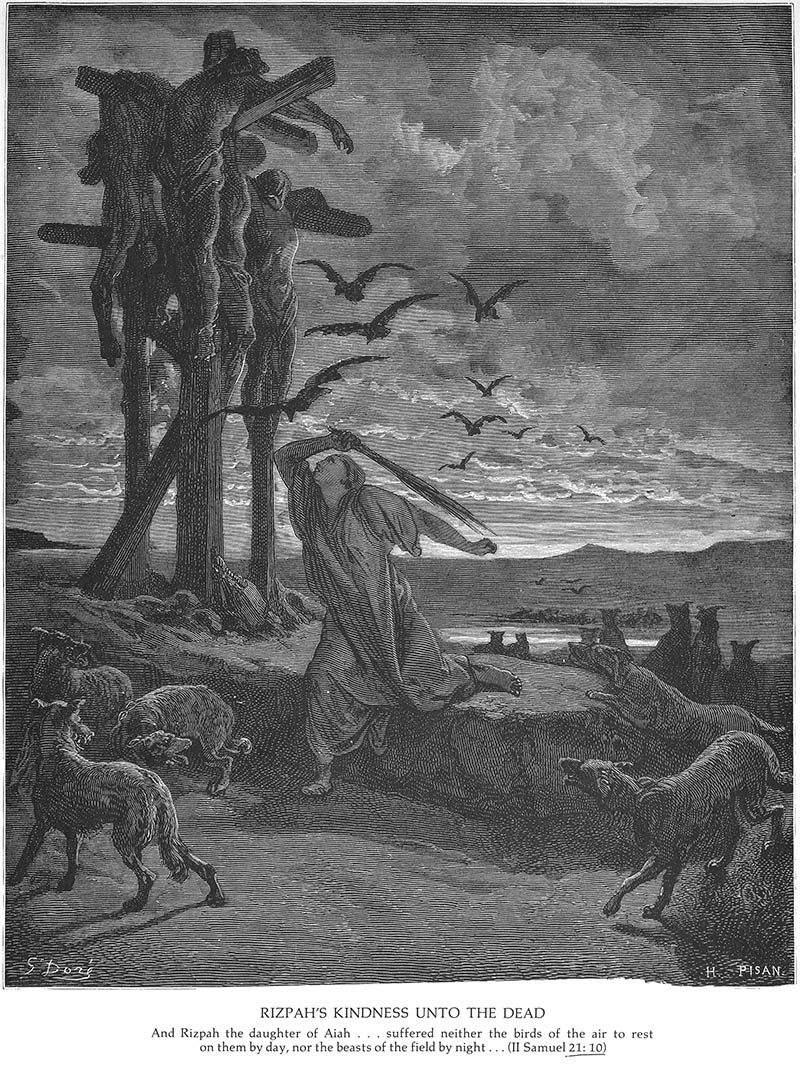
As Susan Niditch writes:
While there is still considerable controversy about the matter, the consensus of scholars over the last decade concludes that child sacrifice was a part of ancient Israelite religion, to large segments of Israelite communities of various periods.
Naturally, this practice would eventually prove to be a major source of shame and embarrassment for them, so later edits and additions to the Bible would attempt to rationalize it and pretend that God never wanted it in the first place. Passages like Deuteronomy 12:29-31 and Deuteronomy 18:9-10 denounce child sacrifice as a barbaric practice of rival religions, and suggest that if any Israelites imitated it, they were only doing so out of misguided ignorance. Ezekiel 20:25-26 bites the bullet and admits that God did in fact order the Israelites to sacrifice their firstborn children, but adds that he was only doing so in order to remind them of his power, not because he enjoyed it:
I gave them also statutes that were not good, and judgments whereby they should not live; And I polluted them in their own gifts, in that they caused to pass through the fire all that openeth the womb, that I might make them desolate, to the end that they might know that I am the LORD.
Still, despite these verses expressing apparent regret for the practice of human sacrifice on a civilizational scale – and it does seem fair to say that the sacrifice of firstborn children, at least, was falling out of favor at the time the Bible was being written – the theme that keeps recurring in the Bible is that certain specific, isolated acts of human sacrifice can and do earn divine favor. And there’s no better example of this than the sacrifice of Jesus himself.
Let’s go back to that idea of sacrificial substitution mentioned a moment ago – the concept of “redeeming” one sacrifice for another. (This is mentioned in verses like Exodus 13:13 and Exodus 34:20 – “The firstling of an ass thou shalt redeem with a lamb: and if thou redeem him not, then shalt thou break his neck”). If the idea rings a bell, there’s a good reason why; the foundational premise of the Christian religion is that people can be redeemed via just such a substitution. The Bible explains it in depth: According to Hebrews 9-10, the Judeo-Christian God is a god of blood. He requires constant killing in order to appease him (in the form of ritual sacrifices), and without these sacrifices, there can be no forgiveness of sins. But the continual sacrifice of bulls and goats can only go so far; it can never completely purge people of their sins on a permanent basis. Therefore, an even greater blood offering is required – a sacrifice to end all sacrifices – and it can’t just be a normal animal sacrifice; it has to be a human sacrifice. What’s more, it can’t just be an ordinary human; only the killing of someone who’s totally pure and innocent can truly appease God. Hence, the execution of Jesus serves as this final sacrifice, and it’s through his death that all of his followers are redeemed. As 1 Peter 1:18-19 puts it, Christians are “bought back” not with “corruptible things, as silver and gold […] but with the precious blood of Christ, as of a lamb without blemish and without spot.” (1 Corinthians 5:7 similarly refers to Jesus as “our Passover Lamb [who] has been sacrificed for us,” and this image of Jesus as a sacrificial lamb is echoed throughout the Bible.) Jesus is the ultimate offering, intended to satisfy God’s thirst for blood and punishment once and for all. In the end, then, Christianity is fundamentally a religion of human sacrifice designed to appease a wrathful God.

Harris gives his thoughts on the subject:
Humanity has had a long fascination with blood sacrifice. In fact, it has been by no means uncommon for a child to be born into this world only to be patiently and lovingly reared by religious maniacs, who believe that the best way to keep the sun on its course or to ensure a rich harvest is to lead him by tender hand into a field or to a mountaintop and bury, butcher, or burn him alive as offering to an invisible God. Countless children have been unlucky enough to be born in so dark an age, when ignorance and fantasy were indistinguishable from knowledge and where the drumbeat of religious fanaticism kept perfect time with every human heart.
In fact, almost no culture has been exempt from this evil: the Sumerians, Phoenicians, Egyptians, Hebrews, Canaanites, Maya, Inca, Aztecs, Olmecs, Greeks, Romans, Carthaginians, Teutons, Celts, Druids, Vikings, Gauls, Hindus, Thais, Chinese, Japanese, Scandinavians, Maoris, Melanesians, Tahitians, Hawaiians, Balinese, Australian aborigines, Iroquois, Huron, Cherokee, and innumerable other societies ritually murdered their fellow human beings because they believed that invisible gods and goddesses, having an appetite for human flesh, could be so propitiated. Many of their victims were of the same opinion, in fact, and went willingly to slaughter, fully convinced that their deaths would transform the weather, or cure the king of his venereal disease, or in some other way spare their fellows the wrath of the Unseen.
In many societies, whenever a new building was constructed, it was thought only prudent to pacify the local deities by burying children alive beneath its foundations (this is how faith sometimes operates in a world without structural engineers). Many societies regularly sacrificed virgins to ward off floods. Others killed their first-born children, and even ate them, as a way of ensuring a mother’s ongoing fertility. In India, living infants were ritually fed to sharks at the mouth of the Ganges for the same purpose. Indians also burned widows alive so that they could follow their husbands into the next world. Leaving nothing to chance, Indians also sowed their fields with the flesh of a certain caste of men, raised especially for this purpose and dismembered while alive, to ensure that every crop of turmeric would be appropriately crimson. The British were actually hard pressed to put an end to these pious atrocities.
In some cultures whenever a nobleman died, other men and women allowed themselves to be buried alive so as to serve as his retainers in the next world. In ancient Rome, children were occasionally slaughtered so that the future could be read in their entrails. Some Fijian prodigy devised a powerful sacrament called “Vakatoga” which required that a victim’s limbs be cut off and eaten while he watched. Among the Iroquois, prisoners taken captive in war were often permitted to live among the tribe for many years, and even to marry, all the while being doomed to be flayed alive as an oblation to the God of War; whatever children they produced while in captivity were disposed of in the same ritual. Certain African tribes have a long history of murdering people to send as couriers in a one-way dialogue with their ancestors or to convert their body parts into magical charms. Ritual murders of this sort continue in many African societies to this day.
It is essential to realize that such obscene misuses of human life have always been explicitly religious. They are the product of what people think they know about invisible gods and goddesses, and of what they manifestly do not know about biology, meteorology, medicine, physics, and a dozen other specific sciences that have more than a little to say about the events in the world that concern them. And it is astride this contemptible history of religious atrocity and scientific ignorance that Christianity now stands as an absurdly unselfconscious apotheosis. The notion that Jesus Christ died for our sins and that his death constitutes a successful propitiation of a “loving” God is a direct and undisguised inheritance of the superstitious bloodletting that has plagued bewildered people throughout history.
Of course, the God of Abraham was no stranger to ritual murder. Occasionally, He condemns the practice (Deuteronomy 12:31; Jeremiah 19:4-5; Ezekiel 16:20-21); at other points, He requires or rewards it (Exodus 22:29-30; Judges 11:29-40; 1 Kings 13:1-2; 2 Kings 3:27; 2 Kings 23:20-25; Numbers 31:40, Deuteronomy 13:13-19). In the case of Abraham, God demands that he sacrifice his son Isaac but then stays his hand at the last moment (Genesis 22:1-18), without ever suggesting that the act of slaughtering one’s own child is immoral. Elsewhere, God confesses to inspiring human sacrifice so as to defile its practitioners (Ezekiel 20:26), while getting into the act Himself by slaying the firstborn of Egypt (Exodus 11:5). The rite of circumcision emerges as a surrogate for child sacrifice (Exodus 4:24-26), and God seems to generally encourage the substitution of animals for people. Indeed, His thirst for the blood of animals, as well as His attentiveness to the niceties of their slaughter and holocaust, is almost impossible to exaggerate.
Upon seeing Jesus for the first time, John the Baptist is rumored to have said, “Behold the Lamb of God, which taketh away the sin of the world” (John 1:29). For most Christians, this bizarre opinion still stands, and it remains the core of their faith. Christianity is more or less synonymous with the proposition that the crucifixion of Jesus represents a final, sufficient offering of blood to a God who absolutely requires it (Hebrews 9:22-28). Christianity amounts to the claim that we must love and be loved by a God who approves of the scapegoating, torture, and murder of one man – his son, incidentally – in compensation for the misbehavior and thought-crimes of all others.
Let the good news go forth: we live in a cosmos, the vastness of which we can scarcely even indicate in our thoughts, on a planet teeming with creatures we have only begun to understand, but the whole project was actually brought to a glorious fulfillment over twenty centuries ago, after one species of primate (our own) climbed down out of the trees, invented agriculture and iron tools, glimpsed (as through a glass, darkly) the possibility of keeping its excrement out of its food, and then singled out one among its number to be viciously flogged and nailed to a cross.
Add to this abject mythology surrounding one man’s death by torture – Christ’s passion – the symbolic cannibalism of the Eucharist. Did I say “symbolic”? Sorry, according to the Vatican it is most assuredly not symbolic. In fact, the judgment of the Council of Trent remains in effect:
I likewise profess that in the Mass a true, proper and propitiatory sacrifice is offered to God on behalf of the living and the dead, and that the body and blood together with the soul and divinity of our Lord Jesus Christ is truly, really, and substantially present in the most holy sacrament of the Eucharist, and that there is a change of the whole substance of the bread into the body, and of the whole substance of the wine into blood; and this change the Catholic Church calls transubstantiation. I also profess that the whole and entire Christ and a true sacrament is received under each separate species.
Of course, Catholics have done some very strenuous and unconvincing theology in this area, in an effort to make sense of how they can really eat the body of Jesus, not mere crackers enrobed in metaphor, and really drink his blood without, in fact, being a cult of crazy cannibals. Suffice it to say, however, that a world view in which “propitiatory sacrifices on behalf of the living and the dead” figure prominently is rather difficult to defend in the year 2007. But this has not stopped otherwise intelligent and well-intentioned people from defending it.
Viewed from this outside perspective, it’s evident that Christianity really is based on some terrifyingly bloody ideas at its root. All the talk of Jesus’s sacrifice and “the blood that was spilled for us” might seem perfectly normal to someone who has grown up in the Church and has heard it so often that they’ve become desensitized and no longer register it on a visceral level – but just imagine how it might sound to someone who’d never heard of Christianity before. I remember a post that was floating around the internet a few years ago (unfortunately I can’t find the original source), which said:
Can someone help me out? I’m trying to remember the name of a particular death cult. The central theme is the glorification of an act of human sacrifice. They celebrate this with ritualistic symbolic cannibalism. Their idol is a torture device, which they usually display a large replica of where they meet, and they believe everybody not in their cult deserves to be set on fire. Any ideas?
And when I saw this post, I had to admit, there wasn’t actually anything in there that was untrue. Technically, Christianity really was a religion that, at its core, was based on a belief in the wonderful redemptive power of bloodshed and death. It glorified the sacrificial killing of innocent people and animals solely for God’s satisfaction, and its culmination was the act of killing the most pure and innocent person of all, solely because God required it. (Of course, the question of whether Jesus’s death counts as a “true” sacrifice is debatable, since he simply came back three days later, good as new, but that’s a whole other conversation.)
Again, though, I found myself feeling like all this brutality just fundamentally didn’t match up with the idea I had in my head of what God was really like. Maybe the idea of blood sacrifice seemed perfectly natural to all those ancient tribes – including those who would become the first Christians – but the God I worshiped wasn’t the kind of bloodthirsty deity that would require violent acts of murder in order to forgive his children; he was a God of peace, whose forgiveness came from his unconditional love. The idea of him wanting some of his beloved creations to gratuitously slaughter others of his beloved creations – not just for the forgiveness of sins, but for any reason – just didn’t seem compatible with the idea of his infinite love and compassion that I’d so deeply internalized.
Not only that, but even if I granted the premise that God’s justice had to be served, and tried to think about it from that perspective, it still didn’t make sense to me that God would accept the killing of a completely innocent person or animal in lieu of wrongdoers themselves actually being responsible for their own actions. How was that serving justice, exactly? As Paine put it:
If I owe a person money, and cannot pay him, and he threatens to put me in prison, another person can take the debt upon himself, and pay it for me. But if I have committed a crime, every circumstance of the case is changed. Moral justice cannot take the innocent for the guilty even if the innocent would offer itself. To suppose justice to do this, is to destroy the principle of its existence, which is the thing itself. It is then no longer justice. It is indiscriminate revenge.
Just to drive home this point, imagine how Christianity’s line of reasoning would work in any other situation. Barker gives one of the best possible illustrations of this:
And NonStampCollector has one that’s equally revealing:
In under two minutes, these clips manage to show just how untenable the central premise of Christianity really is, both in moral terms and, frankly, in terms of basic sanity. How does God killing his own son in order to forgive our sins make sense at any kind of fundamental level?
It gets even more nonsensical once you consider the belief that Jesus himself actually is God the Father, as Christianity claims – that they’re one and the same being. (At least, some parts of the Bible claim this; other parts contradict it.) If you take that belief to its logical conclusion, it means that God essentially sacrificed himself to himself – and that he did it in order to create a loophole in a rule that he created, so as to persuade himself to forgive us for being the way that he made us, and to save us from the cruel punishment that he created for us (and moreover, that all of this only applies if we believe in the arrangement itself). The whole narrative just doesn’t make any sense.
If you only watch two clips from this entire post, watch the two below. The first one is from NonStampCollector:
And the second one is from TheoreticalBullshit:
These two clips summarize the central flaws in the Christian worldview that, for me, finally undercut the structural integrity of the whole framework in such a fundamental way that I finally had to take a step back and question the validity of the whole thing. I’d encountered a lot of challenging ideas throughout my whole process of critically reexamining my beliefs, but it was only when I had to reckon with these most foundational ones that I felt like I was finally starting to reach the critical tipping point. If the core theology of Christianity wasn’t even coherent, then the religion itself didn’t have a leg to stand on. And if it didn’t have a leg to stand on, I would have to admit that whatever the truth about God was, it wasn’t Christianity.
But wait a minute – even if I couldn’t make sense of the theology, that didn’t mean that Christianity was automatically false, right? After all, if Jesus actually did perform miracles and rise from the dead and everything, then that meant Christianity would have to be true, even if I couldn’t personally make sense of the theology of it. If Jesus’s life actually happened as described in the Bible, then there was nothing more to talk about; if the reasoning behind it still seemed questionable to me, well, that was my problem, not Christianity’s.
Unfortunately for Christianity, though, the biblical accounts of what happened in Jesus’s life are such a mess that even trying to establish a seamless narrative of it in the first place is a hopeless task. There are as many mistakes and contradictions in the New Testament as there are in the Old Testament – possibly more so, considering that there are four Gospels (not to mention several additional books from Paul and others) that all try to tell the same story and don’t always agree with each other. And these mistakes and contradictions stretch all the way from Jesus’s birth to his death (and beyond), calling into question everything from his miracles to the most basic details of his biography.
Start with his birth, for instance. Needless to say, this is one of the most important events in all of Christianity, for obvious reasons. But the Bible can’t get the details of it straight – not even where it occurred or in which decade. As Dawkins writes:
A good example of the colouring by religious agendas is the whole heart-warming legend of Jesus’ birth in Bethlehem, followed by Herod’s massacre of the innocents. When the gospels were written, many years after Jesus’ death, nobody knew where he was born. But an Old Testament prophecy (Micah 5:2) had led Jews to expect that the long-awaited Messiah would be born in Bethlehem. In the light of this prophecy, John’s gospel specifically remarks that his followers were surprised that he was not born in Bethlehem: ‘Others said, This is the Christ. But some said, Shall Christ come out of Galilee? Hath not the scripture said, That Christ cometh of the seed of David, and out of the town of Bethlehem, where David was?’
Matthew and Luke handle the problem differently, by deciding that Jesus must have been born in Bethlehem after all. But they get him there by different routes. Matthew has Mary and Joseph in Bethlehem all along, moving to Nazareth only long after the birth of Jesus, on their return from Egypt where they fled from King Herod and the massacre of the innocents. Luke, by contrast, acknowledges that Mary and Joseph lived in Nazareth before Jesus was born. So how to get them to Bethlehem at the crucial moment, in order to fulfil the prophecy? Luke says that, in the time when Cyrenius (Quirinius) was governor of Syria, Caesar Augustus decreed a census for taxation purposes, and everybody had to go ‘to his own city’. Joseph was ‘of the house and lineage of David’ and therefore he had to go to ‘the city of David, which is called Bethlehem’. That must have seemed like a good solution. Except that historically it is complete nonsense, as A. N. Wilson in Jesus and Robin Lane Fox in The Unauthorized Version (among others) have pointed out. David, if he existed, lived nearly a thousand years before Mary and Joseph. Why on earth would the Romans have required Joseph to go to the city where a remote ancestor had lived a millennium earlier? It is as though I were required to specify, say, Ashby-de-la-Zouch as my home town on a census form, if it happened that I could trace my ancestry back to the Seigneur de Dakeyne, who came over with William the Conqueror and settled there.
Moreover, Luke screws up his dating by tactlessly mentioning events that historians are capable of independently checking. There was indeed a census under Governor Quirinius – a local census, not one decreed by Caesar Augustus for the Empire as a whole – but it happened too late: in AD 6, long after Herod’s death. Lane Fox concludes that ‘Luke’s story is historically impossible and internally incoherent’, but he sympathizes with Luke’s plight and his desire to fulfil the prophecy of Micah.
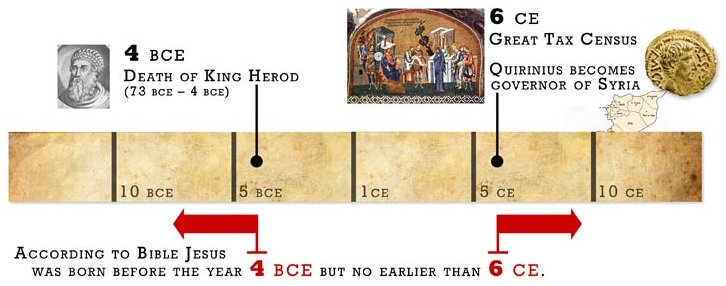
Barker elaborates:
There is very little that can be ascertained from the four Gospels about the historic Jesus. His birthday is unknown. In fact, the year of Jesus’ birth cannot be known. The writer of Matthew says Jesus was born “in the days of Herod the king.” Herod died in 4 B.C.E. Luke reports that Jesus was born “when Cyrenius [Quirinius] was governor of Syria.” Cyrenius became governor of Syria in 6 C.E. That is a discrepancy of at least nine years. (There was no year zero.) Luke says Jesus was born during a Roman census, and it is true that there was a census in 6 C.E. This would have been when Jesus was at least nine years old, according to Matthew. There is no evidence of any earlier census during the reign of Augustus; Palestine was not part of the Roman Empire until 6 C.E. Perhaps Matthew was right, or perhaps Luke was right, but both could not have been right.
[…]
Matthew reports that Herod slaughtered all the first-born in the land in order to execute Jesus. No historian, contemporary or later, mentions this supposed genocide, an event that should have caught someone’s attention. None of the other biblical writers mention it.
The genealogies of Jesus present a particularly embarrassing (to believers) example of why the Gospel writers are not reliable historians. Matthew gives a genealogy of Jesus consisting of 28 names from David down to Joseph. Luke gives a reverse genealogy of Jesus consisting of 43 names from Joseph back to David. They each purport to prove that Jesus is of royal blood, though neither of them explains why Joseph’s genealogy is relevant if he was not Jesus’ father: Jesus was born of the Virgin Mary and the Holy Ghost. (I’d like to see the genome of the Holy Ghost’s DNA.) Matthew’s line goes from David’s son Solomon, while Luke’s goes from David’s son Nathan. The two genealogies could not have been for the same person.
Matthew’s line is like this: David, Solomon, 11 other names, Josiah, Jechoniah, Shealtiel, Zerubbabel, Abiud, six other names, Matthan, Jacob and Joseph. Luke’s line is like this: David, Nathan, 17 other names (none identical to Matthew’s list), Melchi, Neri, Shealtiel, Zerubbabel, Rhesa, 15 other names (none identical to Matthew’s list), Matthat, Heli and Joseph.
Some defenders of Christianity assert that this is not contradictory at all because Matthew’s line is through Joseph and Luke’s line is through Mary, even though a simple glance at the text shows that they both name Joseph. No problem, say the apologists: Luke named Joseph, but he really meant Mary. Since Joseph was the legal parent of Jesus, and since Jewish genealogies are patrilineal, it makes perfect sense to say that Heli (their choice for Mary’s father) had a son named Joseph who had a son named Jesus. Believe it or not, many Christians can make these statements with a straight face. In any event, they will not find a shred of evidence to support such a notion.
There is an insurmountable problem to this argument: the two genealogies intersect. Notice that besides starting with David and ending with Joseph, the lines share two names: Shealtiel and Zerubbabel, both commonly known from the period of the Babylonian captivity. If Matthew and Luke present two distinct parental genealogies, as the apologists assert, there should be no intersection. In a last-ditch defense, some very creative apologists have hypothesized that Shealtiel’s grandmother could have had two husbands and that her sons Jechoniah and Neri represent two distinct paternal lines, but this is painfully speculative.
The two genealogies are widely different in length. One would have to suppose that something in Nathan’s genes caused every one of the men in his line to sire sons when they were 50 percent younger (on average) than the men in Solomon’s line.
Matthew’s line omits four names from the genealogy given in the Old Testament (between Joram and Jotham), and this makes sense when you notice that Matthew is trying to force his list into three neat groups of 14 names each. (Seven is the Hebrew’s most sacred number.) He leaves out exactly the right number of names to make it fit. Some have argued that it was common to skip generations and that this does not make it incorrect. A great-great grandfather is just as much an ancestor as a grandfather. This might be true, except that Matthew explicitly reports that it was exactly 14 generations: “So all the generations from Abraham to David are fourteen generations; and from David until the carrying away into Babylon are fourteen generations; and from the carrying away into Babylon unto Christ are fourteen generations.” (Matthew 1:17) Matthew is caught tinkering with the facts. His reliability as a historian is severely crippled.
Another problem is that Luke’s genealogy of Jesus goes through Nathan, which was not the royal line. Nor could Matthew’s line be royal after Jeconiah because the divine prophecy says of Jeconiah that “no man of his seed shall prosper sitting upon the throne of David, and ruling any more in Judah.” (Jeremiah 22:30) Even if Luke’s line is truly through Mary, Luke reports that Mary was a cousin to Elizabeth, who was of the tribe of Levi, not the royal line.
(Some Christians desperately suggest that the word “cousin” might allowably be translated “countrywoman,” just as believers might call each other “brother” or “sister,” but this is ad hoc.)
Since Jesus was not the son of Joseph, and since Jesus himself appears to deny his Davidic ancestry (Matthew 22:41-46), the whole genealogy is pointless. Instead of rooting Jesus in history, it provides critics with an open window on the myth-making process. The Gospel writers wanted to make of their hero nothing less than what was claimed of saviors of other religions: a king born of a virgin.
ProfMTH mentions a few more problems with the Gospel accounts of Jesus’s birth:
And Tom Flynn raises still more issues – also providing a possible explanation for them:
Most Americans naively assume that Christmas has to do with the birth of a child in a manger in Bethlehem in or around the year 0 – or was it the year 1? Of course, it was neither. Most Christians now believe the Nativity occurred a few years earlier: in 4 BCE or perhaps 7 BCE.
But was there a Nativity at all? Indeed, need we assume that anything the Gospels say about Jesus is historical?
One reason for skepticism is that in so many aspects – not just those revolving around that manger in Bethlehem – the story of Jesus as told (with sundry contradictions) in the four canonical Christian Gospels is so thumpingly familiar – familiar, that is, in the sense that it echoes so many earlier myths and creeds.
[…]
Most savior man-gods were claimed by their followers to have been born of a virgin, venerated by kings in the crib, murdered, and resurrected. Zealous chroniclers claimed virgin births and often resurrections for historical figures as well, including most of the Caesars, Plato, Socrates, Aristotle, and even the mathematician Pythagoras. If Jesus was the Son of God, then we might expect his résumé to make unique claims not anticipated by hack biographers of the rich and famous. If, on the other hand, Jesus was a man just remarkable enough to trigger the myth-making machinery of his time – or if […] he was wholly legendary – then such formulaic and derivative claims are just what we should expect.
Now, let’s turn to the Christian record. What do the Gospel writers say about Jesus? When it comes to his birth, as a group, they say nothing. The Gospels of Mark and John never mention the Nativity. Only Matthew and Luke describe it.
But it’s misleading to say “Matthew and Luke.” One might better say “Matthew vs. Luke,” for the Gospels bearing their names contradict each other on almost every detail. The popular image of shepherds and wise men side by side before the cradle? Matthew says wise men. Luke says shepherds. Neither says both.
The star in the East? Only in Matthew.
“Hark, the herald angels sing” . . . but only in Luke. Matthew never heard of them.
But then, only Matthew heard of Herod’s slaughter of the innocents. […] That’s right, the indiscriminate killing of every male baby in Judea – with one significant exception – did not merit Luke’s attention. On the other hand, no Roman historian chronicles this atrocity either, not even Flavius Josephus. Josephus reviled Herod and took care to lay at his feet every crime for which even a shred of evidence existed. Had Herod really slaughtered those innocents, it is almost unimaginable that Josephus would have failed to chronicle it.
Matthew says Joseph and Mary lived in Bethlehem, moving to Nazareth after their flight into Egypt. But Luke says Joseph and Mary lived in Nazareth all along; Jesus was born in Bethlehem only because Joseph and Mary had traveled there to enroll in the census. Roman records mention no such census; in fact, Roman history records no census ever in which each man was required to return to the city where his ancestral line originated. That’s not how the Romans did things.
Our litany of errors continues. Matthew and Luke both claim to catalogue the male ancestors of Jesus – through Joseph – back to King David. Matthew lists twenty-eight generations between David and Jesus. Luke lists forty-one. Matthew and Luke propose different names for Joseph’s father and grandfather. They propose different names for each ancestor separating Joseph from Zerub’babel, a late Old Testament figure. Incredibly, over the five-hundred-year span preceding the birth of Jesus, Matthew and Luke, whom many Christians consider divinely inspired, cannot agree on the name of a single one of Joseph’s ancestors!
This disparity is less troublesome if one views Christianity in historical rather than metaphysical terms. Scholars tell us the Gospels of Matthew and Luke developed independently in discrete Christian communities. Neither evangelist could know that the other had guessed differently about story details or had made different choices about which pagan traditions to borrow. But why should either evangelist include a genealogy through Joseph if Jesus were born of a virgin – in which case Joseph would not be his father?
Conversely, why should either evangelist borrow various stories (if not the same stories) about the virgin birth, veneration by kings, miracles at age twelve, and the like from sundry Hellenistic mystery cults if the idea was to show Jesus as the Jewish Messiah?
The Gospels of Matthew and Luke preserve, as if in amber, contradictions that embroiled the early Church. The earliest Christians aimed to convert Jews alone; only after the world embarrassingly failed to end as prophesied were Gentiles also targeted for conversion. Hellenistic Gentiles cared nothing whether Jesus was the Hebrew Messiah. If this new religion were to appeal to them, Christianity would need to display some of the elements familiar to them from Hellenistic mystery religions: a hero demigod, born of a virgin, worshiped in the crib, quick to work miracles, fated to die and rise again.
The logics of Davidic descent and virgin birth are mutually exclusive. Forced into the same narrative, they collide like a southbound freight train and an eastbound propane truck. Yet each had its zealous proponents. Unable to jettison either the Jewish Messiah tradition or the Hellenistic virgin-birth tradition, Christianity just held its breath and plunged forward carrying them both. Amazingly, the new religion got away with it.
The more we step back and look at these all these mistakes and contradictions from an outside perspective, the harder it becomes to consider the Gospel accounts of Jesus’s birth credible. But the problems don’t stop there; contradictions about Jesus’s life continue to pile up as the Gospels follow him into adulthood. The first major event of Jesus’s ministry, for example, is his baptism by John the Baptist, a prominent prophet in his own right at the time (and one who would also end up being arrested and executed like Jesus was). According to Matthew 3:11-17, Mark 1:7-11, Luke 3:16-22, and John 1:26-36, John instantly recognizes that Jesus is the messiah, and as soon as he baptizes him, the heavens open up and God declares Jesus to be his son. Later on, though, while John is in prison, Matthew 11:2-3 and Luke 7:18-22 describe him hearing about Jesus’s works – seemingly for the first time – and sending two of his disciples to find out if Jesus might actually be the messiah. Had John somehow forgotten about before? Or were those earlier details just embellishments by the Gospel writers, and/or additions by later editors?
There are more contradictions right after Jesus’s baptism. According to Mark 1:12-13, the first thing Jesus does after being baptized is to immediately go into the wilderness for 40 days, where he’s tempted by the devil. But according to John 1-2, Jesus doesn’t go into the wilderness at all; he spends the first two days after his baptism recruiting his first disciples, and then goes with them on the third day to a wedding in Cana (traveling with them to Capernaum and Jerusalem after that).
In the Gospels that do describe Jesus going into the wilderness, there’s still more disagreement about what actually happens there. Matthew 4:5-8, for instance, says that the devil first takes Jesus up to the parapet of the temple, then takes him to a high place to view all the kingdoms of the world (remember, the ancient Hebrew cosmology held that the earth was flat, so being able to see the whole world all at once would have sounded plausible to the biblical authors). But according to Luke 4:5-9, the devil takes him to the high place to view all the kingdoms first, and then takes him to the parapet of the temple.
Likewise, once Jesus returns to civilization and starts recruiting his first disciples, the order and context in which he meets them is entirely unclear. According to John 1:35-51, Jesus’s first two disciples – Andrew and another unnamed man – start off as disciples of John the Baptist; but the day after Jesus’s baptism, John tells them that he is the son of God, so they approach Jesus, strike up a conversation with him, and subsequently switch their allegiances to him. After that, Andrew recruits his brother Simon Peter; then Jesus goes into Galilee and recruits Philip, and Philip recruits Nathanael. That’s how Jesus meets his first disciples according to John’s Gospel – Andrew, then Peter, then Philip, then Nathanael. But according to Matthew 4:18-22 and Mark 1:16-20, that’s not how it happens at all. In Matthew and Mark’s version, Jesus is walking by the Sea of Galilee (after returning from his 40 days in the wilderness) and he notices Peter and Andrew fishing; he calls out to them, inviting them to become “fishers of men,” and they drop what they’re doing and become his disciples. He then goes a little farther, sees James and his brother John in a ship mending their nets, and calls them to follow him as well, which they do. So in Matthew and Mark’s version, it’s Peter and Andrew, then James and John. Luke 5:1-11 tells a different version of this story still, in which Jesus comes aboard Peter’s ship after its crew has fished all day and caught nothing. They head out onto the water, and Jesus preaches for a while before finally telling Peter to let down his nets one more time. The nets come back up miraculously full of fish, and Peter (along with his fishing partners James and John) are so impressed that they all become followers of Jesus. Andrew isn’t mentioned at all in Luke’s version of the story – it’s just Peter, James, and John, all recruited at once. And on top of all this, the Gospels can’t even agree about when these events supposedly take place; according to Matthew 4:12-19 and Mark 1:14-17, they happen after John the Baptist is arrested and thrown into prison – but according to John 1:40-42 and 3:22-24, they happen while John the Baptist is still free.
At any rate, once James and John become Jesus’s disciples, they become so devoted to him that they ask to be seated at his left and right hand in Heaven. At least, according to Mark 10:35-37, they do. But according to Matthew 20:20-21, it’s their mother who asks for them. At another point, the Gospel of John describes Jesus traveling around with his disciples baptizing people (John 3:22) – only to turn around in the very next chapter and say that Jesus never baptized anyone at all, but that only his disciples did (John 4:2). Even when describing the momentous event of Jesus’s first sermon – his famous Sermon on the Mount – the Gospels can’t agree on whether it actually takes place on a mountaintop at all, as Matthew 5:1-3 claims; according to Luke 6:17-20, Jesus goes down into a flat plain to deliver it. And the Bible even contradicts itself on topics as important as who Jesus’s twelve disciples actually were; according to Matthew 10:2-4 and Mark 3:14-19, there’s a disciple named Thaddaeus, but in Luke 6:14-16 and Acts 1:13, his slot is filled by Judas, the brother of James (not to be confused with the other Judas, Judas Iscariot).
The Gospel accounts of Jesus’s miracles are equally riddled with holes. There’s story in which a Roman centurion asks Jesus to heal his sick slave, for instance; according to Matthew 8:5-8, he asks Jesus himself, but according to Luke 7:1-7, he sends others to ask for him. (Jesus gladly heals the slave, of course, but he doesn’t take issue with the fact that the centurion owns slaves in the first place.) After this miracle, Jesus goes to Peter’s house to heal Peter’s mother-in-law of a fever (Matthew 8:14-15), and then according to Mark 1:29-42, he leaves Peter’s house and cures a man of leprosy. But according to Matthew 8:2-15, the order of these events is switched around – Jesus cures the man’s leprosy before he ever meets the centurion or heals Peter’s mother-in-law. Similarly, there’s a story in which a man named Jairus asks Jesus to heal his daughter; in Mark and Luke’s version of the story, she’s on the verge of death when her father approaches Jesus (Mark 5:22-23; Luke 8:41-42) – but in Matthew’s version, she has already died (Matthew 9:18). (Jesus revives her in both versions.) Another story describes Jesus performing an exorcism on a man possessed with demonic spirits, which Jesus transfers into a nearby herd of pigs, who promptly run off a cliff to their deaths (Mark 5:2; Luke 8:27). But according to Matthew 8:28, there are actually two possessed men whose demons get transferred into the pigs. Likewise, when Jesus and his disciples go to Jericho, Luke 18:35 describes Jesus curing a man’s blindness before entering the city – but according to Mark 10:46, he encounters the blind man after leaving the city, and according to Matthew 20:30, there are actually two blind men, and Jesus cures them after leaving the city.
Even the miracle of Jesus’s transfiguration – in which his disciples witness him miraculously transforming into a state of radiant glory – is unclear in its details. According to Matthew 16:28–17:2 and Mark 9:1-2, it happens six days after Jesus foretells his death; but according to Luke 9:27-28, it happens eight days afterward. (To be fair, it does say it was about eight days afterward, not necessarily exactly eight days, so you might be willing to let that one slide if you consider the Bible to have been written by flawed men – but such sloppy reckoning is harder to explain if you consider it to be the perfect word of God himself.)
Either way though, this event of Jesus foretelling his own death gives us a nice segue into another major issue with the New Testament: the fact that it doesn’t just contradict itself when discussing mundane logistical details, but also when discussing serious theological ones. Here’s a hugely significant question, for instance: Did Jesus actually know all things? John 16:30 and 21:17 say that he did – and if you consider Jesus to be the same being as God the Father, you might agree – but verses like Mark 6:6, Luke 8:45-46 and Matthew 8:10 show Jesus expressing surprise at unexpected events; and in Mark 13:32, Jesus flat-out says that he doesn’t know the exact date when the apocalypse will happen (“But about that day or hour no one knows, not even the angels in heaven, nor the Son, but only the Father”). So then was Jesus actually the same being as God the Father after all? Verses like John 8:58 and 10:30 say he was; but verses like John 12:48, John 14:28, Matthew 19:17, and Mark 10:18 say he wasn’t. (Those latter two verses are particularly interesting because Jesus denies even being a good person, much less a sinless one.) Was Jesus all-powerful? Matthew 28:18 says he was; but Matthew 20:23 and Mark 6:1-6 say that Jesus was incapable of doing certain things. (Mark 6:1-6 actually says that he was unable to perform miracles for the people of his hometown because they didn’t believe in him strongly enough – which is an embarrassingly revealing thing to say, considering that so many phony mystics and mind-readers use the same excuse when their own miracles fail.) And what about the question of whether Jesus came into the world to judge people? Here we don’t even have to look outside the Gospel of John to find repeatedly conflicting answers. In John 5:22-27, Jesus says, “The Father judgeth no man, but hath committed all judgment unto the Son. […] The Father […] hath given him authority to execute judgment.” But then in John 8:15, he turns around and says, “I judge no man.” In John 9:39, Jesus reverses himself again, saying, “For judgment I am come into this world.” Then in John 12:47-49, he contradicts himself one more time, saying, “If any man hear my words, and believe not, I judge him not: for I came not to judge the world, but to save the world. He that rejecteth me, and receiveth not my words, hath one that judgeth him: the word that I have spoken, the same shall judge him in the last day. For I have not spoken of myself; but the Father which sent me.” Didn’t he say earlier that it was the other way around? Was Jesus just lying one of those times? Actually, the Bible even manages to contradict itself on whether we should believe Jesus’s words about himself; in John 8:14, Jesus says, “Though I bear record of myself, yet my record is true” – but in John 5:31, he says, “If I bear witness of myself, my witness is not true.”
At any rate, regardless of whether Jesus considered it his responsibility to pass judgment, there are multiple occasions where we can see him doing so for ourselves. There’s a story in which Jesus is hungry and comes across a fig tree, for instance – but because figs are out of season, there are none on the tree; so in response, Jesus curses the tree to never bear fruit again (not exactly the fig tree’s fault, but whatever; maybe Jesus just wasn’t in a forgiving mood that day). According to Matthew 21:19-20, it withers away the instant he curses it; but in Mark 11:19-20, he and his disciples continue on their way, and it’s only when they pass by the same spot a day later that they notice the tree has withered away. Around the same time, those Gospels also describe Jesus throwing his famous “temple tantrum,” in which he takes a whip and assaults the merchants and moneychangers in the temple, flips over their tables, spills their money everywhere, and drives them out into the streets. But again, the timing of this event differs depending on which Gospel you read. According to Mark 11:12-17, it happens after Jesus curses the fig tree – but according to Matthew 21:12-20, it happens before. And according to John 2:11-16, it actually happens years before, at the very beginning of Jesus’s ministry. How can such a dramatic disparity be squared? Some Biblical apologists have tried to rationalize it by lamely saying that Jesus must have simply thrown multiple temple tantrums.
Either way though, we know how the story ultimately plays out: Jesus’s rabble-rousing upsets the authorities so much that they have him arrested and condemned to death. Before he’s arrested, he shares one last meal with his disciples, during which Peter asks him, “Lord, whither goest thou?” (John 13:36), and Thomas adds, “Lord, we know not whither thou goest; and how can we know the way?” (John 14:5). But a few moments later, Jesus becomes indignant and wonders why no one has asked him the question that they literally just asked him: “Now I go my way to him that sent me; and none of you asketh me, Whither goest thou?” (John 16:5).
Shortly after this exchange, Jesus goes off to a private area and, according to Matthew 26:36-42, Mark 14:35-36, and Luke 22:41-42, starts pleading with God to save him from crucifixion. (Again, this seems like a strange thing to do if Jesus actually is God – is he just praying to himself?) But John 12:27 depicts a braver Jesus who openly mocks the idea of doing this: “Now my soul is troubled, and what shall I say? ‘Father, save me from this hour’? No, it was for this very reason I came to this hour.”
Finally, Judas turns Jesus over to the authorities – and according to Matthew 26:47-49, Mark 14:43-45, and Luke 22:47-48, he identifies Jesus for them by kissing him; but according to John 18:3-5, Jesus walks out to meet them and openly identifies himself, while Judas simply looks on. The authorities then take Jesus straight to the high priest Caiaphas, according to Matthew 26:57, Mark 14:53, and Luke 22:54 – but according to John 18:13, they actually go first to Annas, the father-in-law of Caiaphas. The elders and chief priests accuse Jesus of saying “Destroy this temple, and in three days I will raise it up” – a seemingly blasphemous statement which, according to Mark 14:57-58 and Matthew 26:59-61, is nothing but a phony charge fabricated by false witnesses, but which John 2:19-21 claims that Jesus actually did say. Then they send him to Pontius Pilate for more questioning – and according to Matthew 27:12-14 and Mark 15:3-5, Jesus remains completely silent throughout the entire interrogation; but according to John 18:33-37, he and Pilate have an entire conversation together. (Jesus’s silence in Matthew and Mark may have been an attempt by the authors to bring his story into line with Isaiah 53:7: “He was oppressed and He was afflicted, yet He opened not His mouth; He was led as a lamb to the slaughter, and as a sheep before its shearers is silent, so He opened not His mouth.”)
While all this is happening, bystanders keep approaching Peter and asking him if he knows Jesus – but three times in a row, Peter denies knowing him. Jesus had predicted earlier that this would happen; in Matthew 26:34, Luke 22:34, and John 13:38, he tells Peter, “The cock shall not crow this day, before that thou shalt thrice deny that thou knowest me.” And according to Matthew 26:70-74, Luke 22:57-60, and John 18:17-27, that’s what does happen; Peter denies Jesus three times, and then the cock crows. But according to Mark 14:30, Jesus actually predicts that Peter will deny him three times before the cock crows twice – and in Mark 14:67-72, the cock does in fact crow once after Peter’s first denial and then a second time after his third denial.
The Gospels also differ on who exactly is questioning Peter when he makes these three denials. Matthew 26:69-73 says a servant girl is the first to ask him, then another servant girl, then a group of people. Mark 14:66-71 says it’s a servant girl, then the same girl again, and then a group of people. Luke 22:54-60 says it’s a servant girl, then a man, then another man. And John 18:15-27 says it’s a servant girl, then a group of people, then a male servant.
Meanwhile, the other disloyal disciple, Judas, is overcome with remorse for what he’s done. According to Matthew 27:3-8, he goes to the chief priests and returns the thirty pieces of silver they’d given him to betray Jesus; then he leaves and hangs himself. The priests later use the silver to buy “the potter’s field, to bury strangers in,” and that field earns the nickname “the field of blood.” According to Acts 1:16-19, though, it’s actually Judas himself who buys the field – and he goes there to die, not by hanging, but by falling over and spilling out his guts.
Likewise, when the time finally comes for Jesus himself to die, the Gospels once again contradict each other on the details. According to Mark 14:12, Mark 15:25, Matthew 26:17-20, and Luke 22:7-14, his crucifixion happens the day after the Passover meal, during the third hour of the day (i.e. nine in the morning). But according to John 18:28, 19:14-16, and 19:31, it happens the day before the Passover meal, and it happens after the sixth hour of the day (i.e. after noon). Jesus is dragged before the people, mocked, and forced to wear a beautiful robe; according to Matthew 27:28, it’s a scarlet robe, but according to Mark 15:17 and John 19:2, it’s a purple one – and according to Luke 23:11, it’s Herod’s soldiers who make Jesus wear it, while according to Matthew 27:27-28, Mark 15:15-17, and John 19:1-2, it’s Pilate’s soldiers.
They then march Jesus off to be crucified – and according to John 19:17, Jesus carries his cross all the way to the execution site; but according to Matthew 27:32, Mark 15:21, and Luke 23:26, the soldiers compel a bystander named Simon of Cyrene to carry the cross for him. Once they arrive and crucify Jesus, they crucify him alongside two thieves – and according to Matthew 27:44 and Mark 15:32, both of the thieves insult and ridicule him. But according to Luke 23:39-43, only one of the thieves mocks him; the other one sides with Jesus, and Jesus tells him, “Verily I say unto thee, today shalt thou be with me in paradise.” (This is despite John 20:17 saying that Jesus wouldn’t actually ascend to Heaven until after his resurrection three days later.)
Jesus’s last words on the cross, according to Matthew 27:46 and Mark 15:34, are “My God, my God, why hast thou forsaken me?” But according to Luke 23:46, his last words are “Father, into thy hands I commend my spirit” – and according to John 19:30, he simply says “It is finished.” (You might be noticing a trend here; the earlier Gospels tend to portray a more anxious and uncertain version of Jesus – pleading to be spared beforehand, remaining silent during his interrogation, crying out in desperation on the cross, etc. – while the later Gospels portray him in a much more self-assured light – always confident that everything that happens to him is part of the divine plan. Ehrman has a good summary of the different portrayals in the clip below, from 12:35-17:38 (and the rest of his speech is also worth watching if you get a chance).)
The contradictions keep going after Jesus’s crucifixion. Just before Jesus’s death, according to Luke 23:45-46, the temple curtain spontaneously tears in two; but according to Matthew 27:50-51 and Mark 15:37-38, it actually happens after his death. (Matthew 27:51-53 also mentions a great earthquake and dead people rising from their graves to walk the streets, but none of the other Gospels include those details.) Once Jesus is buried and comes back to life again, the contradictions ramp up to another level still. As Barker writes:
The resurrection of Jesus is one of the few stories that is told repeatedly in the bible – more than five times – so it provides an excellent test for the orthodox claim of scriptural inerrancy and reliability. When we compare the accounts, we see they don’t agree. An easy way to prove this is to issue this challenge to Christians: Tell me what happened on Easter. I am not asking for proof at this stage. Before we can investigate the truth of what happened, we have to know what is being claimed to have happened. My straightforward request is merely that Christians tell me exactly what happened on the day that their most important doctrine was born. Believers should eagerly take up this challenge, since without the resurrection there is no Christianity. Paul wrote, “If Christ be not risen… we are found false witnesses of God; because we have testified of God that he raised up Christ: whom he raised not up, if so be that the dead rise not.” (I Corinthians 15:14-15)
The conditions of the challenge are simple and reasonable. In each of the four Gospels, begin at Easter morning and read to the end of the book: Matthew 28, Mark 16, Luke 24, and John 20-21. Also read Acts 1:3-12 and Paul’s tiny version of the story in I Corinthians 15:3-8. These 165 verses can be read in a few moments. Then, without omitting a single detail from these separate accounts, write a simple, chronological narrative of the events between the resurrection and the ascension: what happened first, second and so on; who said what and when; and where these things happened.
The narrative does not have to pretend to present a perfect picture – it only needs to give at least one plausible account of all of the facts. The important condition to the challenge, however, is that not one single biblical detail be omitted. Of course, the words have to be accurately translated and the ordering of events has to follow the biblical ordering. Fair enough?
Many bible stories are given only once or twice, and are therefore hard to confirm. The author of Matthew, for example, was the only one to mention that at the crucifixion dead people emerged from the graves of Jerusalem to walk around show themselves to everyone – an amazing event that could hardly escape the notice of the other Gospel writers, or any other historians of the period. But though the silence of others might weaken the likelihood of a story – because if they did repeat it, believers would certainly tout the existence of such confirmation – it does not disprove it. Disconfirmation comes with contradictions.
Thomas Paine tackled this matter 200 years ago in The Age of Reason, stumbling across dozens of New Testament discrepancies: “I lay it down as a position which cannot be controverted,” he wrote, “first, that the agreement of all the parts of a story does not prove that story to be true, because the parts may agree and the whole may be false; secondly, that the disagreement of the parts of a story proves the whole cannot be true.”
I tried to solve the discrepancies myself, and failed. One of the first problems I found is in Matthew 28:2, after two women arrived at the tomb: “And, behold, there was a great earthquake: for the angel of the Lord descended from heaven, and came and rolled back the stone from the door, and sat upon it.” (Let’s ignore the fact that no other writer mentioned this “great earthquake.”) This story says that the stone was rolled away after the women arrived, in their presence. Yet Mark’s Gospel says it happened before the women arrived: “And they said among themselves, Who shall roll away the stone from the door of the sepulchre? And when they looked, they saw that the stone was rolled away: for it was very great.” Luke writes: “And they found the stone rolled away from the sepulchre.” John agrees. No earthquake, no rolling stone. It is a three-to-one vote: Matthew loses. (Or else the other three are wrong.) The event cannot have happened both before and after they arrived. Some bible defenders assert that Matthew 28:2 was intended to be understood in the past perfect, showing what had happened before the women arrived. But the entire passage is in the aorist (past) tense, and it reads, in context, like a simple chronological account. Matthew 28:2 begins, “And, behold,” not “For, behold.” If this verse can be so easily shuffled around, then what is to keep us from putting the flood before the ark, or the crucifixion before the nativity?
Another glaring problem is the fact that in Matthew the first post-resurrection appearance of Jesus to the disciples happened on a mountain in Galilee (not in Jerusalem, as most Christians believe), as predicted by the angel sitting on the newly moved rock: “And go quickly, and tell his disciples that he is risen from the dead; and, behold, he goeth before you into Galilee; there shall ye see him.” This must have been of supreme importance, since this was the message of God via the angel(s) at the tomb. Jesus had even predicted this himself 60 hours earlier, during the Last Supper (Matthew 26:32). After receiving this angelic message, “Then the eleven disciples went away into Galilee, into a mountain where Jesus had appointed them. And when they saw him, they worshipped him: but some doubted.” (Matthew 28:16-17) Reading this at face value, and in context, it is clear that Matthew intends this to have been the first appearance. Otherwise, if Jesus had been seen before this time, why did some doubt? Mark agrees with Matthew’s account of the angel’s Galilee message, but gives a different story about the first appearance. Luke and John give different angel messages and then radically contradict Matthew. Luke shows the first appearance on the road to Emmaus and then in a room in Jerusalem. John says it happened later that evening in a room, minus Thomas. These angel messages, locations and travels during the day are impossible to reconcile.
Believers sometimes use the analogy of the five blind men examining an elephant, all coming away with a different definition: tree trunk (leg), rope (tail), hose (trunk), wall (side), and fabric (ear). People who use this argument forget that each of the blind men was wrong: an elephant is not a rope or a tree. You can put the five parts together to arrive at a noncontradictory aggregate of the entire animal. This hasn’t been done with the resurrection.
Apologists sometimes compare the resurrection variations to differing accounts given by witnesses of an auto accident. If one witness says the vehicle was green and the other says it was blue, that could be accounted for by different angles, lighting, perception, or definitions of words. The important thing, they claim, is that they do agree on the basic story – there was an accident (there was a resurrection). I am not a fundamentalist inerrantist. I’m not demanding that the evangelists must have been expert, infallible witnesses. (None of them claims to have witnessed the actual resurrection.) But what if one person said the auto accident happened in Chicago and the other said it happened in Milwaukee? At least one of these witnesses has serious problems with the truth.
Luke says the post-resurrection appearance happened in Jerusalem, but Matthew says it happened in Galilee, sixty to 100 miles away! Could they all have traveled 150 miles that day, by foot, trudging up to Galilee for the first appearance, then back to Jerusalem for the evening meal? There is no mention of any horses, but 12 well-conditioned thoroughbreds racing at breakneck speed as the crow flies would need about five hours for the trip, without a rest. And during this madcap scenario, could Jesus have found time for a leisurely stroll to Emmaus, accepting “toward evening” an invitation to dinner? Something is very wrong here.
This is just the tip of the iceberg. Of course, none of these contradictions prove that the resurrection did not happen, but they do throw considerable doubt on the reliability of the supposed reporters. Some of them were wrong. Maybe they were all wrong.
I say to Christians: Either tell me exactly what happened on Easter Sunday or let’s leave the Jesus myth buried next to Eastre [Ēostre], the pagan Goddess of Spring after whom your holiday was named.
CONSISTENTLY INCONSISTENT
(KJV=King James Version; NRSV=New Revised Standard Version; NIV=New International Version)What time did the women visit the tomb?
- Matthew: “as it began to dawn” (28:1)
- Mark: “very early in the morning . . . at the rising of the sun” (16:2, KJV); “when the sun had risen” (NRSV); “just after sunrise” (NIV)
- Luke: “very early in the morning” (24:1, KJV) “at early dawn” (NRSV)
- John: “when it was yet dark” (20:1)
Who were the women?
- Matthew: Mary Magdalene and the other Mary (28:1)
- Mark: Mary Magdalene, the mother of James, and Salome (16:1)
- Luke: Mary Magdalene, Joanna, Mary the mother of James, and other women (24:10)
- John: Mary Magdalene (20:1)
What was their purpose?
- Matthew: to see the tomb (28:1)
- Mark: had already seen the tomb (15:47), brought spices (16:1)
- Luke: had already seen the tomb (23:55), brought spices (24:1)
- John: the body had already been spiced before they arrived (19:39, 40)
Was the tomb open when they arrived?
Who was at the tomb when they arrived?
- Matthew: One angel (28:2-7)
- Mark: One young man (16:5)
- Luke: Two men (24:4)
- John: Two angels (20:12)
Where were these messengers situated?
- Matthew: Angel sitting on the stone (28:2)
- Mark: Young man sitting inside, on the right (16:5)
- Luke: Two men standing inside (24:4)
- John: Two angels sitting on each end of the bed (20:12)
What did the messenger(s) say?
- Matthew: “Fear not ye: for I know that ye seek Jesus, which was crucified. He is not here for he is risen, as he said. Come, see the place where the Lord lay. And go quickly, and tell his disciples that he is risen from the dead: and, behold, he goeth before you into Galilee; there shall ye see him: lo, I have told you.” (28:5-7)
- Mark: “Be not afrighted: Ye seek Jesus of Nazareth, which was crucified: he is risen; he is not here: behold the place where they laid him. But go your way, tell his disciples and Peter that he goeth before you into Galilee: there shall ye see him, as he said unto you.” (16:6-7)
- Luke: “Why seek ye the living among the dead? He is not here, but is risen: remember how he spake unto you when he was yet in Galilee, Saying, The Son of man must be delivered into the hands of sinful men, and be crucified, and the third day rise again.” (24:5-7)
- John: “Woman, why weepest thou?” (20:13)
Did the women tell what happened?
- Matthew: Yes (28:8)
- Mark: No. “Neither said they any thing to any man.” (16:8)
- Luke: Yes. “And they returned from the tomb and told all these things to the eleven, and to all the rest.” (24:9, 22-24)
- John: Yes (20:18)
When Mary returned from the tomb, did she know Jesus had been resurrected?
When did Mary first see Jesus?
- Matthew: Before she returned to the disciples (28:9)
- Mark: Before she returned to the disciples (16:9,10)
- John: After she returned to the disciples (20:2, 14)
Could Jesus be touched after the resurrection?
After the women, to whom did Jesus first appear?
- Matthew: Eleven disciples (28:16)
- Mark: Two disciples in the country, later to 11 (16:12, 14)
- Luke: Two disciples in Emmaus, later to 11 (24:13, 36)
- John: Ten disciples (Judas and Thomas were absent) (20:19, 24)
- Paul: First to Cephas (Peter), then to the 12. (Twelve? Judas was dead). (I Corinthians 15:5)
Where did Jesus first appear to the disciples?
- Matthew: On a mountain in Galilee (60-100 miles away) (28:16-17)
- Mark: To two in the country, to 11 “as they sat at meat” (16:12, 14)
- Luke: In Emmaus (about seven miles away) at evening, to the rest in a room in Jerusalem later that night. (24:31, 36)
- John: In a room, at evening (20:19)
Did the disciples believe the two men?
What happened at the appearance?
- Matthew: Disciples worshipped, some doubted, “Go preach.” (28:17-20)
- Mark: Jesus reprimanded them, said “Go preach” (16:14-19)
- Luke: Christ incognito, vanishing act, materialized out of thin air, reprimand, supper (24:13-51)
- John: Passed through solid door, disciples happy, Jesus blesses them, no reprimand (21:19-23)
Did Jesus stay on earth for a while?
- Mark: No (16:19) Compare 16:14 with John 20:19 to show that this was all done on Sunday
- Luke: No (24:50-52) It all happened on Sunday
- John: Yes, at least eight days (20:26, 21:1-22)
- Acts: Yes, at least forty days (1:3)
Where did the ascension take place?
- Matthew: No ascension. Book ends on mountain in Galilee
- Mark: In or near Jerusalem, after supper (16:19)
- Luke: In Bethany, very close to Jerusalem, after supper (24:50-51)
- John: No ascension
- Paul: No ascension
- Acts: Ascended from Mount of Olives (1:9-12)
It is not just atheist critics who notice these problems. Christian scholars agree that the stories are discrepant. Culver H. Nelson: “In any such reading, it should become glaringly obvious that these materials often contradict one another egregiously. No matter how eagerly one may wish to do so, there is simply no way the various accounts of Jesus’ postmortem activities can be harmonized.”
A. E. Harvey: “All the Gospels, after having run closely together in their accounts of the trial and execution, diverge markedly when they come to the circumstance of the Resurrection. It’s impossible to fit their accounts together into a single coherent scheme.”
Thomas Sheehan agrees: “Despite our best efforts, the Gospel accounts of Jesus’ post-mortem activities, in fact, cannot be harmonized into a consistent Easter chronology.”
The religiously independent (though primarily Christian) scholars in the Westar Institute, which includes more than 70 bible scholars with Ph.D or equivalent, conclude: “The five gospels that report appearances (Matthew, Luke, John, Peter, Gospel of the Hebrews) go their separate ways when they are not rewriting Mark; their reports cannot be reconciled to each other. Hard historical evidence is sparse.”
I have challenged believers to provide a simple non-contradictory chronological narrative of the events between Easter Sunday and the ascension, without omitting a single biblical detail. Some have tried but, without misinterpreting words or drastically rearranging passages, no one has given a coherent account. Some have offered “harmonies” (apparently not wondering why the work of a perfect deity should have to be harmonized), but none have met the reasonable request to simply tell the story.
It’s actually even worse than that, because there are even more resurrection contradictions than the ones Barker lists. For instance, Matthew (20:18-19, 26:31-32), Mark (8:31, 10:33-34, 14:28), and Luke (18:31-33) all describe Jesus telling his followers that he would rise from the dead after three days – but according to John 20:9, they have no idea what’s coming; his resurrection catches them completely by surprise. When Mary Magdalene first encounters the risen Jesus, according to Matthew 28:9, she and her companions meet him after they’ve left the tomb and are going back to see the disciples; he greets them with two words – “All hail” – and they instantly fall down and start worshiping him, holding onto his feet in adoration. But according to John 20:14-17, Mary is still weeping at the tomb alone (she doesn’t have any companions in John) when Jesus appears to her and he asks her why she’s weeping; but she doesn’t recognize him at all. She assumes he must be the gardener, and she asks if he knows what’s happened to Jesus’s body. It’s only when Jesus calls her by name that she realizes it’s him – but even then, she doesn’t start worshiping at his feet; Jesus tells her that she can’t touch him at all (“for I am not yet ascended to my Father”). He simply tells her to go back to the disciples and tell them of his resurrection. Luke 24:23 tells a different story still; in Luke’s account, Jesus doesn’t appear to Mary or any of the other women at all – they just have a vision of angels telling them that he’s been resurrected, and they pass that message along to the disciples.
Similarly, in 1 Corinthians 9:1 and 15:8, Paul claims to have seen the risen Jesus firsthand. But when Acts 9:3-9 describes Paul’s encounter with Jesus, it says that he never actually sees him visually – just that he’s blinded by a bright light and hears Jesus’s voice. Acts 9:7 also says that Paul’s companions don’t see anyone either – they just hear a voice – and it adds that they remain standing when they hear it. But a few chapters later, in Acts 26:14 (recounting the same story), it claims that they fall to the ground alongside Paul when they hear the voice.
Finally, in what might be the most audacious assertion of all, 1 Corinthians 15:6 claims that the resurrected Jesus appears to more than 500 believers before finally ascending into Heaven. But according to Mark 16:9-19, Luke 24, and Acts 10:40-43, Jesus only appears to a dozen or so people before he ascends into Heaven – his 11 disciples, plus two or three other believers, depending on which book you read.
To make a long story short, then, there are a lot of problems here, to say the least. ProfMTH does a good job summing up these last few contradictions in his pair of clips below (second one starts at 6:15):
Now, granted, some of the things we’ve been discussing here might seem like relatively minor details. (Is it really that important whether Jesus’s robe was red or purple? Maybe it was a kind of burgundy/maroon color; who cares?) But just because some of these inconsistencies are easier to dismiss than others doesn’t mean that all of them can be dismissed; on the contrary, when you look at the totality of the accumulated contradictions – not just one at a time, but all at once – the sheer volume of the incongruity becomes impossible to ignore. The fact that the New Testament can’t even present a cohesive account of its single most important event – the resurrection – isn’t just embarrassing; it’s downright disqualifying. I mean, imagine how this kind of thing would look in any other context. Imagine a murder trial, for instance (to take a more extreme version of Barker’s car accident analogy), in which one of the witnesses claimed that the murder was committed in broad daylight, in the middle of downtown Baltimore, in front of a crowd of hundreds of people, by someone with blonde hair – while another witness claimed that it was committed at night, in suburban Philadelphia, in a small room with fewer than a dozen people, by someone with black hair. Do you think this testimony would hold up in court? Would you consider it reliable?
More to the point, imagine encountering some religion other than Christianity that made as many contradictory claims about one of its own prophets as the Bible makes about Jesus. Imagine if one chapter of its holy book said its prophet was born in 218 AD, while another chapter said he was born in 231 AD; imagine if one chapter said he had miraculously turned rocks into bread, while another said he had actually turned them into cantaloupes; and so on. Would you consider this religion to be especially credible?
If such a religion were true, it’s hard to imagine how it could have accumulated so many mistakes and contradictions in the first place. If someone really did witness their prophet rising from the dead, for instance, it’s hard to imagine how there could be any confusion about whether the prophet had remained on Earth for only a day before ascending to Heaven or whether he had stuck around for over a month. So how do we explain the abundance of such contradictions in the New Testament?
As it turns out, there’s actually a straightforward explanation here – which is that (as some of the video clips above have already mentioned, and as Luke 1:1-4 admits openly) the Gospels weren’t in fact written by eyewitnesses who lived alongside Jesus during his own time. They weren’t written by the disciples Matthew, Mark, Luke, and John (contrary to what most Christians assume); they were written decades after Jesus’s death by unknown authors and circulated anonymously – and the titles “The Gospel According to Matthew,” “The Gospel According to Mark,” etc. were only added later on, during the second century, to give them some extra credibility. (The Gospels themselves never actually claim to have been written by the disciples – nor could they have been, since Jesus’s disciples were illiterate Aramaic-speaking fishermen, and the Gospels were written by well-educated Greek-speaking authors.) The first of them, Mark, was written around 70 AD; the next two, Matthew and Luke, were written around 85-90 AD; and the last one, John, was written 90-110 AD. So when you read the Gospel accounts of Jesus’s birth, for instance – just to put the time span in perspective here – they’re as chronologically distant from the events they’re describing as Bill Gates’s birth was from the American Civil War. They’re like someone today describing events that happened during the Herbert Hoover presidency. And when you consider the fact that there weren’t any official historical records of Jesus’s life for the Gospels to refer to – they were solely getting their details from second-hand stories people had passed down over the years – it’s no wonder there are so many holes in them. The fact that there’s any agreement between the Gospels at all seems almost miraculous in itself.
Or at least, it would seem miraculous, if the Gospels were all written completely independently of one another. But the later Gospels borrowed heavily from their predecessors – Matthew and Luke in particular lifted entire sections from Mark verbatim – to such an extent that it actually makes you stop wondering how they managed to agree on so much and start wondering how they managed to disagree as much as they did. Considering that Matthew and Luke copied so much from Mark (as well as from a second shared source referred to as the “Q” document), it’s embarrassing that they still couldn’t manage to harmonize all the details. According to scholars, though, a lot of the explanation for this inconsistency seems to have just been simple carelessness or laziness on the authors’ part:
[Mark] Goodacre lists a number of occasions where it appears that Matthew or Luke begin by altering Mark, but become fatigued and lapse into copying Mark directly, even when doing so is inconsistent with the changes they have already made.
For example, Matthew is more precise than Mark in the titles he gives to rulers, and initially gives Herod Antipas the correct title of “tetrarch” [Mt 14:1], yet he lapses into calling him “king” [Mt 14:9] at a later verse, apparently because he was copying Mark [Mk 6:26] at that point.
Another example is Luke’s version of the Parable of the Sower, regarding the seed sown on rocky ground [Mk 4:5-6, 16-17; Lk 8:6, 13], where Luke omits several elements of the parable, but then follows Mark in the parable’s interpretation. Luke says merely that the seed withered for lack of moisture and does not mention the seed springing up quickly, nor the lack of roots, nor being scorched by the sun; yet these omissions remain in the interpretation as, respectively, receiving the word with joy, having no firm root, and the time of temptation.
This phenomenon, along with the lack of counterexamples of fatigue occurring in the opposite direction, supports Marcan priority.

The Gospels aren’t the only New Testament books whose authors aren’t who they’re claimed to be, either. Epistles like 1 and 2 Peter are most likely deliberate forgeries – i.e. they claim to have been written by Peter, but were actually just written by some early Christian pretending to be Peter in order to seem more credible – and the same is true for several of the Pauline epistles (Ephesians, 1 and 2 Timothy, Titus, etc.). It should also be pointed out that the falsity of their authorship isn’t a controversial point among scholars; the consensus is so universal that, as Ehrman points out below, most ministers are taught about these books’ false authorship in seminary (if you’re looking for a good summary of the whole New Testament authorship issue, the whole clip provides a nice quick overview):
All this is just to drive home the point that, again, these New Testament books were not written by people who actually saw Jesus’s life firsthand; they were written by later Christians who would have had no direct knowledge of the events they were describing, and so would have had to fill in the details using their own imaginations. To quote the Wikipedia page on biblical inconsistency:
W. D. Davies and E. P. Sanders claim that: “on many points, especially about Jesus’ early life, the evangelists were ignorant … they simply did not know, and, guided by rumour, hope or supposition, did the best they could”. More critical scholars see the nativity stories either as completely fictional accounts, or at least constructed from traditions that predate the Gospels.
The Gospels’ reliability is compromised even further by the fact that subsequent generations of Christians kept editing and adding in more details of their own over the centuries. I’ve already mentioned a few of these – verses like John 5:4 and Acts 8:37 that were added and later removed from some (but not all) versions of the Bible. And I’ve also mentioned how even certain major defining events in Jesus’s story were actually later interpolations – like the story in John 8 where Jesus spares the adulteress with the admonition “Let he who is without sin cast the first stone,” or the line in Luke 23 where he’s dying on the cross and says “Father, forgive them, for they do not know what they are doing.” Another example is Luke 22:43-44, which portrays Jesus experiencing so much agony before his arrest that he sweats blood. (It’s thought that this passage was added in order to counter the docetic belief, held by many at the time, that Jesus was not fully human and didn’t experience the full range of human sufferings.) But these verses are just the tip of the iceberg; the list of textual variants in the New Testament is staggeringly long – and although most of them are relatively minor details, there are also some that have become absolutely fundamental to Christian doctrine despite never actually existing in the original text.
Take 1 John 5:7, for instance. This verse is extremely important to Christian theology because it’s the verse that makes the concept of the Holy Trinity explicit: “There are three that bear record in heaven, the Father, the Word, and the Holy Ghost: and these three are one.” No other verse in the Bible affirms the doctrine of the Trinity like this one does. But it wasn’t actually added to the Bible until the Middle Ages; in the original text of 1 John, it didn’t exist.
Similarly, the last section of Mark – Mark 16:9-20 – is crucial to Christian doctrine because it’s the section that actually describes Jesus coming back to life, appearing to his followers, and ascending into Heaven. Needless to say, if the original version of Mark were missing this section, it would have huge implications – especially considering that Mark was the first Gospel to have been written, and the others were largely copied from it. But as ProfMTH’s video above mentions, Mark 16:9-20 wasn’t actually in the original version of Mark – it was yet another addition by later generations of Christians. In the original text of Mark, Mary Magdalene and her companions go to Jesus’s tomb, encounter a man there who tells them that Jesus has risen, and then leave – and that’s the end of the story. They never tell anyone what they saw at the tomb, “for they were afraid” (Mark 16:8), and Jesus never appears in risen form. Obviously, this raises the question of how anyone else could have ever found out about Jesus’s resurrection if the women never told anyone about it and he never appeared to anyone – so to resolve this plot hole, later editors of the Bible simply filled in those blanks with their own ideas. But again, this tacked-on ending is something that biblical scholars (Christian and non-Christian alike) universally agree did not exist in the original text of Mark – as you can confirm for yourself if you look at the oldest physical copies of it.
To say that the biblical accounts of Jesus’s life are unreliable, then, is an understatement. None of them are eyewitness accounts, and all of them have been tainted by later revisions. The closest any biblical author ever came to actually encountering Jesus was Paul, whose earliest epistles date to around 50-60 AD. But even Paul never claims to have had any firsthand knowledge of Jesus’s life on Earth; he simply says that he was visited by Jesus’s spirit after Jesus’s death – which millions of Christians since Paul’s time have also claimed. That doesn’t exactly tell us much about what the real flesh-and-blood Jesus actually did during his life; all we have to answer that question are a bunch of flawed and contradictory second-hand accounts written decades later by people who never witnessed any of the events they describe. (And it’s worth reiterating that we don’t even have the original versions of the Gospels, either – all we have are copies. I’ve already mentioned how the Gospel of Mark, for instance, is thought to have been written around 70 AD – but the oldest surviving copy of Mark is actually from 220 AD, and the oldest complete copy is from 350 AD. What’s more, despite all the mistakes that have accumulated over the years within these various copies, there are even more mistakes the further back you go; the earliest Gospel manuscripts are actually the ones that contain the most mistakes. As Ehrman points out, it’s likely that the earliest copies of the Gospels were the most embarrassingly mistake-ridden of all, even more so than the “cleaned-up” versions we have now.)
So given these conditions, it’s not hard at all to imagine how such stories might have transformed Jesus’s biography into a larger-than-life legend that made him seem more divine than he actually was. After all, we can easily find even relatively modern historical events like (say) the John F. Kennedy assassination, which were extremely well-documented, had hundreds of eyewitnesses, produced entire libraries’ worth of reports immediately afterwards, and yet have still become the source of countless rumors and conspiracy theories. Just imagine, then, how much harder it would be to know what really happened at JFK’s assassination if the earliest documentation of it was from 40 years later (2003), and was based on nothing but the second-hand oral accounts of a small group of JFK obsessives who had a vested interest in pushing their one particular version of the story. Even more to the point, imagine all this happening in a superstitious and highly-illiterate region of Bronze Age Palestine thousands of years ago – with no mechanisms for fact-checking or empirical corroboration – and you can see why it might be hard to take the Gospels seriously in terms of historical accuracy.
Venaloid provides an even better analogy here:
As a thought experiment, imagine your friend comes up to you and says that she and three other friends of yours saw aliens flying around, and then the aliens landed their spaceship and walked around. Would you believe her? Maybe. Now imagine that your friend didn’t actually witness the event herself, and neither did your other friends; instead they read eyewitness accounts of these events in two different books – one from the 1840s and one from the 1880s. Well, not eyewitness accounts – in fact, your friends don’t really know who wrote the books, nor do the authors ever claim to be eyewitnesses. Now imagine that the aliens are said to have landed in the year 1800, which means the first book was written a full 40 years after the event, and the second book was written at least 80 years after the event. Now imagine that the part of the story where the aliens landed and walked around was added in the 1850s and was not part of the original story. Now imagine that your friends didn’t actually read the original books; instead they read copies of copies of copies of the original books, and it was well known that these copies underwent many changes throughout the years, most notably the landing of the spaceship being added later. If all this were presented to you, would you believe that aliens really did land their spaceship and walk around in the year 1800? I don’t think so. It is for these reasons that the Gospels are not good evidence of the divinity of Jesus or of the resurrection.
And Richard Carrier makes a similar point, drawing parallels between the biblical accounts of Jesus’s resurrection and the conspiracy theories surrounding the 1947 “UFO crash” in Roswell, New Mexico:
I’m going to [give] an analogy: Roswell. I’m sure you all know about Roswell.
[…]
What really happened: yeah, we all know, a guy found some sticks and tinfoil in the desert. That’s what really happened, let’s be honest.
What was said to have happened: that it was debris from an alien spacecraft. And this was said immediately […] it didn’t take 20 years or 40 years, there was no legendary development; it was immediate [that] this was the claim of what was found.
What was said to have happened within just 30 years of this event – just within 30 years (and this is in our era of mass media, universal literacy, universal education, newspapers, CFI, all of this stuff couldn’t prevent this from happening): an entire flying saucer was recovered, complete with alien bodies that were autopsied by the government.
So if this could happen in 20th century America, it would have been vastly easier for something similar to happen in 1st century Judea or Rome.
[…]
Imagine if we only had the stories now written by Roswell believers from 30 years later, and information derived from those texts, and nothing else; imagine if that were the case. We would not know about the tinfoil, right? All we would have are multiple witnesses and sources reporting a flying saucer recovery an alien body autopsy […] neither of which ever existed. […] So what I’m proposing is that that’s exactly what happened to Jesus for the origins of Christianity.
Given how unreliable the biblical accounts of Jesus’s resurrection are, then, how are we supposed to explain the parts of the story which might be likened to the tinfoil in Carrier’s analogy, like Jesus’s empty tomb? Well, of course the simplest explanation is that his tomb wasn’t actually empty – that once he was buried, he stayed buried, and that was the end of it – and that the legend of the empty tomb was developed later on. But even if we imagine for the sake of argument that his tomb really was empty, explaining how it got that way is no more difficult than explaining how any other person’s tomb back then might have gotten that way. It’s not exactly a wildly implausible notion to think that (say) someone might have simply come along and removed his body – especially considering how the Bible describes Mary Magdalene and her companions coming to the tomb for the express purpose of rolling the stone away and meddling with Jesus’s body themselves (by applying spices and so forth). Ehrman lays out a scenario in which some of Jesus’s followers could have removed his body and simply never had the chance to tell anyone else about it:
Why was the tomb supposedly empty? I say supposedly because, frankly, I don’t know that it was. Our very first reference to Jesus’s tomb being empty is in the Gospel of Mark, written forty years later by someone living in a different country who had heard it was empty. How would he know? [But] suppose […] that Jesus was buried by Joseph of Arimathea [as the Bible says he was] and then a couple of Jesus’s followers, not among the twelve, decided that night to move the body somewhere more appropriate. […] But a couple of Roman legionnaires are passing by, and catch these followers carrying the shrouded corpse through the streets. They suspect foul play and confront the followers, who pull their swords as the disciples did in Gethsemane. The soldiers, expert in swordplay, kill them on the spot. They now have three bodies, and no idea where the first one came from. Not knowing what to do with them, they commandeer a cart and take the corpses out to Gehenna, outside town, and dump them. Within three or four days the bodies have deteriorated beyond recognition. Jesus’s original tomb is empty, and no one seems to know why.
Is this scenario likely? Not at all. Am I proposing this is what really happened? Absolutely not. Is it more probable that something like this happened than that a miracle happened and Jesus left the tomb to ascend to heaven? Absolutely! From a purely historical point of view, a highly unlikely event is far more probable than a virtually impossible one.
Again though, as Ehrman mentions, the much more likely explanation here is that there was never actually an empty tomb in the first place. After all, if Jesus’s empty tomb actually had existed and his followers had known where it was, if would seem extremely odd that the site – the place where Jesus rose from the dead and accomplished his greatest miracle of all time – wasn’t venerated by early Christians and didn’t immediately become a holy site. The fact that this didn’t happen suggests either that Jesus was never buried in a tomb (as Ehrman briefly discusses here), that he was buried but his followers never found out where, or that they knew where he was buried but didn’t want to draw attention to the site because it wasn’t really empty. Either way, the evidence suggests that the tales of Jesus’s resurrection were based more on the desperate desire of his followers to believe that he wasn’t really dead than on any kind of physical indication that it actually happened.
After all, despite Jesus’s crucifixion seeming like a perfectly natural part of his story to us today, to his followers at the time it would have come as a devastating shock. The way the Jewish messiah was conceived of back then was that he would bring earthly deliverance, not just spiritual guidance; Jews believed that when the messiah came, he would actually be overthrowing the Roman oppressors and establishing a physical kingdom of God here on Earth, not just promising spiritual rewards in the afterlife. That’s the reason why the Roman authorities executed Jesus in the first place; by claiming to be the King of the Jews, he represented a direct political threat to their power. As Britannica explains:
The traditional Jewish view of the fulfillment of the history of salvation was guided by the idea that at the end of history the messiah will come from the house of David and establish the Kingdom of God – an earthly kingdom in which the Anointed of the Lord will gather the tribes of the chosen people and from Jerusalem will establish a world kingdom of peace. Accordingly, the expectation of the Kingdom had an explicitly inner-worldly character. The expectation of an earthly messiah as the founder of a Jewish kingdom became the strongest impulse for political revolutions, primarily against Hellenistic and Roman dominion. The period preceding the appearance of Jesus was filled with uprisings in which new messianic personalities appeared and claimed for themselves and their struggles for liberation the miraculous powers of the Kingdom of God. Especially in Galilee, guerrilla groups were formed in which hope for a better future blazed all the more fiercely because the present was so unpromising.
[…]
Jesus was condemned and executed by the Roman authorities as a Jewish rioter who rebelled against Roman sovereignty. The inscription on the cross, “Jesus of Nazareth, king of the Jews,” cited the motif of political insurrection of a Jewish messianic king against the Roman government as the official reason for his condemnation and execution.
When Jesus was arrested and crucified before he could complete his mission, then – before he could overthrow the oppressors and bring about the final Kingdom of God on Earth – it would have felt like an absolute catastrophe to his followers. They’d thought he was going to save them all, but instead he’d been unceremoniously killed; how could this be? Reading through the Gospels now, of course, we know what answer they came up with to make sense of their prophet’s apparent failure. They convinced themselves that Jesus’s crucifixion must have actually been part of God’s plan all along – that it must have happened for a reason, that it must have been an intentional sacrifice, because they needed to be saved spiritually before they could be saved physically, but that there was no way Jesus could actually be done for good. No, they told themselves, Jesus wasn’t really dead at all; in fact, he had risen from the grave, more powerful than ever, and would soon be fulfilling his earthly mission once and for all. Maybe he wasn’t actually around for skeptics to see for themselves – conveniently enough, he’d temporarily returned to Heaven where no one could physically see him – but his followers had definitely seen him in risen form, and he’d personally told them that he would be returning any day now to finish what he’d started. That was the good news; Jesus wasn’t really dead, and all was not lost. The people who’d devoted their lives to following him didn’t have to accept that they might have been wrong – they could keep on believing in him more strongly than ever. Maybe they’d only seen his risen form in dreams or “visions” (i.e. imagining him hard enough to convince themselves that they’d really seen him), but that was all they needed to maintain their belief; the fact that they hadn’t technically seen him in the flesh was just an unimportant detail that could easily be glossed over (and ultimately forgotten entirely as the stories of his resurrection were passed along from person to person).
Here’s Barker again:
If the story is not true, then how did it originate? We don’t really know but we can make some good guesses, based on what happened with other legends and religious movements and what we know about human nature.
Assuming that the New Testament is somewhat reliable, Robert Price offers one sensible scenario. Peter’s state of mind is the key. The disciples had expected Jesus to set up a kingdom on earth, and this did not happen. He was killed. They then expected Jesus to return, and this did not happen. Nothing was going right and this created a cognitive dissonance. Peter, who had promised loyalty to Jesus and then denied him publicly a few hours before the crucifixion, must have been feeling horrible. (The day after “Good Friday” is called “Black Sabbath,” the day the disciples were in mourning and shock.)
Imagine you had a horrible argument with a spouse or loved one where you said some unpleasant things you later regretted, but before you had a chance to apologize and make up the person died. Picture your state of mind: grief, regret, shock, embarrassment, sadness, and a desperate wish to bring the person back and make things right. That’s how Peter must have felt.
Believing in God and the survival of the soul, Peter prays to Jesus: “I’m sorry. Forgive me.” (Or something like that.) Then Peter gets an answer: “I’m here. I forgive you.” (Or something like that.) Then Peter triumphantly tells his friends, “I talked with Jesus! He is not dead! I am forgiven!” His friends say, “Peter talked with Jesus? Peter met Jesus? He’s alive! It’s a spiritual kingdom!” (Or something like that.) Paul then lists Peter as the first person to whom Christ “appeared.”
We don’t need to know exactly what happened, only that things like this do happen. Look at the 19th-century Millerites, who evolved into the Seventh Day Adventists when the world did not end as they had predicted. Or the Jehovah’s Witnesses, whose church rebounded after the failed prophecies of Charles Russell and Joseph Rutherford that the world would end in 1914. Oops, they meant 1925. (They got creative and said Jesus actually returned to earth “spiritually.”) After the 21st-century death of Rulon Jeffs, the Prophet of the Fundamentalist Latter Day Saints church who was predicted to rise from the dead, his son Warren Jeffs declared that his father had, in fact, been resurrected “spiritually” and was now directing the church from another dimension. Warren then took his father’s many young wives, the ones that did not run off. (See Stolen Innocence by Elissa Wall.)
Robert Price elaborates: “When a group has staked everything on a religious belief, and ‘burned their bridges behind them,’ only to find this belief disconfirmed by events, they may find disillusionment too painful to endure. They soon come up with some explanatory rationalization, the plausibility of which will be reinforced by the mutual encouragement of fellow believers in the group. In order to increase further the plausibility of their threatened belief, they may engage in a massive new effort at proselytizing. The more people who can be convinced, the truer it will seem. In the final analysis, then, a radical disconfirmation of belief may be just what a religious movement needs to get off the ground.”
There have been other plausible scenarios explaining the origin of the legend, but we don’t need to describe them all. The fact that they exist shows that the historicity of the bodily resurrection of Jesus cannot be taken as a given.
All of this ties into how the New Testament authors and other early Christians thought about the prospect of Jesus’s impending second coming. In their desperation to believe that Jesus hadn’t really left them, the New Testament writers not only developed a narrative that he’d risen from the dead, but emphasized the key point that his final return to Earth was imminent. That is, they not only believed that Jesus was going to come back soon – they believed he was going to come back within their lifetimes. In a sense, they had to believe this – not only because they needed to convince themselves and others that their liberation was still coming, but also because Jewish theology specified that the messiah could only have been born in the first place if the end of history was at hand. So if Jesus really was the messiah, then that must have meant they were living in the end times. And when you read through the New Testament, you can see this idea emphasized again and again. In passages like Matthew 23:26, Matthew 24:34, Mark 13:30, and Luke 21:32, the Gospels describe Jesus promising his disciples in no uncertain terms that his second coming would happen within their generation: “Verily I say unto you, This generation shall not pass, till all these things be fulfilled.” In Matthew 16:28, Mark 9:1, and Luke 9:27, he tells them that several of them will still be alive to witness it: “Verily I say unto you, There be some standing here, which shall not taste of death, till they see the Son of man coming in his kingdom.” He also repeats this in other contexts, like when he’s addressing Caiaphas (the high priest until 36 AD); he tells him, “I say unto you, Hereafter shall ye see the Son of man sitting on the right hand of power, and coming in the clouds of heaven” (Matthew 26:64; Mark 14:62). And likewise, when Jesus is telling his disciples to spread his word throughout Israel, he tells them that he’ll be back before they can even finish visiting each city: “Verily I say unto you, Ye shall not have gone over the cities of Israel, till the Son of man be come” (Matthew 10:23).
The other New Testament authors repeatedly emphasize this message too. Verses like Philippians 4:5, James 5:8-9, and 1 Peter 4:7 exhort believers to be on their best behavior, for “the coming of the Lord draweth nigh” and “the end of all things is at hand: be ye therefore sober, and watch unto prayer.” The book of Hebrews opens with the declaration that “these [are the] last days” (Hebrews 1:1-2) and reiterates it in Hebrews 9:26: “Now once in the end of the world hath [Jesus] appeared to put away sin by the sacrifice of himself.” 1 Peter 1:20 and 1 John 2:18 say the same thing: “The end of all things is at hand […] we know that it is the last hour.” And 1 Corinthians 7:27-31 even says that if any believers are thinking about getting married, they shouldn’t bother; if any of them already have wives, they should “be as though they had none;” and if they’re thinking about buying something, they should assume it won’t be theirs to keep – because time is so short that everything’s about to pass away anyway. The most apocalyptic book of all – Revelation – opens with the assertion that the events it describes “must shortly come to pass […] for the time is at hand” (Revelation 1:1-3); it constantly has Jesus repeating the phrase “Behold, I am coming soon” (Revelation 3:11, 22:7, 22:12, 22:20); and it even declares that the second coming will be happening so soon that the very men who crucified Jesus will be alive to witness his return (Revelation 1:7). As Loftus writes:
All of this fits nicely with Jesus’ and the early church’s radical “interim ethic” where his disciples are to sell all and give to the poor (Luke 12:33), and where Jesus said, “Follow me, and leave the dead to bury their own dead” (Matt. 8:22). According to Bart D. Ehrman, Jesus “urged his followers to abandon their homes and forsake families for the sake of the kingdom that was soon to arrive. He didn’t encourage people to pursue fulfilling careers, make a good living, and work for a just society for the long haul; for him, there wasn’t going to be a long haul.” This makes perfect sense if Jesus and his followers believed and preached an imminent eschaton [i.e. an imminent coming of God’s kingdom on Earth], given that he accepted John the Baptist’s eschatological message of repentance: the kingdom is at hand because “the axe is already laid at the root” (Luke 3:9). Jesus also underwent John’s baptism of repentance – the one that many others underwent in preparation for the eschaton.
This interpretation also fits nicely with the fact that the eschatological “kingdom of God” talk and the imminent prediction was successively watered down (from Mark to Matthew to Luke), to the point where such talk of an imminent eschaton is completely removed in John’s gospel, and the language about “the kingdom of God” is replaced with noneschatological “eternal life” language. In the second-century forged epistle of 2 Peter, which almost didn’t make it into the canon of scriptures, scoffers were already questioning why Jesus didn’t return. These things were an embarrassment to the church of that day. The answer given was expressed in these words: “But do not forget this one thing, dear friends: With the Lord a day is like a thousand years, and a thousand years are like a day. The Lord is not slow in keeping his promise, as some understand slowness. He is patient with you, not wanting anyone to perish, but everyone to come to repentance. But the day of the Lord will come like a thief” (2 Pet. 3:3-10). But this answer falls on deaf ears. It comes across as an excuse for why the eschaton didn’t occur in the very generation Jesus said it would.
And 2 Peter isn’t the only place where we can see the New Testament authors desperately trying to reassure their congregants that Jesus would remain true to his word and return for them despite the fact that all the Church fathers had been dying off and he still hadn’t come back yet. Even as early as 1 Thessalonians (Paul’s first epistle), we can see Paul trying to ease their anxieties and imploring them to remain patient (1 Thessalonians 4:13–5:11), promising them that when Jesus comes back, “we who are still living when the Lord returns” will be reunited with loved ones who’ve died in the interim. He also expresses his hopes that God will preserve their good health and good spirits until Jesus returns for them (1 Thessalonians 5:23), and he repeats this message in 1 Corinthians 1:7-8 and Philippians 1:10 too. Likewise, Hebrews 10:35-37 implores early Christians to remain faithful and not to lose their confidence that Jesus really will return “in a very little while […] and will not delay” (i.e. he won’t wait two millennia to return).
But of course, two millennia later, we know how it turned out. Jesus didn’t return like the Bible said he would; once he was gone, all that was left of him were the legends. Subsequent generations of Christians, naturally, have managed to overlook all the Bible’s promises that Jesus’s second coming would be imminent – rationalizing that (as with so much else in the Bible) they must have just been metaphorical or something. But in truth, these prophecies were all perfectly straightforward; they just turned out to be wrong.
The Christian belief in Jesus’s divinity relies heavily on the idea that the biblical “eyewitness” accounts of his miracles and resurrection couldn’t have just been made up – that there must have been some truth to them, or else they wouldn’t have gained the kind of traction (and inspired the kind of devotion) that they did. But just because Jesus’s followers were able to convince themselves of his divinity doesn’t prove that they were actually correct in their belief. After all, there are scores of other religions whose earliest members were equally convinced that their prophets were divine, and we can feel perfectly confident saying that they must have simply been confused or misled somehow (or maybe just got carried away by wishful thinking). Alexander points to Mormonism as a particularly revealing case study here:
One common apologetics tactic is the argument from the historicity of Christ and the Apostles. That is, the Apostles said they saw the Resurrection of Christ, and it would take quite a conspiracy to make twelve different people lie – not to mention to make them stick to the lie even after Christianity became unpopular and it became clear they would be persecuted or even die for their faith. If the Apostles had been making the story of the Resurrection up, there were ample opportunities for them to say so. Yet either they never did, or it never made it into the tradition.
[…]
One way to knock down this argument is to find a case of twelve people who said they saw something miraculous, didn’t recant despite persecution and strong self-interested reasons to do so – and yet everyone, atheist and orthodox Christian alike, agree they were wrong. Ever since I left Utah I’ve been slowly making my way through The Mormon People, and I was very excited to find a case of exactly that.
If you’re not familiar with Mormonism, it was founded in the 1820s by an American prophet named Joseph Smith, who claimed that an angel led him to a series of golden tablets written in hieroglyphics which, when translated by means of a magic stone, contained various revelations. He attracted various followers despite persecution and today there are over ten million Mormons who believe the insights he took from these tablets and various other angelic encounters form a new testament of the Bible called The Book of Mormon.
During Smith’s lifetime, there was obviously a lot of curiosity over whether his story about angels and golden tablets and hieroglyphics was true. This was compounded by his insistence that he had given the golden tablets back to the angel when he was done translating them and so couldn’t produce the originals for scholarly review anymore.
However, Smith was able to produce eleven witnesses (besides himself, for a total of twelve) for his story. Three witnesses claimed to have seen the angel holding the plates and heard the Voice of God tell them Smith’s story was true:
Be it known unto all nations, kindreds, tongues, and people, unto whom this work shall come: That we, through the grace of God the Father, and our Lord Jesus Christ, have seen the plates which contain this record, which is a record of the people of Nephi, and also of the Lamanites, his brethren, and also of the people of Jared, who came from the tower of which hath been spoken. And we also know that they have been translated by the gift and power of God, for his voice hath declared it unto us; wherefore we know of a surety that the work is true. And we also testify that we have seeen [sic] the engravings which are upon the plates; and they have been shewn unto us by the power of God, and not of man. And we declare with words of soberness, that an angel of God came down from heaven, and he brought and laid before our eyes, that we beheld and saw the plates, and the engravings thereon; and we know that it is by the grace of God the Father, and our Lord Jesus Christ, that we beheld and bear record that these things are true. And it is marvellous [sic] in our eyes. Nevertheless, the voice of the Lord commanded us that we should bear record of it; wherefore, to be obedient unto the commandments of God, we bear testimony of these things. And we know that if we are faithful in Christ, we shall rid our garments of the blood of all men, and be found spotless before the judgment-seat of Christ, and shall dwell with him eternally in the heavens. And the honor be to the Father, and to the Son, and to the Holy Ghost, which is one God. Amen.
Eight others saw the plates later, and although they did not encounter God or any angels, they confirmed that there were a set of mysterious golden tablets with hieroglyphics on them:
Be it known unto all nations, kindreds, tongues, and people, unto whom this work shall come: That Joseph Smith, Jun., the translator of this work, has shewn unto us the plates of which hath been spoken, which have the appearance of gold; and as many of the leaves as the said Smith has translated we did handle with our hands; and we also saw the engravings thereon, all of which has the appearance of ancient work, and of curious workmanship. And this we bear record with words of soberness, that the said Smith has shewn unto us, for we have seen and hefted, and know of a surety that the said Smith has got the plates of which we have spoken. And we give our names unto the world, to witness unto the world that which we have seen. And we lie not, God bearing witness of it.
All eleven signed official legal statements swearing their testimony, which were later incorporated into printed editions of the Book of Mormon.
What are we to make of this?
One obvious possibility is that Smith made some fake tablets and showed them off to few enough people for a brief enough time that the fake couldn’t be investigated closely. I don’t like this explanation for two reasons. The first is that it would be really hard for a dirt-poor farmer to construct a book seemingly constructed of gold tablets inscribed with hieroglyphics. He would need the cooperation of a couple of professionals, and he would have to rely on them keeping quiet. Even moving the tablets – they were said to have weighed several hundred pounds – would have been a production. No goldsmith or wealthy backer has ever come forward claiming a part in it, nor have any likely candidates been proposed. And second of all, this is less parsimonious than most alternative hypotheses. It would require Smith to be pushing two totally different plots at the same time – whatever plot got the first group to testify to angels and divine voices, and the plot to fake a golden book for the second group.
A second possibility is that Smith found a bunch of people who were willing to lie for him. But this suffers from the same problem that the “the Apostles lied” theory does. Several of the witnesses later had very public fallings-out with Joseph Smith and the incipient Mormon Church. Oliver Cowdery, one of the three who saw the angel, got into a fight with Joseph Smith over polygamy and some money matters and got excommunicated from Mormonism. He ended up moving to Ohio, becoming a Methodist, and declaring that he was “ashamed of his connection with Mormonism”. However, he always stuck to his story about seeing the angel and the Golden Plates, even when, according to Wikipedia, “that confession cost him the editorship of a newspaper”.
David Whitmer, another of the three witnesses to the angel, also got in a spat with Joseph Smith and was part of a coup attempt in the Mormon church to expel Joseph Smith as leader and replace him with himself. Smith excommunicated him and then sent a militia to harass him and his family; eventually he was forced to leave the state. Although he denounced Smith for the rest of his life, he continued to swear that he had seen the angel and the golden plates.
Further, the Mormons were getting persecuted ad nauseum by this point. On three different occasions, Mormon towns were burnt, the Mormons lost their land, and a bunch of Mormons were killed or jailed. Joseph Smith himself was killed by an angry mob. Eventually the Mormons got so sick and afraid that they all packed up and fled to Utah, which as anyone who’s seen Utah knows requires a special level of desperation.
This presents a serious problem for the Christian apologists, at least if they’re not Mormon. Their argument is that there’s no way twelve people would simultaneously hallucinate a mystical experience, and although twelve people might agree to lie about the mystical experience there’s no way they would all keep that lie throughout decades of church politics and terrible persecution. But now they’re faced with a dilemma. Either they have to throw out the argument that a dozen people testifying to something and holding to it means it definitely happened, or they all have to convert to Mormonism.
So what did happen with all those witnesses to Mormonism? Well, there are a few helpful hints. All of them were strongly predisposed in Smith’s favor to begin with. Some were his family members. All had a background in the sort of folk mysticism that was common in America at the time.
(notice none of this differentiates it from the Jesus case; those who saw the resurrected Jesus were his disciples, some were members of his family such as his brother James, and they were all steeped in the folk mysticism that was common in Palestine at the time. But I digress)
A number of the Mormon witnesses sort of change their stories in weird ways. One, Martin Harris, supposedly admitted later he saw the plate not with his earthly eyes but with his “eyes of faith”, and a neighbor said he “never claimed to have seen the plates with his natural eyes, only spiritual vision”. Then Harris totally denied ever saying this and said they were definitely literally real in every possible way. Another witness is supposedly on the record as saying the angel had “no form or shape” and was more of a “vague impression”, although again he’s also on the much more official record as totally denying this and saying it was all definitely really real. Apparently in contradiction to these, there is a record of one witness insisting he hefted the (quite heavy) plates and held them on his knees and felt the weight and so on.
The Jesus story also has some weird incongruities. In many cases, the disciples originally thought they were talking to someone else (a gardener, a traveler on the road), and later “realize” it is Jesus. Jesus tells Mary not to touch him, suggesting some kind of belief he might be a vision or apparition, but then Thomas very specifically does touch him, suggesting an attempt to dispel this belief. Although the Christ story admittedly does not have the sort of guarded-then-retracted attempts by the witnesses to say maybe it was really spiritual after all, we also have only about a thousandth as much material in the Jesus case as in the Joseph Smith case, and we totally lack any independent testimony from the Apostles involved let alone any evidence that they were ever questioned harshly by skeptics or had things they mentioned to their neighbors come back to haunt them.
Overall I think the Mormon experience proves (if you’re not Mormon!) that the sort of psychological forces surrounding mystical experiences can be more complicated than we naively expect. We wouldn’t expect twelve witnesses to swear up and down that they saw angels and magical golden plates and so on, and then stick to the story despite a host of opportunities to profit by denying it – and yet if we are to continue denying Mormonism we must admit exactly that. And coming to that conclusion should make us update our probabilities in the case of the Apostles as well.
If you are a (non-Mormon) Christian, of course, you might feel like there was something about Jesus that made him inherently different from other self-proclaimed prophets like Joseph Smith. You might feel like he was such an extraordinary figure, and his miracles so unique, that it somehow wouldn’t have been possible for any kind of made-up stories to develop around him in the same way that they did with these other supposed prophets. Again, though, this is just demonstrably untrue. Alexander continues:
Although there are some atheist accounts that allow for the truth of the Gospels as written while still casting doubt on Christ’s divinity, that’s not where the smart money lies – most atheists would deny to one degree or another the validity of the Gospels themselves. Either the entire thing was made up […] or a historical Jesus had various miracles falsely attributed to him by overzealous believers.
[…]
So what is the probability that, given some historical tradition of Jesus, it will get embellished with made-up miracles and people will write gospels about it? Approximately 1 [i.e. 100%]: both Christians and atheists agree that the vast majority of the few dozen extant Gospels are false, including the infancy gospels, the Gospel of Judas, the Gospel of Peter, et cetera. All of these tend to take the earlier Gospels and stories and then add a bunch of implausible miracles to them. So we know that the temptation to write false Gospels laden with miracles was there.
What’s more, on top of the dozens of false Gospels that were written about Jesus, there were also hundreds of forged epistles and other apocryphal texts that falsely attributed all kinds of fantastical miracles and teachings to Jesus. In fact, even the Bible itself talks about some of the outlandish false stories about Jesus that had already begun circulating before he had even died. Matthew 16:13-14 and Mark 8:27-28, for instance, talk about a widespread belief that Jesus was actually the reincarnation of John the Baptist – a notion that, according to Matthew 14:1-2 and Mark 16:6, even Herod Antipas himself (the one who had had John the Baptist put to death in the first place) believed. As ProfMTH says:
So during the life of Jesus – while he was walking around – there were some people who believed that John the Baptist – a man who was approximately the same age as Jesus – had been raised from the dead in the person of Jesus of Nazareth. People believed this – including, most astonishingly, the man who had ordered John’s execution. If this outlandish claim could garner adherents during the life of Jesus, it’s not at all difficult to believe that any number of outlandish claims could have developed and garnered adherents [decades] after Jesus’s life – including a claim that Jesus himself had been raised from the dead.
The folklore surrounding Jesus is so sketchy, in fact, that some critics of Christianity have even raised the possibility that Jesus might not ever have actually existed as a historical figure at all – that he was just a purely mythical character, like Robin Hood or King Arthur. This is an understandable position, considering that there’s no historical documentation of Jesus’s existence – none whatsoever – from the time period when he’s supposed to have lived. Outside of the books of the New Testament (which themselves were written decades after Jesus’s death), there’s no mention of Jesus anywhere in the historical record until around 100 AD, as Ehrman points out:
Most people don’t realize this, but Jesus is never mentioned in any Greek or Roman non-Christian source until 80 years after his death. There is no record of Jesus having lived in these sources. In the entire first Christian century, Jesus is not mentioned by a single Greek or Roman historian, religion scholar, politician, philosopher, or poet. His name never occurs in a single inscription, and it is never found in a single piece of private correspondence. Zero – zip – references. The first time Jesus is mentioned in a Roman source or a Greek source is by the Roman governor of a province of Asia Minor, a governor named Pliny, in the year 112 – 80 years after Jesus’s death – and even then Pliny doesn’t even name him “Jesus,” he simply refers to his name “Christ” in passing. That is the only reference within 80 years of Jesus’s death. Jesus is mentioned two times, very very briefly, by the Jewish historian Josephus in the year 93 – over 60 years after his death – but he is mentioned in no other Jewish source of the first century at all. If you want to know about Jesus, you have to turn to Christian sources. There is no choice!
Having said all this, though, Ehrman still maintains that Jesus most likely did exist as a historical figure – and I’m inclined to agree with him. As convenient as it might be for the case against Christianity if Jesus really were purely fictional, I think that labeling him as such goes further than the evidence can justify. Christopher Hitchens makes a good point here: If the biblical authors had really made Jesus up out of whole cloth, then why would they have had to go through such contortions to make the details of his life fit with the story they actually wanted to tell? Why, for instance, would they have made up a census that never really happened in order to provide some kind of justification for how Jesus of Nazareth could have “actually” been born in Bethlehem (in order to fit the prophecies), as opposed to just saying he was originally from Bethlehem? As Hitchens puts it:
If they were simply going to make up the whole thing, and there’d never been any such person [as Jesus], then why not just have him born in Bethlehem right there and leave out the Nazarene business? […] The very falsity of it, the very fanatical attempt to make it come right, suggests that, yes, there may have been a charismatic, deluded individual [named Jesus] wandering around at that time.
In truth, there were actually numerous individuals named Jesus wandering around at that time – because Jesus was a fairly common name in that part of the world back then. Even the prisoner whom Pilate allowed to go free instead of Jesus – Barabbas – shared Jesus’s first name; “Barabbas” was his last name. (Later translations of the Bible, of course, would edit out this uncomfortable detail, but you can still see it in the earliest copies.) To say, then, that someone named Jesus existed in that part of the world sometime around 30 AD is a trivial point; there were plenty of people named Jesus at that time. The real question is whether one of them actually said and did all the things the Bible attributes to him – and that’s the claim that falls apart under scrutiny. If there had actually been someone who could cure every disease, feed the masses with just five loaves of bread, and even bring people back from the dead – all while astounding thousands of followers with his sermons and appearing before such high-profile figures as the Jewish high priest, the governor of Judea (Pontius Pilate), and even King Herod Antipas himself – it wouldn’t have somehow escaped the notice of every single person in the world who could have written it down at the time. Just imagine such a person appearing today – what an unprecedented historic event it would be. All diseases could suddenly be cured; world hunger could suddenly be solved; even death itself could suddenly be reversed. It would be an absolute game-changer in every sense. Does it really seem plausible to imagine that nobody would think to take note of it until decades later?
I mentioned a story earlier from the Quran in which Muhammad splits the moon in half, pointing out that obviously this couldn’t have really happened, or else at least one or two other people on the planet would have noticed it and documented it. But Jesus’s story suffers from the same problem. In Matthew 2:16, for instance, Herod orders the massacre of every male infant in Bethlehem and the surrounding area. Does it not seem odd that not a single person other than the author of Matthew would take note of this mass genocide (not even Josephus, who despised Herod and made it a point to document all of his misdeeds in detail)? Similarly, in Matthew 27:45, as Jesus is dying on the cross, “all the land” is plunged into three hours of darkness, even though it’s the middle of the day; and then, when Jesus finally dies a few verses later in Matthew 27:50-53, there’s a massive earthquake and the dead start rising from the grave and roaming the streets of Jerusalem, “appear[ing] to many people.” Yet this never warrants any mention from any source other than those few verses? The sun goes dark in the middle of the day, there’s an earth-shattering seismic event, and there’s even a literal zombie horde rising from the dead and invading the city – and yet not a single person notices this except the author of Matthew (who doesn’t even bother to make a note of it himself until over half a century later)? At the very least, surely we’d expect to see every other religion scrambling to put their own spin on such incredible events and attribute them to their own gods. But what we see instead is… nothing. Not a single word from anyone other than Matthew’s author. Shouldn’t this be a red flag that Matthew’s story might not be describing events entirely honestly? Isn’t the most likely explanation here that these extraordinary events were simply made up, just like the events in the dozens of other forged Gospels that everyone agrees are false?
If you’re a lifelong Christian, it might be hard to entertain the idea that Jesus’s followers could have just made up all the legends about him; how could such mass self-delusion even be possible? But again, if you’re going to take the stance that it’s impossible for large numbers of people to mistakenly convince themselves that their prophets are capable of amazing miracles, then you have to explain how that very thing could have happened so many times with all the other religions throughout history – not just with Joseph Smith and Mormonism, but with countless others as well, especially in the ancient world. After all, in the historical setting in which Jesus lived, supposed miracle-working savior figures were practically a dime a dozen. Even in his own neighborhood, Jesus was far from unique in his divine claims; he was just one among many.
To give a few examples, for starters, there was Apollonius of Tyana, whose biographical details (as recounted by Ehrman) might ring a few bells:
Even before he was born, it was known that he would be someone special. A supernatural being informed his mother that the child she was to conceive would not be a mere mortal but would be divine. He was born miraculously, and he became an unusually precocious young man. As an adult he left home and went on an itinerant preaching ministry, urging his listeners to live, not for the material things of this world, but for what is spiritual. He gathered a number of disciples around him, who became convinced that his teachings were divinely inspired, in no small part because he himself was divine. He proved it to them by doing many miracles, healing the sick, casting out demons, and raising the dead. But at the end of his life he roused opposition, and his enemies delivered him over to the Roman authorities for judgment. Still, after he left this world, he returned to meet his followers in order to convince them that he was not really dead but lived on in the heavenly realm. Later some of his followers wrote books about him.
There was also Simon Magus (AKA Simon the Sorcerer), another prophet who lived alongside Jesus and rivaled him in popularity. According to legend, Simon performed miracles and even had the ability to levitate and fly at will; in fact, he was so powerful that even the biblical authors themselves believed that his abilities were real. As Acts 8:9-10 says: “There was a certain man, called Simon, which beforetime in the same city used sorcery, and bewitched the people of Samaria, giving out that himself was some great one: To whom they all gave heed, from the least to the greatest, saying, This man is the great power of God.” The threat that Simon posed to Christianity was apparently so serious that the author of Acts felt it necessary to go out of his way to discredit him; Acts 8:12-24 describes Simon coming across Jesus’s disciples and being so impressed with their ability to channel the Holy Spirit that he drops what he’s doing and converts to Christianity himself. He even offers them money and says, “Give me also this power, that on whomsoever I lay hands, he may receive the Holy Ghost” – but the disciples rebuke him for his materialism, and he begs their forgiveness and asks them to pray for him. The apocryphal Acts of Peter goes further still in its campaign against Simon; as Wikipedia explains:
The text condemns Simon Magus, a figure associated with gnosticism, who appears to have concerned the writer of the text greatly. Peter preaches that Simon is performing magic in order to convert followers through deception. In Peter’s outrage, he challenges Simon to a contest in order to prove whose works are from a divine source and whose are merely trickery. It is said that Simon Magus takes flight and Peter strikes him down with the power of God and prays that Simon be not killed but that he be badly injured. When the Magus falls from the sky, he suffers a broken leg in three places, and the converted believers of Peter stone him from the city. The Acts then continue to say that he was taken to Terracina to one Castor “And there he was sorely cut (Lat. by two physicians), and so Simon the angel of Satan came to his end.”
But as formidable as Simon Magus supposedly was, he wasn’t the biggest rival to Jesus’s claim to be the Jewish messiah; in fact, he wasn’t even the biggest one named Simon. There was also Simon bar Kokhba, a Jewish leader who was descended from King David, led a rebellion against Rome, and actually won – all things that the messiah was supposed to do (as opposed to Jesus’s more submissive attitude of “Render to Caesar the things that are Caesar’s, and to God the things that are God’s” (Mark 12:17)). He freed Jerusalem from Roman occupation, defeated Roman forces throughout Judea, and declared himself Prince of Israel – leading many to believe that the true savior had finally come, and that it wasn’t Jesus. (This fervor was short-lived, though, since Rome finally crushed his forces a few years later and eradicated Judaism from the region for the next 2,000 years.)
The list goes on. As Nathan Williams summarizes:
Judas the Galilean led a failed violent uprising against Roman occupation, losing sons to crucifixion. Simon of Peraea dubbed himself the “King of the Jews” and was promptly beheaded, his followers crucified. JC contemporary Theudas inveigled the poor to revolt against the status quo, with unsurprising results.
More is written of “The Samaritan Prophet” than Jesus in ancient history books, the most famous penned by a historian named Josephus. Likewise, the SP met a swift end at the hands of a busy Pontius Pilate. Josephus also mentions “The Egyptian” who shared an interest in the Mount of Olives, raising a cult hostile to Rome, “promising deliverance.” Spoilers for anyone who is behind on their first-century history reading, he didn’t. Then there was Manahem, whom Josephus writes off as a jackass opportunist. And finally, there’s “Jonathan the Weaver,” an assassin-rabble rouser of Cyrene.
On top of all these outside rivals (and more), Jesus even had to compete for followers with someone on his own side – John the Baptist. John was much more popular and widely known than Jesus was at the time – so much so, in fact, that some scholars even believe that Jesus himself actually started off as one of John’s followers, rather than the other way around. As Kirsti Barrett Copeland explains:
The fact that Jesus was baptized by John the Baptist is one of the few things we can know for sure about the historical Jesus, because it proved to be such an embarrassment for his followers that they had to neutralize the claim. Because if you think about it, it’s problematic if your savior, your God, had been someone else’s follower, someone else’s disciple – which is in fact when it means for Jesus to have been baptized by John the Baptist. So Jesus was in fact John the Baptist’s disciple before he broke out on his own.
After John was executed, of course, most of his followers switched to following Jesus instead (although one sect, known as the Mandaeans, refused to accept that Jesus was the messiah and continued to venerate John as their prophet – and in fact, the sect still survives to this day, with tens of thousands of Mandaeans worldwide). Jesus did become more popular in the end; but it required considerable effort on the part of his followers to separate him from the crowd – and if not for a few lucky breaks (most notably the Roman emperor Constantine converting to Christianity himself in 312 AD, and the emperor Theodosius making it the official state religion shortly thereafter), Jesus might very well have faded into obscurity along with all the other self-proclaimed messiahs of his day.
The fact that Jesus had to contend with so many rival prophets and miracle-workers, though, shows just how common it was back then for people to believe in all kinds of wild supernatural claims. Stories of divine conception, miraculous feats, and resurrection from the dead could be traced all the way back to the legends of classical Greco-Roman mythology (still widely believed at the time) and its tales of gods like Zeus, Apollo, and Dionysus. Dionysus in particular is an interesting example here, since just like Jesus, he was supposedly born of a mortal mother and a divine father, was persecuted and put on trial for claiming divinity, performed miracles, and had his physical body destroyed only to be “eventually restored to a new life” again. He once even miraculously conjured up wine at a wedding – much like how Jesus’s first miracle was to turn water into wine at a wedding – and he likewise taught his great-granddaughters, the Oenotropae, how to turn water into wine, grass into wheat, and berries into olives so that no one around them ever had to starve – just like how Jesus fed the masses by miraculously conjuring up an endless supply of loaves and fishes. In light of all these parallels, some scholars have speculated that the Gospel accounts of Jesus’s miracles may have been influenced by the Dionysus legends – particularly the Gospel of John, which “may have used Dionysian imagery in effort to show Jesus as ‘superior’ to Dionysus,” as the Wikipedia article puts it:
Mark S. W. Stibbe has argued that the Gospel of John also contains parallels with The Bacchae, a tragedy written by the Athenian playwright Euripides that was first performed in 405 BC and involves Dionysus as a central character. In both works, the central figure is portrayed as an incarnate deity who arrives in a country where he should be known and worshipped, but, because he is disguised as a mortal, the deity is not recognized and is instead persecuted by the ruling party. In the Gospel of John, Jesus is portrayed as elusive, intentionally making ambiguous statements to evade capture, much like Dionysus in Euripides’s Bacchae. In both works, the deity is supported by a group of female followers. Both works end with the violent death of one of the central figures; in John’s gospel it is Jesus himself, but in The Bacchae it is Dionysus’s cousin and adversary Pentheus, the king of Thebes.
But again, Dionysus wasn’t the only pre-Jesus deity to have supposedly been divinely conceived, or to have performed miracles, or to have come back to life after their apparent death. Tales of divine conception were commonplace back then, like in the cases of Heracles, and Helen, and Perseus:
According to the myth, Zeus came to Perseus’s mother Danaë in the form of a shower of gold and impregnated her. Although no surviving Greek text ever describes this as a “virgin birth”, the early Christian apologist Justin Martyr has his Jewish speaker Trypho refer to it as such in his Dialogue with Trypho.
There was also Asclepius, who was supposedly born of a divine father and a mortal mother, performed miracles including healing the sick and raising the dead, and was called “the one who leads and controls all things, the savior of the whole world, and the guardian of mortals.” Even historical figures like Alexander the Great, Augustus Caesar, and Plato were widely believed to have been virgin-born – and were often praised as “savior of the world” themselves.
And just like these legends of miraculous birth, legends of divine figures being resurrected after the destruction of their physical bodies can also be traced back to well before Christianity, even as far back as ancient Egypt, Canaan, and Sumeria. In Egyptian mythology, Osiris is killed and then resurrected to become king of the afterlife realm. In the Canaanite religion, the god Baal (whom you might remember from the Old Testament, where he was one of Yahweh’s rival gods) becomes king, gets killed, comes back to life, and reclaims his throne by defeating Death. (Incidentally, the first part of this story is also considered by scholars to have been “the prototype for the vision recorded in the 7th chapter of the Biblical Book of Daniel.”) Maybe most interesting of all, the ancient Sumerian story of Inanna (AKA Ishtar) describes her dying and then returning after three days, with two divine escorts accompanying her back into the earthly realm (just like how Jesus was resurrected after three days, with a pair of angels heralding his return). The story also features the concept of redemptive substitution that would later become so central to Christian doctrine – with Inanna and her husband Dumuzid alternatively taking each other’s place and suffering punishment on the other’s behalf.
But the legendary figure whose story shares the most striking similarities with Jesus’s (at least in my opinion) is Romulus, the mythical founder of Rome. Supposedly, Romulus was born of a divine father and a mortal mother. Shortly after his birth, the king attempted to have him killed, but he was hidden away and then grew up in a poor family (of shepherds, no less). Upon reaching adulthood, he was hailed as a king, but then was killed by conniving elites who were envious of his power. At the moment of his death, the land was covered in darkness, and his body subsequently disappeared. However, he later returned in a new immortal body with a shining, radiant appearance. He appeared to one of his followers on the road from the city (similar to how Jesus appeared to two of his followers as they traveled from Jerusalem to Emmaus in Luke 24) and gave him the good news of his resurrection. Then he delivered an inspiring speech from a mountaintop, gave his followers instructions for the future, and ascended bodily into Heaven. All these things were supposedly attested to by eyewitnesses, and became the basis for widespread belief by the Roman people. And all these things supposedly happened sometime between 700 and 800 BC – centuries before Jesus’s time.
Of course, just because Jesus’s story has so many parallels with earlier legends doesn’t necessarily mean that Christianity was outright plagiarizing from them; the authors of the Gospels could have just been subconsciously influenced by them – or some of the parallels could have even been purely coincidental (although it seems unlikely that all of them were). Having said that, though, there was at least one religion from which the Gospel writers most certainly do seem to have been deliberately lifting biographical details from earlier prophets in order to give Jesus’s story more legitimacy – the religion of Judaism itself. Wikipedia continues:
According to E. P. Sanders, a leading scholar on the historical Jesus, the Synoptic Gospels contain many episodes in which Jesus’s described actions clearly emulate those of the prophets in the Hebrew Bible. Sanders states that, in some of these cases, it is impossible to know for certain whether these parallels originate from the historical Jesus himself having deliberately imitated the Hebrew prophets, or from later Christians inventing mythological stories in order to portray Jesus as one of them, but, in many other instances, the parallels are clearly the work of the gospel-writers. The author of the Gospel of Matthew in particular intentionally seeks to portray Jesus as a “new Moses“. Matthew’s account of Herod’s attempt to kill the infant Jesus, Jesus’s family’s flight into Egypt, and their subsequent return to Judaea is a mythical narrative based on the account of the Exodus in the Torah. In the Gospel of Matthew, Jesus delivers his first public sermon on a mountain in imitation of the giving of the Law of Moses atop Mount Sinai. According to New Testament scholars Gerd Theissen and Annette Merz, the teachings preserved in the sermon are statements that Jesus himself really said on different occasions that were originally recorded without context, but the author of the Gospel of Matthew compiled them into an organized lecture and invented context for them in order to fit his portrayal of Jesus as a “new Moses”.
This observation that the Gospel authors may have been consciously embellishing parts of Jesus’s story in order to boost his credibility as a prophet provides a perfect explanation for why certain passages in the New Testament contradict each other – like why Luke 6:17-20, for instance, says the Jesus’s first sermon was delivered on a flat plain, while Matthew 5:1-3 claims it was delivered from a mountaintop. It also explains why the narratives surrounding Jesus’s birth and death are such a mess; scholars believe that they were largely contrived as “legends designed to fulfill Jewish expectations about the Messiah.” So the Gospel authors would have wanted to throw in lots of details that would have “confirmed” Jesus’s identity as the true messiah, even if those details produced contradictions or historical inaccuracies. And likewise, they would have wanted to include stories about the most impressive miracles they could think of – including some that had previously been attributed to other prophets and deities – in order to show that Jesus could not only compete with these older gods, but could prove superior to them.
Again, though, the reason for pointing all this out isn’t to say that Christianity was just a blatant rip-off of earlier religions, or that it was outright “copying” from them. The point here is just to show that legends like those attributed to Jesus were everywhere at the time the Gospels were written. Religious superstitions and fantasies of divine wonders and miracles absolutely dominated people’s thinking back then. So to say that it wouldn’t have been possible for a story like Jesus’s to have taken root unless it had actually happened, as some modern-day Christians claim, is just demonstrably untrue. We know that it would have been perfectly easy for entire populations of people to falsely convince themselves that their favorite prophet had been born of a virgin, performed miracles, and rose from the dead – because it had already happened so many times before the Gospels were written, and would continue happening afterward. Jesus was just one in a long line of miracle-working savior figures – and in fact, the first Christians even acknowledged this openly; one of the ways they tried to convert people who believed in the traditional Roman gods was to point out that Jesus was actually just like the Roman gods. Here’s Church father Justin Martyr:
When we [Christians] say also that the Word, who is the first-birth of God, was produced without sexual union, and that He, Jesus Christ, our Teacher, was crucified and died, and rose again, and ascended into heaven, we propound nothing different from what you believe regarding those whom you esteem sons of Jupiter [Zeus]. For you know how many sons your esteemed writers ascribed to Jupiter: Mercury, the interpreting word and teacher of all; Aesculapius, who, though he was a great physician, was struck by a thunderbolt, and so ascended to heaven; and Bacchus too, after he had been torn limb from limb; and Hercules, when he had committed himself to the flames to escape his toils; and the sons of Leda, and Dioscuri; and Perseus, son of Danae; and Bellerophon, who, though sprung from mortals, rose to heaven on the horse Pegasus. For what shall I say of Ariadne, and those who, like her, have been declared to be set among the stars? And what of the emperors who die among yourselves, whom you deem worthy of deification, and in whose behalf you produce some one who swears he has seen the burning Caesar rise to heaven from the funeral pyre? And what kind of deeds are recorded of each of these reputed sons of Jupiter, it is needless to tell to those who already know.
The early Christian Church would continue to deliberately blur the line between Christianity and other religions, too, by adopting the beliefs and customs of rival sects and incorporating them into Christian doctrine. Beliefs like Jesus being born on December 25th, or even the depiction of him having a beard, weren’t originally part of Christianity and aren’t mentioned anywhere in the Bible, but were taken from other religions in order to make the process of converting to Christianity feel like less of a dramatic leap to those who had previously worshiped other gods. If people could believe in these other religions, the thinking went, then they could just as easily believe in Christianity, and vice-versa – because these religions were all making the same kind of claims. And the Church fathers were even more right than they realized; the miracle claims of Christianity really are just like the miracle claims of all these other religions. The fact that Jesus’s miracles seem so extraordinary does nothing to prove that they “couldn’t have just been made up” – because people believed all kinds of extraordinary things back then that were just made up. And just to drive the point home here, people still believe all kinds of extraordinary things that are just made up, even today. Here’s Harris again:
Consider Christianity. The entire doctrine is predicated on the idea that the Gospel account of the miracles of Jesus is true. This is why people believe Jesus was the Son of God, divine, etc. This textual claim is problematic because everyone acknowledges that the Gospels followed Jesus’s ministry by decades, and there’s no extra-biblical account of his miracles. But the truth is quite a bit worse than that. The truth is, even if we had multiple contemporaneous, eyewitness accounts of the miracles of Jesus, this still would not provide sufficient basis to believe that these events actually occurred.
But why not? The problem is that firsthand reports of miracles are quite common – even in the 21st century. I have met literally hundreds, at this point, of Western-educated men and women who think that their favorite Hindu or Buddhist guru has magic powers. The powers ascribed to these gurus are every bit as outlandish as those ascribed to Jesus. I actually remain open to evidence of such powers; but the fact is that people who tell these stories desperately want to believe them. All, to my knowledge, lack the kind of corroborating evidence we should require before believing that nature’s laws have been abrogated in this way. And people who believe these stories show an uncanny reluctance to look for non-miraculous causes. But it remains a fact that yogis and mystics are said to be walking on water, and raising the dead, and flying without the aid of technology, materializing objects, reading minds, foretelling the future – right now. In fact, all of these powers have been ascribed to Sathya Sai Baba, the South Indian guru, by an uncountable number of eyewitnesses. He even claims to have been born of a virgin – which is not all that uncommon a claim in the history of religion. Or in history generally – Genghis Khan was supposedly born of a virgin, as was Alexander. (Apparently parthenogenesis doesn’t guarantee that you’re going to turn the other cheek.) But Sathya Sai Baba is not a fringe figure; he’s not the David Koresh of Hinduism. His followers threw a birthday party for him recently and a million people showed up. So there are vast numbers of people who believe he is a living god. You can even watch his miracles on YouTube. (Prepare to be underwhelmed.) It’s true that he has an afro of sufficient diameter as to suggest a total detachment from the opinions of his fellow human beings; but I’m not sure this is reason enough to worship him.
In any case […] consider, as though for the first time, the foundational claim of Christianity. The claim is this: that miracle stories, of a sort that today surround a person like Sathya Sai Baba, become especially compelling when you set them in the pre-scientific religious context of the first-century Roman empire, decades after their supposed occurrence. We have Sathya Sai Baba’s miracle stories, attested to by thousands upon of thousands of living eyewitnesses, and they don’t even merit an hour on the Discovery Channel. But you place a few miracles stories in some ancient books, and half the people on this earth think it a legitimate project to organize their lives around them. Does anyone else see a problem with that?
So all right, maybe there are some questionable parts of Jesus’s story in terms of the theology. But even if the theology is dubious, aren’t Jesus’s teachings of love and peace and charity still admirable and worth following? Of course they are. Even the most outspoken critics of Christianity, like Dawkins, can agree on that:
Jesus, if he existed (or whoever wrote his script if he didn’t) was surely one of the great ethical innovators of history. The Sermon on the Mount is way ahead of its time. His ‘turn the other cheek’ anticipated Gandhi and Martin Luther King by two thousand years.
Jesus’s teachings of love and compassion are genuinely impressive, especially when compared to the other religious ideologies of his time. When modern people ask themselves “What would Jesus do?” as a shorthand for “What would a perfectly kind and loving person do?” they’re following a legitimately positive moral philosophy. The idea of what Jesus stood for, at least as the popular understanding of it goes, is great.
Having said that, though, it’s worth pointing out that not all of Jesus’s actual ideas (as described by the Bible) are as praiseworthy as the ones we typically remember him for. There are quite a few places where the biblical Jesus doesn’t exactly measure up to the idealized version of Jesus that so many of us hold in our minds. (And in some cases, like with the idea of Hell, his teachings are downright abhorrent.) Jesus did have plenty of great ideas, no doubt – but he wasn’t perfect, and neither was his worldview.
I’ve already mentioned, for instance, how he fully endorsed the Old Testament laws, with all their barbarity, in passages like Matthew 5:17-19 and Luke 16:17 (“It is easier for heaven and earth to pass away than for the smallest part of the letter of the law to become invalid”). In passages like Matthew 8:5-13, Matthew 18:23-35, and Luke 12:46-48, he approves of owning and abusing slaves; and in Matthew 15:3-9, Mark 7:6-10 and John 7:19, he criticizes the Pharisees for not killing their disobedient children in accordance with Old Testament law. For someone whose name has become synonymous with “family values,” it’s also surprising how many other aggressively anti-family statements he makes throughout his ministry. In Matthew 19:29, Mark 10:29-30, and Luke 18:29-30, for example, he promises eternal rewards to his followers who abandon their wives and children in order to become his disciples; and in Matthew 10:37, he adds, “He that loveth father or mother more than me is not worthy of me: and he that loveth son or daughter more than me is not worthy of me.” When one of his followers pleads with him to at least be allowed to go and bury his recently-deceased father first, Jesus brusquely dismisses his feelings: “Follow me; and let the dead bury their dead” (Matthew 8:21-22). And when another asks if he can at least tell his family goodbye before he abandons them, Jesus reproaches him too: “No man, having put his hand to the plough, and looking back, is fit for the kingdom of God” (Luke 9:59-62). Jesus even denies his own family when they try to speak to him in Matthew 12:47-49, Mark 3:31-34, and Luke 8:20-21 – he pretends not to know them and says that his disciples are his only family.
Probably the clearest illustration of how Jesus feels about the subject comes in Luke 14:26, when he flat-out says that his disciples must hate their families if they want to follow him: “If any man come to me, and hate not his father, and mother, and wife, and children, and brethren, and sisters, yea, and his own life also, he cannot be my disciple.” He reiterates this last point – that his followers must even hate their own lives – in John 12:25: “He that loveth his life shall lose it; and he that hateth his life in this world shall keep it unto life eternal.” And 1 John 2:15 covers the rest of the bases by just making a blanket statement that Christians shouldn’t love anything in the world.
All this talk about hating your family and your life and the whole world would seem to contradict other verses like 1 John 3:15, which says that anyone who hates his brother is a murderer who’s unworthy of eternal life – not to mention John 3:16, which praises God for loving the world enough to sacrifice his only son (which wouldn’t make much sense if loving the world weren’t a good thing). But Jesus makes himself clear in Luke 12:51-53 – his intention is very much to stir up strife and tear families apart:
Suppose ye that I am come to give peace on earth? I tell you, Nay; but rather division: For from henceforth there shall be five in one house divided, three against two, and two against three. The father shall be divided against the son, and the son against the father; the mother against the daughter, and the daughter against the mother; the mother in law against her daughter in law, and the daughter in law against her mother in law.
He reaffirms this in Matthew 10:34-36: “I am come to set a man at variance against his father, and the daughter against her mother, and the daughter in law against her mother in law. And a man’s foes shall be they of his own household.” And in that same passage, he includes an even more ominous statement: “Think not that I am come to send peace on earth: I came not to send peace, but a sword.”
A sword? Isn’t this the same Prince of Peace who told his disciples to turn the other cheek? Maybe he’s just being metaphorical here; but then in Luke 22:36 he’s more explicit, telling his followers to actually go and buy literal swords: “He that hath no sword, let him sell his garment, and buy one.” And in John 2:13-16, he even takes up arms himself and starts violently assaulting people who aren’t following his religious customs as closely as he wants. (The fact that he actually takes the time to make his own whip for the purpose, too, shows that this isn’t just a spur-of-the-moment tantrum, but a premeditated act of violence.)
Despite Jesus preaching love and compassion half the time, in the other half of his moods he can be shockingly vindictive. In Luke 19:12-27, he tells a story about a king (symbolizing himself) whose subjects hate and fear him because he’s “a hard man” who takes from others what’s not rightly his. When one of his servants fails to earn extra money for him, the king takes away what little money the servant does have, saying, “Unto every one which hath shall be given; and from him that hath not, even that he hath shall be taken away from him.” Then he concludes the parable with the line, “Those mine enemies, which would not that I should reign over them, bring hither, and slay them before me.” So Jesus is likening himself to an unjust king who takes what he didn’t rightly earn and who orders the death of those who don’t want to be ruled by him? What happened to “Love your enemies”? Jesus’s vengeful attitude here is especially chilling in light of Matthew 12:30 and Luke 11:23, where he declares that he considers anyone who doesn’t explicitly become one of his followers to be his enemy (“He that is not with me is against me”). Does this mean that Jesus wants everyone except his followers to be put to death (or worse, tortured in Hell)?
It’s an important question, considering that there are multiple passages in which Jesus expresses disdain for the idea of reaching out to anyone other than his own people. In Matthew 10:5-6, for instance, he tells his disciples not to preach to gentiles (non-Jews) or Samaritans, but to preach only to “the lost sheep of the house of Israel.” In Acts 16:6-7, his spirit forbids his disciples from preaching in Asia. And in Mark 7:25-30 and Matthew 15:22-28, he meets a woman whose daughter is sick and in need of healing – but because the woman is a Canaanite, Jesus rejects her, telling her that he’s only interested in serving his fellow Jews. She pleads with him for mercy – but again, he tells her to get lost, saying, “It is not right to take the children’s bread and toss it to the dogs.” This is a flagrant display of racial contempt; dogs were considered to be “unclean” animals, so Jesus calling this woman a dog is like a white person nowadays calling a black person a chimp or something like that. It’s only when the woman humiliates herself by agreeing with Jesus that she is a dog – “Truth, Lord: yet the dogs eat of the crumbs which fall from their masters’ table” – that he deigns to heal her daughter.
And Jesus has a habit of doing this throughout the Gospels – withholding his kindness from people, making them humiliate themselves and beg him for it, etc. Considering that he was supposedly God incarnate, he should have been able to just snap his fingers and instantly heal everyone on the planet, but instead he only bothers to heal the people who happen to be lucky enough to run into him in person; and even then, he often does so only with a kind of grudging passive-aggressiveness – like in Matthew 17:14-17, in which a desperate father pleads with Jesus to heal his son, and Jesus responds by practically rolling his eyes and wondering aloud why he even puts up with these stupid people and their problems: “‘You unbelieving and perverse generation,’ Jesus replied, ‘how long shall I stay with you? How long shall I put up with you? Bring the boy here to me.’”
I also mentioned a story earlier, from Matthew 8:28-32, Mark 5:2-13, and Luke 8:27-33, in which Jesus performs an exorcism on a man – or two men, depending on which Gospel you read – and when he exorcises the demonic spirits, doesn’t just banish them to the void; rather, he transfers them into a nearby herd of pigs, driving the pigs off a cliff to their deaths. Why would Jesus have felt such animal cruelty necessary? It’s not like he was trying to protect innocent bystanders or teach some kind of moral lesson here – it’s completely gratuitous. True, the Gospel writers would have considered pigs “unclean,” and so wouldn’t have had any moral regard for them – but just imagine somebody doing something like this today. Imagine, for instance, if a doctor agreed to cure your illness, but only on the condition that he got to kill a whole litter of puppies afterward. Would you consider this doctor to be doing admirable work? Would you consider him to be morally perfect?
There are still more passages in the Gospels in which Jesus frankly just seems kind of bratty, for lack of a better term. You might remember that fig tree, for instance, which Jesus kills simply because he was hungry and it didn’t have any figs for him to eat – which, considering that figs were out of season at the time, seems like a pointlessly petulant thing to do (Matthew 21:18-20; Mark 11:12-21). There’s also a story in Mark 14:3-9, in which Jesus is having his head anointed with expensive oil, and his disciples are questioning his lavishness, “for [the oil] might have been sold for more than three hundred pence, and have been given to the poor.” Rather than agreeing with them, Jesus snaps back at them that the poor will always be around, but that Jesus won’t be, so he should be allowed to indulge himself, even at the poor’s expense: “Ye have the poor with you always, and whensoever ye will ye may do them good: but me ye have not always.” This unapologetic disregard for the poor not only comes across as selfish but as blatantly hypocritical; wasn’t Jesus supposed to have believed in helping the disadvantaged? But he comes across as similarly hypocritical – or at least totally lacking in self-awareness – in other passages as well, like in Matthew 5:22, where he asserts that anyone who calls someone else a fool “shall be in danger of hell fire” – only to turn around later and repeatedly call his critics and disciples fools himself (Matthew 23:19, 23:27; Luke 11:40, 24:25). There’s also Mark 2:23-28, in which he and his disciples roam through people’s cornfields and simply take what they want without asking, like a bunch of modern-day shoplifters (and on the Sabbath, no less) – flouting both the fourth commandment and the eighth commandment in one fell swoop. And when the Jewish authorities challenge Jesus on this point, he just sort of blows them off, saying that the Sabbath isn’t really that important to observe anyway.
On top of all these examples of Jesus contradicting his own teachings, there are also examples of him acting in ways that might appear benevolent at first, but which wouldn’t actually be benevolent at all if Jesus’s teachings were really true. Take the story of Jesus raising Lazarus from the dead, for instance, in John 11. When Jesus sees that his friend has died, he weeps with grief; then he brings Lazarus back to life. But if believers really do go to Heaven after they die, then why would Jesus have done either of those things? As TheraminTrees wonders: “Why wasn’t he happy [that Lazarus] was in Heaven? And didn’t raising him from the dead mean taking him out of Heaven? That didn’t seem very kind.”
(Actually, there is a possible biblical answer to this question, but it’s not one that preserves the belief that Christians go straight to Heaven right after they die. See, in John 11:24, when Lazarus is still dead (and before Jesus appears on the scene to resurrect him), Martha tries to take solace in her belief that Lazarus’s death isn’t really permanent – but what she tells herself isn’t that he’s already in Paradise, but that eventually he “shall rise again in the resurrection at the last day.” That is, he hasn’t actually gone to Heaven yet, but will someday. And other parts of the Bible say the same thing – that the dead don’t actually pass into the afterlife right after they die, but rather that they stay dead until the Final Judgment, sometime in the future, and only then do they go to Heaven or Hell (Luke 14:14; John 5:28-29; Acts 24:15; 1 Corinthians 15; Revelation 20:12-13). The earliest Christians apparently took this view of the afterlife as well, and vocally “defended [it] against the pagan belief that the immortal soul went to the [afterlife] immediately after death.” If that view were actually true, though, it would mean that all the modern-day Christians who “can feel their deceased loved ones looking down on them from Heaven” are just imagining things. I think it’s fair to say that most modern Christians simply reject the biblical view on this one (even if they don’t realize that their beliefs are anti-biblical). Still, it might give you pause if you’re a biblical literalist who feels compelled to agree with the Bible on every point, but who simultaneously wants to believe that those who’ve died are already in Heaven right now.)
At any rate, when it comes to this subject of the afterlife, this is definitely where we see Jesus at his harshest. Remember, before Jesus, the idea of eternally punishing people in Hell wasn’t part of the Jewish tradition; he was the one who introduced the idea. So as heartwarming as it is to read his teachings about love and compassion, it only makes it all the more horrifying when he intersperses those teachings with ones about condemning people to an eternity of fiery torment. And it makes it especially disturbing when you see passages like Matthew 13:10-15 and Mark 4:10-12, in which his disciples ask him why he uses such difficult-to-understand metaphors and parables, and he answers that he does it on purpose, in order to confuse those outside of his immediate circle of followers, so that they won’t be saved and their sins won’t be forgiven. In other passages, of course, Jesus is outraged that those outsiders are failing to embrace his message right away – which seems odd if that’s really what he wants them to do – but either way, he makes it clear that their punishment will be worse than the wrath suffered by Sodom and Gomorrah: “I say unto you, That it shall be more tolerable for the land of Sodom in the day of judgment, than for thee. […] Thou […] shalt be thrust down to hell” (Matthew 11:20-24; Mark 6:11; Luke 10:10-15).
Jesus can’t even let his own disciples off the hook without suggesting at least some pain and bloodshed. He tells them that if they really want to avoid Hell themselves, they should be willing to tear out their own eyes or cut off their own body parts in order to remove the temptation to sin (Matthew 5:27-30, 18:8-9; Mark 9:43-48):
Ye have heard that it was said by them of old time, Thou shalt not commit adultery: But I say unto you, That whosoever looketh on a woman to lust after her hath committed adultery with her already in his heart. And if thy right eye offend thee, pluck it out, and cast it from thee: for it is profitable for thee that one of thy members should perish, and not that thy whole body should be cast into hell. And if thy right hand offend thee, cut it off, and cast it from thee: for it is profitable for thee that one of thy members should perish, and not that thy whole body should be cast into hell.
Is Jesus just being hyperbolic here? You’d certainly think so; but then he goes on in Matthew 19:12 to praise his followers who’ve actually, literally mutilated themselves with castration in order to better serve him:
There are some eunuchs, which were so born from their mother’s womb: and there are some eunuchs, which were made eunuchs of men: and there be eunuchs, which have made themselves eunuchs for the kingdom of heaven’s sake. He that is able to receive it, let him receive it.
(Granted, it wouldn’t surprise me if this one turned out to be a bad translation and the original meaning was more metaphorical – but for better or worse, the above phrasing is what’s been handed down to us, so it’s what have to deal with if we insist on interpreting the Bible literally (as the Church father Origen did when he supposedly castrated himself).)
Of course, from a less absolutist angle, it might seem bizarre that Jesus would recommend his followers take such dramatic measures in order to keep themselves from sinning. After all, isn’t his whole purpose to forgive people of their sins so they won’t be judged based on their conduct? But the New Testament repeatedly contradicts itself on this point. According to some passages, salvation is based solely on whether a person believes in Jesus (Mark 16:16; John 3:18, 3:36; Acts 16:30-31; Romans 3:28, 4:5, 4:13, 10:9; Galatians 2:16, 3:10-14; Ephesians 2:8-9). But according to others, belief alone isn’t enough – God judges people based on their thoughts, words, and actions (Matthew 5:20, 12:37, 16:27, 19:17, 25:41-46; Luke 10:26-28; John 5:29; Romans 2:6, 2:13; 2 Corinthians 5:10, 11:15; James 2:14-26; 1 Peter 1:17; Revelation 2:23, 20:12-13, 22:14). In fact, Jesus even says that there are certain people who can never be forgiven, no matter how much faith they have. According to Matthew 12:31-32, Mark 3:29, and Luke 12:10, anyone who speaks against the Holy Ghost is beyond salvation: “Whosoever speaketh against the Holy Ghost, it shall not be forgiven him, neither in this world, neither in the world to come. […] He that shall blaspheme against the Holy Ghost hath never forgiveness, but is in danger of eternal damnation.” Contrary to the peaceful image of Jesus that most Christians have in their head, then, of a savior who’s all-loving and all-forgiving, the New Testament portrays a Jesus who’s much less unconditional in his love, and much less forgiving of sins, especially toward those whom he considers his enemies.
And nowhere is this clearer than in the last book of the Bible, Revelation. In its prophecies of the end of the world, Jesus is about as far from the “gentle shepherd” archetype as you can imagine; he descends from Heaven mounted on a warhorse, wearing blood-drenched clothing, with his eyes burning like fire and a sharp sword coming out of his mouth – and as he rides into battle and starts slaughtering everyone in sight, an angel calls out to all the birds in the sky, “Come, gather to eat the flesh of kings and generals, horses and their riders, the flesh of all, free and slave, small and large!” (Revelation 19:11-21). In Revelation 14:14-20, Jesus takes a sickle and uses it to “harvest” billions of people, throwing them into “the great winepress of the wrath of God” and crushing them like grapes until their blood pours out in a flood hundreds of miles wide and as high as a horse’s bridle. Pretty much the entire Book of Revelation, actually, is just an unrelenting onslaught of God’s divine forces (including Jesus) torturing and killing the world’s men, women, and children in the most terrifying ways possible. (If you want an illustration of the story that isn’t too graphic, The Brick Testament provides a great recreation of Revelation (and other Bible stories) using Lego bricks.) The ultimate takeaway here is that Jesus, in his final form, is not a gentle peacemaker; he’s a god of vengeance and wrath, just like his father is in the Old Testament.
In light of all these disturbing passages about Jesus, then, what kind of view of him should we really hold? As Terrence Kaye puts it, just imagine if you met someone today, in your real life, who was telling you about what they’d been up to lately and said the following:
This morning I started my day by insulting my mother in public, then punched out my father, my brother, and my sister. Then I gathered up all my clothes, sold them to a second-hand store, and with the proceeds bought a used assault rifle and 50 rounds of ammunition. Next, I went down to the animal shelter and injected all the dogs with a drug that caused them to go insane and dive into the nearby canal where they all drowned. By this time I was hungry, so I went over to my neighbor’s apple orchard and burned it down, because I wanted an orange and there weren’t any. On the way home, I stopped at the local steel mill to discuss my philosophy of life with some of the guys. They laughed at me and said to stow it, so I tossed them all into the blast furnace. That night I discovered my son looking at a copy of Playboy. Concerned for his future welfare, I cut off his right hand.
How would you react to someone telling you all this? Would you consider this person to be the perfect embodiment of goodness? Or would you try to get as far away from them as possible?
It’s true that Jesus said a lot of great things about peace and love – so we certainly shouldn’t throw out the baby with the bathwater here. It’s important to give credit where credit’s due, and on those particular points, Jesus really did get things right. But even there, it’s hard to give Jesus absolute credit, because none of his best ideas were actually completely original to him. The Golden Rule, for instance – “Do unto others as you would have them do unto you” – has existed in some form in practically every cultural tradition throughout history, including many predating Christianity. The Hindu Mahabharata, written centuries before Jesus, says to “treat others as you treat yourself” and to “do not unto others that which would cause you pain if done to you.” The Buddha (who lived around 500 BC) advised his followers to “hurt not others in ways that you yourself would find hurtful” and to compare themselves “to others in such terms as ‘Just as I am so are they, just as they are so am I.’” Texts from the Late Period of ancient Egypt (~664 – 323 BC) say, “That which you hate to be done to you, do not do to another.” The Greek philosopher Isocrates (436 – 338 BC) taught, “Do not do to others that which angers you when they do it to you.” The Roman philosopher Seneca the Younger, whose work preceded the Gospels almost immediately and was extremely popular and influential among the Church fathers, wrote, “Treat your inferior as you would wish your superior to treat you.” And so on. Even the Bible itself doesn’t claim that the principle of “Love your neighbor as yourself” was original to Jesus; the concept appears in the Old Testament a few times (including Leviticus 19:18 and 19:34), and it’s clear that it was this earlier source material from which Jesus drew the inspiration for his ideas – just like a number of other Jewish teachers before him did (e.g. Hillel the Elder (c. 110 BC – 10 AD), who said, “What is hateful to you, do not to our fellow man. That is the entire Law, all the rest is commentary”).
Of course, it’s not too surprising that the idea of “Love your neighbor” had already been thought of before Jesus came on the scene. But even his more distinctive teachings like “Turn the other cheek” and “Love your enemy” – which a lot of people consider to be the defining moral innovations that set Christianity apart from earlier religions – aren’t completely original to him. The idea of treating your enemies kindly can once again be found in the Old Testament (Proverbs 24:17, 25:21) as well as in other earlier religions and philosophies. The Babylonian Counsels of Wisdom (written in the second millennium BC) says, “Do not return evil to the man who disputes with you; requite with kindness your evil-doer […] smile on your adversary.” The Egyptian Instruction of Amenemope (also written in the second millennium BC) says:
Row that we may ferry the evil man away,
For we will not act according to his evil nature;
Lift him up, give him your hand,
And leave him [in] the hands of god;
Fill his gut with your own food
That he may be sated and ashamed.
Seneca the Younger – again, showing why he was so influential with the Church fathers – wrote, “Someone gets angry with you. Challenge him with kindness in return. Enmity immediately tumbles away when one side lets it fall.” And other Greek and Roman philosophers promoted the same ideas.
Just because Jesus wasn’t the first person to have promoted these principles, of course, doesn’t mean that his contributions weren’t valuable. The fact that he was so successful in popularizing these ideas is an extraordinary accomplishment in itself. The point here is just that he wasn’t a totally unique moral visionary, who came up with these ideas single-handedly; his teachings were a natural outgrowth of philosophical concepts that his predecessors had already developed. In other words, Jesus was largely a product of his cultural-historical environment. It’s true that his moral example was well above average in many respects for his time – but by modern standards, he still held plenty of attitudes that were hopelessly backward. For all his talk about love and compassion, it never occurred to him to question social evils like slavery or animal cruelty. For all that his religion was more accepting of female followers than many other competing religions, it never occurred to him to select even a single woman to be one of his 12 disciples or to sit with him at the Last Supper. (This is often cited as one of the reasons why the Catholic Church still doesn’t allow women to be ordained as priests even today.) And for all that he supposedly did to establish a “new covenant” that would supersede the Old Testament laws, he still reaffirmed many of the Old Testament’s cruelest and most repressive attitudes, from upholding child abuse to condemning divorcees as adulterers (Matthew 5:32, 19:6-9; Mark 10:11; Luke 16:18) – not to mention threatening fiery vengeance toward his perceived enemies. This isn’t to say that Jesus was a complete monster, of course; but neither was he a perfect paragon of virtue against which all other people should be judged. Again, he was simply a product of his time – a regular, mortal preacher, with some great ideas and some not-so-great ideas, whose legend turned him into something larger than life. And in this respect, he was actually a lot like his divine father, Yahweh – who started off as a local god with provincial origins, limited by the imaginations of the people who wrote his story and accordingly prone to all the same flawed ideas and moral prejudices that they shared – but who would ultimately develop into something much bigger and more all-encompassing.
The history of Yahweh’s evolution as a deity is actually really fascinating when you dig into it. See, in the early days of the Israelite religion, the concept of monotheism didn’t exist yet – so Yahweh wasn’t considered to be “the one and only God;” the Israelites acknowledged the existence of rival gods as well (like Baal, Chemosh, Moloch, etc.). They still worshiped Yahweh alone, of course; but it wasn’t because they considered him to be the only god that existed – rather, it was because he was the patron deity of their particular tribe and they considered him to be superior to other tribes’ gods. This system of “belief in the existence of many gods but with the consistent worship of only one deity” is known as monolatrism (not to be confused with regular polytheism), and evidence of it can be found throughout the Old Testament. Psalm 86:8, for instance, says, “Among the gods there is none like unto thee, O Lord.” Psalm 135:5 says, “Our Lord is above all gods.” Exodus 15:11 and Deuteronomy 3:24 ask, “Who is like unto thee, O LORD, among the gods? […] What God is there in heaven or in earth, that can do according to thy works?” And Exodus 18:11 says, “Now I know that the LORD is greater than all gods.” Other verses say that the Old Testament God is the “God of gods” (Psalm 136:2; Daniel 11:36), “a great King above all gods” (Psalm 95:3), and that the other gods worship him: “Worship him, all ye gods” (Psalm 97:7), “for the LORD your God is God of gods, and Lord of lords” (Deuteronomy 10:17). And Psalm 82:1 adds that God is so powerful that he can come into the divine assembly and pass judgment on the other gods: “God standeth in the congregation of the mighty, he judgeth among the gods.” Exodus 12:12 says the same thing, with Yahweh passing judgment on the gods of Egypt: “Against all the gods of Egypt I will execute judgment.” And Numbers 33:4 describes this judgment as well: “Upon their gods also the LORD executed judgments.” Zephaniah 2:11 even goes so far as to say that God “will famish all the gods of the earth,” with Jeremiah 10:11 adding that in the end, all the other gods will die and Yahweh will be the last one standing: “The gods that have not made the heavens and the earth, even they shall perish from the earth, and from under these heavens.” In Psalm 82:6-7, Yahweh addresses his rival deities in the divine assembly directly: “I have said, Ye are gods […] But ye shall die like men.”
In one strangely conciliatory verse, Exodus 22:28 instructs the Israelites not to harbor any ill will toward these rival gods: “Thou shalt not revile the gods.” Nevertheless, the rest of the Old Testament vehemently forbids Yahweh’s people from even thinking about worshiping them: “Thou shalt have no other gods before me […] Thou shalt not bow down thyself to them, nor serve them: for I the LORD thy God am a jealous God” (Exodus 20:3-5; Deuteronomy 5:7); “Thou shalt worship no other god: for the LORD, whose name is Jealous, is a jealous God” (Exodus 34:14); “Ye shall not go after other gods, of the gods of the people which are round about you; (For the LORD thy God is a jealous God among you)” (Deuteronomy 6:14-15, 28:14). Yahweh spends chapter after chapter admonishing his followers not to make sacrifices to other gods (Exodus 22:20), make covenants with them (Exodus 23:32), burn incense in their names (Jeremiah 1:16), or even mention their names at all (Exodus 23:13). He stipulates that if anyone actually does serve any god other than him, they “shall be utterly destroyed” (Exodus 22:20). And in Exodus 32:26-28, if you’ll recall, he actually follows through on this threat, killing thousands of his own people after they start worshiping a golden calf.
Why would he have felt so insecure about his people worshiping other gods? And for that matter, why would they have actually done so – especially considering that they’d personally interacted with Yahweh beforehand and knew for a fact that he existed? These passages wouldn’t make very much sense if Yahweh really was the only game in town and everyone knew that he was the only god in existence. But in a monolatrist context, it makes perfect sense; the reason why people followed other gods, and the reason why Yahweh had to deter them from doing so, is that in the biblical narrative, those other gods were just as real as Yahweh was. This is shown in Exodus itself: When Yahweh has Moses perform miracles in front of Pharaoh in Exodus 7 (turning his rod into a snake, turning water into blood, etc.), Pharaoh’s priests are able to match him step for step and perform those same miracles themselves, indicating that some force other than Yahweh was responsible for their sorcery. But it’s also shown even more directly in other passages. In 2 Kings 3:24-27, for instance, the Israelites are overpowering the Moabites, and the Moabite king sacrifices his son as a burnt offering to his god Chemosh, so that Chemosh might save them – and it actually works: “There came a great wrath against Israel. And they withdrew from him and returned to their own land.” (This event is also recorded by the Moabites themselves on the Mesha Stele, an inscribed tablet from ~840 BC that “tells how Chemosh, the god of Moab, had been angry with his people and had allowed them to be subjugated to Israel, but at length, Chemosh returned and assisted Mesha to throw off the yoke of Israel and restore the lands of Moab.”) Additionally, Judges 11:24 acknowledges that Chemosh sometimes granted his followers land and other blessings, using this as an argument that Yahweh could do the same thing: “Wilt not thou possess that which Chemosh thy god giveth thee to possess? So whomsoever the LORD our God shall drive out from before us, them will we possess.”
The evidence for multiple gods existing in the Bible even goes back as far as the creation story itself. In Genesis 1:26, when God is creating humans, he says, “Let us make man in our image, after our likeness” (note the plural). A couple chapters later, after Adam and Eve eat the forbidden fruit, God laments, “Behold, then man is become as one of us, to know good and evil” (Genesis 3:22). Later still, after seeing the Tower of Babel, God says, “Let us go down, and there confound their language” (Genesis 11:7). You could reasonably argue, of course, that in this last verse God is just using the phrase “let us” in the same figurative sense that someone might use it in a sentence like “Let’s see what’s on TV,” even if they were alone at the time. But even if you give God the benefit of the doubt there, it’s harder to explain his use of the phrase “man is become as one of us” using the same logic; that particular wording certainly seems to indicate that there’s more than one of him up there.
And this is where it’s helpful to go back to the history of the Israelite religion again – because in its original form, God most definitely wasn’t the only one up there. He had other gods all around him, contending with him for earthly influence – and he even had a wife, known as Asherah. There was a whole assembly of gods, with a cosmic creator god named El at the top of the hierarchy and an assembly of gods beneath him (including Yahweh, Baal, Chemosh, etc.) known as the “Elohim” or the “Sons of God,” each of whom ruled over a particular nation. Eventually, of course, Yahweh – who’d started off as a kind of warrior god for the Israelite nation – would be merged with the supreme god El and elevated to the status of “God most high” (a title which had originally been used to distinguish El from the lower gods beneath him), and the scriptures would be edited to give the impression that it had been that way the whole time. (Exodus 6:2-3, for instance, attempts to retcon the narrative by having God tell Moses that he used to be called El back in the days of Abraham and Isaac and Jacob, but his real name all along was actually Yahweh; he just never told them that.) But before all these theological changes occurred, Yahweh and the other gods of the Elohim “were more or less equal, reflecting the fact that kingdoms themselves were more or less equal” – and in that regard, they really did bear a striking resemblance to the gods of the Greco-Roman pantheon (Poseidon, Athena, Dionysus, etc.). They were subject to all same kinds of earthly drama as those deities – competing for followers, waging war against each other, and so on. And they even occasionally had sex with mortal women, just as the Greco-Roman gods did; as Genesis 6:1-4 describes it, they would impregnate these mortal women and cause them to give birth to literal giants:
It came to pass, when men began to multiply on the face of the earth, and daughters were born unto them, That the Sons of God saw the daughters of men that they were fair; and they took them wives of all which they chose. […] There were giants in the earth in those days; and also after that, when the Sons of God came in unto the daughters of men, and they bare children to them, the same became mighty men which were of old, men of renown.
The whole history of the Israelite religion is well worth digging into if you’re interested in how these kinds of legends can evolve – but to make a long story short, the basic gist (per Wikipedia) is:
In the oldest biblical literature, Yahweh is a warrior deity who leads the heavenly army against Israel’s enemies; he later became the main god of the Kingdom of Israel (Samaria) and of Judah, and over time the royal court and Temple in Jerusalem promoted Yahweh as the god of the entire cosmos, possessing all the positive qualities previously attributed to the other gods and goddesses. By the end of the Babylonian captivity (6th century BCE), the very existence of foreign gods was denied, and Yahweh was proclaimed as the creator of the cosmos and the one true God of all the world.
Israel emerges into the historical record in the last decades of the 13th century BCE, at the very end of the Late Bronze Age when the Canaanite city-state system was ending. The milieu from which Israelite religion emerged was accordingly Canaanite. El, “the kind, the compassionate”, “the creator of creatures”, was the chief of the Canaanite gods, and he, not Yahweh, was the original “God of Israel” – the word “Israel” is based on the name El rather than Yahweh [its probable meaning is “may El rule” or some other sentence-form involving the name of El]. He lived in a tent on a mountain from whose base originated all the fresh waters of the world, with the goddess Asherah as his consort. This pair made up the top tier of the Canaanite pantheon; the second tier was made up of their children, the “seventy sons of Athirat” (a variant of the name Asherah). Prominent in this group was Baal, who had his home on Mount Zaphon; over time Baal became the dominant Canaanite deity, so that El became the executive power and Baal the military power in the cosmos. Baal’s sphere was the thunderstorm with its life-giving rains, so that he was also a fertility god, although not quite the fertility god. Below the seventy second-tier gods was a third tier made up of comparatively minor craftsman and trader deities, with a fourth and final tier of divine messengers and the like. El and his sons made up the Assembly of the Gods, each member of which had a human nation under his care, and a textual variant of Deuteronomy 32:8-9 describes El dividing the nations of the world among his sons, with Yahweh receiving Israel:
When the Most High (’elyôn) gave to the nations their inheritance,
when he separated humanity,
he fixed the boundaries of the peoples
according to the number of divine beings.
For Yahweh’s portion is his people,
Jacob his allotted heritage.The Israelites initially worshipped Yahweh alongside a variety of Canaanite gods and goddesses, including El, Asherah and Baal. [But then,] in the period of the Judges and the first half of the monarchy, El and Yahweh became conflated in a process of religious syncretism. As a result, ’el (Hebrew: אל) became a generic term meaning “god”, as opposed to the name of a worshipped deity, and epithets such as El Shaddai [God Almighty] came to be applied to Yahweh alone, diminishing the worship of El and strengthening the position of Yahweh.
[…]
Asherah, formerly the wife of El, [came to be] worshipped as Yahweh’s consort or mother; potsherds discovered at Khirbet el-Kôm and Kuntillet Ajrûd make reference to “Yahweh and his Asherah”, and various biblical passages indicate that her statues were kept in his temples in Jerusalem, Bethel, and Samaria. Yahweh may also have appropriated Anat, the wife of Baal, as his consort, as Anat-Yahu (“Anat of Yahu”, i.e., Yahweh) is mentioned in 5th century BCE records from the Jewish colony at Elephantine in Egypt. A goddess called the Queen of Heaven was also worshipped, probably a fusion of Astarte and the Mesopotamian goddess Ishtar, possibly a title of Asherah. Worship of Baal and Yahweh coexisted in the early period of Israel’s history, but they were considered irreconcilable after the 9th century BCE, following the efforts of King Ahab and his queen Jezebel to elevate Baal to the status of national god, although the cult of Baal did continue for some time.
The worship of Yahweh alone began at the earliest with Elijah in the 9th century BCE, but more likely with the prophet Hosea in the 8th; even then it remained the concern of a small party before gaining ascendancy in the exilic and early post-exilic period. The early supporters of this faction are widely regarded as being monolatrists rather than true monotheists; they did not believe that Yahweh was the only god in existence, but instead believed that he was the only god the people of Israel should worship. Finally, in the national crisis of the exile, the followers of Yahweh went a step further and outright denied that the other deities aside from Yahweh even existed, thus marking the transition from monolatrism to true monotheism.
[…]
Features of Baal, El, and Asherah were [subequently] absorbed into the Yahweh religion, Asherah possibly becoming embodied in the feminine aspects of the Shekinah or divine presence, and Baal’s nature as a storm and weather god becoming assimilated into Yahweh’s own identification with the storm.
One of the best summaries of this history that I’ve seen is Evid3nc3’s video clip below; if nothing else, you should at least give that a watch, because it really is eye-opening (at least it was for me):
The bottom line here, then, is that the God of the Bible – just like his son Jesus – was never the kind of grand cosmic deity you might imagine existing from the beginning of time and spanning the whole universe. He was a local god – just one among many – and his origins were as provincial as the origins of every other god that has existed throughout history. That doesn’t necessarily mean, of course, that a more universal God might not actually exist in reality; but what does seem clear is that the biblical God just doesn’t meet that profile. Like Jesus, Yahweh was fundamentally a product of his historical environment.
Now, when I first learned about all this history myself, it’s safe to say it totally bowled me over. Granted, by the time I learned about it, I’d already reached a point where I was willing to let my beliefs diverge from the standard doctrines of Christianity – so as shocking as these new insights were, it no longer felt like they posed an existential threat to my own identity; rather, it was starting to feel more like they were an existential threat to a religion, Christianity, which I was coming to recognize was something separate from my own worldview. But even so, learning about these things still felt like a major turning point for me – like one more nail in the coffin for my belief in the unique truth of Christianity – simply because of how much it forced me to realize the extent to which people’s religious beliefs are the result of completely arbitrary contingencies of history and geography.
As Loftus writes:
Philosopher of religion John Hick tells us that “it is evident that in some ninety-nine percent of the cases the religion which an individual professes and to which he or she adheres depends upon the accidents of birth. Someone born to Buddhist parents in Thailand is very likely to be a Buddhist, someone born to Muslim parents in Saudi Arabia to be a Muslim, someone born to Christian parents in Mexico to be a Christian, and so on.”
Richard Dawkins said the same thing in a harsher tone: “Out of all of the sects in the world, we notice an uncanny coincidence: the overwhelming majority just happens to choose the one that their parents belong to. Not the sect that has the best evidence in its favour, the best miracles, the best moral code, the best cathedral, the best stained glass, the best music: when it comes to choosing from the smorgasbord of available religions, their potential virtues seem to count for nothing, compared to the matter of heredity. This is an unmistakable fact; nobody could seriously deny it. Yet people with full knowledge of the arbitrary nature of this heredity, somehow manage to go on believing in their religion, often with such fanaticism that they are prepared to murder people who follow a different one…. The religion we adopt is a matter of an accident of geography.”
Two widely accepted books on persuasive psychology are Influence: The Psychology of Persuasion by Robert B. Cialdini and Attitudes and Persuasion: Classic and Contemporary Approaches by Richard E. Petty and John T. Cacioppo. Social psychologists refer to these two books to show how people believe and defend their beliefs. Petty and Cacioppo wrote: “Since most of the information that children have about the world comes directly from their parents, it is not surprising that children’s beliefs, and thus their attitudes, are initially very similar to their parents.” They claim that “social psychologists have well documented that children tend to share their parents’ racial prejudices, religious preferences, and political party affiliations.”
If you were born in Saudi Arabia, you would be a Sunni Muslim right now. This is an almost undeniable cold, hard sociological and cultural fact. In today’s world, if you were born in Iran, you’d be a Shi’a Muslim. If you were born in India, you’d be a Hindu right now. If you were born in Japan, you’d be a Shintoist, and if you lived in Mongolia, you’d be a Buddhist. If you were born in the first century BCE in Israel, you’d adhere to the Jewish faith, and if you were born in Europe in 1200 CE, you’d be a Roman Catholic. These things are as close to being undeniable facts as we can get in the sociological world.
But there’s more. Had we lived in ancient Egypt or Babylon, we would have been very superstitious and polytheistic to the core. We would have sought divine guidance through divination and sought to alter our circumstances through magic. If we’d been first-century Christians, we would probably have believed that God sent illnesses and disasters to discipline and punish people for their sins, and we would have believed in what has come to be called the ransom theory of Jesus’ atonement. Had we been Christians in Europe during the Middle Ages, we would probably have seen nothing wrong with killing witches, torturing heretics, and ruthlessly conquering Jerusalem in the Crusades. In short, we are overwhelmingly products of our times.
There is a whole range of issues that admit of diversity in the moral and political areas as well, based to an overwhelming degree on “accidents of birth.” Caucasian American men would’ve believed with President Andrew Jackson in manifest destiny, our God-given mandate to seize Native American territories in westward expansion. Up through the seventeenth century we would have believed that women were intellectually inferior to men, and consequently, we would not even have allowed them to become educated in the same subjects as men. Like Thomas Jefferson and most Americans, we would’ve thought this way about black people as well, that they were intellectually inferior to whites, while if we were born in the South, we would have justified slavery from the Bible.
If we were born black in America and were also football fans, we would probably have believed O. J. Simpson was not guilty of murder because of our distrust of white police officers, who have had a history of arresting us and railroading us in the legal system as scapegoats for crimes they cannot solve. If we were born in the Palestinian Gaza Strip, we would probably hate the Jews and want to kill them all. If we were born in France, we would probably have opposed the war in Iraq to oust Saddam Hussein.
These kinds of moral, political, religious, and cultural beliefs, based upon specific cultural conditions, can be extended into a lengthy list of beliefs we would’ve had if we had been born in a different time and/or place. There is a whole range of issues like these, including how we dress, what foods we like, what music we listen to, and even somewhat the criteria for what kinds of people we consider beautiful. For someone to claim that he or she wouldn’t have shared these same beliefs is what I call chronological snobbery, which runs completely counter to the sociological and cultural facts. According to Voltaire, “Every man is a creature of the age in which he lives, and few are able to raise themselves above the ideas of the time.” These kinds of facts are undeniable.
Just to illustrate the point, take a look at this time-lapse map of how the major world religions spread out over the centuries:
And now consider Dawkins’s thoughts on the subject:
Plumbline Pictures drives the point home:
To reiterate, then, there are literally tens of thousands of religions that have existed throughout history. Each of them has claimed to have the absolute truth about the nature of the divine – and yet, none of them has been able to produce any definitive evidence that they’re right; they all insist that it’s a matter of faith. In other words, you just have to believe that their claims are true, without any kind of confirmation that your belief is correct. You have to trust that out of all the tens of thousands of religions that you might have been born into, you just happen to have been born into the exact right one. What are the odds of that? If you’re looking at things from an outside view, it certainly seems like an awfully convenient coincidence.
Of course, my earlier Christian self would have pushed back against this argument, pointing out that there actually were good reasons to think that Christianity was the right religion – like the fact that I’d personally communed with God directly, or the fact that there had been miracles performed in his name. But by this point, I was starting to recognize that every true believer of every faith thinks that they’ve communed with their gods; every religion claims that their gods have performed miracles. The fact that I really felt like I’d experienced my God’s presence in my life didn’t prove that my religion was true, any more than the fact that a Muslim or a Hindu really felt the same way about their gods proved that their religion was true. At best, all I could say was that we were all connecting with the same divine presence. But what I could no longer say with any confidence was that this deity was the specific one posited by the Bible – because it had become unavoidably clear to me by that point that the Bible just wasn’t a reliable source of information on the subject.
Eventually, I had to come to terms with the fact that although I still believed in God, I no longer believed in the Christian God, any more than I believed in any of the other Christian dogma I’d already rejected. It wasn’t a planned decision – there was never a particular moment when I officially stopped being a Christian once and for all – at some point, I just realized that I could no longer use the word “Christian” to accurately describe my beliefs or state of mind. In other words, I never really chose to reject Christianity; Christianity just stopped making sense. I realized that if there really was a God, it wouldn’t have been the petty, shortsighted, finite God of the Bible; it would have been a grand cosmic God – one that was universal and all-encompassing. It would have been a God of infinite peace and love. That was the God I’d believed in all along – it had just taken me a while to realize that it wasn’t the God of Christianity.
After realizing all this, then, I gradually settled into a kind of deism – that is, I still believed in God, but I didn’t confine him to one particular religion. The way I figured it, humankind’s flawed religions may have been unable to fully encapsulate the power and glory of God within their rigid dogmas, but that didn’t mean that God wasn’t real. Just because all the religions had such wildly disparate views of God’s nature didn’t mean that they weren’t all tapping into the same thing when they prayed and communed with him. Maybe they were just all seeing different sides of the same universal, nondenominational deity; maybe there was one God with a thousand different faces. If there was one thing I believed, it was that there was at least some kind of all-knowing and all-loving and all-powerful deity up there, watching over us and looking out for our best interests.
In time, though, I started to realize that even this concept had its problems. For instance, if there really was a God who was all-loving, and all-knowing, and all-powerful, then why was there so much gratuitous suffering in the world? I mean, I knew a lot of people who attributed their belief in God to the fact that they had so many blessings in their lives – but to me, that seemed like a pretty self-centered way of looking at things, considering that there were millions of other people out there (especially in the most poverty-stricken parts of the world) who never received such blessings and whose lives were just an unrelenting barrage of anguish and misery. Sure, you might have gotten a nice promotion at your job, or given birth to a beautiful, healthy child – but if you count those things as evidence for God’s existence, then does the fact that 5.6 million children die every year before they reach the age of five (i.e. one child dying every six seconds) count as evidence against it? As David Attenborough put it in a TV interview:
When people talk about saying that God created all of these things, they always think of beautiful things, like roses and hummingbirds and so on. But I also think of a little African boy sitting on the banks of a river in West Africa, with a worm eating its way through his eyeball, so he’s going to be blind in the next few years. Now if you’re telling me that God created the rose and the hummingbird and all the rest of it, presumably he also created this thing in your eye. And it didn’t evolve in the way that I believe it did, but you believe that it was created by God. Some way or another, God said, “I will make a worm that can only live by boring through people’s eyes.” Now I don’t actually find that compatible with the Christian idea of a God who cares individually for the welfare of each of us.
Templeton also talks about this issue (known as “the problem of suffering” or “the problem of evil”) at length:
Is there anyone who has not asked some of the following questions?
- If there is an omnipotent and loving God, why does he permit earthquakes, hurricanes, droughts, and other natural disasters to kill indiscriminately tens of thousands of men, women, and children?
- How could a loving God originate as part of his creation such horrible illnesses as encephalitis, cerebral palsy, the various cancers, leprosy, Alzheimer’s, and other incurable diseases, and permit them indiscriminately to afflict tens of thousands of men, women, and children?
- When an earthquake in Turkey buries thousands alive, when a typhoon drowns 150,000 Pakistanis over a weekend, when a drought in Somalia kills thousands of men, women, and children by starvation, why does a loving God not do something to help the helpless?
- How could a loving God create an endless hell and consign the majority of the world’s people to it, year after year, century after century, simply because they do not worship him?
—
What has been called “the problem of evil” has puzzled men and women of every generation in every part of the world. Why, in a world created by a loving and omnipotent God, are disease, suffering, and death an inescapable part of life? What is the reason for it? The theologians have attempted to address the question and have offered a variety of answers, but none of them are convincing.
Most of the horrors cannot simply be attributed to or blamed on humankind’s sinfulness – so many of those who hunger and suffer and die are decent men, women, and children. Some are babes in arms. When an earthquake or a plague devastates an area, killing thousands and leaving tens of thousands injured and other thousands homeless, or when a prolonged drought turns productive soil into a desert, the people stricken by these natural disasters are not the wicked getting what they deserve; they are more often than not the poor, the defenceless, and the children.
We have come to understand something about natural disasters and are sometimes able to ameliorate their impact, but we are not the cause of them and can do little if anything to control them. A meteorologist may accurately predict the onset of a hurricane, a geologist may warn of an imminent earthquake, but neither can keep them from happening. They are, quite simply, beyond human control.
The insurance companies continue to call them acts of God.
—
There is also a host of personal disasters over which we have little or no control. They include incapacitating illnesses, genetic defects, metabolic disorders, and those physiological or psychological aberrations that produce such horrors as Down’s syndrome in the newborn and Alzheimer’s in the aging. The victims and those who love them often suffer piteously. A foetus may be hopelessly afflicted before it is born. Some have been called “human vegetables.” Others cannot breathe without a respirator. Many of the aged are afflicted with brain or motor degeneration. Flesh and bone diminish, the body wasting away to the point where the individual is as much as dead.
Indeed, in some cases they would be better off dead.
—
But there are other kinds of suffering, many that have nothing to do with natural disasters or with disease. A member of the congregation of which I was the minister, a zestful, intelligent, and beautiful woman in her early twenties, was so afflicted. I officiated at her wedding. The man she married was personable, intelligent, and apparently successful in business, but he proved to be an inveterate liar and physically abusive. And he deserted her a few months into the marriage when he learned she was pregnant – emptying their joint bank account as he left.
The pregnancy palliated her sorrow somewhat. The life growing within her gave her hope and purpose and a reason to live.
I visited her in hospital the day her child was born. She was heavily sedated, and when roused by the nurse looked at me through vacant eyes. When I held her hand and spoke to her, she made no response. The baby, I was informed by the nurse, had been born hydrocephalic and would die within days. I was shown the infant: a boy, quivering spasmodically in a respirator, the upper part of his head twice normal size and visibly pulsing with the heartbeat.
Later that week I performed the child’s funeral. It was private. I can’t recall what I said – I’m sure it was all the obligatory things: vapid statements about how God’s ways are not ours and are often mysterious and beyond human understanding; but that we must have faith in his divine purpose, believing that, one day, it will all become clear…
Afterwards, I said nothing. I simply held the woman in my arms, trying to will strength into her while she wept great, shuddering sobs. I hadn’t the wisdom – or the temerity – to offer the usual explanations.
Her tragedy was soul-destroying. But consider for a moment the millions of children in the Third World who are cursed from the day they are born: by their sickly bodies, their indifferent parents, and their place of birth. They grow up in slums, in many instances lacking home and family and affection. They suffer from those deficiencies and illnesses caused by malnutrition and the poor health of the mother. They are raised in poverty, clothed in rags, illiterate for want of schooling, and from early childhood, forced by events to scratch out a living any way they can.
Millions of children – yes, millions – are doomed from the day they are born.
—
Some years ago a missionary friend told me of a girl who came into the world in Calcutta. From her birth and throughout her lifetime she never knew one moment of affection. She was born onto a filthy piece of cardboard in a filthy inner-city dump. Her mother was a teenage prostitute. She suffered from rickets from birth, and as a child of four was put onto the streets to beg. From the age of ten, the man who had fathered her sold her daily to various men for a few rupees. She was dead at the age of fourteen from pneumonia complicated by syphilis and malnutrition.
Hearing about her I was reminded of the little song we sang in Sunday school,
Jesus loves the little children,
All the children of the world.
Black and yellow, red and white,
They are precious in his sight…—
CARE International reports that some five million children die each year from cholera simply because they lack clean water to drink. The World Health Organization estimates that forty thousand people a day die from preventable diseases. Thousands of others die in famines such as those in Eritrea, the Sudan, Somalia, and elsewhere. Who can ever erase from their memory the pictures on television showing these men, women and, most pathetically, children – human beings literally starving to death. Mothers with babies, whose limbs are like bundles of dry sticks, held to a dry breast. Children without the energy to cry or raise a hand to drive the flies from their eyes and the corners of their mouths.
Yes, the politicians and the feuding armies and the various warlords in the region are partly to blame – often they appropriate for their own use the shipments of food and medicine sent to the area by foreign governments or charitable institutions – but these children did not choose to be born into this world nor were they or their parents the cause of the drought.
It is sometimes argued that these innocents suffer not so much from nature’s failure as from man’s inhumanity to man. But surely both are true. Yes, many of them die because evil men do evil, but beyond that and apart from it they die because there has been no rain! – something over which neither they nor their parents nor the politicians nor anyone else has any control.
And all the while, other people in other parts of the world are dying by the tens of thousands because there is too much rain! When, in 1989, Hurricane Hugo swept through the Caribbean, it killed hundreds of Jamaicans and left thousands homeless. Every year there are reports from various parts of the world of towns and settlements wiped out by high winds or by what are called “storm surges” – masses of water driven before an oncoming hurricane. Who can forget the reports of the onslaught of the elements that swept across Bangladesh in the spring of 1991, killing 125,000 men, women, and children and leaving ten million homeless.
It was not the first time it had happened.
Nor will it be the last. Who was not moved to pity in December 1988 by the newspaper and television reports of those Armenian refugees who, driven from their homeland by their traditional enemies, the Turks, fled to the apparent safety of Azerbaijan only to have a violent earthquake kill fifty thousand of them?
—
The pervasiveness of pain and suffering and death is equally horrific in the animal world. It is a world pervaded by – based on – suffering and death.
According to the first chapter of Genesis, before God made man he created animals: the great and lesser beasts, the birds, the reptiles, the fish, and “all manner of creeping things.” They are all in different degrees sensate creatures. They manifest fear, they feel pain, they suffer and die. Their life and death is part of what has been called nature’s grand design.
This being so, one is bound to ask why the loving God found it necessary to base the sustaining of the life of so many of his creatures on killing and devouring? Surely it would not be beyond the competence of an omniscient deity to create an animal world that could be sustained and perpetuated without suffering and death.
Why does God’s grand design require creatures with teeth designed to crush spines or rend flesh, claws fashioned to seize and tear, venom to paralyze, mouths to suck blood, coils to constrict and smother – even expandable jaws so that prey may be swallowed whole and alive?
There are three basic types of animal: the herbivorous, the carnivorous, and the omnivorous. The herbivorous ingest plant life, the carnivorous subsist mostly on flesh, and the omnivorous – which includes us – on anything that has nutritive value and can be ingested.
As a consequence:
On land: the big cats kill zebras or wildebeest or impala or any creature they can bring down. Hyenas and jackals kill anything they can overwhelm by numbers. Crocodiles kill anything driven to their waterhole by thirst. Wolves kill hares. Grizzly bears kill salmon. Foxes kill birds and burrowers. So do snakes, which also kill larger prey through the injection of venom or by squeezing the life out of them or by swallowing them alive.
In the waters: whales kill krill, killer whales kill seals, sharks kill porpoises, porpoises kill mullet, sea-lions kill penguins, conger eels kill squid, bass kill fingerlings, mullet kill minnows.
From the air: eagles kill salmon, hawks kill rodents, vultures eat carrion, gulls eat anything they can ingest, alive or dead. On and on, day and night, the maiming, killing, and devouring continues, with all the omnivorous or predatory creatures “doing what comes naturally.”
The grim and inescapable reality is that all life is predicated on death. Every carnivorous creature must kill and devour another creature. It has no option. Meanwhile, all the herbivorous creatures engorge themselves on grasses and grains and berries so that – albeit unwittingly – they may provide nutrition for the carnivores through what is called the food chain.
This is the way the world works. All life is predicated on death. Ingest some living thing or die of starvation.
The reader of these lines – unless he or she is a vegetarian – is alive because a steer or lamb or pig or calf or chicken was butchered and brought to market. In one large Canadian city 12,500 cattle, 8,000 pigs, 1,700 sheep and 50,000 chickens are slaughtered every day so that we omnivorous humans may live.
Nor is mercy admitted to the occasion. When animals kill, as often as not the victim’s death is painful and protracted. When a pack of hyenas or wild dogs runs down a zebra they first cut it from the herd and then bring it down through sheer numbers. No individual could accomplish the kill. The prey is seized by the muzzle. Another member of the pack clamps onto the tail or fastens on a haunch, and the remainder swarm in to bring the victim to the ground. Hyenas cannot do as a lion might, break the neck or close off the windpipe, and as a consequence their victims die slowly. Usually, because it is the area of easiest access, predators go in through the belly, often beginning to devour the innards while the victim is still alive.
The predators – at whatever level and whatever their method of killing – are not evil; they are doing what they were born to do. It is the way the world works, and has been across millions of years as various species of mammals, birds, fish, snakes, and insects – and even humans – have perpetuated themselves by eating one another.
Nature is, in Tennyson’s vivid phrase, “red in tooth and claw,” and life is a carnival of blood.
The grand design also includes the creation of parasites: worms, fleas, ticks, lice are themselves unable to kill, but following their destiny, are capable of penetrating the skin, burrowing into the body, or flourishing in the lungs, bloodstream, or digestive system, often destroying the health of and sometimes killing the host creature, and generally making life miserable.
On an even more minuscule scale are the bacteria, the viruses, the aberrant cells that attack the body or the organs or the brain, and the malignant cells that stimulate abnormal growth or the development of diseased tissue.
—
Consider for a moment the epidemics or plagues that in every age have devastated the population in various parts of the world. The word plague is used to describe any contagious, malignant, epidemic disease. The bubonic plague and the black plague – so named because multiple haemorrhages beneath the skin turned it black – were two forms of the same disease, one transmitted by fleas from infected rats, the other by infected squirrels, rabbits, and chipmunks. The afflicted died in three to four days. And there was no cure.
The earliest visitation of which there is a record took place in Europe in 430 B.C. and began in Athens. An outbreak in Rome in the third century B.C. killed as many as five thousand men, women, and children daily. The most widespread plague in Western history began in Constantinople in 1334 and moved through Europe – spread in part by the returning Crusaders who had been off killing infidels to the greater glory of God. It is estimated by historians that, in fewer than twenty years, that particular plague killed as much as three-quarters of the population of Europe and Asia. In untreated cases – and there was little if any treatment available – the mortality rate ran as high as 90 per cent.
After Columbus “discovered” the Americas he was followed there by the Spanish conquistadores, who brought with them various European diseases. The Latin American Indians had no antibodies to protect them and sickened and died in uncounted numbers. In Brazil alone, the pre-conquest population of 2.4 million was reduced to slightly more than 200,000.
Today, we are facing a relatively new international plague – AIDS. The cause is the HIV virus. There is no known cure. The virus spreads by passing directly from the blood of an infected person into the blood of an uninfected person – or, less commonly, through semen or saliva. In North America it is primarily (although not exclusively) a homosexual disease, but in parts of Africa, where the disease is rampant, it most commonly afflicts heterosexuals, men, women, and their children alike.
Let me add to this list of physical afflictions that degeneration of the human brain commonly called Alzheimer’s disease.
Alzheimer’s is a geriatric illness that diminishes and even erases memory, and in its late stages obliterates any sense of personal identity and family relationships. The Alzheimer’s sufferer may manifest few physical symptoms, may not be confined to bed, and may be able to function in many ways, but – and this is surely the ultimate loss – he no longer knows who he is!
In its later stages, the victim of the disease cannot be permitted to leave his place of residence alone because he cannot recall where he lives, those he lives with, or even his own name, and within a city block from home can become hopelessly lost.
How by any reach of the imagination can this bizarre and tragic affliction serve any good end? It commonly destroys marriages, parenthood, friendships, and a sense of family – the things on which most loving relationships are predicated – and replaces them with quarrelsomeness, rancour, resentment, estrangement, despair, and finally, death.
How, one must ask, could a loving Heavenly Father so order it? Alzheimer’s is not a punishment for wrongdoing; it does not afflict only the wicked. It seems to be genetically destined and strikes indiscriminately and without apparent cause both the decent and the reprobate. Perhaps the worst aspect of the illness is that it destroys not only the victim but the victim’s loved ones. For the families of Alzheimer’s sufferers, it is as though the loved one had died and been resurrected as an irascible look-alike stranger. Love and affection has been replaced by estrangement, suspicion, and resentment. Somewhere in the brain of the individual the past has been erased.
—
How could a loving and omnipotent God create such horrors as we have been contemplating? Jesus said: “Are not five sparrows sold for a penny, and not one of them is forgotten before God; and are you not of more value than many sparrows?” But if God grieves over the death of one sparrow, how could even his eternal spirit bear the sickness, suffering, and death of the multiplied millions of men, women, children, animals, birds, and other sensate creatures, in every part of the world, in every century since time began?
Especially when he would know that it all stems from his creativity!
The inescapable answer is that “a loving God” could not possibly be the author of the horrors we have been describing – horrors that continue every day, have continued since time began, and will continue as long as life exists. It is an inconceivable tale of suffering and death, and because the tale is fact – is, in truth, the history of the world – it is obvious that there cannot be a loving God.
Harris emphasizes some of the same points in a debate with the Christian apologist William Lane Craig:
Nine million children die every year before they reach the age of five. Picture an Asian tsunami of the sort we saw in 2004 that killed a quarter of a million people – one of those every ten days, killing children only under five. That’s twenty-four thousand children a day, a thousand an hour, seventeen or so a minute. That means before I get to the end of this sentence, some few children very likely will have died in terror and agony.
Think of the parents of these children. Think of the fact that most of these men and women believe in God and are praying at this moment for their children to be spared; and their prayers will not be answered. But according to Dr. Craig, this is all part of God’s plan.
Any god who would allow children by the millions to suffer and die in this way, and their parents to grieve in this way, either can do nothing to help them or doesn’t care to. He is therefore either impotent or evil. And worse than that, on Dr. Craig’s view, most of these people – many of these people, certainly – will be going to Hell because they’re praying to the wrong god. Just think about that: Through no fault of their own, they were born into the wrong culture, where they got the wrong theology, and they missed the revelation. There are 1.2 billion people in India at this moment. Most of them are Hindus; most of them therefore polytheists. In Dr. Craig’s universe, no matter how good these people are, they are doomed. If you are praying to the monkey god Hanuman, you are doomed – you’ll be tortured in hell for eternity. Now is there the slightest evidence for this? No. It just says so in Mark 9 and Matthew 13 and Revelation 14.
So God created the cultural isolation of the Hindus; he engineered the circumstance of their deaths in ignorance of revelation, and then he created the penalty for this ignorance, which is an eternity of conscious torment in fire.
On the other hand, on Dr. Craig’s account, your run-of-the-mill serial killer in America, who spent his life raping and torturing children, need only come to God, come to Jesus on death row, and after a final meal of fried chicken, he’s going to spend eternity in heaven after death.
One thing should be crystal clear to you: This vision of life has absolutely nothing to do with moral accountability.
And please notice the double standard that people like Dr. Craig use to exonerate God from all this evil. We’re told that God is loving and kind and just and intrinsically good. But when someone like myself points out the rather obvious and compelling evidence that God is cruel and unjust, because he visits suffering on innocent people of a scope and scale that would embarrass the most ambitious psychopath, we are told that God is mysterious. Who can understand God’s will? Yet this merely human understanding of God’s will is precisely what believers use to establish his goodness in the first place. If something good happens to a Christian – he feels some bliss while praying, or he sees some positive change his life – we’re told that God is good. But when children by the tens of thousands are torn from their parents’ arms and drowned, we are told God is mysterious.
This is how you play tennis without the net.
And I want to suggest to you that it is not only tiresome when otherwise intelligent people speak this way – it is morally reprehensible. This kind of faith really is the perfection of narcissism: “God loves me, don’t you know? He cured me of my eczema; he makes me feels so good while singing in church; and just when we had given up hope, he found a banker who was willing to reduce my mother’s mortgage.” Given all this God of yours does not accomplish in the lives of others, given the misery that’s being imposed on some helpless child at this instant, this kind of faith is obscene.
To think in this way is to fail to reason honestly, or to care sufficiently about the suffering of other human beings. And if God is good and loving and just and kind, and he wanted to guide us morally with a book, why give us a book that supports slavery? Why give us a book that admonishes us to kill people for imaginary crimes, like witchcraft?
Of course, there’s a way of not taking these questions to heart. According to Dr. Craig’s divine command theory, God is not bound by moral duties. God doesn’t have to be good; whatever he commands is good. So when he commands the Israelites to slaughter the Amalekites, that behavior becomes intrinsically good because he commanded it.
Here we’re being offered – I’m glad [Craig] raised the issue of psychopathy – we’re being offered a psychopathic and psychotic moral attitude. It’s psychotic because this is completely delusional: There’s no reason to believe that we live in a universe ruled by an invisible monster Yahweh. But it is psychopathic, because this is a total detachment from the well-being of human beings. This so easily rationalizes the slaughter of children.
Just think about the Muslims at this moment who are blowing themselves up, convinced that they are agents of God’s will. There’s absolutely nothing that Dr. Craig can say against their behavior in moral terms, apart from his own faith-based claim that they’re praying to the wrong god. If they had the right god, what they were doing would be good, on divine command theory.
Now I’m obviously not saying that Dr. Craig or all religious people are psychopaths and psychotics – but this, to me, this is the true horror of religion: It allows perfectly decent and sane people to believe by the billions what only lunatics could believe on their own. If you wake up tomorrow morning thinking that saying a few Latin words over your pancakes is going to turn them into the body of Elvis Presley, you have lost your mind. But if you think more or less the same thing about a cracker and the body of Jesus, you’re just a Catholic.
And I’m not the first person to notice that it’s a very strange sort of loving God who would make salvation depend on believing in him on bad evidence. If you lived 2000 years ago, there was evidence galore – he was just performing miracles – but apparently he got tired of being so helpful. And so now we all inherit this very heavy burden of the doctrine’s implausibility. And the effort to square it with what we now know about the cosmos and what we know about the all-too-human origins of scripture becomes more and more difficult.
And it’s not just the generic God that Dr. Craig is recommending; it is God the Father and Jesus the Son. Christianity, on Dr. Craig’s account, is the true moral wealth of the world. I hate to break it to you here at Notre Dame, but Christianity is a cult of human sacrifice. Christianity is not a religion that repudiates human sacrifice; it is a religion that celebrates a single human sacrifice as though it were effective: “God so loved the world he that gave his only son” – John 3:16. The idea is that Jesus suffered the crucifixion so that none need suffer Hell – except those billions in India, and billions like them throughout history.
This doctrine is astride a contemptible history of scientific ignorance and religious barbarism. We come from people who used to bury children under the foundations of new buildings as offerings to their imaginary gods. Just think about that. In vast numbers of societies, people would bury children in postholes – people like ourselves – thinking that this would prevent an invisible being from knocking down their buildings. These are the sorts of people who wrote the Bible.
If there is a less moral moral framework than the one Dr. Craig is proposing, I haven’t heard of it.
Of course, as Templeton and Harris note, there have been plenty of attempts by religious apologists to explain the problem of suffering – most of which boil down to some variation of the idea that all the suffering in the world is “just part of God’s plan” and that it all serves some higher purpose that’s ultimately for our own good. But as Harris points out, this idea doesn’t do much to explain why our universe is the way it is, because it could just as easily be used to explain any universe with any amount of suffering in it:
The human respiratory and digestive tracts share a little plumbing at the pharynx. In the United States alone, this intelligent design feature lands tens of thousands of children in the emergency room each year. Some hundreds choke to death. Many others suffer irreparable brain injury. What compassionate purpose does this serve? Of course, we can imagine a compassionate purpose: perhaps the parents of these children needed to be taught a lesson; perhaps God has prepared a special reward in heaven for every child who chokes to death on a bottle cap. The problem, however, is that such imaginings are compatible with any state of the world. What horrendous mishap could not be rationalized in this way? And why would you be inclined to think like this? How is it moral to think like this?
TheraminTrees offers another perspective on the idea that all this suffering must be for our own good:
For many folks, doubts about their religion get stirred up by distressing life events involving illness, loss, injustice, death. At these times, when many cry out, “Why, Oh Lord?” and crave robust answers, it seems all religions have to offer is a welter of mimsy platitudes. People are told: “God doesn’t give us anything we can’t handle.” In rebuttal, one word: suicide. When people take their own lives to escape some anguish – whether that anguish comes from chronic pain, relentless bullying, insufferable loss, or an inability to construct a future – they have, by definition, been given more than they could handle. People are told: “God doesn’t give you the people you want. He gives you the people you need.” In rebuttal, again one word: pedophile. Is anyone seriously going to argue that their god gave sexually-abused children the pedophiles they needed?
If you assume that everything must be part of God’s plan, that means that every act of abuse, cruelty, and sadism must happen because God wants it to happen. In other words, it means that he causes evil to exist on purpose. And the Bible actually has quite a few verses in support of this idea: In Isaiah 45:7, for instance, God says, “I form the light, and create darkness: I make peace, and create evil: I the LORD do all these things.” Amos 3:6 says the same thing: “Shall there be evil in a city, and the LORD hath not done it?” And so does Lamentations 3:38: “Out of the mouth of the most High proceedeth not evil and good?”
Again though, just asserting that God is all-loving, and that all the world’s suffering must therefore be for the best, doesn’t answer the question of why his perfect plan should cause so much suffering, or why so much of it should be so gratuitous and excessive. As Peter Singer puts it, “Some say that we need to have some suffering to appreciate what it is like to be happy. Maybe – but we surely don’t need as much as we have.” In fact, Christianity itself rejects the idea that it wouldn’t be possible to have a world full of happy people without also making them suffer – because after all, according to Christianity, such a world already exists; it’s called Heaven. The whole point of Heaven is that it’s better than Earth, and everybody’s maximally happy, precisely because of the lack of suffering there. So if you’re trying to argue that suffering must exist in order to make happiness possible, you have to explain how a place like Heaven could exist (and how, for that matter, the Garden of Eden could have existed – since after all, it too was originally created as a place of perfect happiness without any suffering). It’s one thing to make a general argument that some amount of suffering might help us appreciate happiness more – but it’s another thing altogether to say that the only way happiness can be possible is if you also constantly have billions of people and animals being agonizingly tortured to death by disease and war and famine and so on. That argument just seems indefensible.
(And in fact, I’d even go so far as to say that you could make a reasonable case that no amount of suffering is actually necessary to help us appreciate happiness. Why not? Well, just think about it from the opposite direction: Could someone experience real suffering without also experiencing happiness? Imagine someone living their entire life in a state of constant pain without having ever experienced joy or contentment or anything like that (e.g. an infant with some fatal birth defect). Would you then say that because that person never experienced happiness, and therefore never had anything to measure their suffering against, that they’d never truly suffered at all? Was some amount of happiness really necessary to put their suffering into perspective? Or would it be perfectly valid to say that they truly were suffering, arguably even more so than if they’d had some sliver of happiness to hold onto? It seems clear to me that it’s the latter; so why, then, shouldn’t that logic apply in the other direction as well? Why isn’t it valid to say that if somebody had a happy life, they’d be able to experience the full measure of that happiness without also having endured some suffering along the way? Admittedly, this is a purely theoretical question, so I can’t claim to know what the true answer is; but to me, the “suffering is wholly unnecessary” stance at least seems plausible enough to be worth considering. I think there’s a fair case to be made that, as John Green’s character Hazel Grace Lancaster puts it, “the existence of broccoli does not in any way affect the taste of chocolate.” (And if you wanted to take this idea even further, you could even argue that the existence of suffering actually makes it less possible for us to feel maximally happy, since it forces us to be aware, even in our happiest moments, that those moments can only ever be temporary, and that we’ll eventually have to experience suffering again.) Like I said, this is all purely theoretical – I’m not making any definitive factual claims here – but it does seem telling to me, at least, that we don’t typically see therapists recommending that their patients try to increase the amount of stress and pain in their lives on the basis that it will make them happier in the long run. Notwithstanding certain gentle techniques like exposure therapy, I suspect you’d have a hard time making a living as a therapist if your advice to your patients always included suggestions like “Have you tried gouging your eyes out? It’d probably make you a lot more appreciative of all the other parts of your life that aren’t as horrible!”)
And this raises another idea similar to the “suffering helps us enjoy life more” argument, which is the idea that suffering must be necessary for the purpose of character-building or “soul-making.” According to this argument (also known as the Irenaean theodicy), we have to have all this suffering in the world not only because it makes us happier, but because it helps us develop resilience and other important character traits.
As the Wikipedia article summarizes, though:
The Irenaean theodicy has been challenged [firstly] with the assertion that many evils do not seem to promote spiritual growth, and can be positively destructive of the human spirit. […] Horrendous suffering often leads to dehumanization, [and] its victims in truth do not grow spiritually but become vindictive and spiritually worse. […] A second issue concerns the distribution of evils suffered: were it true that God permitted evil in order to facilitate spiritual growth, then we would expect evil to disproportionately befall those in poor spiritual health. This does not seem to be the case, as the decadent enjoy lives of luxury which insulate them from evil, whereas many of the pious are poor, and are well acquainted with worldly evils. Thirdly, states [G. Stanley] Kane, human character can be developed directly or in constructive and nurturing loving ways, and it is unclear why God would consider or allow evil and suffering to be necessary or the preferred way to spiritual growth.
[…]
This reconciliation of the problem of evil and God, states [Nicola Hoggard] Creegan, also fails to explain the need or rationale for evil inflicted on animals and resultant animal suffering, because “there is no evidence at all that suffering improves the character of animals, or is evidence of soul-making in them”.
On a more fundamental level, the soul-making theodicy assumes that the virtues developed through suffering are intrinsically, as opposed to instrumentally, good. The virtues identified as “soul-making” only appear to be valuable in a world where evil and suffering already exist. A willingness to sacrifice oneself in order to save others from persecution, for example, is virtuous precisely because persecution exists. Likewise, we value the willingness to donate one’s meal to those who are starving because starvation exists. If persecution and starvation did not occur, there would be no reason to consider these acts virtuous. If the virtues developed through soul-making are only valuable where suffering exists, then it is not clear that we would lose anything if suffering did not exist.
In light of the failure of these arguments, then, another approach apologists sometimes take is to simply deny that such a thing as suffering even exists at all. The most common phrasing of this argument is that “evil is just an absence of good,” in the same way that cold is just an absence of heat. The problem with this approach, though, is that it doesn’t actually resolve the issue; it just rephrases it. We can grant for the sake of argument that suffering might be nothing but an absence of well-being, but all that does is redefine the question at hand from “Why does God allow suffering?” to “Why does God allow an absence of well-being?” Besides, not to put too fine a point on it here, the idea that suffering actually does exist just seems so self-evidently true that it’s hard to imagine anyone could think otherwise unless they were specifically trying to rationalize away this particular theological problem. As the article above points out: “Scholars who criticize the privation theory state that murder, rape, terror, pain and suffering are real life events for the victim, and cannot be denied as mere ‘lack of good.’” It’s hard to tell someone who’s in intense agony that what they’re experiencing is actually good, just less good than it could be. Clearly, what they’re experiencing is honestly, genuinely bad.
Given all this, there’s one more line of defense against the problem of suffering, which is just to say that although all the suffering in the world may in fact be terrible and unnecessary, God is the one who created us, so that gives him the right to do whatever he wants with us, and we have no right to condemn him for it or say that anything he does is bad. This is an argument that Dinesh D’Souza once used in a debate against Singer; but Singer was ready with a response, as he recounts:
D’Souza argued that since God gave us life, we are not in a position to complain if our life is not perfect. He used the example of being born with one limb missing. If life itself is a gift, he said, we are not wronged by being given less than we might want. In response I pointed out that we condemn mothers who cause harm to their babies by taking alcohol or cocaine when pregnant. Yet since they have given life to their children, it seems that, on D’Souza’s view, there is nothing wrong with what they have done.
Tim Maroney adds to this:
[One response] I have heard to this sort of argument in the past [is,] “You can’t judge God by the same standards as man.” In that case, why is it that I keep getting told that God is good? Are there two meanings of the word “good”, one of which forbids murder, deliberate starvation, infecting people with disease, and so on, and another which allows these things? I suggest that there is already a word for the second meaning. That word is “evil”.
[…]
Let’s see how Yahweh/Jesus stands up to his own standards. In Matthew 26:41-46, we hear the King, “Next he will say to those on his left hand, ‘Go away from me, with your curse upon you, to the eternal fire prepared for the devil and his angels. For I was hungry and you never gave me food; I was thirsty and you never gave me anything to drink; I was a stranger and you never made me welcome, naked and you never clothed me, sick and in prison and you never visited me.’ … And they will go away to eternal punishment, and the virtuous to eternal life.”
In the light of this, [God] himself is the worst of sinners; if there is no double standard, he will be at the head of that line into eternal punishment. He is guilty of every crime of which he accuses the damned.
Of course, there are actually ways of explaining the existence of suffering that could still allow for God’s existence. For instance, maybe some kind of benevolent deity really does exist, but he just isn’t all-powerful. A few Bible verses actually support this idea, as before: In Judges 1:19, for example, God is unable to overcome his enemies because they have iron chariots (“The LORD was with Judah; and he drave out the inhabitants of the mountain; but could not drive out the inhabitants of the valley, because they had chariots of iron”). And in Titus 1:2 and Hebrews 6:18, the Bible says that it’s “impossible for God to lie” (notwithstanding the parts of the Bible mentioned earlier in which he actually does lie). Still, I think it’s safe to say that most believers don’t take the idea of a non-omnipotent God very seriously – and it’s understandable why they wouldn’t, since a deity that’s powerless to do certain things just wouldn’t seem quite as worthy of being called “God” as an all-powerful one. As Epicurus (supposedly) put it:
Is God willing to prevent evil, but not able? Then he is not omnipotent.
Is he able, but not willing? Then he is malevolent.
Is he both able and willing? Then whence cometh evil?
Is he neither able nor willing? Then why call him God?
There’s still another possibility here, though, which is that maybe God is both all-loving and all-powerful, but he just isn’t all-knowing. In other words, maybe he wants to help us, and it’s theoretically within his power to do so, but he simply isn’t aware of everything that happens, so a lot of otherwise-preventable cases of suffering fall through the cracks. Again, there are a number of Bible verses supporting this idea: In Genesis 3:8-13, for instance, Adam and Eve hide from God and he’s unable to find them at first – then, when they confess what they’ve done, it seems to catch him by surprise:
[Adam and Eve] heard the voice of the LORD God walking in the garden in the cool of the day: and Adam and his wife hid themselves from the presence of the LORD God amongst the trees of the garden. And the LORD God called unto Adam, and said unto him, Where art thou? And he said, I heard thy voice in the garden, and I was afraid, because I was naked; and I hid myself. And he said, Who told thee that thou wast naked? Hast thou eaten of the tree, whereof I commanded thee that thou shouldest not eat? And the man said, The woman whom thou gavest to be with me, she gave me of the tree, and I did eat. And the LORD God said unto the woman, What is this that thou hast done? And the woman said, The serpent beguiled me, and I did eat.
Later on, in Genesis 11:4-6, God hears about the Tower of Babel and has to go visit it in person to see if what he’s heard is true. And later still, in Genesis 18:20-21, he hears about the sins of Sodom and Gomorrah and has to do the same thing again:
And the Lord said, Because the cry of Sodom and Gomorrah is great, and because their sin is very grievous, I will go down now and see whether they have done altogether according to the cry of it, which is come unto me; and, if not, I will know.
Verses like this appear throughout the Bible, with God having to question people and investigate things in order to obtain information that he would already know perfectly well if he were omniscient. In Hosea 8:4, he even flat-out admits that it’s possible for certain things to escape his knowledge: “[The Israelites] have set up kings, but not by me: they have made princes, and I knew it not.”
Again though, in spite of these verses, I don’t think many believers actually take the idea of a non-omniscient God seriously, for the same reasons that they don’t take the idea of a non-omnipotent God seriously. A God who doesn’t know everything seems less like an actual supreme cosmic overlord and more like one of the flawed gods of Greco-Roman mythology. (Plus, if God really were omnipotent but not omniscient, he could simply snap his fingers and make himself omniscient any time he wanted to.) So omniscience seems like it should be a given.
That being said, if we assume that God must be omniscient, that assumption brings a whole new set of complications of its own. After all, one of the most common explanations for the existence of suffering is that it must be necessary in order to allow humans to have free will; if we didn’t have the ability to choose between good and evil (even if it sometimes led to harmful results), we wouldn’t have true freedom at all. But the thing is, if God knows all things – past, present, and future – then he already knows everything that’s going to happen in advance. The course of our lives is already set in stone – our choices are already determined – and so free will must be an illusion. As Underlings points out, there are certainly plenty of Bible verses that readily support this idea despite its implications (and despite being contradicted by all those other verses I just mentioned):
What does the Bible say about who really decides what actions we take? Well, Proverbs 16:4 says, “The Lord works out everything to its proper end – even the wicked for the day of disaster.” It doesn’t say that God determines some things; it says he determines everything, including what the wicked do. And Ephesians 1:11 says, “In him we were also chosen, having been predestined according to the plan of him who works out everything in conformity with the purpose of his will.” So again, God plans and predestines everything. The Bible also says that God doesn’t even allow random chance to affect his plan. Proverbs 16:33: “The dice are thrown, but the Lord determines every outcome.” It’s not actually random if God decides what the result will be, is it? To make matters worse, the Bible emphasizes that not only does God control us even when we might otherwise be inclined to do something different, but he even controls every step we take. Proverbs 16:9: “In their hearts humans plan their course, but the Lord establishes their steps. Jeremiah 10:23: “Lord, I know that people’s lives are not their own; it is not for them to direct their steps.” Proverbs 20:24: “A person’s steps are directed by the Lord. How then can anyone understand their own way?” Okay, these are just a handful of examples – but there are literally dozens more passages reinforcing the claim that God determines everything we do, including our very steps. So the Christian is left with only two options: Either the Bible is lying about God planning everything – and thus it cannot be trusted to tell you the truth – or God determines every decision we make, he is 100% responsible for every evil action, and free will is only an illusion. Either conclusion undermines the very foundation of Christianity; heads you lose, tails you lose.
Besides, even if we imagine free will to be possible, it still isn’t sufficient to explain all the world’s suffering. As mentioned earlier, there’s still plenty of suffering caused by things other than human choice (birth defects, natural disasters, etc.), and there’s still all kinds of suffering in the animal kingdom, separate from human actions. On top of that, even if we only limit ourselves to the evil caused by humans, it’s not clear why the ability to make free choices should include the ability to cause suffering. We could easily imagine, for instance, an alternative universe in which humans still had free will but were simply impervious to harm (i.e. if you shot someone, the bullet would just bounce off them). Alternatively, we could imagine a universe in which humans had the full ability to make choices, but they simply weren’t inclined to choose evil and so never did. Such humans shouldn’t be a challenge for an all-powerful God to create; after all, according to the Bible, Adam and Eve themselves were created with both free will and the ability to live completely sinless lives. The only reason they didn’t was because God put the tree of the knowledge of good and evil right in the middle of the Garden of Eden where they could stumble across it – but if not for that oversight, Earth would have been a place that both had free will for its inhabitants and was completely free of suffering.
Likewise, Christianity describes Heaven as a place without suffering – and yet its inhabitants, the angels, presumably have free will of their own (otherwise, there could be no such thing as “fallen angels” like Lucifer who choose to reject God). The angels who remain in Heaven (i.e. the non-fallen ones) enjoy the ability to choose freely; they simply always choose to do what’s good. Why, then, could God not have created a world that was exclusively inhabited by such beings?
You could even include Jesus himself in this class of beings that have both free will and the ability to live without sinning. As Underlings discusses:
According to the Bible, Jesus was the only perfectly sinless man. God specifically created him to grow up to be without sin. Yet as a man, Jesus presumably had free will, right? If so, that means it is undeniably possible for God to create free-willed human beings incapable of sinning. Apologists may insist that Jesus was God incarnate, and that it was in his nature to be incapable of sinning – but that only confirms that it is completely possible for God to create humans that are, by nature, sinless. The fact that he didn’t indicates that God must have wanted human beings to be capable of sin, regardless of whether or not he gave them free will.
To sum up, then, the “free will” argument doesn’t provide a satisfactory explanation for why suffering must exist. Nor, for that matter, do any of the other aforementioned arguments that assume the existence of an omnipotent and omnibenevolent God. That doesn’t mean it’s impossible for there to be any kind of theistic solution, mind you – maybe God exists, but he simply has bigger priorities than maximizing the well-being of his creations; or maybe there’s some other explanation (I’ll speculate on a few later). But the existence of suffering does seem to preclude the possibility of having a Christian-style God who’s both all-powerful and wants the best for all of his creations during their time on Earth. The only option left, aside from conceding one of those traits, is to consider that there might not actually be anyone up there watching out for our well-being at all.
And this raises another issue related to the problem of suffering: the fact that both suffering and well-being are so indiscriminate in whom they affect. Whenever there’s a natural disaster, the average death rate among religious people is the same as among non-religious people. Whenever there’s a plane crash, the average proportion of believers who survive is the same as the proportion of nonbelievers who survive. People who pray for good fortune win the lottery at roughly the same rate as those who don’t; people who pray for good health are killed by deadly diseases at roughly the same rate as those who don’t; people who pray for happy marriages get divorced at roughly the same rate as those who don’t; and so on.
If there really were a God who intervened in earthly affairs, and if praying to him actually worked, you wouldn’t expect to see this – especially if you were talking about the biblical God. After all, Jesus repeatedly emphasizes throughout the Gospels that any believer who asks anything of God through prayer will receive it. He’s extremely specific about this; he doesn’t just say that God will hear your prayers – he says that God will grant them, full stop. And he stresses this point again and again; in Matthew 21:21-22 and Mark 11:23-24, for instance, he says, “What things soever ye desire, when ye pray, believe that ye receive them, and ye shall have them.” In John 14:13-14, he says, “If ye shall ask any thing in my name, I will do it.” In John 15:7, he says, “Ask what ye will, and it shall be done unto you.” In John 15:16 and 16:23, he says, “Verily, verily, I say unto you, Whatsoever ye shall ask the Father in my name, he will give it you.” In Matthew 7:7-8 and Luke 11:9-13, he says, “Ask and it will be given to you; seek and you will find; knock and the door will be opened to you. For everyone who asks, receives; and the one who seeks, finds; and to the one who knocks, the door will be opened.” In Matthew 18:19-20, he says, “If two of you agree on earth about anything that they may ask, it shall be done for them by My Father who is in heaven. For where two or three have gathered together in My name, I am there in their midst.” And just in case there was even a trace of ambiguity left, he makes a blanket statement in Mark 9:23 that “all things are possible to him that believeth” – adding in Mark 16:17-18 and Luke 10:19 that “these signs shall follow them that believe; In my name shall they cast out devils; they shall speak with new tongues; They shall take up serpents; and if they drink any deadly thing, it shall not hurt them; they shall lay hands on the sick, and they shall recover. […] Behold, I give unto you power to tread on serpents and scorpions, and over all the power of the enemy: and nothing shall by any means hurt you.” The granting of prayers isn’t a matter of needing to have a superhuman amount of faith, either; according to Matthew 17:20 and Luke 17:6, even someone whose faith is as miniscule as a mustard seed can bring about any result they want simply by praying for it: “Verily I say unto you, If ye have faith as a grain of mustard seed, ye shall say unto this mountain, Remove hence to yonder place; and it shall remove; and nothing shall be impossible unto you. […] If ye had faith as a grain of mustard seed, ye might say unto this sycamine tree, Be thou plucked up by the root, and be thou planted in the sea; and it should obey you.”
These statements are about as unambiguous as it’s possible to get. What’s more, if they were actually true, they’d be trivially easy to confirm; any believer could simply pray for whatever they wanted, and they’d receive it. At the very least, if there were any validity to the idea of intercessory prayer whatsoever, you’d expect that people who prayed regularly would have things generally go their way in life more often than people who didn’t. And yet that’s simply not the case. When people pray for good outcomes, they tend to receive them about as often as those who don’t pray. When evangelical churches take to heart those verses about being able to safely handle venomous snakes, and they adopt the practice as a part of their services (as some have), the result is over a hundred people dying from snakebite. And when a religious foundation spends millions of dollars studying the effects of intercessory prayer on thousands of medical patients, the results show that the patients who know they’ve got people praying for them fare no better than the patients who don’t have anyone praying for them. (In fact, the 2006 study showed that they fared slightly worse, “perhaps because of the expectations the prayers created.”)
In a way, it seems strange that the idea of intercessory prayer should even exist in the first place. After all, if God is omniscient and knows all of our thoughts and desires, there’s no reason to think that prayer would tell him anything he doesn’t already know. And if he already has a master plan and only causes things to happen that are in accordance with his will, there’s no reason to think that praying would have any effect anyway. If something is part of his plan, he’s going to do it regardless of whether anyone prays for it; and if it’s not part of his plan, he’s not going to do it.
Intercessory prayer might have made sense in a pre-Christian world, where the individual gods were less in control of everything, and a request for earthly intervention might have actually brought some new information to their attention or caused them to take some action that they wouldn’t otherwise have taken. But with an all-knowing, all-powerful deity, it doesn’t make as much sense.
TheraminTrees recounts his own process of working through these implications as a believer:
At church [one] Sunday, during tea and biscuits after the service, I put the question to some of the congregation. One woman spoke about prayers healing the sick. I asked: […] What about when the person we pray for dies? She paused and said that it was just their time. I pointed out that if it was already determined whether or not it was someone’s time, that made prayer pointless. An awkward smile from her. And the beginnings of panic in me. My critical thinking was spilling into my religious thinking – and, like prayer and predestination, they didn’t mix well. I tried to make the predestination argument work. Could it be argued the predestined prayers worked because they were predestined to be heard by Yahweh? But this made a nonsense of Yahweh’s omniscience. This demanded that he would have to pretend to himself that he had a different plan for people, knowing all along that he would then hear a predestined prayer that would change his mind.
Of course, there are other ways of rationalizing away these kinds of questions. Usually, the go-to response when prayers fail is just to say that “God works in mysterious ways” and to stop thinking about it. Another common response, though, is to say that “God does answer all prayers – it’s just that sometimes the answer is no.” This aphorism has a lot of appeal because it’s worded in such a snappy and clever way, so it feels like it must be saying something important. But like a lot of snappy-sounding aphorisms, the cleverness of the wording distracts from the fact that it doesn’t actually provide much insight at all. If you’re trying to figure out whether there really is someone up there listening to your prayers, the concept of a God who sometimes allows things to go your way and sometimes doesn’t is fundamentally indistinguishable from things just going your way sometimes and not going your way other times due to sheer coincidence. A God who “works in mysterious ways” is indistinguishable from the ordinary vagaries of chance and circumstance. True, you might occasionally experience some extraordinarily improbable stroke of good fortune right after praying for it – and after such an occurrence, you might easily convince yourself that God must have answered your prayers – but the crucial point here is that it’s just as common for people who haven’t prayed at all to experience equally improbable strokes of good luck. The fact that you prayed was just coincidental; considering that you probably pray for thousands of other things throughout your life as well, it’s just a matter of statistical probability that some of the things you pray for will happen to come true, even if they’re extremely unlikely in a vacuum. Winning a few rounds of metaphorical roulette, in other words, doesn’t mean much if you had to spin the wheel thousands of times to get those wins.
Evid3nc3 illustrates the point:
So given the extent to which intercessory prayer so often fails, Kaye asks a multiple-choice question:
A great sadness has come into your life which you feel you cannot bear. A friend informs you of a free counseling service which has never failed to aid and comfort many others. You call the counselor; the phone rings and rings with no answer; you finally hang up. What is the most likely explanation?
- The counselor is sitting by the phone but not answering in order to test your faith in him
- The counselor is fully qualified and able to help you, but just doesn’t feel like it right now
- The counselor will not answer because he wants you to profit by the spiritual strength that only comes through suffering
- The counselor is not home
It might feel nice to imagine that somebody really is up there listening to your prayers. But without any indication that this is actually the case, it’s probably not a good idea to actively expect that your prayers will be granted, any more than you’d normally expect them to come true without prayer.
Of course, that doesn’t necessarily mean that it’s impossible to ever get any kind of value out of prayer. If your preferred method of praying, for instance, is to simply imagine it as a kind of therapy session with a silent, invisible therapist, and you’re not asking for anything or expecting anything in return, then prayer might be helpful for your psychology in the same way that meditation can be helpful for some people trying to get their thoughts in order.
That being said, though, if you’re actually pinning your expectations on the belief that God really is up there listening to your prayers, and you’ve convinced yourself that he’ll intervene on your behalf if you just believe hard enough, then prayer can be decidedly harmful to your psychology when it inevitably fails. As Loftus describes the experience:
We are told God is under no obligation to answer the prayers of someone who doesn’t believe he will (Mark 11:24; James 1:6-8; 5:15). This faith must show itself to be persistent and earnest (Matt. 7:7; Luke 11:5-8; 18:1-8). Jesus talks as if all you need is faith in order for God to intervene for us. He makes it sound easy. All you should have to do is say to that mountain to move over there, and it shall be done. But it doesn’t move. So you blame yourself. Something must be wrong with your faith. Then that failure is remembered, causing you to avoid stepping out so far on the limb next time. And when you fail in faith again, you hesitate to step out on that limb again. This happens until you find yourself clinging to the tree trunk for fear of stepping out on faith much at all. So you feel guilty about this all over again. Then you hear a good sermon and try again, and when your faith fails again, you’re back to the tree trunk. So you feel guilty again.
It’s simply impossible for adults to have childlike faith because they are no longer children. They’ve had too many experiences that temper their faith – too many tragedies, too many unanswered prayers, too many setbacks. And all these things have taught them that faith doesn’t always work. So they simply don’t believe like they think they should. So they feel guilty and struggle some more. And they feel guilty some more for struggling, and so on.
This goes on until all that believers can do is offer up nonfalsifiable prayers, which can’t be tested to see whether or not God actually did anything as a result of prayer (“God, be with them,” or “Help them.”), and/or self-fulfilling prayers (“Give me strength,” “Give me wisdom to know what to do,” “Please encourage me,” or “Help me stay on the narrow road that leads to you.”). I blame the Christian faith for causing this guilt and for these lame, modern, nonfalsifiable, and self-fulfilling prayers. My [non-religious] view doesn’t produce guilt because I no longer have such expectations.
All this talk about the unreliability of prayer – along with a lot of the other things we’ve talked about here – points to a broader question: If God really does exist, and he truly wants us to know him, why does he not provide at least some kind of clear indication of his existence? Why not reveal himself to everyone in a way that’s completely unmistakable (or at least more unmistakable than just vague feelings of his presence and personal convictions that he must be influencing things)?
One Christian argument for this “divine hiddenness” – similar to the argument for suffering – is that God has to remain hidden in order to preserve our free will. If we knew that he existed, the argument goes, we’d have no choice but to accept him and follow him – but God wants us to make that decision freely, so he gives us enough deniability to let us go either way.
As QualiaSoup and TheraminTrees point out, though, if this were actually true, it would essentially amount to a kind of gaslighting:
We’re directed to develop a relationship with a divine being who, we’re told, withholds evidence of itself for the bizarre reason that it wants us to have the option of not believing it exists. If human parents deliberately withheld all evidence of their existence from a child, while claiming to want a relationship with the child, we’d immediately see the madness of that scenario. Substitute “human parent” with “divine being” and we get exactly the same madness.
Another Christian argument is to say that God hasn’t hidden himself at all – he has revealed himself through the Bible. But if God really were trying to reveal himself to all of humanity, then speaking solely with a handful of men in a highly-illiterate part of the world thousands of years before the development of effective communication technology, and then allowing his words to be dispersed exclusively via a collection of writings riddled with contradictions, mistranslations, and other flaws – so that even thousands of years later, the majority of humanity still wouldn’t have gotten the message – would be a terrible way of doing it. TheraminTrees continues:
Divine characters like Allah and Yahweh are conceptualised as all-knowing. If they existed, they’d know that people indoctrinated into other religions are generally immune to all but their own religion’s revelation stories. They would therefore also know that to get through to those people in other religions, a much more powerful method of persuasion was needed than revelation stories – i.e. proof that has the power to transcend all religious biases and barriers. Proof that has the power to reach every individual.
For all the centuries of lip-flapping about all-powerful gods, not one single religion has produced the goods. By an astounding coincidence, every single one of them has instead required their followers to take their word for it.
So, in the absence of proof, what do we have? Here we come to the biggest problem so far. Taking just Islam and Christianity, in both cases we have a divine character who’s content to do nothing while millions of human beings, through no fault or desire of their own, are indoctrinated into other faiths. It knows that this indoctrination will create powerful biases in those humans, immunising them against its religion. It then watches as these humans descend to unspeakable torment in Hell as punishment for not believing.
What we’re talking about is a holocaust bystander. To describe this behaviour as “callous” limboes beneath understatement. But what I want to highlight is its sheer stupidity.
Imagine the following situation: You’re a night security guard for an apartment block. You’re stationed in a small hut attached to the block, with CCTV screens and speaker access to all areas. There’s a fire in the building that forces everyone down to a basement area, where they find a red door and a yellow door. They debate which one to take. They can hear traffic noises behind the yellow door. But then someone sees the faded word “EXIT” above the red door. The group becomes sharply divided into Reds and Yellows, each rejecting the arguments of the other. You watch all of this on your CCTV screen, knowing that the red door leads to freedom, while the yellow door leads to a dead-end and certain death. There’s a vent next to your desk connected to a vent in the basement. You can see that one of the Reds is standing near it. If you shout down the vent, “Take the red door,” she’ll just about hear you, and she’ll report receiving advice from a disembodied voice. You know the Reds are already predisposed to believe her. But you also know the Yellows will easily dismiss this ridiculous ghostly message. Alternatively, you could use the public address system at your disposal to give an announcement over the basement speakers that’ll be clearly heard by everyone, identifying yourself as the guard from the security hut and telling them to take the red door. So, do you choose the vent or the PA system? Allah and Yahweh chose the vent.
I’ve said it before: All-knowing gods should be geniuses. But the ill-conceived system of private revelation employed by prophet-based religions has the grubby fingerprints of limited human thinking all over it. If you want to overcome the doubts of serious thinkers, you seriously need to up your game.
TheoreticalBullshit adds a few more points to sum up the whole divine hiddenness issue:
As he points out, one of the most vexing parts of all this is that according to the Bible, God used to make himself known all the time. He appeared and spoke directly to Moses, Noah, Abraham, and all the other major characters of the Bible (including many who would later disobey his will, like Cain (Genesis 4) and the idolatrous Israelites (Exodus 32)). He had the risen Jesus appear directly to the disciple Thomas after Thomas expressed doubt that Jesus really had come back from the dead, and he allowed him to see and touch the wounds Jesus had suffered on the cross (John 20:24-29). Similarly, in Judges 6:11-24, he had an angel appear to Gideon, and when Gideon expressed skepticism that the angel was real and asked for a miracle as proof, he gladly obliged him by bringing fire forth from a rock. A few verses later in Judges 6:36-40, when Gideon was still skeptical, God provided even more miraculous evidence for his existence, as Dan Ariely describes:
In chapter 6 of the Book of Judges, we find a guy named Gideon having a little conversation with God. Gideon, being a skeptical fellow, is not sure if it’s really God he’s talking to or an imagined voice in his head. So he asks the Unseen to sprinkle a little water on a fleece. “If You will save Israel by my hand, as You have said,” he says to the Voice, “look, I will put a fleece of wool on the threshing floor; if there be dew on the fleece only, and it be dry upon all the ground, then shall I know that You will save Israel by my hand, as You have said.”
What Gideon is proposing here is a test: If this is indeed God he’s talking with, He (or She) should be able to make the fleece wet, while keeping the rest of the ground dry. What happens? Gideon gets up the next morning, discovers that the fleece is wet, and squeezes a whole bowlful of water out of it. But Gideon is a clever experimentalist. He is not certain if what happened was just by chance, whether this pattern of wetness occurs often, or whether it happens every time he leaves a fleece on the ground overnight. What Gideon needs is a control condition. So he asks God to indulge him again, only this time he runs his experiment a different way: “And Gideon said to God: ‘Do not be angry with me, and I will speak just this once: let me try just once more, I ask You, with the fleece; let it now be dry only upon the fleece, and upon all the ground let there be dew.’” Gideon’s control condition turns out to be successful. Lo and behold, the rest of the ground is covered with dew and the fleece is dry. Gideon has all the proof he needs, and he has learned a very important research skill.
There are still more biblical examples of God providing proof of his existence on demand. In 2 Kings 20:8-11, when Hezekiah asks for proof that God has healed him, God moves the sun backward ten degrees (which would have killed everyone on Earth if it had actually happened, since it would’ve required reversing the rotation of the planet, but never mind). In 1 Kings 18:16-40, when Elijah is arguing with his fellow Israelites over whether to worship Yahweh or Baal, he challenges them to a miracle contest, and God rains down fire from the sky to prove that he’s real. (Baal fails to match this miracle, so Elijah has 450 of Baal’s followers killed.) In 2 Kings 1:9-12, the same thing happens again, with God raining down fire (and killing over 100 people) to prove his superiority to Baal. And the Bible continues to describe miracle after miracle, in which God is not just willing but positively eager to reveal his existence as visibly as possible. The problem of divine hiddenness isn’t a problem at all in the Bible; God is all too happy to intervene constantly in earthly affairs and to make his existence known to anyone who asks.
So the question remains: Why does God not give us the same definitive proof that he so willingly gave to Thomas and Gideon and everyone else in the Bible? Why did he spend thousands of years readily intervening and performing all kinds of massive, earth-shattering miracles in front of countless onlookers in order to prove his existence, only to abruptly change his mind and decide that he had to remain hidden as soon as humans learned how to reliably record and verify these miracles?
This question doesn’t just apply to his huge miraculous spectacles, either – it also includes his more personal acts of miraculous healing and other such blessings. Why did God allow people to live to the age of 900 for several generations, only to abruptly stop as soon as people started recording birthdates? Why did he stop curing people of conditions like blindness and malformed limbs? Believers might respond that God never did stop performing these miracles – he still cures people of their maladies every day. But it doesn’t seem like a coincidence that the percentage of people who’ve been “miraculously healed” of their medical conditions has corresponded precisely with the progression of medical science over the years. It doesn’t seem like a coincidence that the number of people who’ve miraculously overcome cancer has risen sharply since the invention of chemotherapy and radiation therapy. And it also doesn’t seem like a coincidence that the number of people whose medical conditions can’t yet be cured by science (or heal on their own) – e.g. people who’ve lost limbs or organs – have never once had their limbs or organs miraculously grow back. Miraculous healings always – 100% of the time – involve conditions that are either capable of healing on their own, or can be treated through modern medicine.
As commenter Colin writes (satirically speaking from “God’s” perspective):
[An] annoying habit my “miracles” seem to have is that they always seem to tag along, just behind medical science, like an annoying kid brother who won’t go away. Until the mid nineties, those with AIDS who prayed for a miracle were never granted one. Medical science finds a way to permanently suppress the disease, and all of a sudden I start to perform miracles with AIDS patients. No polio patient ever received a miracle until the Salk vaccine and I routinely ignored cancer patients until chemotherapy and radiation treatments were developed. Suddenly, prayers to me from cancer patients are regularly “answered.”
Why is it that I still seem deaf to the pleadings of amputees who would like their fingers, arms or legs back, to those who have physically lost eyes or ears, to the horribly burned and to all others who ail from patently visible and currently incurable maladies? Why is it that, at the very same time, I am very receptive to the prayers of those whose condition is uncertain, internal and vulnerable to miraculous claims?
Take five minutes to make two lists; one of those ailments I will miraculously cure and the other of those I will not. You will quickly find it coincides perfectly with those conditions medical science (or the human body itself) can defeat and those we cannot. Why do you think that is? It is almost as my miracles are created out of medical ambiguity isn’t it?
And this kind of medical ambiguity can even be seen in the miracles that are performed in the Gospels themselves, as Carrier points out:
In the time of Jesus, half of all children died before adulthood from diseases. I want you to imagine that. Imagine that now, more than half of all children born – all children you know, your own children – never survive to be adults. Most die miserably. And imagine that’s just the way things are – and yet it’s totally preventable.
[…]
Not only could someone who had the ability to eradicate all diseases just get rid of the problem altogether, immediately, but even just knowing the germ theory of disease – and how to decontaminate water, food, and milk, and sterilize instruments and utensils, and maintain community sanitation – even that can reduce the frequency of child death from half of all children to less than one in one thousand, like in America today. Now imagine that now, half of all children were dying, but we could make that one in one thousand.
Now did Jesus do that for us? Did he or his God tell us about germs or parasites, or how to create a less-diseased world? No. Humans had to figure it out on their own, after thousands of years of misery. And then they had to do it themselves. Jesus never mentioned anything about how to create this better world that we made. Nor did any Christian get the message for almost two thousand years of ruling half the world. And when they did get it, it didn’t come from Jesus or God. It came from guesswork and experiment. It came from science.
In the Gospels, the Jews come to Jesus and complain that his disciples don’t wash their hands before they eat, like everyone else is doing. In fact, everyone else was washing their cooking utensils as well. We now know that’s a pretty good idea, and we know why: It reduced infection. So did Jesus say, “Hey, you know you’re right. In fact, you should do that even more diligently, because it will kill the germs that kill you and all your children”? No. Jesus argued that we don’t have to wash our hands before we eat – that washing is a human tradition, with no endorsement from God – and that nothing we put into us can harm us [Mark 7:5-19] (and as he is claimed to have said in the Gospel of Mark, not even poison) [Mark 16:17-18]. Clearly, Jesus knew nothing about germs. Nor did he know that faith doesn’t make you immune to poison, either. Notably, nowhere in the New Testament does Jesus or God ever impart any correct knowledge or information about the world that wasn’t already known to men at the time. Thus, apparently Jesus and his God were as ignorant as every other first-century human.
So Jesus said nothing about the existence of germs and what to do about them. He thus failed to save the lives of millions upon millions of innocent children. He and his God just let them die miserably for thousands and thousands of years (because remember, humanity has been around a lot longer than Jesus has). Jesus also didn’t say anything about parasites, water-born or animal-born. Most curiously, the Gospels only have Jesus performing occasional faith healings on people with no actual verifiable diseases. Similar faith-healing acts are performed in all religions today. Yet they never cure any verifiable disease like malaria or influenza (anecdotes aside – we’ve never scientifically confirmed this). Much less do they restore lost organs or limbs. Jesus also never cured any verifiable disease, nor ever restored any lost organ or limb. Jesus thus had no more power than any other random faith healer from any other religion today. (Not just Christians can do faith-healing; Muslims and practitioners of other religions can. Pagans did as well.)
Now let’s compare that with what an actual God could do. A God (or any man granted his power) could cure all sick people on the whole earth. Now imagine Jesus had done that – with just a thought – not just a few people he happened to bump into in one tiny corner of the world. In fact, an actual God (or any man granted his power) could simply eliminate all germs and parasites altogether, or render them all harmless to humans, or at least to children.
But no. Jesus and his God didn’t do anything godlike. Just as their knowledge was ignorantly human, so was their ability. In the time of Jesus, the top killers of millions of children and adults were malaria, typhoid, and tuberculosis. Pay close attention to the Gospels. Never once does Jesus meet with a single person clearly afflicted with those ailments. And yet those are the most common ailments most commonly killing people around him at the time. Once, according to the Gospels, he cured a fever, and that’s it – just an ordinary fever. Yet hundreds of thousands were dying of those more serious illnesses all around him. Carefully avoiding them, Jesus never had to try to heal them. We know he couldn’t, as no other human faith healer can, either. Because faith-healing isn’t real. It’s psychosomatic. If it worked, we’d have faith-healing wings in all our hospitals.
Malaria – killer of millions of children even still today, shockingly, even after 2000 years of Christianity – malaria is caused by parasites transmitted by mosquitoes, which breed in stagnant pools of water and can be warded off with chemicals and nets, or just killed. At the very least, Jesus could have mentioned that. “Hey, you know, you should do something about these stagnant pools of water over here. And there’s this thing called a mosquito net I want to tell you about.” But no. Jesus didn’t even know to do that, much less just eliminate the malaria parasite, like any actual God would do.
Typhoid and other lethal fevers are transmitted by a lack of public and personal sanitation – basic germ theory of disease. Jesus didn’t mention that either, or do anything about it.
A leading cause of tuberculosis in children is contaminated milk. Ever wonder why we pasteurize our milk? Now you know. Did Jesus tell us that? No. You’d think a really nice thing to do would be to tell everyone that the milk they’re drinking and the cheese they’re eating is killing them and their kids, and that simply heating the milk up a bit would solve the problem, saving millions of lives and ending ages of misery.
An actual God, or anyone in regular chat mode with him, would at least know to tell us how to fight these diseases – washing hands, sanitizing cooking utensils and medical instruments, mosquito nets and getting rid of standing water, heating milk before drinking it or making cheese from it, basic stuff like that. But Jesus didn’t even know that eating with unwashed hands is bad for you.
Knowledge is not the only thing a real God would have, that he could give us if he cared about us and existed. God would know the actual cure for every disease right now – every disease, cancer, everything. He could even just cure every disease right now.
Now imagine if he were an ordinary person. We weren’t talking about God, we’re just talking about a Joe. Some guy who knew how to cure every disease on Earth and could do it immediately at no expense to himself – yet didn’t tell anyone or do anything. Would you think that person cared about us? I wouldn’t. I mean, let’s take it seriously. Would you think it is reasonable to worship a guy like that? Or think anything kind of him? That’s not the example of a nice guy, not the sort of example of a guy you’d want to follow or have faith in.
The Christian religion is simply not believable in the face of this evidence. Neither Jesus nor Christianity as a whole has exhibited any special source of information about the world. Nothing distinctive of actual divine communication. They didn’t know about germs, they didn’t know about parasites. Christians have no more evidence of having a pipeline to a kind and all-knowing God than any other religion in history has. And that’s the principle point here. The fact that it took Christians 1800 years – do the math on that, 1800 years – to figure out that germs and parasites even existed, and it might be a good idea to kill them before they kill our kids, [reveals] that Christianity is a man-made religion, and not anything received from any real God.
If you were a time traveler and went back to the first century, what would be one of the first things you told them? Why, about germs and parasites, of course, and how to combat them. It would be absolutely cruel not to, to withhold that information, and watch over half of all children die miserably from preventable diseases, for thousands of years. Thus, if Jesus were really God’s emissary, he would have told us those things, as surely as any compassionate time traveler would. As surely as you would, had you the chance.
If you are more informed about the world, and more compassionate, than Jesus and his God, then the Christian faith is simply not reasonable. It’s just another false religion.
Carrier raises some good points here: Considering how localized and small-scale Jesus’s supposed miracles were, you have to wonder why the supreme cosmic ruler of all space and time would limit himself solely to the kind of miracles that any two-bit magician of the time could have easily faked (recall the miracle claims of Apollonius, Simon Magus, etc.) – as opposed to, say, instantly curing global epidemics with a snap of his fingers. If we don’t buy into the miracle claims of these other false prophets, why exactly are Jesus’s miracle claims more credible? It’s also worth recalling that part in Mark 6:1-6, describing how Jesus was unable to perform miracles for the people of his hometown, supposedly because they didn’t believe in him strongly enough. Like I said before, this is an embarrassingly revealing thing for the Bible to say, considering that so many phony mystics and mind-readers use the same excuse when their own miracles fail. But that’s the whole point here; if you take a skeptical eye toward the miracle claims of all those false prophets of ancient times – as well as their modern-day equivalents, the celebrity “psychics” and “mystics” who make a living scamming gullible people out of their money – you should be just as skeptical of the miracle claims made by the self-proclaimed prophets of Christianity. Carrier continues:
Let’s be honest here. You don’t really trust these kinds of things [when they come from anywhere other than your own religion]. If I gave you a book that claimed that Gandhi flew through the sky with the devil, battled demons, cured the blind with magical mud, stopped hurricanes with a single command, cast spells that made dinner materialize out of thin air, levitated at will, transmuted substances with a gesture, and survived a month without eating a single morsel, would you believe that book? No, you would not. And you wouldn’t make excuses for why you should believe it. You know it’s bunk, you don’t need to research it. And this would be the case especially when you asked me who wrote the book and I told you I wasn’t sure, I don’t really know. Even more especially when you asked where the mysterious author of this book learned of these things, and I told you, he never really says. It is simply not reasonable to believe books like this, and there is simply no way to honestly gainsay that fact. You would not trust such a book from any other religion. And yet the book I just described is the New Testament. The Gospels claim that Jesus did all these things that I just mentioned there. It even narrates them.
You wouldn’t believe such a book about Gandhi. Why would you believe such a book about Jesus?
The fact is, phony miracle-workers can claim “divine power” just as easily as they can claim any other false source of power. (They might do so even more readily, in fact, if they think it might give them more credibility among potential followers.) In light of this, we shouldn’t just uncritically take their word for it that their supposed “miracles” must be true. Just because somebody invokes a particular god to explain an outlandish miracle claim doesn’t make it more likely to have actually happened. Just because somebody claims to be able to perform miracles for divine reasons doesn’t make them any more credible than someone who claims to be able to perform miracles for non-divine reasons. And for that matter, just because a bunch of other people also believe in those miracle claims doesn’t mean that they all must be right. True, it might at first seem implausible that so many people who claim to have personally witnessed a miracle could all be confused or misled about what they’ve seen – but if you reject the miracle claims of other religions (like the Quran’s claim of Muhammad splitting the moon in half), then you’re acknowledging that such erroneous miracle claims, an improbable as they are, happen all the time. As Barker puts it:
It is a fact of history and of current events that human beings exaggerate, misinterpret or wrongly remember events. Humans have also fabricated pious fraud. Most believers in a religion understand this when examining the claims of other religions.
[…]
Protestants and Catholics seem to have no trouble applying healthy skepticism to the miracles of Islam, or to the “historical” visit between Joseph Smith and the angel Moroni. Why should Christians treat their own outrageous claims any differently? Why should someone who was not there be any more eager to believe than doubting Thomas, who lived during that time, or the other disciples who said that the women’s news from the tomb “seemed to them as idle tales, and they believed them not?” (Luke 24:11)
Certain miracle claims might seem harder to dismiss if they’re attested to by large groups of supposed eyewitnesses. But as much of a stretch as it might feel like to reject such claims, it’s even more of a stretch to accept them, as Dawkins writes:
On the face of it mass visions, such as the report that seventy thousand pilgrims at Fatima in Portugal in 1917 saw the sun ‘tear itself from the heavens and come crashing down upon the multitude’, are [hard] to write off. It is not easy to explain how seventy thousand people could share the same hallucination. But it is even harder to accept that it really happened without the rest of the world, outside Fatima, seeing it too – and not just seeing it, but feeling it as the catastrophic destruction of the solar system, including acceleration forces sufficient to hurl everybody into space. David Hume’s pithy test for a miracle comes irresistibly to mind: ‘No testimony is sufficient to establish a miracle, unless the testimony be of such a kind, that its falsehood would be more miraculous than the fact which it endeavours to establish.’
It may seem improbable that seventy thousand people could simultaneously be deluded, or could simultaneously collude in a mass lie. Or that history is mistaken in recording that seventy thousand people claimed to see the sun dance. Or that they all simultaneously saw a mirage (they had been persuaded to stare at the sun, which can’t have done much for their eyesight). But any of those apparent improbabilities is far more probable than the alternative: that the Earth was suddenly yanked sideways in its orbit, and the solar system destroyed, with nobody outside Fatima noticing. I mean, Portugal is not that isolated.
That is really all that needs to be said about personal ‘experiences’ of gods or other religious phenomena. If you’ve had such an experience, you may well find yourself believing firmly that it was real. But don’t expect the rest of us to take your word for it, especially if we have the slightest familiarity with the brain and its powerful workings.
When considering miracle claims like this, the fundamental question is simple: What’s more likely – that the laws of physics and nature were momentarily suspended, or that someone just misunderstood what they saw (or were confused or misled or tricked)? In fact, it’s worth asking this question even if you witness an apparent miracle yourself, as Hitchens points out:
If you see something apparently involving suspension of the laws of nature – shall we say, the sun standing still so Joshua can win his battle, or the raising of Jairus’s daughter, or even my favorite miracle, the turning of the water into wine at Cana (attributed to the Hellenistic influence that still persisted in Palestine at that time) – you still have to ask yourself a question: Which is more probable, that the laws of physics or nature have been suspended (by the way in my favor), or that I’m under a misapprehension? Everyone has to ask themselves that question. That’s if they saw it themselves. If they take it as a report, filtered through dozens of other non-eyewitnesses and corrupt text down the years, then I would think anyone who says they think of the resurrection as a historic fact is advertising a willingness to believe in absolutely anything.
The reason why it’s so important to be skeptical is because, as it turns out, it’s actually shockingly easy to convince people that they’ve seen something they haven’t really seen. As Douglas Starr summarizes:
Supreme Court Justice William J. Brennan wrote in 1981, “There is almost nothing more convincing than a live human being who takes the stand, points a finger at the defendant, and says, ‘That’s the one!’”
But according to hundreds of studies over the past 30 years, there is almost nothing less reliable than what an eyewitness thinks he saw. Memory is not videotape. We may believe that we remember things precisely, but most of our memories are a combination of what we think we observed and information we have been exposed to since then.
[…]
Of the 297 cases that have been overturned by DNA evidence in the United States, more than 70 percent were based on eyewitness testimony. Those witnesses were not liars or jailhouse snitches but ordinary people utterly convinced that their memories were accurate. And this may be the tip of the iceberg. Tens of thousands of people are indicted every year because a witness has picked them out of a lineup. The implication: Across the legal system, a frightening number of people are being mistakenly arrested.
[…]
[Psychologist Gary Wells] and some colleagues [conducted a study on the reliability of eyewitness testimony] by staging a simulated crime. They put out the word that they were recruiting students for a big study. When a student arrived to be interviewed, a member of Wells’s group was sitting in the waiting room. At one point, Wells’s confederate would put down a calculator and go to the men’s room – those were the days when calculators cost several hundred dollars – and another team member would come in and walk off with it. The idea was to see how many of the students could later pick the thief from a six-person photographic lineup. The result, after 65 trials: Despite good lighting and the proximity of the suspect, nearly 70 percent of the participants identified the wrong person.
Wells’s finding built on earlier studies that demonstrated how startlingly unreliable memory can be. In the early years of the 20th century, the renowned Harvard psychologist Hugo Münsterberg randomly staged crimes in his lecture hall and then asked students to remember the details. The responses were so varied and inaccurate that he realized that direct witnesses can have drastically different versions of the same event. That insight was reaffirmed by several psychologists who came of age during the 1960s and 1970s, most notably Robert Buckhout, a professor of psychology at Brooklyn College in New York. At one point, Buckhout persuaded a local television station to broadcast a simulated mugging and then ask viewers to pick the suspect from a lineup. Of the 2,145 viewers who called in, only 14.1 percent picked the correct man. Buckhout highlighted the experiment in an article he playfully titled “Nearly 2,000 Witnesses Can Be Wrong.”
More recently Elizabeth Loftus at the University of California, Irvine, demonstrated that memory is not only fallible, it is changeable. She showed that changes in the way people are questioned – even when the change amounts to a single word – can alter what they think they’ve seen. In a now-classic series of experiments, Loftus showed volunteers a video of a car crash and asked them to estimate the impact speed. The answers depended on whether she said one car “hit” or “smashed” the other. As her experiments grew in complexity, she found she could induce people to “remember” entire episodes from childhood (such as being lost in a shopping mall and rescued by a kindly old man in a flannel shirt) simply by dropping subtle verbal cues. Eventually she became embroiled in the notorious recovered memory controversy of the 1990s, in which adults thought they had discovered repressed memories of sexual abuse during childhood. Loftus testified that therapists sometimes created those memories by unwittingly dropping cues.
In situations like these, people will often swear with utter certainty that they saw things a certain way, even though they’re completely wrong in that belief. In other cases, they might be less certain, but they’ll be so strongly motivated to make a particular claim about what they saw that they’ll exaggerate their certainty and convince themselves that they saw something even though they didn’t. Other times, of course, they’ll be motivated to embellish – or even outright lie – for personal or ideological reasons, despite knowing perfectly well that they never saw what they claim to have seen.
And this is important – because when it comes to religiously-based miracle claims, those motivations are arguably stronger than in any other context. People want to believe that miracles are real, and they want to convince others that they’re real too. So the real surprise wouldn’t be if people were constantly making false miracle claims; the real surprise would be if they weren’t. Again, we have to ask ourselves that central question, this time articulated by Paine:
Is it more probable that nature should go out of her course, or that a man should tell a lie? We have never seen, in our time, nature go out of her course; but we have good reason to believe that millions of lies have been told in the same time; it is, therefore, at least millions to one, that the reporter of a miracle tells a lie.
Reports of miracles aren’t always (or even usually) outright lies, of course. My impression is that most of the time, they’re more the product of wishful thinking combined with subconscious self-deception. Either way though, the biggest factor driving them seems to simply be believers’ intense desire that they be true. Potholer54 provides a perfect illustration of how, because of this desire, even normal events can become more and more exaggerated with each retelling until they become bona fide miracle stories:
You might think it’s relatively rare for people to exaggerate what they see for ideological reasons. You might also think it’s rare for wishful thinking to cause people to misunderstand what they see. I personally don’t think that such things are very rare at all – but the point here is that however unlikely you might think these things to be, it’s even more unlikely that an actual miracle occurred. In fact, as Ehrman writes: “Miracles, by our very definition of the term, are virtually impossible events. [So] miracles, by their very nature, are always the least probable explanations for what happened.”
Cdk007 elaborates on this point:
The general definition of a miracle is an event that requires supernatural intervention to have occurred. By this definition, miracles are proof of God. Let’s be clear, the Virgin Mary appearing on toast is not a miracle, cancer going into remission is not a miracle, and a sports team winning against all odds is not a miracle, as all of these have natural explanations and occur quite often. A miracle, by definition, is the explanation with the lowest possible probability, simply because it defies the laws of nature. Well, this sets up a huge problem. If a man on the street, or a book in your local house of worship, claims that a miracle happened in the past, should you believe it? Let’s disregard all the possibilities that the person or book is being intentionally dishonest for political, monetary, or personal reasons, and assume that they are entirely genuine, well-intentioned, and honestly believe what they are saying is true. The answer is still no. Because miracles are so unlikely to actually occur, the probability of a natural explanation, the person or book being in error – either being mistaken in what they saw, simply having been tricked, or having suffered a vivid hallucination – is always higher. When you apply logic and reason, one quickly realizes that all claims of miracles must be rejected. Even if you believe you experienced a miracle personally, it is more likely you didn’t and are mistaken. Now, I’m not claiming miracles don’t happen. And I’m not claiming God doesn’t exist. But what I am claiming is that logically, miracles should never be believed.
The truth is, sometimes exceptionally improbable events simply happen on their own. There’s nothing miraculous about them; it’s just a matter of probability that if you spin a roulette wheel a million times, every once in a while the ball will land on 00 – and likewise, if you diagnose a million people with cancer every year, every once in a while some of them will go into remission. Some people might claim to have experienced even more miraculous events than these – and in some cases, they may even be right that those events really did happen to them – but there’s nothing surprising about that; even the most wildly implausible events can happen if you’re considering the totality of human experiences. In fact, as a matter of statistical probability, such events must happen every now and then. But as Dawkins demonstrates, that doesn’t mean that there’s anything supernatural going on:
Dawkins’ insight here isn’t just useful for explaining everyday occurrences; we can even step back and apply it to the biggest apparent miracle of all – the fact of our own existence. One of the most common arguments for the existence of God is the sheer improbability that something as complex as intelligent life could have emerged without the guidance of some divine hand. We’ve already seen, of course, how complex life isn’t actually that improbable at all once you have large organic molecules that are capable of reproducing themselves – evolution takes care of the rest. But even so, what are the odds that such molecules could come into existence in the first place? One in a billion? You might think that something that only had a one-in-a-billion chance of happening naturally could only be the product of a miracle. But on the contrary, the kind of universe you’d expect to see, if something had a one-in-a-billion chance of happening naturally, was a universe in which there were a billion instances of the thing not happening for every one instance in which it did happen. And sure enough, that’s exactly what we see in our own universe when it comes to complex life. There are billions of planets in the known universe (roughly a billion trillion planets, in fact) – none of which are known to contain any trace of life – and one planet, Earth, that does contain it. The fact that life exists, then, despite seeming so improbable in a vacuum, is no more a miracle than the fact that people win the lottery every day. True, it may be overwhelmingly unlikely that any one particular person will win the lottery, just like it’s overwhelmingly unlikely that any one particular planet will contain complex life, but the fact that someone will win the lottery is practically guaranteed if enough people buy tickets – and the fact that complex life will emerge somewhere in the universe is practically guaranteed if there are enough opportunities for it to emerge (which, considering that there are estimated to be roughly a billion trillion planets in the universe, there certainly are).
If anything, the rarity of complex life in our universe ought to be a point against the religious worldview. After all, if God created the universe for humans to inhabit, then why would he devote 99.999999% of it to nothing but cold, empty space and occasionally some random clumps of lifeless gas or rock? Why waste so much space? As Robert L. Park writes:
If the universe was designed for life, it must be said that it is a shockingly inefficient design. There are vast reaches of the universe in which life as we know it is clearly impossible: gravitational forces would be crushing, or radiation levels are too high for complex molecules to exist, or temperatures would make the formation of stable chemical bonds impossible […] Fine-tuned for life? It would make more sense to ask why God designed a universe so inhospitable to life.
Having said this, of course, there’s a sense in which it really does seem noteworthy that the laws of physics are so finely-tuned as to allow for the formation of things like rocks and molecules in the first place, such that any life is possible at all. If the fundamental constants of the universe (e.g. the speed of light, the charge of an electron, etc.) were even a few percentage points different from what they are, things like stellar fusion and differentiation of the elements could never occur, and life as we know it would be impossible. And although there may be a lot of planets in this universe, there’s only the one universe – so the “large sample size” argument wouldn’t seem to apply here; it really does seem like something more must be going on, right?
But this is a case where the framing of the issue is crucial – because the apparent fine-tuning of the universe only seems remarkable if you’re working backward from the assumption that intelligent life must be the conclusion. It’s like if you were thinking about how our modern society came to exist, and were struck by how many remarkable coincidences had to occur for us to get to this point. If George Washington hadn’t crossed the Delaware on the exact date that he did, would the United States have become an independent nation? If Thomas Edison’s parents hadn’t met at the exact moment that they did, would the widespread adoption of electricity have happened in the same way? Considering how many things had to go exactly the way they did for us to end up where we are now, surely it couldn’t have all just been the result of sheer happenstance, right? But of course, that’s exactly what it was. Our modern society wasn’t a foregone conclusion; there are a billion ways history could have gone, and it just happened to go the way that it did. Similarly, the universe itself could have gone a billion different ways, and although it’s wonderful for us that it turned out the way it did (such that the emergence of intelligent life turned out to be physically possible), that outcome wasn’t preordained – it’s just how things happened to go. The universe could have just as easily had a different set of physical constants and ended up being a thinly-dispersed soup of quarks or something – and if you were looking at that universe from the perspective of someone who thought that a soup of quarks was the most remarkable state a universe could be in, and you were trying to figure out how its physical constants could have been so precise as to allow for that exact outcome, you might find it just as miraculous and inexplicable as we currently find the laws of our own universe. But there’s no objective reason why you should work from the assumption that a soup of quarks is somehow a necessary state for the universe to reach; and likewise, there’s no objective reason why you should work from the assumption that a universe containing intelligent life is the necessary conclusion. We might subjectively consider a universe containing intelligent beings to be more interesting than any other possible hypothetical universe; but that valuation is just that – a subjective one. The laws of physics themselves are totally indifferent as to whether the universe is inhabited by intelligent beings or by a soup of quarks.
Kaye makes a good analogy to explain this point (continuing with his pop-quiz format from before):
Although you are new at golf, you have just hit a beautiful 200-yard drive and your ball has landed on a blade of grass near the cup at Hole 3. The green contains ten million blades of grass. The odds of your ball landing on that blade of grass are 9,999,999 to one against, too improbable to have happened by mere chance. What’s the explanation?
- The wind guided it
- Your muscles guided it
- There is no need for an explanation
- You consciously designed your shot to land on that particular blade
The truth is, no matter how the universe had turned out, it would have been bafflingly improbable for that exact outcome to have occurred. It might seem miraculous to us, now that we’re here, that the universe turned out in such a way that its physical laws were compatible with life – but then again, what other kind of universe could we have expected to see? The conditional probability of finding ourselves in a universe compatible with our own existence must always be 100%; if the universe hadn’t had physical laws that were compatible with life, we wouldn’t be around to notice it! (This is known as the anthropic principle: “Conditions that are observed in the universe must [by definition] allow the observer to exist.”)
In addition to all this, it’s also worth noting that the fine-tuning of the universe’s physical constants might not even be as necessary for the emergence of life as it appears to be. We tend to think of life solely in terms of the carbon-based architecture we’re familiar with here on Earth – but if other forms of life are possible, then it’s also possible that our universe’s physical constants could vary within a much wider range and still leave room for life to emerge. In that case, finding ourselves in a universe compatible with life would be less like hitting a golf ball onto on a particular blade of grass and more like hitting it onto a particular half of the green (i.e. not that unexpected at all). It might turn out that just as universes can hypothetically come in all kinds of different varieties, so can lifeforms also come in all kinds of different varieties to match the physical laws of whatever universe they’re in. As Kenneth Silber writes (quoting Victor Stenger):
There is no good reason, says Stenger, to “assume that there’s only one kind of life possible” – we know far too little about life in our own universe, let alone “other” universes, to reach such a conclusion. Stenger denounces as “carbon chauvinism” the assumption that life requires carbon; other chemical elements, such as silicon, can also form molecules of considerable complexity. Indeed, Stenger ventures, it is “molecular chauvinism” to assume that molecules are required at all; in a universe with different properties, atomic nuclei or other structures might assemble in totally unfamiliar ways.
And as the Wikipedia summary of the subject adds:
Stephen Jay Gould, Michael Shermer, and others claim that the [fine-tuning argument seems] to reverse known causes and effects. Gould compared the claim that the universe is fine-tuned for the benefit of our kind of life to saying that sausages were made long and narrow so that they could fit into modern hotdog buns, or saying that ships had been invented to house barnacles. These critics cite the vast physical, fossil, genetic, and other biological evidence consistent with life having been fine-tuned through natural selection to adapt to the physical and geophysical environment in which life exists. Life appears to have adapted to the universe, and not vice versa.
Silber also points out that some of the parameters that appear to show unmistakable signs of fine-tuning might actually turn out not to be so sensitive to changes in their value after all. In other words, the idea that the universe’s physical constants could even have different values in the first place could be largely illusory:
[Gregg] Easterbrook writes: “Researchers have calculated that, if the ratio of matter and energy to the volume of space, a value called ‘omega,’ had not been within about one-quadrillionth of one percent of ideal at the moment of the Big Bang, the incipient universe would have collapsed back on itself or suffered runaway relativity effects. Instead, our firmament is stable and geometrically normal: ‘smooth,’ in the argot of cosmology postdocs.”
[…]
Isn’t this, as George Will writes, “theologically suggestive”? Actually, this particular cosmic mystery may have already been solved, without recourse to theology. The answer lies in the theory of cosmic inflation, first developed by MIT physicist Alan Guth and now widely accepted among cosmologists. Inflation theory states that the early universe underwent a brief period of exponential growth before settling into the slower expansion seen since. And the relevant point here is that omega (which is a measure of the “curvature” of space) is not a constant; it changes with time.
Easterbrook writes that omega had to be “within about one-quadrillionth of one percent of ideal at the moment of the Big Bang.” But actually, omega could have started out at just about any number, and it still would have hit the required “ideal.” Why? Because this ideal is a very special number: one. If omega equals one, the universe is perfectly “flat” or “smooth” (whereas numbers higher or lower mean its geometry is warped by matter and energy). Now, think of a balloon; as it inflates, its surface becomes increasingly flat and smooth. And if the universe (or a balloon) is inflating exponentially – which is to say, extremely fast – then its geometry will get extremely flat very quickly, no matter how wrinkled it may have been before.
As Guth explains in his book The Inflationary Universe, “With inflation, it is no longer necessary to postulate that the universe began with a value of omega incredibly close to one. Before inflation, omega could have been 1,000 or 1,000,000, or 0.001 or 0.000001, or even some number further from one. As long as the exponential expansion continues for long enough, the value of omega will be driven to one with exquisite accuracy.” Moreover, in the billions of years since, as stars and galaxies formed, the curvature of space likely has drifted from its “fine-tuned” value. (In case you’re curious, current astronomical evidence indicates omega is somewhere between 0.1 and two.)
It seems, then, that a number of the apparent constraints associated with our universe’s physical constants might not actually be so constraining after all. For all we know, they could all turn out to be like that to some degree or another. But even if we take it as a given that at least some of our universe’s constants really must fall within a specific narrow range in order for us to exist, there’s still one more possibility we have to account for – which is that maybe this universe isn’t actually the only one that exists after all, and that maybe (just as with planets) there are a billion lifeless universes out there for every one like ours that includes life. You might be familiar with the idea of such a “multiverse,” with countless other universes existing alongside ours, just from its portrayals in science fiction – but it’s actually one of the most popular ideas in mainstream physics, and it elegantly resolves all kinds of mathematical issues that are otherwise very hard to explain. Silber continues:
Why do the seeming “constants” of nature – the strengths of forces and the masses of particles – have the values that they have? It may be that they are not constants at all. Much current work in cosmology points to two remarkable, and interrelated, possibilities: What we regard as the universe may in fact be just one part of a far larger “multiverse.” And the laws of physics may have “evolved” in a process similar to natural selection in biology. These ideas remain speculative, but they cast the “fine-tuning” issue in a whole new light – and they do so without invoking intelligent design.
According to theories of the multiverse, the Big Bang was not a unique event. Instead, numerous “big bangs” have occurred – and continue to do so, in regions beyond our observational horizon. Each “bang” leads to a new universe, one bubble in a vast froth of bubbles. (One might object that the “universe” by definition is everything that exists, but its expanded scope if such theories are correct has given rise to the “universe/multiverse” terminology.) Different universes contain different combinations of forces and particles. If the range of combinations that support life is narrow, then the multiverse might be littered with uninhabited bubbles. But in at least one universe, the “constants” are suitable for carbon-based life.
The latter may be just a matter of chance. Given enough universes, sooner or later one is likely to hit upon the “right” combination for life (even assuming only one type of life is possible). But there may be more to it than that. Consider the theory of “cosmological natural selection” proposed by Penn State physicist Lee Smolin and detailed in his 1997 book The Life of the Cosmos. In this theory, our universe emerged from a black hole in a previous universe; moreover, each black hole in our universe (and other universes) generates yet another universe. Universes that produce lots of black holes therefore have more “progeny” than universes that don’t. The laws of physics are reshuffled slightly with each black hole, and increasingly the multiverse is dominated by universes whose laws are “fine-tuned” to produce black holes.
So what? Well, black holes are formed when massive stars collapse. Stars are massive if they contain heavy elements – elements such as carbon. The selection process thus gives rise to universes such as our own, where carbon and other heavy elements are available as the building material for life.
In God: The Evidence, [Patrick] Glynn dismisses all multiple-universe theories, including Smolin’s. These, he argues, are contrivances produced by “secular-minded scientists” to explain away the evidence for design. Glynn writes that “some scientists have speculated that there may exist billions of ‘parallel’ universes – which, mind you, we will never be able to detect – of which ours just happens to be one. If there were billions of invisible universes, then the series of miraculous coincidences that produced life in this one might not seem so unlikely.” Such theories, according to Glynn, are “reminiscent of medieval theologians’ speculations about the number of angels that could dance on the head of a pin.”
But is the multiverse so far-fetched? The Big Bang seems to have occurred under conditions of extremely high density; similar conditions occur throughout our universe – in black holes. Similarly, Stanford cosmologist Andrei Linde argues that the fast inflation of the early cosmos – which requires merely a small region of curved space, or “false vacuum,” to get started – implies a “self-reproducing” universe. The assumption that there are not multiple universes seems unwarranted by current evidence. Says Stenger: “There’s no law of any kind that we know that says this could only have happened once. In fact, you’d have to invent a law of nature to explain why there was only one universe.”
In addition to these multiverse theories, there’s also a theory that the multiple universes don’t exist alongside each other in space, but come one after another in time, sequentially – that whenever a universe dies, its collapse triggers a new Big Bang that gives birth to a new universe, in an ongoing cycle known as the oscillatory universe.
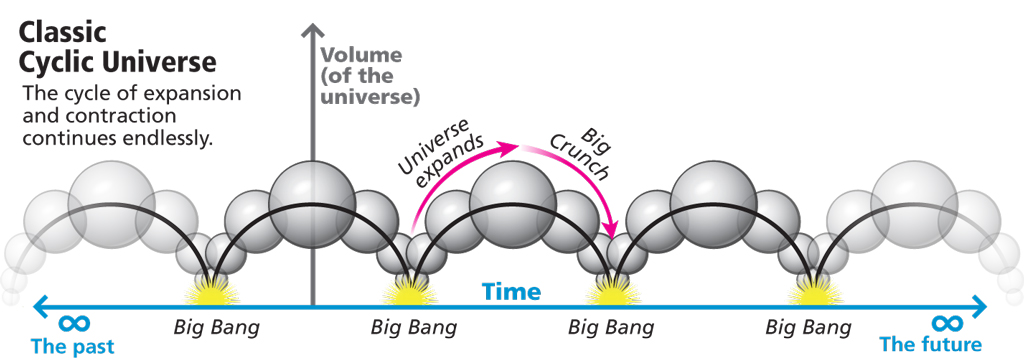
There’s even a theory that the multiple universes don’t just exist in separate locations or times from each other, but that they all “overlap” and exist simultaneously in a state of quantum superposition. This is known as the “many worlds” interpretation of quantum mechanics, and what it basically says is that every possible path that the history of the universe could have taken – every theoretical timeline it could have followed – actually exists, in parallel with all the other timelines, and that any time there’s a new event that could lead to two different outcomes, the universe splits into two separate universes and both outcomes occur separately. In other words, the universe isn’t just one straight line from start to finish – it’s more like a tree with billions of different branches, where the base of the trunk represents the Big Bang, and the branches represent all the different parallel universes diverging from each other. In some of those universes, Washington never crosses the Delaware. In other universes, he does (and everything else is exactly the same as in this universe), but his hat is a slightly different color. In other universes still, he’s never born in the first place. And in still more universes, no form of life ever comes into existence at all. There’s a universe for every single combination of possibilities – and although we never interact with these other parallel universes, so it seems to us (from the inside) like our own universe is the only one that exists, every possible universe has its own branch of the universe-tree, right alongside ours. Again, this might all sound like science fiction – but the idea is taken very seriously within the field of physics, and there’s a good mathematical case to be made that it actually makes more sense than the single-universe alternative. (See, for instance, Carroll’s post here.)
Of course, as much fun as these “multiple universe” models are to think about, it’s worth stressing that they’re all still purely theoretical at this point. It’s safe to say that the question of whether there’s just one universe or many universes is still an open one, to say the least. Still though, if any of these ideas turn out to be true, it would provide yet another point against the fine-tuning argument, for the same reason that having billions of planets would make it unsurprising that at least one of them would be compatible with life. If you play the lottery enough times, eventually you’ll win – not because it’s part of any divine plan, but simply because there are only so many combinations of possibilities that can exist. The apparent fine-tuning of our universe might seem miraculous to us from the inside, but if there are billions of other universes in which that fine-tuning is absent, then our amazement is nothing but the product of survivorship bias, not the result of intentional design.
For what it’s worth, if we could somehow determine that our universe really was the only one in existence, then I actually do think that the fine-tuning argument would be one of the stronger arguments for our universe being intentionally designed, just in Bayesian terms. That is to say, if a hypothetical universe where a designer existed was more likely to have our universe’s physical constants than a hypothetical universe where a designer didn’t exist, then the fact that those physical values are what they are could in fact constitute a point in favor of the designer existing. It wouldn’t constitute proof, mind you; increasing the probability of a certain proposition by a percentage point or two doesn’t mean much if the baseline odds of the proposition are already extremely low. (Having a stranger come up to you and tell you that they can fly, for instance, should technically increase your estimated probability that they can in fact fly (since their claim would be more probable in a universe where they could fly than in one where they couldn’t) – but that doesn’t make it more likely that they can actually fly than that they can’t.) And it wouldn’t suggest that the designer would have to be divine in nature either; we could just as easily be talking about alien engineers or future computer programmers running a simulation or whatever. But still, I can understand why so many people find the fine-tuning argument so compelling. Even if I don’t think it proves the existence of God, I too find the question of why our universe’s physical constants are what they are to be a fascinating one, just in terms of trying to find out what the scientific causes could have actually been. From a human perspective, our existence really does seem like an enormously improbable one. Still, as Kenneth Einar Himma writes, “The mere fact that it is enormously improbable that an event occurred […] by itself, gives us no reason to think that it occurred by design […] as intuitively tempting as it may be.” Just because you flip ten coins and get ten heads in a row doesn’t mean that you did it on purpose.
Besides, even if you believe that the improbability of our existence must necessarily imply the existence of a divine designer, that belief only introduces an even bigger scientific problem than the one it supposedly solves – and the more credibility you give to the improbability argument, the bigger this problem becomes. As Dawkins writes:
The argument from improbability is the big one. In the traditional guise of the argument from design, it is easily today’s most popular argument offered in favour of the existence of God and it is seen, by an amazingly large number of theists, as completely and utterly convincing. It is indeed a very strong and, I suspect, unanswerable argument – but in precisely the opposite direction from the theist’s intention. The argument from improbability, properly deployed, comes close to proving that God does not exist. My name for the statistical demonstration that God almost certainly does not exist is the Ultimate Boeing 747 gambit.
The name comes from Fred Hoyle’s amusing image of the Boeing 747 and the scrapyard. I am not sure whether Hoyle ever wrote it down himself, but it was attributed to him by his close colleague Chandra Wickramasinghe and is presumably authentic. Hoyle said that the probability of life originating on Earth is no greater than the chance that a hurricane, sweeping through a scrapyard, would have the luck to assemble a Boeing 747. Others have borrowed the metaphor to refer to the later evolution of complex living bodies, where it has a spurious plausibility. The odds against assembling a fully functioning horse, beetle or ostrich by randomly shuffling its parts are up there in 747 territory. This, in a nutshell, is the creationist’s favourite argument – an argument that could be made only by somebody who doesn’t understand the first thing about natural selection: somebody who thinks natural selection is a theory of chance whereas – in the relevant sense of chance – it is the opposite.
The creationist misappropriation of the argument from improbability always takes the same general form, and it doesn’t make any difference if the creationist chooses to masquerade in the politically expedient fancy dress of ‘intelligent design’ (ID). Some observed phenomenon – often a living creature or one of its more complex organs, but it could be anything from a molecule up to the universe itself – is correctly extolled as statistically improbable. [But] in fact […] however statistically improbable the entity you seek to explain by invoking a designer, the designer himself has got to be at least as improbable. God is the Ultimate Boeing 747.
[…]
The […] question [is] ‘Who made God?’ […] A designer God cannot be used to explain organized complexity because any God capable of designing anything would have to be complex enough to demand the same kind of explanation in his own right. God presents an infinite regress from which he cannot help us to escape. This argument […] demonstrates that God, though not technically disprovable, is very very improbable indeed.
Naturally, in response to this point, there’s one last line of defense a creationist might resort to, which is to just flatly assert that none of these considerations apply to God at all, because he’s all-powerful and therefore unconstrained by the laws of physics. But as Carroll points out, this assertion – the denial that the laws of physics are even truly laws at all when it comes to God – makes it pointless to even bring up the whole fine-tuning argument in the first place – because after all, if an all-powerful God existed, he wouldn’t have any need for physics to be finely-tuned to begin with, because he’d be able to just imbue matter with life and consciousness no matter what form it took. As Carroll puts it:
The idea of fine-tuning is, if let’s say […] the neutron were a little bit lighter than the proton, then neutrons would be the ground state of matter, protons would decay away, we would have no atoms and therefore no life. Well, if you believe in God, you could have life anyway, even if the universe were nothing but neutrons, because God can do anything. The only idea that would prohibit life from existing in a universe with nothing but neutrons is naturalism. If you believe that life is nothing more or less than some configuration of physical stuff, then maybe you have a chance of making an argument that without fine-tuned constants, we would not be able to have life. But if God exists, we can have life no matter what matter is doing. We can have individual neutrons be alive. God could do that. God can attach your soul to a neutron, no problem. The only time you need finely-tuned physics is if God doesn’t exist. So I think that the argument that God must exist because physics is finely-tuned is precisely backwards.
Again, the existence of finely-tuned physics does raise some fascinating questions about the nature of the universe – but ironically, it may actually be pointing away from the idea that a religious God created the universe, not toward it.
Of course, there are other angles from which you might approach this question of whether God really created the universe. One of the most popular is the argument from apparent design (AKA the teleological argument) – which, instead of focusing on how everything in our universe was formed, asks why it was formed, pointing to the most impressive features of the natural world and concluding that some intelligent being must have designed them because they’re obviously so well-suited to some particular intended function. This is basically the argument that people are making whenever they look at something like a human eye or a bird wing and ask, “How could something that’s so exquisitely intricate, and so clearly geared toward a specific purpose, have just happened by accident? Obviously there must have been a God who designed it for that purpose.” But it was most famously articulated by William Paley with his “watchmaker analogy.” Paley says to imagine that you’re walking across a stretch of land, when all of a sudden you notice a pocket watch sitting among the rocks and shrubs. You wouldn’t conclude that the watch was just another natural part of the landscape and that it must have been formed by natural processes; watches are obviously too finely engineered for that. The more reasonable thing would be to assume that some watchmaker somewhere had deliberately designed it. And according to Paley, you should apply the same reasoning to all the remarkably complex features of plants and animals and the rest of our natural world as well. They’re too perfectly engineered to have just emerged naturally; someone must have designed them.
But this argument fails on a few different levels. For one thing, it’s just not a great analogy; the fact that the watch seems so out of place amongst the rocks and shrubs suggests that its nature is fundamentally different from theirs, not that they’re fundamentally the same. If every part of the natural landscape seemed just as obviously deliberately engineered as the watch, then the watch wouldn’t have stood out as unusual in the first place. More to the point, though, in the couple of centuries since Paley originally drew this analogy, we’ve learned a lot about how natural processes like evolution work – and so we now know all about how features like eyes and wings, rather than being the product of deliberate design, actually did evolve gradually in response to environmental pressures. (Recall the whole section on evolution from earlier.) You might say that in a sense, these features were in fact “designed” – but not by the supernatural intervention of any God. Nature itself was the designer; and it didn’t have any deliberate plans or intentions about where everything would end up. It was, as Dawkins famously phrased it, a “blind watchmaker.” It simply ran its course, and certain traits randomly appeared due to genetic mutations; then, whichever of those traits happened to provide the greatest survival and reproductive advantages were preserved and passed down to subsequent generations – improving more and more with each generation, until they went from rudimentary light-sensitive patches of cells to full-fledged eyes, and from slightly fuzzy forelimbs to full-fledged wings, and so on. You can trace every species’ evolutionary history backwards through time as far as you want, and there’s never any point at which God reaches down from the heavens and engineers a particular feature to be a particular way. The only forces at work, all the way back to the beginning of time, are the fundamental physical laws of cause and effect.
Well all right then, you might say, maybe the laws of cause and effect can explain everything that’s happened since the beginning of the universe – but don’t those causal laws also apply to the beginning of the universe itself? What happens when we trace the timeline of the universe all the way back to the very beginning of that cause-and-effect chain?
This is where another popular argument for God’s existence comes in: the cosmological argument. According to this argument (which you might recall from Carroll’s mention of it earlier), everything that begins to exist must have a prior cause, and the universe began to exist, so therefore the universe must have had a cause – i.e. God. Like the teleological argument, though, the cosmological argument has some fundamental problems. The concept of something “beginning to exist,” for instance, is a slippery one; you might say that a wooden chair “began to exist” when you constructed it, but really you weren’t causing any new matter to come into existence at all – you were just rearranging already-existing matter (wood, nails, etc.) into a new form. In fact, pretty much everything that we say “begins to exist” is actually just matter being rearranged into different forms. In that sense, the only kinds of matter that can truly be said to “begin to exist” at all are the particles and antiparticles (mentioned in Section IV) that periodically pop into existence out of nowhere due to quantum fluctuations. But according to the most popular interpretation of quantum mechanics, these fluctuations aren’t actually the result of straightforward deterministic processes with clearly-defined causes and effects; they’re fundamentally spontaneous, and their outcomes are randomly determined by sheer probability, not by any kind of higher guiding force. In other words, according to this model, the only things that begin to exist actually do so without a straightforwardly deterministic causal mechanism – and this would therefore also include the universe itself, since our current understanding of the Big Bang is that it was essentially just an inflation of those random quantum fluctuations.
That being said, of course, you might prefer other interpretations of quantum mechanics that still preserve a more traditional sense of determinism on all scales – and that’s reasonable enough. (I’d personally be inclined to agree with you.) But even if you accept that the universe did begin to exist and did have a deterministic cause, that still doesn’t justify leaping to the conclusion that this cause must have therefore been an intelligent personal deity. As mentioned earlier, the Big Bang could have been caused by any number of things – a black hole from within another universe, a collision of higher-dimensional membranes, a bunch of aliens pressing “start” on their universe simulator, etc. Just because something triggered the Big Bang doesn’t mean that it was God; so if you want to want to prove God’s existence, you have to do in a way that’s more specific.
In light of this, then, there’s one other popular argument that’s worth mentioning here – one which attempts to prove that God must necessarily exist, by the very definition of the word “God.” The ontological argument, as it’s called, defines God as “a being than which no greater can be conceived,” and then says that “if the greatest possible being exists in the mind, it must also exist in reality. If it exists only in the mind, then an even greater being must be possible – one which exists both in the mind and in reality. Therefore, this greatest possible being must exist in reality.”
This is genuinely one of my favorite arguments for God’s existence, just because of how creative it is. But unfortunately, it turns out to be one of those arguments that’s built more on a conceptual sleight of hand than on a valid chain of reasoning. TheoreticalBullshit breaks down its fatal flaws:
God certainly does “exist” as a concept (in the same way that dragons exist as a concept). But that’s not the same thing as physically existing as an independent being in the real world, regardless of how the ontological argument tries to conflate the two. The only things that can be said to physically exist are… well, physical things. And sure, it sounds obvious when you phrase it like that. But the fact that something has to actually exist materially in order to exist physically presents a major problem for theism – not only because it neutralizes the ontological argument, but because it makes it difficult to conceive how God (at least as he’s traditionally defined) even could exist in the real world at all. After all, God is supposedly an immaterial being, but also supposedly exists in physical reality somehow – not just as a concept, but as a real entity. And this is just self-contradictory. If you want to claim that something is capable of existing in the physical world – and what’s more, that it’s capable of affecting other things in the world physically (whether that be intervening in material events or creating the universe in the first place) – you have to explain how exactly this physical/non-physical interaction is supposed to work; and there just isn’t any good way of formulating such an explanation. The only way that physical objects can interact with anything else is through physical means; so the only way it’d be possible for something like a deity to have any kind of effect or influence on physical objects is if it had some kind of physical presence itself that could interact with them (as even invisible things like wind and radio waves do). If God did have such physical effects on the material world, of course, those effects would be empirically observable and verifiable. We’d be able to see that some unseen force was producing material effects with no apparent material cause. But so far, we haven’t confirmed any such effects; all we have are unproven miracle claims from the various world religions. Based on everything we’ve observed, the only things that can defensibly be said to exist in our physical reality are the material ones – or as Democritus memorably put it over 2,000 years ago, “only atoms and the void.”
Now, if our reality really is entirely physical, and everything really is just the result of natural processes, then needless to say it doesn’t just have some serious implications for God’s existence; it has implications for other major metaphysical questions too. For instance, does a purely naturalistic worldview leave any room for the human soul? Is everything about our minds and our personalities also just the result of purely physical processes? Or is it possible for someone’s personality to exist independent of their physical existence?
As it turns out, this is another question where science has already given us some clear answers. As Steve Ramirez writes:
If neuroscience has taught us anything in the last two decades, it’s that the separation between “mental” and “physical” phenomena simply does not exist. We know this because of the tragic loss-of-function experiments that affect millions of people each year. Broken brain pieces give rise to broken thoughts. Pharmaceutical treatments, however, help glue together these broken thoughts. No amount of philosophy will fight off depression, but a blue pill called fluoxetine is effective. Schizophrenic symptoms shatter lives, but risperidone can intervene and help turn lives around. Minds can go into fits of mania, but these can be curbed by lithium. Parkinsonian symptoms are debilitating beyond belief, but they can be temporally kept at bay thanks to L-Dopa. Alzheimer’s has all sorts of dramatic effects on memory; donepezil can at least partly treat this kind of dementia. The general principle underlying the effectiveness of these pills is simple: physical stuff interacts only with physical stuff, and the mind is just that. Like a pill, it has a measurable mechanism of action.
Adam Benforado elaborates:
The soft tissue of the brain is the starting point for everything we do.
What is allowing you to perceive the words of this sentence, understand their meaning, remember the contents of the previous section, feel the pages or device you hold in your hands, and decide to continue on to the next paragraph?
The answer is nothing more than neurons, synapses, and neurotransmitters. Take away these electrochemical interactions and that’s it: no thoughts, no emotions, no choices, no behavior.
Even for those with no religious inclination, it doesn’t feel that way. It feels as if we have something like a “soul” – independent, purposeful, and rational – directing our actions. How could that thing be nothing more than neurons generating electrical impulses, triggering chemical signals carried to other neurons? It seems improbable, impossible even. But that is the truth.
[…]
Even back in [the 1800s], there was some appreciation of the fact that particular areas of the brain might be involved in regulating particular behaviors. Perhaps the most famous example was that of a twenty-five-year-old supervisor for the Rutland and Burlington Railroad in Vermont, Phineas P. Gage.
Gage’s fame all came down to a tragic and miraculous event one day in 1848, when he decided to pack explosive powder into a rock using a metal rod. His actions (perhaps not unexpectedly, to our cautious modern eyes) triggered a sudden explosion, and the thirteen-pound piece of iron was driven up through his left cheek and straight out of the top of his head.
In an amazing bit of luck, despite horrible damage to his prefrontal cortex and other areas of his brain, Gage survived with most of his physical and intellectual capacities preserved. But as his friends quickly noticed, Gage was “no longer Gage.” Respectful, pleasant, and dutiful before the accident, Gage became lazy, boorish, and foul-tempered. The injury to particular parts of his brain seemed to change particular aspects of his behavior.
[…]
Perhaps a more relevant case […] is one reported in the Archives of Neurology more than 150 years after Gage suffered his injury.
[…]
In 2000, a married forty-year-old Virginia schoolteacher, Mr. Oft, who had never had abnormal sexual urges, suddenly began collecting child pornography and, soon thereafter, attempted to molest his prepubescent stepdaughter. As a first-time offender, the man was diverted to a twelve-step inpatient program for treatment of his sexual addiction. Any serious slip-up and he would be sent to prison. Even though he understood that risk, did not want to be incarcerated, and seemed to know that what he was doing was wrong, he began to solicit sex from the staff at the rehabilitation facility.
Oft was kicked out of the program, of course, and was set to be sentenced the next day, when he developed an intense headache. It was so bad that he had to go to the hospital. But no sooner had his neurological examination begun than he was propositioning the women in the room and openly discussing his fear that he would rape his landlady.
With his bad behavior in clear evidence, the doctors might have written off the headache as a mere ruse to delay going to prison, but instead they ordered a brain scan. What they found was staggering: a tumor, as big as an egg, in the right orbitofrontal area.
The surgery to remove it provided similarly stunning results: with the tumor excised, Oft lost all interest in pornography and easily completed the Sexaholics Anonymous program that had previously been such a struggle. Seven months later, he was permitted to return home.
Oft’s apparent recovery, however, did not last. By October 2001, his headache had reappeared – as had his secret collection of explicit materials. Were the two again connected? Sure enough, when doctors ordered another brain scan, they found that the tumor had grown back. And with a second surgery, in February 2002, the sexual deviance vanished once again.
Cases like these provide vivid illustrations of how deficits in the brain can produce profound changes in behavior.
[…]
[And] the evidence related to traumatic brain injuries is similarly stark: while less than 9 percent of those outside of prison have experienced such trauma, roughly 60 percent of those in prison have had at least one such injury.
Pinker delves even deeper into this research, mentioning Gage’s story along with some other equally remarkable examples:
One can say that the information-processing activity of the brain causes the mind, or one can say that it is the mind, but in either case the evidence is overwhelming that every aspect of our mental lives depends entirely on physiological events in the tissues of the brain.
When a surgeon sends an electrical current into the brain, the person can have a vivid, lifelike experience. When chemicals seep into the brain, they can alter the person’s perception, mood, personality, and reasoning. When a patch of brain tissue dies, a part of the mind can disappear: a neurological patient may lose the ability to name tools, recognize faces, anticipate the outcome of his behavior, empathize with others, or keep in mind a region of space or of his own body. (Descartes was thus wrong when he said that “the mind is entirely indivisible” and concluded that it must be completely different from the body.) Every emotion and thought gives off physical signals, and the new technologies for detecting them are so accurate that they can literally read a person’s mind and tell a cognitive neuroscientist whether the person is imagining a face or a place. Neuroscientists can knock a gene out of a mouse (a gene also found in humans) and prevent the mouse from learning, or insert extra copies and make the mouse learn faster. Under the microscope, brain tissue shows a staggering complexity – a hundred billion neurons connected by a hundred trillion synapses – that is commensurate with the staggering complexity of human thought and experience. Neural network modelers have begun to show how the building blocks of mental computation, such as storing and retrieving a pattern, can be implemented in neural circuitry. And when the brain dies, the person goes out of existence. Despite concerted efforts by Alfred Russel Wallace and other Victorian scientists, it is apparently not possible to communicate with the dead.
Educated people, of course, know that perception, cognition, language, and emotion are rooted in the brain. But it is still tempting to think of the brain as it was shown in old educational cartoons, as a control panel with gauges and levers operated by a user – the self, the soul, the ghost, the person, the “me.” But cognitive neuroscience is showing that the self, too, is just another network of brain systems.
The first hint came from Phineas Gage, the nineteenth-century railroad worker familiar to generations of psychology students. Gage was using a yard-long spike to tamp explosive powder into a hole in a rock when a spark ignited the powder and sent the spike into his cheekbone, through his brain, and out the top of his skull. Phineas survived with his perception, memory, language, and motor functions intact. But in the famous understatement of a co-worker, “Gage was no longer Gage.” A piece of iron had literally turned him into a different person, from courteous, responsible, and ambitious to rude, unreliable, and shiftless. It did this by impaling his ventromedial prefrontal cortex, the region of the brain above the eyes now known to be involved in reasoning about other people. Together with other areas of the prefrontal lobes and the limbic system (the seat of the emotions), it anticipates the consequences of one’s actions and selects behavior consonant with one’s goals.
Cognitive neuroscientists have not only exorcised the ghost but have shown that the brain does not even have a part that does exactly what the ghost is supposed to do: review all the facts and make a decision for the rest of the brain to carry out. Each of us feels that there is a single “I” in control. But that is an illusion that the brain works hard to produce, like the impression that our visual fields are rich in detail from edge to edge. (In fact, we are blind to detail outside the fixation point. We quickly move our eyes to whatever looks interesting, and that fools us into thinking that the detail was there all along.) The brain does have supervisory systems in the prefrontal lobes and anterior cingulate cortex, which can push the buttons of behavior and override habits and urges. But those systems are gadgets with specific quirks and limitations; they are not implementations of the rational free agent traditionally identified with the soul or the self.
One of the most dramatic demonstrations of the illusion of the unified self comes from the neuroscientists Michael Gazzaniga and Roger Sperry, who showed that when surgeons cut the corpus callosum joining the cerebral hemispheres, they literally cut the self in two, and each hemisphere can exercise free will without the other one’s advice or consent. Even more disconcertingly, the left hemisphere constantly weaves a coherent but false account of the behavior chosen without its knowledge by the right. For example, if an experimenter flashes the command “WALK” to the right hemisphere (by keeping it in the part of the visual field that only the right hemisphere can see), the person will comply with the request and begin to walk out of the room. But when the person (specifically, the person’s left hemisphere) is asked why he just got up, he will say, in all sincerity, “To get a Coke” – rather than “I don’t really know” or “The urge just came over me” or “You’ve been testing me for years since I had the surgery, and sometimes you get me to do things but I don’t know exactly what you asked me to do.” Similarly, if the patient’s left hemisphere is shown a chicken and his right hemisphere is shown a snowfall, and both hemispheres have to select a picture that goes with what they see (each using a different hand), the left hemisphere picks a claw (correctly) and the right picks a shovel (also correctly). But when the left hemisphere is asked why the whole person made those choices, it blithely says, “Oh, that’s simple. The chicken claw goes with the chicken, and you need a shovel to clean out the chicken shed.”
The spooky part is that we have no reason to think that the baloney-generator in the patient’s left hemisphere is behaving any differently from ours as we make sense of the inclinations emanating from the rest of our brains. The conscious mind – the self or soul – is a spin doctor, not the commander in chief. Sigmund Freud immodestly wrote that “humanity has in the course of time had to endure from the hands of science three great outrages upon its naïve self-love”: the discovery that our world is not the center of the celestial spheres but rather a speck in a vast universe, the discovery that we were not specially created but instead descended from animals, and the discovery that often our conscious minds do not control how we act but merely tell us a story about our actions. He was right about the cumulative impact, but it was cognitive neuroscience rather than psychoanalysis that conclusively delivered the third blow.
Cognitive neuroscience is undermining not just the Ghost in the Machine but also the Noble Savage. Damage to the frontal lobes does not only dull the person or subtract from his behavioral repertoire but can unleash aggressive attacks. That happens because the damaged lobes no longer serve as inhibitory brakes on parts of the limbic system, particularly a circuit that links the amygdala to the hypothalamus via a pathway called the stria terminalis. Connections between the frontal lobe in each hemisphere and the limbic system provide a lever by which a person’s knowledge and goals can override other mechanisms, and among those mechanisms appears to be one designed to generate behavior that harms other people.
Nor is the physical structure of the brain a blank slate. In the mid-nineteenth century the neurologist Paul Broca discovered that the folds and wrinkles of the cerebral cortex do not squiggle randomly like fingerprints but have a recognizable geometry. Indeed, the arrangement is so consistent from brain to brain that each fold and wrinkle can be given a name. Since that time neuroscientists have discovered that the gross anatomy of the brain – the sizes, shapes, and connectivity of its lobes and nuclei, and the basic plan of the cerebral cortex – is largely shaped by the genes in normal prenatal development. So is the quantity of gray matter in the different regions of the brains of different people, including the regions that underlie language and reasoning.
This innate geometry and cabling can have real consequences for thinking, feeling, and behavior. […] Babies who suffer damage to particular areas of the brain often grow up with permanent deficits in particular mental faculties. And people born with variations on the typical plan have variations in the way their minds work. According to a recent study of the brains of identical and fraternal twins, differences in the amount of gray matter in the frontal lobes are not only genetically influenced but are significantly correlated with differences in intelligence. A study of Albert Einstein’s brain revealed that he had large, unusually shaped inferior parietal lobules, which participate in spatial reasoning and intuitions about number. Gay men are likely to have a smaller third interstitial nucleus in the anterior hypothalamus, a nucleus known to have a role in sex differences. And convicted murderers and other violent, antisocial people are likely to have a smaller and less active prefrontal cortex, the part of the brain that governs decision making and inhibits impulses. These gross features of the brain are almost certainly not sculpted by information coming in from the senses, which implies that differences in intelligence, scientific genius, sexual orientation, and impulsive violence are not entirely learned.
The research on those patients whose left and right brain hemispheres have been surgically separated (AKA “split-brain” patients) is especially fascinating. As V. S. Ramachandran points out, it creates some glaring problems for the idea of the soul:
And there are still other considerations here too – like the fact that general anesthesia (a physical treatment applied to your physical brain) makes your consciousness go away entirely while it’s in your system. This is yet another strong piece of evidence that consciousness doesn’t come from an immaterial soul; if consciousness was completely independent of your physical body, then why would anesthetizing your physical brain have any effect on it?
But all these questions ultimately circle back around to the big one mentioned earlier, which we already discussed with regard to (the supposedly immaterial) God. If you believe that a person’s physical body is controlled by an immaterial soul, the biggest question you have to answer is simply how such a physical/non-physical interaction could even theoretically work in the first place. After all, like I said before, there would have to be some kind of interaction there; if the non-physical didn’t interact with the physical in any way, there’d be no way for it to have any effect on it. But by what mechanism, exactly, would it be possible for something non-physical to interact with something physical (unless the non-physical substance was somehow manifesting itself as a physical force, which would be detectable)? And for that matter, what would it even mean to say that a non-physical substance could exist at all? Isn’t “non-physical substance” an oxymoron? Here’s QualiaSoup:
In the philosophy of mind, substance dualism is the view that there are two kinds of substance: physical (or material) substance, and the non-physical (or immaterial) substance of souls, minds, or consciousness.
[…]
Something that instantly triggers our scepticism of this philosophy is the use of the term “non-physical substance.” What exactly is this supposed to mean? Let’s be clear: concepts like truth and justice may be defined as abstract ideas. In that sense, it’s reasonable to call them non-physical concepts. But they don’t have their own independently active existence. What dualists are proposing is a non-physical thing existing in addition to brains and physical matter, as an active, thinking entity.
[…]
How is a thing with no conceivable physical aspect meant to think? Or do anything at all? In what sense could it even be said to exist? If minds are entirely non-physical, what anchors them to particular bodies? These are not questions to be swept aside, nor do they reflect some irrational dread of dualism and its implications. They reflect a reasonable expectation that dualists who make the factual claim that mind or consciousness is a non-physical substance should make their claim comprehensible. Dualists who can’t or won’t explain coherently what they’re proposing have no genuine complaint if dualism gets a poor reception. Likening a non-physical substance to energy, magnetic fields, or sound waves channeled by a radio set is obviously a non-starter, as those things are all physical. Saying a non-physical thing is like a physical thing (except it’s not physical) glosses over the very thing that needs explaining.
Again, the central point here is that physical stuff can only interact with anything else physically. However you want to define the human mind (or personality, or “soul”), the one thing that science keeps showing us again and again is that it can only be the result of purely physical processes – just like everything else in the universe. If our brains and bodies were being controlled by immaterial souls, we’d constantly be seeing them do things without any detectable physical causes, as if they were possessed by poltergeists or something. But all we ever see is that physical actions are driven by physical causes, top to bottom.
Now, naturally this has implications beyond just whether the soul exists; it also extends to concepts like free will that are similarly central to so many religious doctrines. After all, if everything that we think and do is just a product of how the physical components of our brains operate, and if the way our brains operate is determined solely by the interactions of the atoms that make them up, and if the way those atoms interact is dictated solely by the unchangeable and unbreakable laws of physics and chemistry (just as surely as are the paths of colliding billiard balls), then once you get down to the most basic level, we’re really nothing but biological machines – albeit extremely complex ones – and we can’t be said to possess true free will any more than any other mechanical object (like, say, a pocket watch) can. It might feel from the inside like we have total freedom over our thoughts and actions – and for practical purposes, it might be useful for us to act as if we do – but this feeling is an illusion. The true causes of our thoughts and actions are all the electro-chemical processes happening “under the hood” of our brains – and the only reason why it seems otherwise is because we aren’t consciously aware of these processes as they’re happening. Here’s David Eagleman:
As far as we can tell, all activity in the brain is driven by other activity in the brain, in a vastly complex, interconnected network. For better or worse, this seems to leave no room for anything other than neural activity – that is, no room for a ghost in the machine. To consider this from the other direction, if free will is to have any effect on the actions of the body, it needs to influence the ongoing brain activity. And to do that, it needs to be physically connected to at least some of the neurons. But we don’t find any spot in the brain that is not itself driven by other parts of the network. Instead, every part of the brain is densely interconnected with – and driven by – other brain parts. And that suggests that no part is independent and therefore “free.”
So in our current understanding of science, we can’t find the physical gap in which to slip free will – the uncaused causer – because there seems to be no part of the machinery that does not follow in a causal relationship from the other parts. Everything stated here is predicated on what we know at this moment in history, which will certainly look crude a millennium from now; however, at this point, no one can see a clear way around the problem of a nonphysical entity (free will) interacting with a physical entity (the stuff of the brain).
But let’s say that you still intuit very strongly that you have free will, despite the biological concerns. Is there any way neuroscience can try to directly test for free will?
In the 1960s, a scientist named Benjamin Libet placed electrodes on the heads of subjects and asked them to do a very simple task: lift their finger at a time of their own choosing. They watched a high-resolution timer and were asked to note the exact moment at which they “felt the urge” to make the move.
Libet discovered that people became aware of an urge to move about a quarter of a second before they actually made the move. But that wasn’t the surprising part. He examined their EEG recordings – the brain waves – and found something more surprising: the activity in their brains began to rise before they felt the urge to move. And not just by a little bit. By over a second. […] In other words, parts of the brain were making decisions well before the person consciously experienced the urge. […] It seems that our brains crank away behind the scenes – developing neural coalitions, planning actions, voting on plans – before we receive the news that we’ve just had the great idea to lift a finger.
Libet’s experiments caused a commotion. Could it be true that the conscious mind is the last one in the chain of command to receive any information? Did his experiment drive the nail into the coffin of free will? Libet himself fretted over this possibility raised by his own experiments, and finally suggested that we might retain freedom in the form of veto power. In other words, while we can’t control the fact that we get the urge to move our finger, perhaps we retain a tiny window of time to stop the lifting of our finger. Does this save free will? It’s difficult to say. Despite the impression that a veto might be freely chosen, there is no evidence to suggest that it, too, wouldn’t be the result of neural activity that builds up behind the scenes, hidden from conscious view.
People have proposed several other arguments to try to save the concept of free will. For example, while classical physics describes a universe that is strictly deterministic (each thing follows from the last in a predictable way), the quantum physics of the atomic scale introduces unpredictability and uncertainty as an inherent part of the cosmos. The fathers of quantum physics wondered whether this new science might save free will. Unfortunately, it doesn’t. A system that is probabilistic and unpredictable is every bit as unsatisfying as a system that is deterministic, because in both cases there’s no choice. It’s either coin flips or billiard balls, but neither case equates to freedom in the sense that we’d desire to have it.
Other thinkers trying to save free will have looked to chaos theory, pointing out that the brain is so vastly complex that there is no way, in practice, to determine its next moves. While this is certainly true, it doesn’t meaningfully address the free-will problem, because the systems studied in chaos theory are still deterministic: one step leads inevitably to the next. It is very difficult to predict where chaotic systems are going, but each state of the system is causally related to the previous state. It is important to stress the difference between a system being unpredictable and it being free. In the collapse of a pyramid of ping-pong balls, the complexity of the system makes it impossible to predict the trajectories and final positions of the balls – but each ball nonetheless follows the deterministic rules of motion. Just because we can’t say where it’s all going does not mean that the collection of balls is “free.”
So despite all our hopes and intuitions about free will, there is currently no argument that convincingly nails down its existence.
And Harris (whose short book Free Will is a great read if you’re intrigued and/or unnerved by this whole discussion) adds:
Free will is actually more than an illusion (or less) in that it cannot even be rendered coherent conceptually, since no one has ever described a manner in which mental and physical events could arise that would attest to its existence. Surely, most illusions are made of sterner stuff than this. If, for instance, a man believes that his dental fillings are receiving radio broadcasts, or that his sister has been replaced by an alien who looks exactly like her, we would have no difficulty specifying what would have to be true of the world for his beliefs to be, likewise, true. Strangely, our notion of “free of will” achieves no such intelligibility. As a concept, it simply has no descriptive, or even logical, moorings. Like some perverse, malodorous rose, however we might attempt to enjoy its beauty up close, it offers up its own contradiction.
The idea of free will is an ancient artifact of philosophy, of course, as well as a subject of occasional, if guilty, interest among scientists. […] It has long been obvious, however, that any description of the will in terms of causes and effects sets us sliding toward a moral and logical crevasse, for either our wills are determined by prior causes, and we are not responsible for them, or they are the product of chance, and we are not responsible for them. The notion of free will seems particularly suspect once we begin thinking about the brain. If a man’s “choice” to shoot the president is determined by a certain pattern of neural activity, and this neural activity is in turn the product of prior causes – perhaps an unfortunate coincidence of an unhappy childhood, bad genes, and cosmic-ray bombardment – what can it possibly mean to say that his will is “free”? Despite the clever exertions of many philosophers who have sought to render free will “compatible” with both deterministic and indeterministic accounts of mind and brain, the project appears to be hopeless. The endurance of free will, as a problem in need of analysis, is attributable to the fact that most of us feel that we freely author our own actions and acts of attention (however difficult it may be to make sense of this notion in logical or scientific terms). It is safe to say that no one was ever moved to entertain the existence of free will because it holds great promise as an abstract idea.
In physical terms, every action is clearly reducible to a totality of impersonal events merely propagating their influence: genes are transcribed, neurotransmitters bind to their receptors, muscle fibers contract, and John Doe pulls the trigger on his gun. For our commonsense notions of agency to hold, our actions cannot be merely lawful products of our biology, our conditioning, or anything else that might lead others to predict them – and yet, were our actions to be actually divorced from such a causal network, they would be precisely those for which we could claim no responsibility. It has been fashionable, for several decades now, to speculate about the manner in which the indeterminacy of quantum processes, at the level of the neuron or its constituents, could yield a form of mental life that might stand free of the causal order; but such speculation is entirely oblique to the matter at hand – for an indeterminate world, governed by chance or quantum probabilities, would grant no more autonomy to human agents than would the incessant drawing of lots. In the face of any real independence from prior causes, every gesture would seem to merit the statement “I don’t know what came over me.” Upon the horns of this dilemma, fanciers of free will can often be heard making shrewd use of philosophical language, in an attempt to render our intuitions about a person’s moral responsibility immune to worries about causation. […] Although we can find no room for it in the causal order, the notion of free will is still accorded a remarkable deference in philosophical and scientific literature, even by scientists who believe that the mind is entirely dependent upon the workings of the brain.
What most people overlook is that free will does not even correspond to any subjective fact about us. Consequently, even rigorous introspection soon grows as hostile to the idea of free will as the equations of physics have, because apparent acts of volition merely arise, spontaneously (whether caused, uncaused, or probabilistically inclined, it makes no difference), and cannot be traced to a point of origin in the stream of consciousness. A moment or two of serious self-scrutiny and the reader might observe that he no more authors the next thought he thinks than the next thought I write.
But as troublesome as these findings are for the concept of free will, the discovery that all of our thoughts and actions are the result of purely physical processes also challenges the religious worldview in an even more direct way. As science uncovers more and more about how much of our experience can be explained by natural causes, it’s also finding that even transcendent religious experiences themselves – seemingly the most non-physical experiences of all – can in fact be explained in terms of electro-chemical activity in the brain. In other words, it’s not just that naturalistic explanations make religious beliefs unnecessary; they can even explain how those religious beliefs arise in the first place, for reasons other than their truth value.
It’s been found, for instance, that overstimulation of a person’s temporal lobe can cause religious experiences. When scientists used an electromagnetic device to stimulate subjects’ temporal lobes directly, many of those subjects reported feeling like they were in the presence of God (or angels, or some other supernatural entity), as Molly Edmonds explains:
[Michael] Persinger has gained attention for his work with the “God Helmet,” headgear so named because it may induce a person to feel the presence of God. The God Helmet includes electrodes that Persinger uses to alter the electromagnetic field at the temporal lobes. Persinger claims he can create a religious experience for anyone by disrupting the brain with regular electric pulses. This will cause the left temporal lobe to explain the activity in the right side of the brain as a sensed presence. The sensed presence could be anything from God to demons, and when not told what the experiment involved, about 80 percent of God Helmet wearers reported sensing something nearby.
Of course, these self-reports ought to be taken with a grain of salt; the intensity of the magnetic fields in these experiments was extremely low, so it’s not clear how much of the subjects’ response was actually due to the stimulation itself, and how much of it was just the subjects’ own suggestibility. Still, there are plenty of other cases in which subjects’ temporal lobes have been stimulated much more aggressively – not by careful scientists, but by natural causes – and in those cases, the data are much stronger; overstimulating the temporal lobe really does lead to heightened religious belief, not just during the episodes themselves, but also long-term. Ramachandran explains (starting at 4:16):
As Eagleman writes, this could explain many of the visions and revelations experienced by religious prophets throughout history:
If an epileptic seizure is focused in a particular sweet spot in the temporal lobe, a person won’t have motor seizures, but instead something more subtle. The effect is something like a cognitive seizure, marked by changes of personality, hyperreligiosity (an obsession with religion and a feeling of religious certainty), hypergraphia (extensive writing on a subject, usually about religion), the false sense of an external presence, and, often, the hearing of voices that are attributed to a god. Some fraction of history’s prophets, martyrs, and leaders appear to have had temporal lobe epilepsy. Consider Joan of Arc, the sixteen-year-old-girl who managed to turn the tide of the Hundred Years War because she believed (and convinced the French soldiers) that she was hearing voices from Saint Michael the archangel, Saint Catherine of Alexandria, Saint Margaret, and Saint Gabriel. As she described her experience, “When I was thirteen, I had a voice from God to help me to govern myself. The first time, I was terrified. The voice came to me about noon: it was summer, and I was in my father’s garden.” Later she reported, “Since God had commanded me to go, I must do it. And since God had commanded it, had I had a hundred fathers and a hundred mothers, and had I been a king’s daughter, I would have gone.” Although it’s impossible to retrospectively diagnose with certainty, her typical reports, increasing religiosity, and ongoing voices are certainly consistent with temporal lobe epilepsy. When brain activity is kindled in the right spot, people hear voices. If a physician prescribes an anti-epileptic medication, the seizures go away and the voices disappear. Our reality depends on what our biology is up to.
And Barbara Bradley Hagerty adds to this, pointing out that we actually have ample historical records showing that people who suffered from temporal lobe epilepsy in ancient times were widely regarded as religious prophets:
Some 2,500 years ago, notes Orrin Devinsky, who directs the epilepsy center at New York University, Hippocrates wrote one of the very first texts we have on epilepsy – and he named it “On the Sacred Disease.”
The disease was considered sacred because the ancients thought that sufferers were possessed by demons, or blessed with divine messages and visions. Devinsky says neurologists suspect some of the religious giants were epileptics themselves. Did Paul hear Jesus on the road to Damascus, or was he experiencing an auditory hallucination? What about Joseph Smith and the two angels? Muhammad? Joan of Arc? And what about Moses and that burning bush?
“Assuming for now a more rational scientific view, he was having a visual hallucination and he heard God’s voice,” Devinsky observes.
It could have been God; it could have been a seizure. But one thing Devinsky does believe is “whatever happened back there in Sinai, Moses’ experience was mediated by his temporal lobe.”
Speculating on Moses’s mental state, of course, is more of a hypothetical exercise than anything – since, after all, Moses probably wasn’t a real historical figure. But Hagerty’s mention of Paul – the founder of the Christian Church himself – is more interesting, because Paul’s miraculous conversion on the road to Damascus might actually be the best example of all of an apparent epileptic episode. As Edmonds writes:
Paul’s story is interesting not just to biblical scholars, but to neuroscientists as well. Some scientists claim that the account of this conversion, found in the book of Acts, contains enough evidence to diagnose Paul with temporal lobe epilepsy. The flash of light, the voices and the fall to the ground are the evidence of a seizure, according to these neuroscientists, with the blindness a result of the postictal state that follows a seizure. […] While most doctors agree that it’s impossible to diagnose epilepsy definitively in someone who lived so long ago, Paul would join some other religious figures reputed to have brain disorders, including Moses and St. Teresa of Avila.
Again, this whole question of whether these religious prophets were actually just experiencing overstimulated temporal lobes is a highly speculative one (especially considering that we can’t even know for sure if they ever had “religious experiences” in the first place, or if they were just claiming to have had them). But the neurological phenomenon of temporal lobe overstimulation is genuine, regardless of whether figures like Joan of Arc and Paul actually experienced it themselves – and so is the scientific research linking it to heightened religiosity.
What’s more, temporal lobe stimulation isn’t even the only thing that can cause people to become more religious for purely biological reasons. For another example, here’s Robert Sapolsky:
In 1936, [Paul Radin] wrote a book containing an idea that, if taken to its logical conclusion, should undo some of the most cherished underpinnings of Judeo-Christian thought.
Radin’s speculations indirectly cast light on the question of why schizophrenia exists. This is not necessarily an obvious question to ask. Schizophrenia is one of the most catastrophic ways in which the mind can go awry. It is worth reviewing the features of the disease in order to appreciate Radin’s insight and its potential consequences. This is also useful to help counteract an odd misuse of the word “schizophrenia” by the media and by nonexperts. The erroneous view is of schizophrenia as a disease of sudden, unpredictable lurches between emotional extremes – “God, what a schizophrenic day I’m having. First my car wouldn’t start this morning and I got to work really late. But then I landed this account I’ve been angling for, for months. Then, at lunch I had this really upsetting argument with a friend. What a schizy day.”
In contrast to this incorrect picture, schizophrenia is a disease of disordered thought. The marvel of it is that the cognitive tumult is not just random, but has surprisingly consistent patterns from one sufferer to the next.
Above all else, schizophrenics show “loose associations.” Most of us might relate an incident in a way where there is an obvious logical progression from one step to the next. Schizophrenics, in contrast, produce a storm of non sequiturs or make leaps that, while having a certain strained connectiveness, are not the ones anyone else would make: “So I guess I’ve been a real disappointment to my parents. After all they did for me to get a good education, you know what I’ve wound up doing? I’m a caddie. A caddie. And no one wants caddies these days. Everyone wants the Japanese cars.”
Schizophrenics also have problems with levels of abstraction. Most of us can hear a story and intuit readily whether it is meant to be a factual, literal relating of events, or a parable, meant to be taken symbolically. We intuit whether the point of a particular story is the trees or the forest. Schizophrenics lack that intuition, and their bias is to perceive things on the far more literal, detailed level. “Concreteness” is the term for it and it manifests itself endlessly:
THERAPIST: Hello, Mr. Smith, what’s on your mind today?
PATIENT: My skull.Or:
THERAPIST: Tell me, what do apples, bananas, and oranges have in common?
PATIENT: They all are multisyllabic words.
THERAPIST: Anything else?
PATIENT: They all contain letters that form closed loops..For schizophrenics, it’s not a matter of trees and forests. Instead, it’s habitually seeing only the bark.
Schizophrenics are also prone toward delusions, inserting themselves into situations, making claims that cannot be so, and seemingly believing them. (“Heard of the Great Wall of China? Yes? My idea. The emperor came to me at night with a map and I said, ‘Here’s where it goes.’”) Related to this are the hallucinations, predominantly auditory, that are defining features of the disease. And related to this is the tendency in many schizophrenics toward a florid, permeating paranoia. (“What do apples, bananas, and oranges have in common?” “They’re all wired for sound.”)
Add to that some of the other features of the disease less related to thought – an inappropriate flattening of emotions, an aching social isolation, a tendency toward horrifying acts of self-mutilation and suicidalism – and you have one of the great medical tragedies to befall a person.
One might ask why should schizophrenia exist in culture after culture on this planet, as it does. The disorder has a genetic component (and by this I mean the modern view of human behavioral genetics – not that there is a gene that inevitably causes schizophrenia, but that there are genes that make the individual more sensitive to schizophrenogenic triggers in the environment). The disorder runs in families. Studies of adopted individuals showed that the trait is more common among the genetic, biological pedigree, rather than through the nongenetic, adoptive one. And currently, molecular biologists search for the actual genes, the precise DNA sequences, relevant to the disease.
Thus, if there is a genetic component to the disease, no matter how small, when one asks, Why should schizophrenia exist? one is actually asking, Why should the gene(s) involved in schizophrenia have evolved and been maintained by natural selection in the human gene pool?
Evolution, we were all taught in ninth-grade biology, is the process by which genetic traits are passed on over time and become more common only if they are advantageous. Once, long ago, when giraffes had the short necks of most mammals, one had a somewhat longer neck for a genetically based reason. And that giraffe could reach leaves higher up in the tree, was fruitful, and multiplied… and now it is that giraffe’s long-necked descendants who stroll around the savannah. Evolution, we were taught, works something along those lines. So what’s the evolutionary advantage to schizophrenic genes? Schizophrenics are “unfit” in strict evolutionary terms, which is to say that they have a lower reproductive rate, and thus pass on fewer copies of their genes, than do healthy individuals. Then why is this disorder being maintained in the population?
The answer probably lies in a facet of genetics that we all also learned in ninth grade. Sometimes, genetic traits can come in different degrees of severity, and while the full-blown version of such a trait may be disadvantageous, the moderately “penetrant” version that occurs in a relative may carry a big advantage. And if the magnitude and frequency of the advantageous form outweighs the deleterious, the trait will be selected for in the population. The classic example is sickle-cell anemia affecting people of African descent. In its extreme form, it is a lethal hematologic disorder, while in its less penetrant form, it protects against malaria. There is evidence for a similar pattern in Tay-Sachs disease among Ashkenazi Jews. In its full-blown form, it is a fatal neurological disaster. In its milder form, some data suggest, it confers protection against tuberculosis. There’s also the suggestion that the gene for cystic fibrosis protects against cholera.
Schizophrenia probably shows this pattern. What would be the mild, advantageous version of schizophrenia? As was mentioned in the first piece in this volume, this form is now called “schizotypal” personality disorder. Schizotypals are not the dysfunctional isolates that schizophrenics are. They just tend toward solitary hobbies and professions, are uncomfortable in social situations involving unfamiliar people, are aloof, with few close friends. They are the fire tower rangers, the lighthouse keepers, the film projectionists alone each night in their booths. Moreover, schizotypals are not floridly delusional, hallucinating like schizophrenics. Their disordered thoughts and behaviors are far subtler, in that they have a tendency toward what is termed the “metamagical.” They may have an extremely strong interest in science fiction and fantasy, or in some New Age paranormal belief such as ESP or levitation. They often report odd perceptual experiences – sensing spirits in a room, seeing illusions. Or, as a foreshadowing of the tumult to come, they may have a profound faith in very literal, very concrete interpretations of religious dogma – it really is possible for Jesus to have walked on water, the Patriarchs truly lived for nine hundred years, the creation of the world in seven days is reporting of precise fact rather than a parable. Schizotypal personality disorder was first recognized in precisely the population where you would expect it – among close relatives of schizophrenics, among those individuals who share a certain percentage of genes with schizophrenics.
It is important to recognize that none of these traits count as all-out mentally ill in the conventional sense used by most in society, in which “crazy” is most usually akin to the shattering psychosis of schizophrenia. Perfectly respectable businessmen may sneak off to their Star Trek conventions, an erstwhile actress may publish a best-selling account of her previous lives, a First Lady may consult astrologers and still be taken seriously in the fashion pages.
Who are the schizotypals? Not the lone schizotypal operating the film projector in a movie theater, sensing the presence of Elvis in the room. I mean who were the schizotypals in preindustrial societies, throughout 99 percent of our human history? Here is the key. In 1936, Radin was the first to advance the idea that many shamans, witch doctors, and medicine men (and women) are “half-crazy.”
It fits. The shamans, the forbidding, charismatic religious leaders in tribal life, the ones who sit and converse with the dead ancestors, who have solitary sojourns in the desert, whose huts sit separate from everyone else’s, who spend the night transformed into wolves or bears or hyenas, the ones who lead the trance dances and talk in tongues and bring word of the wishes of the gods.
It was Radin who first focused attention on the idea that, in Western societies, shamans would be viewed as a bit psychiatrically suspect. “Throughout the world of primitive man some form of emotional instability and well-marked sensitivity has always been predicated as the essential trait of the medicine-man and shaman.” He branded the shaman with a label that, based on my perusal of the psychiatric texts of his time, I suspect was invented – “neurotic-epileptogenic.” I think this terminology reflected an odd, tragic chapter in the psychiatry of his era, in which epilepsy was considered a psychiatric rather than neurologic disorder, and where the pre-seizure auras of the epileptic were often grouped with the auras and hallucinations of the schizophrenic.
Importantly, Radin focused on the notion not only of the shaman as “half-crazy,” but of his instabilities as the creative seeds of future religious convention. “[The shaman displays his possession by a spirit] by publicly reenacting his specific personal experience, that of a man suffering from a particular mental affliction. His projections, his hallucinations, his journey through space and time, thus became a dramatic ritual and served as the prototype for all future concepts of the religious road of perfection.” If you aspire to shape supernatural belief in your society for generations to come, some half-mad inspiration would help.
Radin’s ideas were soon echoed by others. Erwin Ackerknecht, a physician and naturalist, discussed the shaman as the “healed madman.” Jules Silverman, a psychotherapist, weighed in with a similar view and explicitly compared the symptoms of the schizophrenic with the traits of the shaman. In a rather pungent statement, the psychoanalyst George Devereux wrote: “[Primitive] religion and in general ‘quaint’ primitive areas are organized schizophrenia.” By the 1960s, the anthropologist Richard Shweder was even conducting empirical studies in the field, demonstrating that shamans have different cognitive styles than other members of their societies.
Probably the most insightful elaborations on Radin’s notion came in 1940 from Alfred Kroeber, one of the biggest guns in anthropology. “In some cultures one of the most respected and rewarded statuses known to the society is acquired only by experience of a condition which in our culture we could not label anything else than psychotic.”
Kroeber emphasized a number of points. While Radin had focused on the generative and creative potential of the psychiatric afflictions of the shaman, Kroeber was more impressed with the fact that these afflictions are nonetheless framed within a preexisting cultural framework. You do not merely report on your time as a wolf or burst out in glossolalic babbling in order to get licensed as a witch doctor. Rather, there are rules as to how shamans go about being psychiatrically unruly. Kroeber discussed how in endless cultures, young individuals are recognized by the established shamans as showing the first signs of the hallucinations and psychoses and are thereafter trained in the particular patterns of shamanistic experience in that culture. Thus, the schizotypal traits are channeled and standardized.
As a second point, Kroeber dwelled on the rewards of such psychosis. “To us a person that hears the dead speak or proclaims that he sometimes turns into a bear is socially abnormal, at best useless, and likely to be a burden or menace.” Shamans, instead, are anything but that. They are powerful, honored, feared, sought after. Shamanism is a highly rewarded state. It is true that in many traditional societies, such shamanism is associated with a reclusiveness, a social withdrawal often linked to celibacy. But in at least as many cultures, shamans and their kin are rewarded not just materially and with respect, but reproductively as well. Sure, you don’t want everyone to be a shaman. This was stated well by a Winnebago tribesman who turned to Radin during a particularly frothy shamanistic ceremony and said, “Well, it’s good that some of us are that way some of the time, but it would be disastrous if all of us were that way all of the time.” However, having the occasional shaman is highly valued by traditional societies, and these shamans are typically powerful, respected members. Insofar as shamanism and its attendant hallucinations, metamagical thought, and psychiatric instability reflect some genetic component, these are not unfit traits being winnowed from the gene pool.
Kroeber encapsulated his idea of the acceptance and rewards of the traits of the shaman in the title of his essay, “Psychosis or Social Sanction.” That final word gave me a poignant twinge when considering its similar derivation as “sanctuary,” and the rarity with which the most modern of psychiatry can provide that for our mentally ill.
In the years since Radin and Kroeber, most anthropologists have distanced themselves from the strongest versions of their ideas. There is, in fact, next to no evidence in any culture that shamanism is “always predicated” on psychiatric instability, that such status is “acquired only by” psychosis. In most traditional cultures, the majority of shamans appear to be quite mentally healthy and are often orphans who had been raised by shamans as surrogate parents. It is probably these average-joe shamans, punching in the ol’ nine to five clock, who mostly ply their trade through the classic shamanistic image of “tricksterism” – sleight of hand, ventriloquism, a certain degree of manipulative showmanship. There is little evidence that they are wired to have different cognitive styles from everyone else, and there are virtually no anthropologists who are trying to find that out. The main point of Radin’s and Kroeber’s ideas is not that all shamans are “half-crazy,” but that if you are half-crazy in the right way, shamanism constitutes a uniquely protected and rewarding refuge.
Kroeber emphasized an additional and critical point in his writing on the subject. He made clear that even the most floridly addled of shamans are typically not what we would now classify as schizophrenic, at the extremes of psychotic dysfunction. He noted how even traditional societies have little use for someone who perpetually believes himself to be a tree and acts as such. As a by-product of some of my own research in East Africa, I have had the occasion to observe that traditional societies there are no less unnerved by and intolerant of schizophrenics than ours is. But these are not shamans, whose psychoses are more controlled. Shamans hear voices during times of crisis rather than all the time, or bellow in tongues during ceremonies rather than at the critical silent moment during a hunt. “In general, the psychopathologies that get rewarded among primitives are only the mild and transient ones,” Kroeber wrote. Years before the invention of the term “schizotypal,” Kroeber had linked shamans to that classification rather than to schizophrenia.
As Sapolsky stresses, this isn’t to say that all religious prophets – much less all religious believers in general – suffer from some kind of brain disorder; clearly the vast majority of believers are perfectly neurotypical. But it certainly seems plausible enough to think that at least a few of history’s most prominent religious prophets who thought they were hearing the voice of God were in fact just experiencing the effects of somewhat abnormal brain chemistry. The point here is just to show that it’s possible for people’s brains to produce apparent religious experiences even when nothing divine is actually occurring.
And in fact, moving outside the topic of brain disorders, we can find plenty of examples of people swearing that they’re having religious experiences even when they know that their brain chemistry is being altered by some outside substance (and even when they’ve deliberately introduced substances into their bodies for that exact purpose). There are entire religious sects, for instance, that revolve around taking psychedelic drugs as a means of inducing transcendent experiences on demand, and their adherents often interpret those experiences as coming from God (and merely being mediated by the drug) rather than coming solely from the drug itself. It’s practically a cliché for certain drug users to describe their experiences as “bringing them closer to God” or “revealing God’s true nature to them.” And in some cases, they’ve even reported experiencing hallucinations identical to the visions of the afterlife described by religious believers who’ve had near-death experiences – a white light, an overwhelming sense of love, a feeling of leaving their body, and so on. Here’s commenter 42staples, for instance, describing his experience on DMT:
I am an atheist and completely reject the idea of a deity. I would say I have never had a truly spiritual experience, until I tried DMT. When I took a hit from the device we had put together I immediately had to sit down. From this point there was an immediate detachment from reality so I decided to close my eyes as I like the visuals our minds can conjure up without any external stimuli.
On closing my eyes I could see a bright light in the distance which was beckoning me. I was drawn to it and so let myself ‘go towards the light.’ As I got closer I noticed silhouettes of people dancing and chanting, calling to me and welcoming me. I could not say who these people were, but what I could discern was these people loved me. I’m not sure if they said the words or not but the message I was receiving was, “It’s okay, join us. We’re so glad you’re finally here.” etc. These faceless outlines and I had an inexplicable bond and I felt very strong emotions for them, somewhat akin to close family bonds.
Meanwhile the intense ball of light swirled and took on every colour of the rainbow as it did. It was like a ball of fire. It provided a warmth. Not a physical warmth but an emotional warmth. Like safety, familiarity… love. When the intensity of the trip began to wear off I felt myself moving away from the light and the people waved goodbye. I didn’t want to leave.
Again, I am not a religious person, but this experience really opened my eyes and has helped me better understand my interpretation of the process of dying. This is the ‘near death experience’ I have heard about a hundred times. Tunnel. Light. Loved ones. It’s the story, right? It doesn’t end there. Out of the 10 or so people my friend gave DMT to all of them experienced a similar kind of trip. I’ve read a lot online after the experience and everyone says similar things. It’s fascinating.
It might not be a coincidence that DMT, aside from being used as a recreational drug, is also produced naturally in the brain, and is hypothesized by some to flood the brain in the moments right before death. If true, this would perfectly explain where religious visions of “the afterlife” might come from.
But such speculation about DMT might not even be necessary. As it turns out, visions like these can also come from something as simple as oxygen deprivation. McRaney explains:
For many years, the U.S. Air Force has trained pilots using a giant contraption called the Holloman centrifuge. The centrifuge is basically a fake cockpit attached to a giant shaft of metal with a tremendously powerful motor at its center. The center spins, rotating the shaft, and propels the cockpit round and round with a pilot inside. Imagine a string tied to a rock, and then imagine spinning that rock around lasso-style, and then imagine you are inside the rock. Pilots do this to feel the effects of g-forces, or gravity. In a high-performance fighter jet, pulling up and away from the Earth or turning hard at insane speeds applies g-forces to the body. When you accelerate in one direction, you feel the pull of Newton’s laws in the other. When you hit the accelerator in a car, for example, your head is forced to flop backward. In a jet, that force is much greater, and the blood in your arteries can’t get to your brain. The effect is like a chokehold, and pilots often pass out or become incoherent zombies. Either way, pulling too many g’s, as they say, can end in disaster.
The air force and agencies such as NASA use centrifuges to create massive g-forces in a controlled environment. This way, they can teach pilots techniques for keeping blood in their brains. Such techniques involve lots of grunting and straining, which would otherwise seem a bit embarrassing if, you know, they weren’t fighter pilots. At a certain point, pilots will black out and lose consciousness. As they go in and out of this state, they often report visions, hallucinations of the fantastic and the everyday, like dreams. James Whinnery, a medical doctor for the air force, has studied hundreds of these blackouts over the last thirty years, videotaping them and comparing their nuances, interviewing the pilots and recording their reports. Over time, he has found striking similarities to the same sorts of things reported by patients who lost consciousness on operating tables, in car crashes, and after returning from other nonbreathing states. The tunnel, the white light, friends and family coming to greet you, memories zooming around – the pilots experienced all this. In addition, the centrifuge was pretty good at creating out-of-body experiences. Pilots would float over themselves, or hover nearby, looking on as their heads lurched and waggled about. As Whinnery and other researchers have speculated, the near-death and out-of-body phenomena are both actually the subjective experience of a brain owner watching as his brain tries desperately to figure out what is happening and to orient itself amid its systems going haywire due to oxygen deprivation. Without the ability to map out its borders, the brain often places consciousness outside the head, in a field, swimming in a lake, fighting a dragon – whatever it can connect together as the walls crumble. What the deoxygenated pilots don’t experience is a smeared mess of random images and thoughts. Even as the brain is dying, it refuses to stop generating a narrative, the scaffolding upon which it weaves cause and effect, memory and experience, feeling and cognition. Narrative is so important to survival that it is literally the last thing you give up before becoming a sack of meat. It is the framework of your conscious experience. Without it, there would be nothing but noise. Better still, after the pilots regain consciousness they go through the same sort of explanatory routines as patients in emergency rooms who have technically died and returned to life. After the psychedelic wonder of a prolonged loss of oxygen, many people see that light and tunnel as the passage to the afterlife. The stories differ, depending on the belief system, but there is always a story.
Again, the lesson here is simple enough: When people have apparent divine experiences, that doesn’t necessarily mean that the source of those experiences is actually divine. What they’re feeling as “the presence of God” could just be the product of their own brain activity.
Now, having said all that, it’s clear that most religious experiences don’t actually involve major brain disorders or mind-altering drugs or oxygen deprivation or anything like that. How, then, do we explain those experiences? What are we to make of the cases where otherwise clear-minded people honestly just feel like they’re communing with God? It’s an important question – maybe the most critical question when it comes to this subject – because for most believers, personal experiences are the absolute core of their faith. Certainly this was the case for me when I was a believer. When I worshiped and communed with God, I knew that I wasn’t just experiencing a false sensation caused by my own brain; I was genuinely feeling God’s presence. At least, that’s what I convinced myself of – and I used this certainty as my justification for rejecting all the other (more logic-based) arguments against my faith. The fact that so much science and history seemed to contradict my religion didn’t matter to me, because I’d experienced God’s existence directly; everything that contradicted that must have just somehow been wrong.
But in using my personal feelings as a basis for rejecting all the findings of science and history – entire fields of study involving millions of researchers – I was placing a staggering amount of confidence in the inerrancy of my own feelings. And looking back, I can see this for the hubris that it was. It might have been one thing if I’d actually seen the risen Jesus with my own eyes, and touched his wounds with my own hands, like Thomas did in the Bible. But all I’d ever had were internal feelings and experiences, which are much more subjective than external sensory ones, and are accordingly much more subject to misinterpretation.
It’s true that I had some extremely powerful experiences when I was a believer. The emotions I felt when I was worshiping God were undoubtedly genuine, and it would have been wrong to say that I was just “pretending” to feel the way I did. But it was also a mistake to say that because I was so certain that my feelings were real, that I could be equally certain that their source was divine. And that was my mistake for all those years: I conflated my subjective religious experiences with the actual presence of a real God, without ever allowing myself to realize that those could have been two separate things.
In retrospect, I can say now that I wasn’t really experiencing God’s presence like I thought I was. What I was actually doing was taking the powerful emotions that I was experiencing, and imbuing them with divine significance. As TheraminTrees puts it:
What I did was take experiences that I found rewarding or punishing, or seemed improbable or inexplicable, and attributed them with divine significance. [I was] defining a supernatural agent as the cause of these experiences, then taking those experiences as evidence of that supernatural agent. It’s a system perfectly designed to reinforce unjustified beliefs.
Evid3nc3 gives a similar explanation of his own experiences:
[Jean] Baudrillard defines the term “simulacrum” as something that is only an image of something either real or imagined, but that is interacted with as if it really is what it represents. This interaction can be referred to as a “simulation” of what a real interaction with the real thing would be like. So for example, if someone wears a pendant and believes it is lucky, the physical pendant has become a simulacrum of a magical pendant. To the wearer, it represents the idea of a magical pendant, and is treated directly as if it were magical. When a person believes that the pendant brings them luck, they’re simulating the experience that the pendant actually is magical. The physical pendant itself can be completely mundane, and have no magical properties whatsoever – but to the wearer, who is simulating a magical experience in their mind, otherwise mundane but fortunate events are perceived as expressions of the pendant’s power. One can think similarly about idols that are prayed to as if they are direct representations of gods – or pictures, possessions, or internal images of deceased loved ones that are spoken to as if they contain that person’s consciousness.
According to Baudrillard […] God himself, as experienced by the religious, was probably just another simulacrum – an image, representing the concept of a supreme supernatural being. Religious followers simulated an experience of this supreme being in their own mind by the way that they interpreted otherwise natural events, but this experience most likely involved no actual supreme being interacting with them at all. So when I experienced profound emotions due to what I perceived as the Holy Spirit, I was (according to Baudrillard) just simulating subconsciously in my own mind what I would feel like if the Holy Spirit actually existed and was reaching out to me. I experienced real emotions, but they were in response to a simulated experience. It felt real because my mind made it feel real. Our brains, apparently, are profoundly adept at creating simulations for our consciousness to experience.
This kind of thing can be found in a wide variety of areas, not just in religion. There are some practitioners of martial arts, for instance, who’ve convinced themselves that they can use invisible forces to control their opponents without touching them. These techniques are completely bogus, of course, and they fail spectacularly as soon as they come into contact with reality – but as long as the true believers can insulate themselves from outside skepticism by training privately in their own dojos, they can delude themselves into thinking that their “powers” are real:
There’s actually a whole genre of YouTube clips of this phenomenon:
And the key thing to notice here is that practitioners of these techniques truly seem to believe that what they’re doing is real. They’ve genuinely convinced themselves that they’re capable of creating invisible force fields and controlling their opponents with their minds. It’s only when some outside skeptic forces them to put their belief to the test that its failure becomes painfully obvious:
How can people delude themselves into believing such nonsense? Commenter CapableLover offers one possible explanation (slightly edited for clarity):
I imagine it works a lot like this:
The sensei convinces one guy he can do what he claims. Now that one guy really believes the sensei; maybe they’re friends or something, and that one guy has no reason to think the sensei would lie to him. He wants to be able to do the same thing the sensei claims – he wants the “power” – so he listens to the sensei. He does the meditations, the exercises, buys the books, probably invests a lot of time and money in preparatory things the sensei says he needs. Could be that he needs crystals and CDs and DVDs, books, outfit, maybe a special diet. It could just be he’s paying the sensei’s rent in exchange for the sensei to continue “training” with him.
So this goes on for months, more and more time, and money pissed away; the sensei probably has little bullshit examples he can give the guy through the power of suggestion that he believes show some sort of progress. After a particularly long deep breathing exercise, the sensei might say something like, “Do you feel calm?” The guy will respond, “You know I do,” and the sensei tells him something like, “That’s the power. I can feel you becoming more powerful every day. I noticed early on you have incredible potential. One day you’ll be more powerful than me, because your vibrations/chi/magic/frequency is amazing!” At that point the guy’s like, “Wow, the sensei thinks I have potential.”
Now the guy’s thinking, “I’m really making progress.” And continues paying the sensei’s rent and “training” for a couple more months.
So that goes on, and the sensei keeps telling or convincing the guy he’s making incremental progress; the guy’s probably getting a little frustrated but now he’s in too deep. If he were to admit to himself now that this is all bullshit, he’d have to admit that he’s an idiot, that he’s wasted too much time and money and maybe has been duped. The sensei probably picks up on this vibe or maybe the guy comes right out and says it one day.
That’s when the sensei tells the guy, “You’re ready.”
They prepare for a demonstration. They meditate for a few hours, rub crystals, listen to whale songs, bang gongs, and play with singing bowls. Then the sensei tells the guy, “Okay, focus your energy and open your heart, calm your mind, blah, blah, blah… I’m going to attack you with all my might!”
Now the guy’s like, “Holy shit this is it! I hope I’m ready – otherwise I’m gonna get the shit kicked out of me.” The two square off.
The sensei charges at the guy full tilt – “YAAAAAAAAAAAARG!” The guy raises his hand and swats the air like he’s waving away smoke, and the sensei flies ass over teakettle in the most dramatic fashion you can imagine.
“I did it! Oh my god I did!” the guy thinks. “Oh my god… Sensei! Are you hurt?”
The sensei gets to his feet and tells him, “Yes I’m hurt. You’re very powerful; these are very powerful forces. I told you once you may be more powerful than even me. I know that that’s true now, but your power is too wild; you need to harness it. I can show you how; we’ll resume your training tomorrow.”
And now the guy’s on the hook for another couple of months and probably starts evangelizing the sensei at this point, telling his friends and coworkers what happened, showing them stupid little demonstrations the sensei showed him. “You feel that warmth when I almost touch your hand? That’s the power!”
So some more time passes, until one day it’s time for the sensei to show the guy what “the master” is capable of.
They prepare and square off. The sensei tells the guy to attack him.
The guy charges, and a few things could possibly happen. At this point he’s already a believer; he’s built up what the sensei is capable of in his mind and is hoping the sensei doesn’t just vaporize him on the spot. So he charges the sensei, and it seems like he’s about to plow this mother fucker right in the face. His brain starts doing some figuring on a subconscious level:
“You’re either about to knock out some asshole who’s completely scammed you, stolen your time and money or made you look like an idiot, which doesn’t make any sense because you have the power… right? Right. You did what the sensei’s about to do to. You remember the demonstration? Or you’re about to hit a powerful wizard in the face, which isn’t a very good idea.”
Before the guy lands the blow, he flies ass over teakettle like the sensei did during the first demonstration, and it’s time to go find a third asshole and start the whole process over again.
Or he hits the sensei right in his stupid face and breaks his nose, at which point the sensei comes at him a different way:
“You’re too powerful; you broke right through my force field and now my nose is bleeding all over the place! You see this blood! This shit’s real, and you’re not taking your training seriously enough! You’re going to kill someone! Shame on you! I don’t know if I can be your sensei anymore. No, you have to control your power, we need to train more.”
So then the guy’s on the hook for another couple of months. And now the training consists of the sensei trying to convince the guy to convince himself to take a dive before he hits the sensei. And the guy will keep training and seeking the sensei’s approval until he consciously or subconsciously starts flying ass over teakettle every time the sensei farts in his direction.
Then they go find a third asshole and start the process over again, and it gets easier with each new person.
Now, obviously this isn’t how things go in all of these types of situations. But it certainly happens often enough. And the same kind of thing can happen in other contexts, too – including religion. AronRa speaks from his own personal experience as a former member of a kind of neo-pagan religious sect:
With neo-pagan… not necessarily witchcraft, but meditation and astral projection and things like that – the way that all that works is you have to enhance your psychic acumen, and integrate that with your physical senses, to stretch the boundaries of normal perception so that you can see auras, and you can see spiritual beings, and you’re able to perceive or sense wards, and other sorts of things like this. That’s the way you describe it. But enhancing and integrating your psychic acumen – there’s another way of paraphrasing that: You imagine shit that isn’t really there.
I found it remarkably easy to do. Drums have a certain amount of ambience that puts you in the mood. Firelight does the same thing. Candles burning, music playing, certainly drugs have their effect, as do groups of people holding hands, chanting, and all of this sort of thing. As long as you’re psyched up enough, and you already have some predisposed acceptance of whatever it is that you expect to experience, you can – and very likely will – experience that.
And it’s the same in more mainstream religions as well. When it comes to Christianity in particular, you might notice some obvious parallels between “no touch” martial artists supposedly overwhelming their opponents with invisible forces, and self-proclaimed faith healers supposedly overwhelming their congregants with the power of the Holy Spirit (as Super Eyepatch Wolf illustrates):
But this kind of phenomenon is perhaps even more clearly exemplified by the widespread practice of “speaking in tongues,” in which believers claim to be so overcome by the Holy Spirit that they’re compelled to spontaneously start praising God in other languages:
Again, there’s no doubt that these worshipers genuinely believe that they’re channeling the Holy Spirit. There’s no doubt that the strong emotions they’re feeling are real. But linguistic analysis has shown that the “tongues” these people are speaking in aren’t real languages (aside from that one guy throwing in a bit of Spanish); the worshipers are just making up gibberish off the top of their heads. Commenter QTCicero explains:
I’m a graduate linguistics student and I can assure you that a huge amount of research has been done into this phenomenon over the past century, mainly by the Canadian linguist William Samarin.
Not only is no meaningful information communicated by these utterances, even the very phonetic structure of the utterances proves that they are created on the spot by the human mind. [Commenter] Procrastinationist makes the salient point that only native phonemes are used in glossolalic utterances, but it gets even better than that: not only do speakers use only native phonemes, they use these phonemes in a way which maximises articulatory ease. That is to say, they always use the most “easiest” combinations of vowels and consonants for the human speech organs to produce (e.g. there is a strong preponderance of the vowel A and for the syllable structure consonant-vowel-consonant-vowel, etc.).
So either it’s just a massive, global coincidence that the language of the Spirit is limited to easier-to-pronounce recombinations of native sounds, or they’re making it up.
From a dispassionate outside perspective, the whole practice might look pretty absurd – like a bunch of children playing make-believe at best, or like a bunch of people who’ve completely lost their marbles at worst. For someone who’s never believed, it might be hard to imagine how these people could really believe in this stuff. But AronRa’s point from a moment ago is key to understanding this phenomenon; the reason Christians can get so “swept up in the Holy Spirit” that they start spouting gibberish is because in those moments, they aren’t in a dispassionate, neutral state of mind. Religious services are designed to put congregants into a much more worshipful mindset than usual, and this can prime them to feel things that they wouldn’t normally feel, and act in ways that they wouldn’t normally act. A particularly moving or inspirational sermon, for instance, can be a potent way of stirring up emotions; and powerful musical performances can be more effective still. Having formerly performed in a worship band myself, I can attest to just how deliberately the worship music played in modern churches is designed to evoke the maximum possible emotional response; the songs feature soaring vocals and instrumentals that swell to triumphant crescendos, which are performed loudly enough to resonate in your bones – and those songs are interspersed with softer, gentler ones designed to break down your emotional walls and move you to tears. The result is often a genuinely stirring – and even life-changing – flood of emotions. And given that all this happens in the highly religious context of a church worship session, is it any surprise that believers are so willing to attribute the power of these experiences to the Holy Spirit itself?
This effect is only amplified by the fact that these worship sessions typically occur in large group settings. As any concertgoer or football fan can attest, certain experiences can be far more powerful when you partake in them with a huge crowd of people than when you just watch them in your room by yourself. And religious experiences are no different; if everyone around you is overflowing with religious ecstasy, throwing their hands up in the air, and speaking in tongues, you’ll probably be a lot less self-conscious about engaging in these behaviors yourself than if you were the only one doing them.
That isn’t to say, of course, that the opposite can’t also be true sometimes; given the right conditions, moments of quiet solitude can be just as emotionally stirring as group worship sessions. If you’re up late one night listening to really emotional music, for example, that can put you in a frame of mind that’s more receptive to religious feelings. Or if you’re out in nature and you see a beautiful waterfall or a breathtaking sunset, you might feel so moved by the beauty you’re seeing that you can’t help but to imbue it with divine significance. This was certainly a common occurrence for me back when I was a believer. But looking back, I can now understand that just because something is beautiful doesn’t automatically mean it’s divine. All I was doing in these instances was taking my subjective feelings of awe and wonder and attributing them to God, when in fact those feelings were coming solely from within my own mind.
Again, the point here is just to underscore how incredibly good the human brain is at taking meaningful – but purely natural – experiences and endowing them with supernatural significance. Whether it’s a beautiful natural landscape, a poignant worship session, or even some completely random life event, it’s almost always possible to come up with a divine explanation. And in fact, there have even been cases where we’ve been able to see this happen on a civilizational scale in real time. Dawkins describes one such example, in which people’s eagerness to attribute divine significance to purely material interactions gave birth to a whole new religion:
In The Life of Brian, one of the many things the Monty Python team got right was the extreme rapidity with which a new religious cult can get started. It can spring up almost overnight and then become incorporated into a culture, where it plays a disquietingly dominant role. The ‘cargo cults’ of Pacific Melanesia and New Guinea provide the most famous real life example. The entire history of some of these cults, from initiation to expiry, is wrapped up within living memory. Unlike the cult of Jesus, the origins of which are not reliably attested, we can see the whole course of events laid out before our eyes (and even here, as we shall see, some details are now lost). It is fascinating to guess that the cult of Christianity almost certainly began in very much the same way, and spread initially at the same high speed.
My main authority for the cargo cults is David Attenborough’s Quest in Paradise, which he very kindly presented to me. The pattern is the same for all of them, from the earliest cults in the nineteenth century to the more famous ones that grew up in the aftermath of the Second World War. It seems that in every case the islanders were bowled over by the wondrous possessions of the white immigrants to their islands, including administrators, soldiers and missionaries. They were perhaps the victims of (Arthur C.) Clarke’s Third Law: […] ‘Any sufficiently advanced technology is indistinguishable from magic.’
The islanders noticed that the white people who enjoyed these wonders never made them themselves. When articles needed repairing they were sent away, and new ones kept arriving as ‘cargo’ in ships or, later, planes. No white man was ever seen to make or repair anything, nor indeed did they do anything that could be recognized as useful work of any kind (sitting behind a desk shuffling papers was obviously some kind of religious devotion). Evidently, then, the ‘cargo’ must be of supernatural origin. As if in corroboration of this, the white men did do certain things that could only have been ritual ceremonies:
They build tall masts with wires attached to them; they sit listening to small boxes that glow with light and emit curious noises and strangled voices; they persuade the local people to dress up in identical clothes, and march them up and down – and it would hardly be possible to devise a more useless occupation than that. And then the native realizes that he has stumbled on the answer to the mystery. It is these incomprehensible actions that are the rituals employed by the white man to persuade the gods to send the cargo. If the native wants the cargo, then he too must do these things.
It is striking that similar cargo cults sprang up independently on islands that were widely separated both geographically and culturally. David Attenborough tells us that
Anthropologists have noted two separate outbreaks in New Caledonia, four in the Solomons, four in Fiji, seven in the New Hebrides, and over fifty in New Guinea, most of them being quite independent and unconnected with one another. The majority of these religions claim that one particular messiah will bring the cargo when the day of the apocalypse arrives.
The independent flowering of so many independent but similar cults suggests some unifying features of human psychology in general.
One famous cult on the island of Tanna in the New Hebrides (known as Vanuatu since 1980) is still extant. It is centred on a messianic figure called John Frum. References to John Frum in official government records go back only as far as 1940 but, even for so recent a myth, it is not known for certain whether he ever existed as a real man. One legend described him as a little man with a high-pitched voice and bleached hair, wearing a coat with shining buttons. He made strange prophecies, and he went out of his way to turn the people against the missionaries. Eventually he returned to the ancestors, after promising a triumphal second coming, bearing bountiful cargo. His apocalyptic vision included a ‘great cataclysm; the mountains would fall flat and the valleys would be filled; old people would regain their youth and sickness would vanish; the white people would be expelled from the island never to return; and cargo would arrive in great quantity so that everybody would have as much as he wanted’.
Most worryingly for the government, John Frum also prophesied that, on his second coming, he would bring a new coinage, stamped with the image of a coconut. The people must therefore get rid of all their money of the white man’s currency. In 1941 this led to a wild spending spree; the people stopped working and the island’s economy was seriously damaged. The colonial administrators arrested the ringleaders but nothing that they could do would kill the cult, and the mission churches and schools became deserted.
A little later, a new doctrine grew up that John Frum was King of America. Providentially, American troops arrived in the New Hebrides around this time and, wonder of wonders, they included black men who were not poor like the islanders but
as richly endowed with cargo as the white soldiers. Wild excitement overwhelmed Tanna. The day of the apocalypse was imminent. It seemed that everyone was preparing for the arrival of John Frum. One of the leaders said that John Frum would be coming from America by aeroplane and hundreds of men began to clear the bush in the centre of the island so that the plane might have an airstrip on which to land.
The airstrip had a bamboo control tower with ‘air traffic controllers’ wearing dummy headphones made of wood. There were dummy planes on the ‘runway’ to act as decoys, designed to lure down John Frum’s plane.
In the 1950s, the young David Attenborough sailed to Tanna with a cameraman, Geoffrey Mulligan, to investigate the cult of John Frum. They found plenty of evidence of the religion and were eventually introduced to its high priest, a man called Nambas. Nambas referred to his messiah familiarly as John, and claimed to speak regularly to him, by ‘radio’. This (‘radio belong John’) consisted of an old woman with an electric wire around her waist who would fall into a trance and talk gibberish, which Nambas interpreted as the words of John Frum. Nambas claimed to have known in advance that Attenborough was coming to see him, because John Frum had told him on the ‘radio’. Attenborough asked to see the ‘radio’ but was (understandably) refused. He changed the subject and asked whether Nambas had seen John Frum:
Nambas nodded vigorously. ‘Me see him plenty time.’
‘What does he look like?’
Nambas jabbed his finger at me. “E look like you. ‘E got white face. ‘E tall man. ‘E live ‘long South America.’
This detail contradicts the legend referred to above that John Frum was a short man. Such is the way with evolving legends.
It is believed that the day of John Frum’s return will be 15 February, but the year is unknown. Every year on 15 February his followers assemble for a religious ceremony to welcome him. So far he has not returned, but they are not downhearted. David Attenborough said to one cult devotee, called Sam:
‘But, Sam, it is nineteen years since John say that the cargo will come. He promise and he promise, but still the cargo does not come. Isn’t nineteen years a long time to wait?’
Sam lifted his eyes from the ground and looked at me. ‘If you can wait two thousand years for Jesus Christ to come an’ ‘e no come, then I can wait more than nineteen years for John.’
Robert Buckman’s book Can We Be Good without God? quotes the same admirable retort by a John Frum disciple, this time to a Canadian journalist some forty years after David Attenborough’s encounter.
The Queen and Prince Philip visited the area in 1974, and the Prince subsequently became deified in a rerun of a John-Frum-type cult (once again, note how rapidly the details in religious evolution can change). The Prince is a handsome man who would have cut an imposing figure in his white naval uniform and plumed helmet, and it is perhaps not surprising that he, rather than the Queen, was elevated in this way, quite apart from the fact that the culture of the islanders made it difficult for them to accept a female deity.
I don’t want to make too much of the cargo cults of the South Pacific. But they do provide a fascinating contemporary model for the way religions spring up from almost nothing. In particular, they suggest four lessons about the origin of religions generally, and I’ll set them out briefly here. First is the amazing speed with which a cult can spring up. Second is the speed with which the origination process covers its tracks. John Frum, if he existed at all, did so within living memory. Yet, even for so recent a possibility, it is not certain whether he lived at all. The third lesson springs from the independent emergence of similar cults on different islands. The systematic study of these similarities can tell us something about human psychology and its susceptibility to religion. Fourth, the cargo cults are similar, not just to each other but to older religions. Christianity and other ancient religions that have spread worldwide presumably began as local cults like that of John Frum. Indeed, scholars such as Geza Vermes, Professor of Jewish Studies at Oxford University, have suggested that Jesus was one of many such charismatic figures who emerged in Palestine around his time, surrounded by similar legends. Most of those cults died away. The one that survived, on this view, is the one that we encounter today. And, as the centuries go by, it has been honed by further evolution (memetic selection, if you like that way of putting it; not if you don’t) into the sophisticated system – or rather diverging sets of descendant systems – that dominate large parts of the world today.
Of course, these cargo cults aren’t exactly like Christianity. The islanders listening for the voice of John Frum through their “radios” aren’t quite the same as Christians listening for the voice of Jesus through their prayers. But in a lot of ways, they’re very similar. Both groups want to believe that they’re communicating with a higher power. In many cases, they want to believe it so badly that they successfully convince themselves that they really are communicating with that higher power. They feel it so deeply in their hearts that they even go so far as to organize their entire lives around that belief. And yet, when someone asks them to demonstrate that they are in fact communicating with a higher power (as when Attenborough asked to see the “radio”), they have a hard time backing up their beliefs with any kind of concrete substantiation; all they have is their conviction that they’re right.
If you were a believer who wanted to know if it was truly possible to communicate with God, there’d be a pretty straightforward way of finding out; you could simply ask him something empirically verifiable that you’d have no way of knowing or intuiting yourself (and would be unlikely to guess by chance). For instance, you could ask him which day of the upcoming year would get the most rainfall, or what the twenty-seventh word in the Book of Job was (or some other more relevant example) – and then pray for an answer in the same way that you pray for answers to other problems in your life. After all, people talk all the time about how God provides them with answers to those other questions – the ones involving career decisions, relationship issues, and so on. But what those types of questions have in common is that it’s perfectly possible for people to come up with their own answers to them using their own knowledge and intuition. So once you take those factors out of the equation, and start asking the kind of questions that you wouldn’t have any basis for being able to figure out on your own, does it still feel like God would be able to provide you with the answers? Or does it feel more like if you asked him which day of the year would get the most rainfall, you’d be able to pray all you wanted and would still have absolutely no idea what the answer was?
I know a lot of believers will object to this point. Asking God about something as prosaic as rainfall figures might not seem like a sincere prayer request, because such a thing wouldn’t have any actual relevance to your life; it’d just feel like you were presumptuously testing God, and why would he respond to something like that? But aside from all the aforementioned biblical examples of God gladly providing proof of his existence on demand to anyone who asked, getting a clear and unambiguous answer to such a question could in fact have plenty of relevance to your life (and not just if you were a farmer, or lived in an area with lots of floods or hurricanes). Even if all you were seeking was the reassurance that God was listening to you and looking out for you – the one thing that believers pray for more than anything else – what could be more reassuring than getting a precise answer that turned out to be exactly right? It’d certainly be more reassuring than just getting some vague internal feeling that he might be listening to your other prayers; you’d know he was listening. So if praying something as commonly prayed for as “please reveal your presence to me” wouldn’t count as “testing God,” then neither would this; the only difference is that the wording here would be more specific.
Still, I expect that believers might object to this point too – not the request itself, but the specificity of it. You can’t just presume that God will communicate with you in anything as clear as an audible voice telling you an exact date; that’s not how he works. The way God operates is through more subtle means, like unspoken feelings and impressions and urges. But that’s the whole point I’m trying to make here: If God never gives us anything concrete, that’s all the more reason to think that what we’re experiencing isn’t actually God. From an inside point of view, there’s no discernable difference between “feeling the Holy Spirit guiding you,” and feeling your own conscience guiding you (via hunches, emotional realizations, etc.) and simply thinking it’s the Holy Spirit. The whole point of subjective feelings is that they’re subjective. They’re open to interpretation. And that means they’re open to misinterpretation too.
Of course, a lot of believers like to talk as if they really are hearing an audible voice and seeing God in a literal sense – and they’ll be especially adamant about this if they feel like someone is challenging the truth of their faith and they have to defend it. But if you’re a fellow believer whom they trust, and you can catch them in a moment of honesty and vulnerability, you might be surprised by how often they’ll admit that, well okay, they’re actually just speaking figuratively too. Certainly I was surprised myself when I heard this from my fellow believers; I’d always assumed that even if I personally struggled to hear God’s voice myself, at least some of my fellow believers were having no trouble hearing it in an unmistakable way. In fact, although I didn’t consciously realize it at the time, this belief in the legitimacy of other people’s religious experiences was one of the biggest reasons why I felt like I could be confident in my own faith. I might not have personally felt God’s presence as unambiguously as I wanted to, but at least I could be confident that other people did. Surely everybody wasn’t having to work as hard as I was to convince themselves that what they were feeling really was God’s presence – right? Surely everybody didn’t have to fight that nagging feeling whenever they prayed that they were just sending words up into an empty sky – right? Well, as it turned out, my experience of interacting with God wasn’t quite as unusual as I thought it was. Nobody (aside from those suffering from neurological conditions like schizophrenia) was actually hearing literal voices in their heads; they were all just telling themselves that they were.
TheraminTrees describes his own experience coming to grips with the same realization:
In [one] Christian Union meeting, I put the question to the group. I was sure I’d get some good answers, because some members had claimed in very strong terms that Yahweh had actually told them to do things. But when pressed, they now said they just meant that they’d interpreted certain life experiences as messages from Yahweh. I was bewildered. You’d never claim humans “told” you to do things when all you meant was that you thought they might want you to do things. There I’d been, hoping Yahweh would one day speak to me like he had to them, when all the time they’d had no more experience of him than me.
In retrospect, I suppose I should have caught on to this earlier; there were some red flags that might have tipped me off. Shouldn’t it have struck me as odd, for instance, that so many of the people claiming to have directly spoken with God differed so wildly in their opinions of what he was like and what he wanted? NonStampCollector illustrates this point:
What’s more, this wasn’t just an issue of different denominations within Christianity disagreeing with each other; there was also the even larger-scale question of other religions besides Christianity, and their own personal experiences with their gods. Didn’t it seem strangely convenient that whenever anyone had a deeply moving religious experience, they’d always claim that the god they had come face-to-face with was whichever god they were expecting to come face-to-face with? Why did Muslims and Hindus always claim that they could feel the presence of their own gods, but were never surprised to feel the presence of each other’s gods? Why did so many Christians claim that Jesus had appeared to them, but not a single Native American before 1492 ever did? And more to the point, why was it that when all these believers did claim that they had personally spoken with a deity, they would so often say that the deity had told them to do or believe something that was directly at odds with what other religions were saying?
This was the key question: How could each of these different cultures have become so utterly convinced that they were communicating with so many completely different deities who were telling them such completely different things? The only answer that made any sense was that some of them – the vast majority of them, in fact – must have simply been misinterpreting what they were experiencing. They might have thought they were hearing the voice of a deity telling them to do or believe something, but in fact all they were hearing was their own subconscious minds.
Again, all of this comes back to the innate tendency of the human brain to want to attribute divine significance to non-divine events and experiences. It’s this tendency towards over-interpretation that explains not only how each of the individual world religions developed, but how religiosity itself evolved. And so once we understand it, we can understand not only where individual religious experiences come from, but even where belief in God itself originally came from. That’s the bedrock of this whole issue; and now we’ve finally drilled down deep enough that we can turn our attention to it.
Unsurprisingly, the story of how human beings first came to believe in gods starts with natural selection. Watts has us imagine the following scenario:
Fifty thousand years ago there were these three guys spread out across the plain, and they each heard something rustling in the grass. The first one thought it as a tiger, and he ran like hell, and it was a tiger but the guy got away. The second one thought the rustling was a tiger, and he ran like hell, but it was only the wind and his friends all laughed at him for being such a chickenshit. But the third guy, he thought it was only the wind, so he shrugged it off and a tiger had him for dinner. And the same thing happened a million times across ten thousand generations – and after a while everyone was seeing tigers in the grass even when there weren’t any tigers, because even chickenshits have more kids than corpses do. And from those humble beginnings we learned to see faces in the clouds and portents in the stars, to see agency in randomness, because natural selection favors the paranoid. Even here in the twenty-first century you can make people more honest just by scribbling a pair of eyes on the wall with a Sharpie. Even now, we are wired to believe that unseen things are watching us.
As AntiCitizenX illustrates (starting at the 6:44 mark below), once you’ve got that hypersensitive agency detection module in the human brain, the natural next step from that is for people to start attributing conscious intent to even the most random natural events; and from there, the natural next step is widespread belief in gods (he also does a great job showing how cultures progress from animism to polytheism to monolatrism to monotheism):
With the right combination of biological traits, the emergence of religious belief isn’t just natural – it’s inevitable. Our brains have evolved to recognize patterns, make connections, and discern intentions, even where none actually exist; so if we think that someone is watching over us, our natural inclination will be to convince ourselves that whatever happens to us must be a result of their intervention. That’s just the way we’re wired. Here’s TheraminTrees:
If you’re not familiar with the illusionist Derren Brown, I encourage you to change that. If you have 50-odd minutes to spare, I recommend the second part of his “Fear and Faith” project. In it, he explored our desire to make sense out of the randomness we experience. He invited applications to a fake TV show called “Intervention.” Meeting his chosen subject Emma, he explained that a number of actors would be intervening in her everyday life over the next few weeks, in order to teach her lessons that she could use in a positive way. She was told all the encounters would be filmed to see her reactions. Her task was to detect these interventions, and record them in a video diary. In fact, there were no actors and no cameras. She was left to go about her business unobserved. Nonetheless, she recorded a number of events that she suspected to be artificially staged, like people staring at her, or running after her with money. And she started to consider the lessons they might be teaching her. For instance, she began to think she should smile a bit more, and worry less. But the interventions – and the lessons – were all in her head.
The parallels with theism are clear. Having been a theist myself, I recognise how we were encouraged to look out for divine interventions in our lives. And just like Emma, we of course identified many interventions, along with the lessons we thought they might be teaching us. What evidence did we ever have that they were in fact any divine interventions? None whatsoever.
As Douglas Adams writes, it’s this tendency to interpret the world as being intentionally designed for our benefit that lies at the heart of humanity’s belief in God:
Where does the idea of God come from? Well, I think we have a very skewed point of view on an awful lot of things, but let’s try and see where our point of view comes from.
Imagine early man. Early man is, like everything else, an evolved creature, and he finds himself in a world that he’s begun to take a little bit of charge of. He’s begun to be a tool-maker, he’s begun to be a changer of his environment with the tools that he’s made; and he makes tools, when he does, in order to make changes in his environment.
To give an example of the way man operates, as opposed to other animals: As we know, speciation tends to occur when a small group of animals gets separated from the rest of the herd by some geological upheaval, or population pressure, or food shortage, or whatever it is, and finds itself in a new environment with maybe something different going on. Take a very simple example: Maybe a bunch of animals suddenly finds itself in a place where the weather is rather colder. And we know that in a few generations, those genes that favour a thicker coat will have come to the fore, and we’ll come and we’ll find that the animals have now got a thicker coat. Now, man, who’s a tool maker, doesn’t have to do this. He can inhabit an extraordinarily wide range of habitats on earth, from tundra to the Gobi Desert – he even manages to live in New York, for heaven’s sake – and the reason is this: When he arrives in a new environment, he doesn’t then have to wait for several generations, if he’s arrived, say, in a cold environment, for those genes which favour a thicker coat to come to the fore; he sees now an animal who’s already got a thicker coat, and says “I’ll have it off him.” Because tools have enabled us to think intentionally, to make things and to do things and to create a world that fits us better.
Now imagine an early man surveying his surroundings at the end of a happy day of doing whatever he’s been doing. And he looks around himself and he sees a world which pleases him mightily: Behind him are mountains with caves in them; mountains are great because you can go and hide in the caves and you are out of the rain and the bears can’t get you, so mountains are great. In front of him there’s the forest; it’s got nuts and berries and great food that’s delicious. There’s a stream going by, which is full of water; water’s delicious to drink, you can do all sorts of stuff with it, you can float your boats in it and do whatever you like with it. Here’s cousin Ug and he’s caught a mammoth; mammoths are great, mammoths are fabulous, you can eat them, you can wear their coats, you can take their bones to create weapons to catch other mammoths. I mean, this is a great world; it’s fantastic.
But he’s got a moment to reflect, and he’s thinking, “Well, this is an interesting world that I find myself in,” and then he asks himself a very treacherous question – and it’s a question which is actually completely meaningless and fallacious, but only comes about because of the nature of the sort of person he is, the sort of person he has evolved into, and the sort of person who has thrived because he thinks this particular way. Man the maker looks at his world and says, “So who made this, then?”
Who made this? You can see why it’s a treacherous question. And he thinks, well, because there’s only one sort of being he knows that makes things, he thinks, “Well it must therefore necessarily be a much bigger, much more powerful, and necessarily invisible one of me. And because I tend to be the strong one who does all the stuff, he’s probably male.” And so we have the idea of a god.
And then, because when we make things, we do it with the intention of doing something with them, he asks himself this question, which is: “Well, if he did make it, then what did he make it for?” Now the real trap springs, because man is thinking, “Well, this world fits me very well. Here are all these things that support me and feed me and look after me, and the world fits me very well.” And he has an inescapable conclusion, which is that whoever made it, made it for him – which is rather like, if you imagine a puddle waking up one morning and thinking, “This is an interesting world I find myself in – an interesting hole I seem to be inhabiting. It fits me rather neatly, doesn’t it? In fact it fits me staggeringly well. It must have been made to have me in it!” And this is such a powerful idea that, as the sun rises in the sky and gradually the air heats up, and gradually the puddle is getting smaller and smaller, it’s still frantically hanging on to the notion that everything’s going to be all right – because this world was meant to have him in it, was built to have him in it – so the moment he disappears kind of catches him a little bit by surprise.
I think this may be something we need to be on the lookout for.
Adams’s description here is a good one. Our brains insist on turning everything – even completely random events – into narratives; and these narratives almost always involve intentional actions by conscious agents, even when no such intentionality is present. This tendency to read too much into random patterns is so deeply ingrained that psychologists have been aware of it for generations; and in fact, they’ve even found it in species other than humans – most famously in B.F. Skinner’s 1947 study on pigeons, which demonstrated how the birds could form false beliefs around their feeding mechanisms which led them to habitually perform superstitious “rituals”:
Skinner placed a series of hungry pigeons in a cage attached to an automatic mechanism that delivered food to the pigeon “at regular intervals with no reference whatsoever to the bird’s behavior”. He discovered that the pigeons associated the delivery of the food with whatever chance actions they had been performing as it was delivered, and that they subsequently continued to perform these same actions.
One bird was conditioned to turn counter-clockwise about the cage, making two or three turns between reinforcements. Another repeatedly thrust its head into one of the upper corners of the cage. A third developed a ‘tossing’ response, as if placing its head beneath an invisible bar and lifting it repeatedly. Two birds developed a pendulum motion of the head and body, in which the head was extended forward and swung from right to left with a sharp movement followed by a somewhat slower return.
Skinner suggested that the pigeons behaved as if they were influencing the automatic mechanism with their “rituals”, and that this experiment shed light on human behavior:
The experiment might be said to demonstrate a sort of superstition. The bird behaves as if there were a causal relation between its behavior and the presentation of food, although such a relation is lacking. There are many analogies in human behavior. Rituals for changing one’s fortune at cards are good examples. A few accidental connections between a ritual and favorable consequences suffice to set up and maintain the behavior in spite of many unreinforced instances. The bowler who has released a ball down the alley but continues to behave as if she were controlling it by twisting and turning her arm and shoulder is another case in point. These behaviors have, of course, no real effect upon one’s luck or upon a ball half way down an alley, just as in the present case the food would appear as often if the pigeon did nothing – or, more strictly speaking, did something else.
You’ve probably also encountered this kind of behavior if you’ve ever known a hardcore sports fan (or a hardcore gambler). If they’re sitting in a certain chair when their favorite team wins a few games in a row, for instance, they’ll insist on sitting in that same chair whenever they watch a game from then on, because they’ll think it’s somehow creating good luck for their team. Or if they were eating a certain snack when their team scored a goal, they’ll start eating it again the next time there’s a scoring opportunity. The pattern-detection modules in their brains have gone into overdrive, so they’re drawing connections even where none exist.
But of course, as strong as this kind of thinking can be in sports fans and gamblers, the area where it’s strongest is in religion. Consider, for instance, the following story from the Bible itself, which bears such a strong resemblance to Skinner’s pigeons that you’d think that some cheeky atheist had fabricated it solely for the purpose of drawing that parallel and showing how baseless religious superstitions can be. Loftus describes it:
We read that during a particular battle, “Joshua fought the Amalekites as Moses had ordered, and Moses, Aaron and Hur went to the top of the hill. As long as Moses held up his hands, the Israelites were winning, but whenever he lowered his hands, the Amalekites were winning. When Moses’ hands grew tired, they took a stone and put it under him and he sat on it. Aaron and Hur held his hands up – one on one side, one on the other – so that his hands remained steady till sunset” (Exod. 17:10-12). Jesus purportedly commended the centurion in his day for having the faith that Jesus could merely speak the word and his servant would be healed (Matt. 5:5-10). But apparently God required Moses to raise his hands to defeat the enemy. This is a case of [superstitious] magic. […] Just imagine standing there, watching this scenario play out in front of your eyes and you’ll see the utter foolishness of these grown men. Just because the Israelites gained the victory, this is not evidence that what Moses did worked.
Loftus’s criticism (though harsh) is well-founded, even if we grant for the sake of argument that this story actually happened and wasn’t just made up or embellished from some other less impressive feat (which it almost certainly was; have I mentioned that Moses probably wasn’t a real person?). If such a battle really did occur, it’s a pretty good bet that Moses wasn’t actually influencing its outcomes by holding his arms up in the air; it only appeared to him that he was.
Having said all this about self-deception and self-delusion, though, it’s not hard to sympathize with Moses’s behavior here (or, for that matter, with the pigeons’ behavior in Skinner’s experiment). I suspect that anyone with even the slightest hint of religious belief might have done the same thing if they’d been in Moses’s position. If you were in a situation as stressful as a literal battle for your life, you too might latch onto anything that you felt could give you some kind of handle on the situation – even if it was something as ridiculous as holding your arms in a weird pose for hours on end.
And in fact, I think the desire for this kind of reassurance is so universal that it’s one of the biggest reasons of all why religious belief came to exist. We all want to feel like everything that’s happening in our lives is, in some meaningful sense, under control. Even if it involves forces that are beyond our ability to control ourselves, we want to feel like at least there’s some higher power up there that is controlling them – and in that same vein, we want to feel like that higher power is something that we can interact with, commune with, and maybe even occasionally influence. What we can’t simply accept (at least not easily) is the idea that we’re completely on our own – that what we see is all there is, and that our existence only lasts for as long as we’re alive. In a sense, then, the reason why our species believes so strongly in the supernatural is because we so often feel a deep emotional need to believe in it. And there’s no context in which this is more true than the kind of high-stakes context in which Moses found himself, where life itself was hanging in the balance and he had to face the possibility that the people he cared about might die.
The task of confronting death isn’t easy for anyone to handle on their own; to say that we humans struggle with the concept of death is an understatement. It can feel almost impossible to internalize the idea that when we die, that really is the end of us, and this short time on Earth is all we’ll ever get to experience. It can feel almost impossible to accept that when we lose our loved ones, they really are gone forever, and we won’t ever get to see them again. In the face of something so unbearable, we often can’t help but to feel an overwhelming desire that it simply can’t be true – that there simply has to be some kind of afterlife; death can’t just be the end. And it seems likely that this is one of the biggest reasons why religious belief arose, and why it continues to hold such a deeply-rooted place in the human psyche. The belief in the afterlife can often seem like the only psychological defense we humans can muster against the overpowering force of death.
I mean, just imagine being an early human and having to comfort a child attending his mother’s burial, for instance. What could you possibly tell that child that would make things better for him? In a vacuum, there’s really nothing you could say that would make things better – losing a loved one is just unequivocally tragic and devastating, and there’s nothing to do but endure it. But you can’t tell him that – you have to tell him something; you have to make things better somehow. So what do you say? Well, one thing you could say is that his mother isn’t actually dead at all. She’s still alive – and not only that, she’s in a place where everything is happy and wonderful; and if he’s good, then one day he’ll be able to see her again. This idea is practically tailor-made to ease the child’s pain; in fact, it puts his loss in such a positive light that it ostensibly leaves him with nothing to be upset about at all. If his mother is in Heaven, then nothing tragic has occurred in the first place; her death is a cause for celebration.
But the fact that this explanation so conveniently addresses his grief in such a seemingly perfect way is exactly why we should suspect that it was given for reasons other than its truth value. After all, we’ve all seen people use the very same approach in other contexts where we know that what they’re saying is untrue. Think about the classic cliché of the family dog dying, and the parents trying to spare their children the heartache of losing him by telling them that he hasn’t actually died at all, but has simply gone to live on a big farm upstate where he can run around freely and happily with all the other animals. In this situation, the parents know that what they’re saying is untrue – but they decide that giving their children a perfectly accurate account of reality simply has to take a backseat to the emotional needs of the moment. And in a way, that’s the core of what a lot of religious belief is about too. It’s not that it’s deliberately trying to hide the truth; it’s just making people’s emotional needs its foremost priority. And if that sometimes means seeking comfort in wishful thinking rather than always forcing people to face the cold hard truth no matter what… well, even the most rationally-minded nonbelievers can understand that, even if they disagree with it. Here’s Carl Sagan on the subject:
My parents died years ago. I was very close to them. I still miss them terribly. I know I always will. I long to believe that their essence, their personalities, what I loved so much about them, are – really and truly – still in existence somewhere. I wouldn’t ask very much, just five or ten minutes a year, say, to tell them about their grandchildren, to catch them up on the latest news, to remind them that I love them. There’s a part of me – no matter how childish it sounds – that wonders how they are. “Is everything all right?” I want to ask. The last words I found myself saying to my father, at the moment of his death, were “Take care.”
Sometimes I dream that I’m talking to my parents, and suddenly – still immersed in the dreamwork – I’m seized by the overpowering realization that they didn’t really die, that it’s all been some kind of horrible mistake. Why, here they are, alive and well, my father making wry jokes, my mother earnestly advising me to wear a muffler because the weather is chilly. When I wake up I go through an abbreviated process of mourning all over again. Plainly, there’s something within me that’s ready to believe in life after death. And it’s not the least bit interested in whether there’s any sober evidence for it.
So I don’t guffaw at the woman who visits her husband’s grave and chats him up every now and then, maybe on the anniversary of his death. It’s not hard to understand. And if I have difficulties with the ontological status of who she’s talking to, that’s all right. That’s not what this is about. This is about humans being human.
I feel much the same way as Sagan does. Life can be hard sometimes – and in its hardest moments, it can feel like it’s just too much to bear. So I can’t begrudge any believer for clinging to their faith if that’s what it takes to keep their head above water.
As for myself and my own beliefs, though, I just can’t overlook the fact that there’s a difference between what’s comforting and what’s true. As wonderful as it would be if truth were always uplifting and reassuring, sometimes it just isn’t – sometimes it’s harsh and painful – and trying to avoid that fact only makes things worse in the long run. True, it might help in the short term – and again, I can understand why some people might feel it necessary; but in the long term, it all it does is reshape the pain into a more subtle form of discomfort that gnaws away at you subconsciously. By telling a person who’s lost a loved one that Heaven is real, and that nothing bad has actually happened to their loved one at all – and that there’s therefore no reason for them to feel as devastated as they do – you’re not actually taking away their pain; all you’re doing is taking away their opportunity to properly mourn their loved one and to fully go through the grieving process that they need to go through in order to truly heal and find closure.
You might say, of course, that letting them believe that their loved one is in Heaven does provide closure – and in a sense, it sort of does. But I don’t think that this can count as true closure unless the person knows for sure that their loved one really is in Heaven, and they’ve fully internalized that knowledge. And based on people’s behavior when their loved ones die, that hardly ever seems to be the case. People might fully convince themselves on a conscious level that their loved ones are in a better place; but on a subconscious level, there almost always seem to be nagging qualms. After all, if you really believed in your core that your deceased loved one had gone to Heaven, then you might miss them terribly, but you wouldn’t mourn them; you wouldn’t grieve for them. It’d just be as though they’d moved to some faraway country and wouldn’t be seeing you again for the next couple decades; it wouldn’t be as though you’d truly lost them for good.
The thing is, as easy as it might be to reassure ourselves that our loved ones are in a better place, that’s not the same thing as genuinely internalizing that idea and believing it as fully as we believe that the sun will rise tomorrow. There’s always some part of us that can’t help but to feel, when we lose someone, that we really have lost them, and there really is something there to be upset about. There are always those doubts. And I think that those doubts are worth listening to. When we try to suppress them, all we’re doing is stopping ourselves from working our way through the emotional processes that we need to work through if we want to come to terms with what’s happened.
Again, it’s not hard to understand why believers might want to suppress their doubts and act more certain of their faith than they really are. Not only can it make them seem more credible to other people; it can also help them convince themselves that they’re right – and that can feel important not only during the hard times, but just during daily life too. I can attest to having done this myself when I was a believer; I didn’t just think that God existed – I knew he did. I knew that I was talking to him when I prayed; and I knew that Heaven was real. At least, that’s what I told myself. But of course, a lot of people “know” things that turn out to be untrue. Everyone before Copernicus’s time “knew” that the sun revolved around the earth (well, almost everyone). The 9/11 hijackers “knew” that God wanted them to kill themselves and thousands of other people. Millions of monotheists around the world “know” that their religion is the correct one, and millions of polytheists “know” the same of their own mutually incompatible religions.
What ought to be clear, then, is that in at least some of these examples, people’s self-proclaimed certainty that their beliefs are true doesn’t represent the actual probability that those beliefs are true. Rather, it’s just serving as a proxy for something else, like how important those beliefs are to them, or how much they want to convince others that they’re true. In some cases, people may even take the beliefs for which they have the least support and insist most strongly that they know them to be true, because they subconsciously feel like they have to compensate for those beliefs’ weakness. As Michel de Montaigne put it, “Nothing is so firmly believed as that which we least know.” Whatever the reason, though, it’s clear that the one thing their “100% certainty” doesn’t represent is actual 100% certainty.
The fact is, nobody can truly be 100% certain in their faith; that’s why it’s called faith. If you could have 100% certainty in some particular religious proposition, there wouldn’t be any need to have faith that it was true; you’d just know it was true. The Christian philosopher Soren Kierkegaard stressed this point emphatically in his theology:
Kierkegaard thought that to have faith is at the same time to have doubt. So, for example, for one to truly have faith in God, one would also have to doubt one’s beliefs about God; the doubt is the rational part of a person’s thought involved in weighing evidence, without which the faith would have no real substance. Someone who does not realize that Christian doctrine is inherently doubtful and that there can be no objective certainty about its truth does not have faith but is merely credulous. For example, it takes no faith to believe that a pencil or a table exists, when one is looking at it and touching it. In the same way, to believe or have faith in God is to know that one has no perceptual or any other access to God, and yet still has faith in God.
And TheraminTrees makes a similar point (albeit more critically) in describing his deconversion from Christianity:
I realized that […] religious faith was not earned – it was simply demanded, based on a stack of bold claims that were never substantiated. In fact, bizarrely, if direct evidence was ever offered, faith would become instantly redundant. Faith, by its very nature, was forced to reside in the ambiguous, the circumstantial, relying purely on the believers’ conviction that their inferences were correct.
The fact that some proposition is “a matter of faith” means that, at least to some extent, it must be unsubstantiated. The believer can’t know for sure that what they’re believing is true – they can’t even have good empirical reasons for believing it – they just have to believe it anyway, because that’s what faith is.
So Kierkegaard is right to say that anyone who has faith must, by definition, also have doubts. And crucially, there’s nothing wrong with that. But because so many believers feel like they have to be 100% certain in their beliefs – because they feel like to admit otherwise would be to admit that they might be deceiving themselves – they can often feel like there is something wrong with them if they have any doubts. And their inevitable failure to attain that 100% certainty in their beliefs often causes them to suffer feelings of guilt and shame, which ultimately drive them into unhealthy spirals of self-repression. Their desire to have perfect faith backfires on them – because the very idea of “perfect faith,” by definition, is an oxymoron.
Again, this is something that I can attest to from my own firsthand experience; I struggled for a long time with that distressing sense that my faith wasn’t as strong as I wanted it to be. But my example is far from the only one. As I mentioned before, even the people who seem most in touch with God – the people who you’d think must surely be hearing from him directly – often secretly struggle with the same uncertainty themselves. It’s just a universal part of the experience of faith. And in fact, as Harris points out, even the most famously Christian person of our time had to grapple with the fact that, when she forced herself to be brutally honest, she just couldn’t feel God’s presence the way she thought she should have been able to – to the point that the shame of it practically tore her apart:
[We’ve recently learned] that even Mother Teresa, the most celebrated exponent of [Christianity] in a century, had her doubts all the while – about the presence of Christ in the Eucharist, about heaven, and even about the existence of God:
Lord, my God, who am I that You should forsake me? The Child of your Love – and now become as the most hated one – the one – You have thrown away as unwanted – unloved. I call, I cling, I want – and there is no One to answer – no One on Whom I can cling – no, No One. – Alone … Where is my Faith – even deep down right in there is nothing, but emptiness & darkness – My God – how painful is this unknown pain – I have no Faith – I dare not utter the words & thoughts that crowd in my heart – & make me suffer untold agony.
So many unanswered questions live within me afraid to uncover them – because of the blasphemy – If there be God – please forgive me – When I try to raise my thoughts to Heaven – there is such convicting emptiness that those very thoughts return like sharp knives & hurt my very soul. – I am told God loves me – and yet the reality of darkness & coldness & emptiness is so great that nothing touches my soul. Did I make a mistake in surrendering blindly to the Call of the Sacred Heart?
– addressed to Jesus, at the suggestion of a confessor, undated
Mother Teresa’s recently published letters reveal a mind riven by doubt (and well it should have been). They also reveal a woman who was surely suffering from run-of-the-mill depression, though even secular commentators have begun to politely dress this fact in the colors of the saints and martyrs. Mother Teresa’s response to her own bewilderment and hypocrisy (her term) reveals just how like quicksand religious faith can be. Her doubts about God’s existence were interpreted by her confessor as a sign that she was now sharing Christ’s torment upon the cross; this exaltation of her wavering faith allowed her “to love the darkness” she experienced in God’s apparent absence. Such is the genius of the unfalsifiable. We can see the same principle at work among her fellow Catholics: Mother Teresa’s doubts have only enhanced her stature in the eyes of the Church, being interpreted as a further confirmation of God’s grace. Ask yourself, when even the doubts of experts are taken to confirm a doctrine, what could possibly disconfirm it?
It’s clear that Mother Teresa’s doubts were causing her to feel terrible anguish; and it’s also clear that her struggles to suppress those doubts were only making things worse. You can just imagine how bad it would have been for her if, in the midst of all this inner turmoil, someone close to her had died; not only would she have had to deal with the pain of the loss itself, but on top of that she also would have had to deal with the guilt of not knowing for sure that they’d gone to Heaven, and the shame of not hearing any response from God when she prayed to him about it. Her religiosity wouldn’t have been the answer to her troubles – it would have only exacerbated them.
If Mother Teresa had only been able to confront her doubts head-on, rather than trying to suppress them, she might have reached a point of greater clarity and not been so suffocated by anxiety. It would have been more uncomfortable in the short term, no doubt – but in the long term it would have left her better off.
Unfortunately, though, that’s not how these things usually go. When religious believers start having doubts, their typical response isn’t to take a closer look at their own thoughts and start interrogating their beliefs in order to attain greater clarity; it’s to just put their heads down and try to power through their doubts – to force them away using sheer willpower. Rather than actually trying to resolve their doubts, they just suppress them. They tell themselves that they just have to persist in their faith; and whenever the doubt starts to creep in again, that’s what they come back to – just keep the faith. Just keep believing, even if your reasons to believe fail. And usually, that’s enough to carry them along until their next “religious experience” gives them an emotional rush that allows them to feel vindicated in their faith, and they can tell themselves that they knew it all along and never had any reason to doubt. But just sticking your fingers in your ears and persisting in your belief for its own sake, even in the face of evidence that it might be untrue, isn’t a recipe for success in the long run. Merely having faith that you’re right is something that anybody can do for any belief – even the most disastrously wrong ones. If all you have to go on is blind faith, you might just as easily end up falling for any false religion – or for that matter, any second-rate scam or con game – that comes along.
If you want to be truly secure in your beliefs, and you want to be confident that they’re genuinely true, you need to actually have valid reasons for believing them. Just believing something because you want to believe it or you need to believe it isn’t good enough. As Christina puts it:
To me, this idea that it’s okay to believe in something without any evidence – and in fact when the evidence is pretty much contradicting you flatly, staring you in the face and telling you that you’re wrong – this idea that it’s okay? That’s a really harmful idea. And it’s an idea that has harm that affects every aspect of our life. You know, I look at all of these social issues that I care about passionately, and almost all of them are touched by religion. And almost all of them are touched by this idea that faith is a good thing – that it’s not only an acceptable thing, that it’s a positive thing, that it’s a virtuous thing, that it makes you a good person to believe things that you have no good reason to think are true. And to me, that just makes no sense. And it’s actually harmful.
And Maroney writes something similar:
Christians commonly […] claim that there is a virtue in believing something without proof; that is, faith in itself is held to be a virtue. [But] I see no virtue in accepting a thing on faith, since it may well be false, and it is clearly not a virtue to believe the false. Given the willingness to have faith, how does one decide whether to put it in Christianity instead of Hinduism? There is no way; you just have to cross your fingers and take the plunge. Whichever choice you take, you will hear voices in your head, see divine manifestations, and so on, so even once the plunge is taken there is no way to know you are correct.
He adds that if someone’s strategy for deciding what to believe is to simply go by blind faith and then stick with their decision no matter what, they might just as soon end up deluding themselves into serving a devil posing as God rather than the real God: “No amount of evidence could convince them that the devil was bad once they had decided to worship him; their basic assumption is that they are correct, so they are untouchable by any rationality.”
In order to get things right, then, there has to be a place for rationality – it can’t just be blind faith alone. There has to be room for taking on new information, making adjustments, and even changing beliefs if they turn out to be unjustifiable – because after all, that’s what it means to truly believe something. If you really think that something is true, then by definition, you think that it reflects the way reality actually is. And that means that you can’t just say “I believe this and nothing could ever change my mind;” you have to be able to continually update your beliefs to match the facts as you perceive them. As Harris points out:
As long as a person maintains that his beliefs represent an actual state of the world (visible or invisible; spiritual or mundane), he must believe that his beliefs are a consequence of the way the world is. This, by definition, leaves him vulnerable to new evidence. Indeed, if there were no conceivable change in the world that could get a person to question his religious beliefs, this would prove that his beliefs were not predicated upon his taking any state of the world into account. He could not claim, therefore, to be representing the world at all.
Again, it’s one thing to profess a particular belief – but it’s another to actually believe it (and not just convince yourself that you believe it). A lot of people try to overlook that distinction (either consciously or subconsciously), but it’s ultimately one that makes all the difference in the world.
As a believer, I had quite a few occasions to update my religious beliefs, to say the least. It was a long process and had a lot of different stages; I didn’t just go straight from Christianity to nonbelief in one giant leap. Rather, it was more like slowly coming down a ladder one step at a time. I started off just conceding a relatively minor belief or two, reassuring myself that although X might not have been true after all, I had at least been justified in believing it because the more fundamental belief Y was still true. Then later on, I conceded that, all right, Y might not have been true either, but I had still been justified in believing it because, after all, the more fundamental belief Z was still true. And on and on I went, conceding one marginal belief at a time, until I’d retreated all the way from fundamentalist Christianity to moderate Christianity to a kind of soft deism. In isolation, each individual step down the ladder made perfect sense – and often it even felt like each new insight was making my faith stronger than ever – but in the end, when all those steps finally added up, I found that I’d reached the bottom of the ladder without ever originally intending to.
Ultimately, I finally felt forced to conclude that my belief in a personal God – i.e. a God with a particular personality, with particular desires, with particular likes and dislikes, and so on – was just a lingering remnant of my former belief in Christianity, not an idea that could independently hold up under its own strength. Once I realized that, my perspective shifted yet again, and I started to think of God not so much as a human-like being, but more as a kind of ineffable, all-permeating life energy – sort of like the Force in Star Wars. There wasn’t necessarily an invisible white-bearded man up in the sky, I concluded; instead, there was a universal life force that animated all of us and bound us all together, and when we died, we would return to that force and become one with it again.
As I settled into this idea and started thinking more deeply about the nature of this universal life force, I started exploring the question of what this force actually was, and eventually I had what felt like a monumental revelation: This universal force was love. All these years, I’d been saying “God is love” without a second thought, but it never occurred to me that this phrase might actually be literal. Now, though, I realized that God wasn’t just an embodiment of love; God was the force of love itself – a benevolent energy that permeated everything in the universe. And the same thing applied to the phrase “God is good” – it wasn’t just that the word “good” described God; the two words were synonyms. God was the force of goodness itself; anything that had goodness within it had the presence of God within it.
Of course, as revelatory as this idea felt to me at the time, it wasn’t exactly original. There are plenty of people who think of God in similar terms, equating him with concepts like goodness and wonder and beauty and so on. Frank Lloyd Wright put it most memorably when he said, “I believe in God, only I spell it ‘Nature.’” Albert Einstein had a similar view, describing himself as a “deeply religious nonbeliever.” And millions more people who describe themselves as “spiritual but not religious” believe the same thing.
Evid3nc3 describes the feeling of discovering this idea for himself:
For the first time in my life, I realized that there was something more important to me than God – and that was truth. And for the first time in my life, I learned that if I had to choose between God and truth, I would choose truth. Before, I had placed God and truth on the same level, as if they were equals. But I now began to realize that truth was necessarily a greater good than God – because it was possible for God not to exist, but it was not possible for truth not to exist. And this made truth God’s master and ultimate judge. The state of the truth determined whether God even existed. If God’s existence did not match the state of truth, then the entire concept of God was worthless; it would simply fall into the graveyard of false ideas. But truth itself would carry on. Truth did not need God to function. Its potential to transform and shape the world held its own power.
But what was the truth about God?
Theism defines God as both the creator of the universe and an intervening force in that universe. It also defines God as personal, meaning that God is a person – a being, separate from the universe he created. Having faced my fear of losing God and survived it, I allowed myself, for the first time in my life, to really look at the concept and ask: Is this true? Do I really believe this? Given what I know about the world, and this definition of God, does this even make sense?
And the answer was a resounding no. It didn’t. For one, if this being were roaming around the universe breaking its natural laws, then why did it create those laws in the first place? Further, there just seemed to be no room for this being in existence. Every job that this being was supposed to do appeared to already be fulfilled by some fully explainable natural process. Every step science took forward seemed to leave less and less room for this evasive supernatural being.
And this didn’t only apply to science; it applied to my everyday life. In order to connect with this supernatural being, I had to actively disconnect from the natural world around me – which, ironically, was the only existence I could verify with my own eyes. This is what it meant for me, as a theistic Christian, to be holy – to not be “of the flesh,” to not be “worldly.” It meant disconnecting from the world – and ultimately, I now felt, disconnecting from reality.
[…]
And so, I concluded, I did not believe in this theistic supernatural being anymore.
But when I thought about it, there was another way that I had interacted with what I had called God that did not involve disconnecting with reality through rituals like prayer. In fact, in this second way of interacting with God, I fully embraced reality – I embraced every heartbeat, every glance into the eyes of another person, every breath, every thought, and every ray of sunlight – and when I saw these things, I felt like I was literally seeing God face to face. Not a creation of God, not a symbol of God, but the ineffable reality of God itself. This was what I felt was meant by the verse “God is love.” This God was not only compatible with the natural world; this God was nature itself. This God was the ultimate form of unity: It was literally everything. This God was not a being; this God was beyond being. This was a God I could believe in.
I didn’t know it at the time, but this conception of God is called “pantheism.” Formally, pantheism is the belief that God is the transcendent reality, of which the material universe and human beings are a part. I perceived this God, in the form of interactions between the natural world and human psychology, as the true source of my numinous experiences. In fact, the more I contrasted this God with the God of theism, the more I despised theism for preventing me from seeing this greater form of God.
Like I said, my own experience was similar; after I had this insight, I felt like I’d finally found the true nature of God once and for all. I thought I’d reached the end of my spiritual journey.
In time, though, even this conception of God started to slip away. After all, if what I was calling “God” was actually just love or beauty or nature, then why complicate what I was saying by using the word “God” at all? Why not just call it love or beauty or nature? Love didn’t have to also be called “God” – love was just love. Beauty didn’t have to be called “God” – beauty was just beauty. The universe was just the universe. Nature was just nature. And God… well, at this point it seemed like God was nothing but a label that I was having trouble letting go of. I’d finally gotten to the point where the word “God” had been reduced to little more than a figure of speech – but the more I thought about it, the clearer it became to me that it was a figure of speech that no longer made any sense, and was no longer necessary. Whatever desire I still had to keep clinging to God – even just to something I could call God – was, I now realized, nothing but a leftover idea that had been ingrained in me by my religion, combined with my innate biological inclinations toward pattern-seeking and wishful thinking. But I no longer belonged to that religion; and I’d become aware enough of my own biological biases that they no longer pushed me toward theistic explanations. So what reason was left for me to continue believing in God? I no longer felt that I had one. Every last piece of the armor protecting the God belief had been removed – and there had turned out to be nothing inside. I could no longer describe myself as having any supernatural beliefs at all.
Here’s Evid3nc3 again, describing how he finally arrived at the same conclusion:
Is God the world we see, or something beyond what we see? Did reality emanate from God, or was God reality itself? Was God the creative forces of the universe, or the basic laws upon which those forces were based? Did God live through human beings, or was God a reality outside of human beings? Was God simply everything, or was God something specific that we were seeking after? Was God the grounding that made our actions possible, or was God the energy with which we acted?
All of these conceptions of a non-theistic God were different, and they all meant different things. What I was slowly starting to realize […] was that maybe God was just what we called things that we don’t understand. Or maybe God was what we called powerful emotions we had. In describing God, perhaps what we were really describing were not things outside of us, but our own psychology – our connection to other people, our sense of wonder about the things in the world that we do understand, our sense of mystery about the things in the world that we don’t understand. All these things had been called God, yet they all represented something distinctly different about physical reality. And saying that it is all God – that everything is God – is profound in its own way; but saying that also diminishes the special quality of each individual perspective. Again, perhaps what we were labeling as God was not the things outside of us, but the feelings we have when we experience these things – our own psychology.
[…]
There was a creeping problem with all [the traditional religious] reasoning about God – a creeping problem that had started to slowly but steadily crystallize as I read the theological reasoning of people like John Shelby Spong, Karen Armstrong, and religious thinkers throughout history. And that problem was evidence. None of these conceptions of God were motivated by verifiable and binding evidence. And without evidence, we might as well be debating about how many angels could fit on the head of a pin, or the best strategy Frodo Baggins could use to get the Ring to Mordor. The theological thought process was contained entirely within our own minds and our own feelings, with no grounding in physical reality.
This realization of a lack of grounding in evidence was a problem not only for theism, but for every conception of God, including panentheism and pantheism. If “God” was just a name that we gave things that we do have evidence for, then using the term “God” to describe them is meaningless and unhelpful, because of the theological baggage the term carries. If we call the natural universe “God,” we risk implying that it has theistic properties, when that isn’t what we mean. This was one of Einstein’s greatest mistakes as a de facto atheist – one that still annoys atheists today, as theists exuberantly claim him as a believer. But if “God” is meant to refer to something that is beyond our understanding, like something powerful and intelligent that preceded the universe, or a grounding of our perceived reality that we cannot fully understand, or a universal consciousness that benevolently guides all things, then another problem occurs: By the very nature of these claims, we have no evidence for them.
Either way, as I thought about it over the next several months, I could not justify using the term “God” to describe any aspect of reality any longer. Again, perhaps God was just what we called things that made us feel a certain way. Perhaps ultimately, the best way to think of God was as a feeling we experience, a part of our own psychology. How was it that it was so hard for people to agree on what God was, yet so easy for them to agree that there was a God? Because God is a feeling. A feeling of the ultimate, and the numinous. A feeling that all people share and experience. Not a thing, but a feeling that we use to label our experiences, often the most meaningful experiences of our lives. And a lot of things throughout history had made people have this feeling – so a lot of things throughout history had been called God, or called evidence of God.
I think that a lot of people find this feeling – of something profound and transcendent and bigger than themselves – to be so beautiful that they make it part of their religious identity for that reason alone. It’s not so much that they strongly feel that their faith must be true in a hard operational sense – they honestly don’t tend to give that aspect of it very much thought – it’s more like they’re believing in it just for the aesthetics of believing in it. As one minster told Luke Muehlhauser, “In a way, I am a Christian because I want to be one, and the logic flows from there.” The actual truth or falsehood of the belief isn’t so much their central concern; they just believe in it because they find it beautiful and profound and uplifting, and that’s all the justification they need.
At its core, though, I don’t think this kind of “belief” can actually be considered genuine belief. It seems like more of an affinity for an idea – a personal identification with an idea – than a literal belief in that idea. It’s sort of like a parent boasting that their child is the best baseball player in Little League. They might realize on a logical level that what they’re saying may not be literally true – but that’s not why they’re saying it; it’s more that they just consider supporting their child to be inherently noble in itself. And the same kind of thing is often true of religious faith; people may not explicitly believe in a literal deity, but they believe that faith itself is a virtue. As Daniel Dennett puts it, they “believe in belief.” (See also Manvir Singh’s post here on the distinction between “factual” beliefs and “symbolic” beliefs.)
This inclination is understandable enough, especially if you’ve been raised your whole life to associate faith with noble concepts like hope and righteousness. But the question of what’s actually true does still matter here. If you found out tomorrow that God definitely didn’t exist – if you could somehow know it for a fact – would you still “believe” in him anyway? Would you still want to? Some people might say that they would. They might say something like, “Maybe it’s not true for everyone, but it’s true for me, and that’s what matters.” But this way of thinking just doesn’t hold water. The idea of “Maybe it’s not true for everyone but it’s true for me” might make sense if you were just talking about your philosophy of life, like “Don’t dwell on the past” or “Always do more than expected” or whatever. Those kinds of ideas really are pretty person-specific in their applicability. But when it comes to religious matters, the propositions at hand are most often ones of objective fact. Questions like whether God really created the world, or whether he really commanded us to kill gay people, or whether he really brought Jesus back from the dead, are ones with objective historical answers; either these things happened or they didn’t. Likewise for the questions of whether God exists at all, whether he answers prayers, and so on; either these things are objectively true or they aren’t. There’s no room for someone to say “This might not be true for everyone but it’s true for me,” any more than they can say something like “My personal truth is that Harry Truman was the first president of the United States,” or “My personal truth is that giraffes didn’t exist until the year 1920,” or “My personal truth is that 2+2=5,” or what have you.
Everyone may be entitled to their own opinions and personal philosophies and so on – but as Daniel Patrick Moynihan put it, they aren’t entitled to their own facts. And to act as though such questions of objective fact can be treated as mere matters of subjective preference isn’t just misguided; it can be downright dangerous. If your only basis for believing that you could read people’s minds, for instance, was that it made you feel special and powerful, then if you ever found yourself in a situation where the consequences of that belief actually came into play (like an argument or a mugging or something), then the fact that you couldn’t really read minds could cause serious harm to both yourself and others. And the same is true of religious beliefs; if you’re counting on God to answer your prayers and guide your decisions, then you’d better be right if you’re actually deciding anything of consequence (like what kind of education to give your children, or whether to support a particular political policy, or whether to give an elderly relative a life-saving stem cell-based medical treatment rather than letting them “go to Heaven,” etc.). Otherwise, your religious belief is like an unhealthy drinking habit – wonderful while you’re enjoying its intoxicating effects, and easy to rationalize as a harmless indulgence in the short term, but in the long term a potentially major detriment to both you and the people around you.
Edwin Way Teale put it this way: “It is as morally bad not to care whether a thing is true or not, so long as it makes you feel good, as it is not to care how you got your money as long as you have got it.” It might be uplifting and reassuring to believe that there’s a God and an afterlife and so on, but that in itself isn’t a good enough reason for believing it; there has to be some indication that it’s actually true.
And for what it’s worth, I’m speaking to myself as much as anyone here. I would personally love to find out that there was a God up there watching out for me. I desperately wish it were true that Heaven was real and that we could all live forever in perfect happiness. But if my only reason for believing things was that I enjoyed how it felt to believe them, then I might just as well start “believing” that I could fly, or that I was an immortal billionaire, or that everybody thought I was the greatest person in the world or something. Again, what ultimately matters here isn’t how rewarding it feels to believe in a particular idea; what matters is whether the idea is actually true. And in the case of God and the supernatural, there just isn’t any good reason to think that it is.
Of course, that isn’t to say that it’s impossible to even imagine how an actual deity might exist (or at least how something similar enough to be a functional approximation of a deity might exist). Nonbelievers will sometimes talk about how they can’t even conceive of such a thing even being theoretically possible, but I suspect they just aren’t giving it enough thought. There are all kinds of imaginary scenarios you can come up with to explain how a deity could hypothetically exist, if only as a fun thought exercise if nothing else.
Like for instance, maybe Nick Bostrom’s simulation hypothesis is true. If you haven’t heard of this idea, here’s the basic premise:
Many works of science fiction as well as some forecasts by serious technologists and futurologists predict that enormous amounts of computing power will be available in the future. Let us suppose for a moment that these predictions are correct. One thing that later generations might do with their super-powerful computers is run detailed simulations of their forebears or of people like their forebears. Because their computers would be so powerful, they could run a great many such simulations. Suppose that these simulated people are conscious (as they would be if the simulations were sufficiently fine-grained and if a certain quite widely accepted position in the philosophy of mind is correct). Then it could be the case that the vast majority of minds like ours do not belong to the original race but rather to people simulated by the advanced descendants of an original race. It is then possible to argue that, if this were the case, we would be rational to think that we are likely among the simulated minds rather than among the original biological ones.
Bostrom does point out that this argument makes a few assumptions that might be considered questionable; for instance, it’s far from clear that it would be logistically feasible (or even physically possible) for a future civilization to simulate an entire universe with perfect fidelity without running up against hard computational limits, even if their technology were extremely advanced. (Cool Worlds also provides an interesting Bayesian argument against the simulation hypothesis here.) Still, if such simulations were possible – and if our own universe happened to be one of those simulations – then you might say that whoever programmed our universe could be considered its “God” (or at least its designer/creator).
And if you were willing to go even further, you could even use this idea to explain things like the problem of suffering. After all, just because someone has the power to create and control an entire simulated universe doesn’t mean that they’ll necessarily be a perfectly benevolent being; maybe the creator of this universe just wants to see what happens when things are allowed to play out naturally and the universe’s inhabitants are allowed to suffer. Maybe God exists and (at least to some extent) wants us to suffer. Maybe God is still a novice programmer who hasn’t yet figured out how to remove suffering from the universe (or is just too lazy to be bothered). Or alternatively, maybe we aren’t even on God’s radar at all; maybe he (or she, or they) designed this universe for some reason completely unrelated to earthly affairs, like seeing how black holes formed or something. Maybe this universe’s sole function is (say) to simulate microbes, and intelligent life-forms like humans are just an incidental by-product that God doesn’t really have any interest in. Or maybe God’s grand master plan for the universe is some completely different thing that doesn’t have anything to do with the happiness or suffering of sentient beings, which we can’t even imagine.
Stephen West explains Voltaire’s thoughts on this possibility:
[Voltaire] compares the universe to a ship that was built by [a] king. […] He says God is like the king; […] he built this ship that we all live on, and we as humans are like rats in the lower deck of the ship, drowning in puddles or starving to death. Yes, we are a part of God’s creation. Yes, God may even be consciously aware of our existence. But he didn’t create the ship just so that rats could scurry around on the lower deck of the ship. No, he built the ship for some greater purpose, like sailing him around the Mediterranean – a purpose that the rats could never fully comprehend. So when these rats get stuck in these puddles underneath, is the king […] concerned about that? Is the king […] bothering himself, running around, trying to save every single rat, or maintaining that the rats exist in the best of all possible ship decks? No, the king […] doesn’t even think about it.
At the other extreme from this “indifferent God” idea, another possibility is that God might be deeply concerned with the experiences of sentient life-forms, and that’s precisely why he allows for the existence of suffering – because he wants to see what those experiences are like. After all, just being able to run a simulation of a universe doesn’t necessarily mean that you already have perfect knowledge of everything that’s going to happen in that universe; your whole reason for wanting to run the simulation in the first place might be that you don’t know what its inhabitants’ experiences will be like, and you want to find out.
I mean, just imagine if you had godlike powers yourself (but weren’t omniscient). How might you use those powers? Well, the first thing you’d probably do is live out all your wildest fantasies, create a perfect utopia, and so on. But after you’d done that a few billion times (assuming you had the ability to give yourself the subjective equivalent of countless eons of simulated time), you might start to get a bit bored of it and decide to try something else just to add a little variety. You might try living out the life of someone whose experience was less than perfect, just so you could know what it was like. (For authenticity’s sake, of course, you’d want to temporarily wipe your memory for this span.) Then you might try living out the life of someone whose experience was even worse, just to understand what that was like. After a few eons of this, you might eventually become so bored of living out relatively decent lives that you start trying out more harrowing ones. And after that, you might try living as every kind of non-human organism you could think of – seeing what it’s like to live as a starfish, or an oak tree, or an amoeba. Eventually, you might to decide to just go all the way with it; as commenter brotacular11 suggests, you might “want to live every possible outcome the universe has to offer in order to reach the absolute meaning of life.” And in fact, if you weren’t all-knowing from the start, maybe this exact process would be the method by which you’d ultimately achieve omniscience – by going through every single possibility in the universe directly, until you’d learned it all by heart. It’s not like you’d have anything else to do with your countless eons of time, right?
One of my favorite short stories, Andy Weir’s “The Egg,” provides a wonderfully imaginative variation on this idea (and de Pony Sum describes another variation that includes the consent of the participants):
You were on your way home when you died.
It was a car accident. Nothing particularly remarkable, but fatal nonetheless. You left behind a wife and two children. It was a painless death. The EMTs tried their best to save you, but to no avail. Your body was so utterly shattered you were better off, trust me.
And that’s when you met me.
“What… what happened?” You asked. “Where am I?”
“You died,” I said, matter-of-factly. No point in mincing words.
“There was a… a truck and it was skidding…”
“Yup,” I said.
“I… I died?”
“Yup. But don’t feel bad about it. Everyone dies,” I said.
You looked around. There was nothingness. Just you and me. “What is this place?” You asked. “Is this the afterlife?”
“More or less,” I said.
“Are you god?” You asked.
“Yup,” I replied. “I’m God.”
“My kids… my wife,” you said.
“What about them?”
“Will they be all right?”
“That’s what I like to see,” I said. “You just died and your main concern is for your family. That’s good stuff right there.”
You looked at me with fascination. To you, I didn’t look like God. I just looked like some man. Or possibly a woman. Some vague authority figure, maybe. More of a grammar school teacher than the almighty.
“Don’t worry,” I said. “They’ll be fine. Your kids will remember you as perfect in every way. They didn’t have time to grow contempt for you. Your wife will cry on the outside, but will be secretly relieved. To be fair, your marriage was falling apart. If it’s any consolation, she’ll feel very guilty for feeling relieved.”
“Oh,” you said. “So what happens now? Do I go to heaven or hell or something?”
“Neither,” I said. “You’ll be reincarnated.”
“Ah,” you said. “So the Hindus were right,”
“All religions are right in their own way,” I said. “Walk with me.”
You followed along as we strode through the void. “Where are we going?”
“Nowhere in particular,” I said. “It’s just nice to walk while we talk.”
“So what’s the point, then?” You asked. “When I get reborn, I’ll just be a blank slate, right? A baby. So all my experiences and everything I did in this life won’t matter.”
“Not so!” I said. “You have within you all the knowledge and experiences of all your past lives. You just don’t remember them right now.”
I stopped walking and took you by the shoulders. “Your soul is more magnificent, beautiful, and gigantic than you can possibly imagine. A human mind can only contain a tiny fraction of what you are. It’s like sticking your finger in a glass of water to see if it’s hot or cold. You put a tiny part of yourself into the vessel, and when you bring it back out, you’ve gained all the experiences it had.
“You’ve been in a human for the last 48 years, so you haven’t stretched out yet and felt the rest of your immense consciousness. If we hung out here for long enough, you’d start remembering everything. But there’s no point to doing that between each life.”
“How many times have I been reincarnated, then?”
“Oh lots. Lots and lots. And into lots of different lives.” I said. “This time around, you’ll be a Chinese peasant girl in 540 AD.”
“Wait, what?” You stammered. “You’re sending me back in time?”
“Well, I guess technically. Time, as you know it, only exists in your universe. Things are different where I come from.”
“Where you come from?” You said.
“Oh sure,” I explained “I come from somewhere. Somewhere else. And there are others like me. I know you’ll want to know what it’s like there, but honestly you wouldn’t understand.”
“Oh,” you said, a little let down. “But wait. If I get reincarnated to other places in time, I could have interacted with myself at some point.”
“Sure. Happens all the time. And with both lives only aware of their own lifespan you don’t even know it’s happening.”
“So what’s the point of it all?”
“Seriously?” I asked. “Seriously? You’re asking me for the meaning of life? Isn’t that a little stereotypical?”
“Well it’s a reasonable question,” you persisted.
I looked you in the eye. “The meaning of life, the reason I made this whole universe, is for you to mature.”
“You mean mankind? You want us to mature?”
“No, just you. I made this whole universe for you. With each new life you grow and mature and become a larger and greater intellect.”
“Just me? What about everyone else?”
“There is no one else,” I said. “In this universe, there’s just you and me.”
You stared blankly at me. “But all the people on earth…”
“All you. Different incarnations of you.”
“Wait. I’m everyone!?”
“Now you’re getting it,” I said, with a congratulatory slap on the back.
“I’m every human being who ever lived?”
“Or who will ever live, yes.”
“I’m Abraham Lincoln?”
“And you’re John Wilkes Booth, too,” I added.
“I’m Hitler?” You said, appalled.
“And you’re the millions he killed.”
“I’m Jesus?”
“And you’re everyone who followed him.”
You fell silent.
“Every time you victimized someone,” I said, “you were victimizing yourself. Every act of kindness you’ve done, you’ve done to yourself. Every happy and sad moment ever experienced by any human was, or will be, experienced by you.”
You thought for a long time.
“Why?” You asked me. “Why do all this?”
“Because someday, you will become like me. Because that’s what you are. You’re one of my kind. You’re my child.”
“Whoa,” you said, incredulous. “You mean I’m a god?”
“No. Not yet. You’re a fetus. You’re still growing. Once you’ve lived every human life throughout all time, you will have grown enough to be born.”
“So the whole universe,” you said, “it’s just…”
“An egg.” I answered. “Now it’s time for you to move on to your next life.”
And I sent you on your way.
We can actually go even further than just imagining a divine being living through every individual life within our universe’s history. After all, if it was possible to simulate a universe, the creator could just as easily simulate a whole slew of them – so that they could not only see every detail of one particular universe’s timeline, but could see every possible timeline for every possible universe. And that could offer yet another explanation for problems like the existence of suffering and the presence of design flaws in our biology. If God were simulating every possible experience within every possible timeline of every possible universe – the theological equivalent of the various “multiple universes” theories in physics – then it’d be no surprise if some of those experiences and some of those universes contained their share of suffering and imperfection. A collection of all possible outcomes would necessarily have to include those things.
Alexander’s “Answer to Job” is another great short story in this vein:
Job asked: “God, why do bad things happen to good people? Why would You, who are perfect, create a universe filled with so much that is evil?”
Then the Lord spoke to Job out of the whirlwind, saying “WHAT KIND OF UNIVERSE WOULD YOU PREFER ME TO HAVE CREATED?”
Job said “A universe that was perfectly just and full of happiness, of course.”
“OH,” said God. “YES, I CREATED ONE OF THOSE. IT’S EXACTLY AS NICE AS YOU WOULD EXPECT.”
Job facepalmed. “But then why would You also create this universe?”
Answered God: “DON’T YOU LIKE EXISTING?”
“Yes,” said Job, “but all else being equal, I’d rather be in the perfectly just and happy universe.”
“OH, DON’T WORRY,” said God. “THERE’S A VERSION OF YOU IN THAT UNIVERSE TOO. HE SAYS HI.”
“Okay,” said Job, very carefully. “I can see I’m going to have to phrase my questions more specifically. Why didn’t You also make this universe perfectly just and happy?”
“BECAUSE YOU CAN’T HAVE TWO IDENTICAL INDIVIDUALS. IF YOU HAVE A COMPUTATIONAL THEORY OF IDENTITY, THEN TWO PEOPLE WHOSE EXPERIENCE IS ONE HUNDRED PERCENT SATURATED BY BLISS ARE JUST ONE PERSON. IF I MADE THIS UNIVERSE EXACTLY LIKE THE HAPPY AND JUST UNIVERSE, THEN THERE WOULD ONLY BE THE POPULATION OF THE HAPPY AND JUST UNIVERSE, WHICH WOULD BE LESS GOOD THAN HAVING THE POPULATION OF THE HAPPY AND JUST UNIVERSE PLUS THE POPULATION OF ONE EXTRA UNIVERSE THAT IS AT LEAST SOMEWHAT HAPPY.”
“Hmmmmm. But couldn’t You have made this universe like the happy and just universe except for one tiny detail? Like in that universe, the sun is a sphere, but in our universe, the sun is a cube? Then you would have individuals who experienced a spherical sun, and other individuals who experienced a cubic sun, which would be enough to differentiate them.”
“I DID THAT TOO. I HAVE CREATED ALL POSSIBLE PERMUTATIONS OF THE HAPPY AND JUST UNIVERSE AND ITS POPULACE.”
“All of them? That would be…a lot of universes.”
“NOT AS MANY AS YOU THINK.” said God. “IN THE END IT TURNED OUT TO BE ONLY ABOUT 10^(10^(10^(10^(10^984)))). AFTER THAT I RAN OUT OF POSSIBLE PERMUTATIONS OF UNIVERSES THAT COULD REASONABLY BE DESCRIBED AS PERFECTLY HAPPY AND JUST. SO I STARTED CREATING ONES INCLUDING SMALL AMOUNTS OF EVIL.”
“Small amounts! But the universe has…”
“I WAS NOT REFERRING TO YOUR UNIVERSE. I EXHAUSTED THOSE, AND THEN I STARTED CREATING ONES INCLUDING IMMENSE AMOUNTS OF EVIL.”
“Oh.” Then: “What, exactly, is Your endgame here?”
“I AM OMNIBENEVOLENT. I WANT TO CREATE AS MUCH HAPPINESS AND JOY AS POSSIBLE. THIS REQUIRES INSTANTIATING ALL POSSIBLE BEINGS WHOSE TOTAL LIFETIME HAPPINESS IS GREATER THAN THEIR TOTAL LIFETIME SUFFERING.”
“I’m not sure I understand.”
“YOUR LIFE CONTAINS MUCH PAIN, BUT MORE HAPPINESS. BOTH YOU AND I WOULD PREFER THAT A BEING WITH YOUR EXACT LIFE HISTORY EXIST. IN ORDER TO MAKE IT EXIST, IT WAS NECESSARY TO CREATE THE SORT OF UNIVERSE IN WHICH YOU COULD EXIST. THAT IS A UNIVERSE CONTAINING EVIL. I HAVE ALSO CREATED ALL HAPPIER AND MORE VIRTUOUS VERSIONS OF YOU. HOWEVER, IT IS ETHICALLY CORRECT THAT AFTER CREATING THEM, I CREATE YOU AS WELL.”
“But why couldn’t I have been one of those other versions instead!”
“IN THE MOST PERFECTLY HAPPY AND JUST UNIVERSE, THERE IS NO SPACE, FOR SPACE TAKES THE FORM OF SEPARATION FROM THINGS YOU DESIRE. THERE IS NO TIME, FOR TIME MEANS CHANGE AND DECAY, YET THERE MUST BE NO CHANGE FROM ITS MAXIMALLY BLISSFUL STATE. THE BEINGS WHO INHABIT THIS UNIVERSE ARE WITHOUT BODIES, AND DO NOT HUNGER OR THIRST OR LABOR OR LUST. THEY SIT UPON LOTUS THRONES AND CONTEMPLATE THE PERFECTION OF ALL THINGS. IF I WERE TO UNCREATE ALL WORLDS SAVE THAT ONE, WOULD IT MEAN MAKING YOU HAPPIER? OR WOULD IT MEAN KILLING YOU, WHILE FAR AWAY IN A DIFFERENT UNIVERSE INCORPOREAL BEINGS SAT ON THEIR LOTUS THRONES REGARDLESS?”
“I don’t know! Is one of the beings in that universe in some sense me?”
“THERE IS NO OBJECTIVE COSMIC UNEMPLOYMENT RATE.”
“Huh?”
“I MEAN, THERE IS NO MEANINGFUL ANSWER TO THE QUESTION OF HOW MANY UNIVERSES HAVE A JOB. SORRY. THAT WILL BE FUNNY IN ABOUT THREE THOUSAND YEARS.”
“Let me try a different angle, then. Right now in our universe there are lots of people whose lives aren’t worth living. If You gave them the choice, they would have chosen never to have been born at all. What about them?”
“A JOB WHO IS AWARE OF THE EXISTENCE OF SUCH PEOPLE IS A DIFFERENT JOB THAN A JOB WHO IS NOT. AS LONG AS THESE PEOPLE MAKE UP A MINORITY OF THE POPULATION, THE EXISTENCE OF YOUR UNIVERSE, IN ADDITION TO A UNIVERSE WITHOUT SUCH PEOPLE, IS A NET ASSET.”
“But that’s monstrous! Couldn’t You just, I don’t know, have created a universe that looks like it has such people, but actually they’re just p-zombies, animated bodies without any real consciousness or suffering?”
“ . . . ”
“Wait, did You do that?”
“I AM GOING TO PULL THE ‘THINGS MAN WAS NOT MEANT TO KNOW’ CARD HERE. THERE ARE ADVANTAGES AND DISADVANTAGES TO THE APPROACH YOU MENTION. THE ADVANTAGES ARE AS YOU HAVE SAID. THE DISADVANTAGE IS THAT IT TURNS CHARITY TOWARDS SUCH PEOPLE INTO A LIE, AND MYSELF AS GOD INTO A DECEIEVER. I WILL ALLOW YOU TO FORM YOUR OWN OPINION ABOUT WHICH COURSE IS MORE ETHICAL. BUT IT IS NOT RELEVANT TO THEODICY, SINCE WHICHEVER COURSE YOU DECIDE IS MORALLY SUPERIOR, YOU HAVE NO EVIDENCE THAT I DID NOT IN FACT TAKE SUCH A COURSE.”
“Actually, I do have some evidence. Before all of this happened to me I was very happy. But in the past couple years I’ve gone bankrupt, lost my entire family, and gotten a bad case of boils. I’m pretty sure at this point I would prefer that I never have been born. Since I know I myself am conscious, I am actually in a pretty good position to accuse You of cruelty.”
“HMMMMMMMM…” said God, and the whirlwind disappeared.
Then the Lord gave Job twice as much as he had before, and healed his illnesses, and gave him many beautiful children, so it was said that God had blessed the latter end of Job more than his beginning.
Granted, this is another idea that’s based on some debatable assumptions, to say the least (like the computational theory of identity, or the idea that omnibenevolence would require an aggregative approach to happiness) – but that’s not really the point; this story was mostly just for fun. The point is simply that if you imagine God creating multiple universes rather than just this one (maybe for reasons other than omnibenevolence), it could give you yet another clever solution to the problem of suffering.
And the “multiple universes” idea isn’t just a creative way of resolving problems that might come up if we took it for granted that a God already existed and was already creating universes. It could also give us another way of imagining how a God (or gods) could come to exist in the first place. After all, if there really were multiple universes – even if we assumed that these universes weren’t themselves created by some higher power – it might be reasonable to expect that at least some of them could contain beings that would be considered godlike. Maybe, even if there isn’t a God in our particular universe, there could be some parallel universe out there somewhere that was identical to ours in every way except that some kind of invisible cosmic overlord did exist. For that matter, maybe there could be a universe that was identical to ours in every way (including Christianity apparently being false), except that Jesus really did rise from the dead, and all the apparent errors in the Bible really were just hugely improbable coincidences, and all the fossils were just red herrings designed to test our faith, so on. And maybe there could be still another universe in which all the stories from Islam were completely true, and another in which the stories from Hinduism were true, and so on. Maybe, given enough universes, it’d be possible to find near-perfect approximations of every religion’s doctrines within some universe or another, just by sheer statistical probability.
Of course, it’s worth noting that some religious ideas might not be possible even if there were infinite universes. Just because there are an infinite number of values between 0 and 1 doesn’t mean that one of them is 2; and just because there might be infinite universes doesn’t mean that they must include every imaginable event – they could only include every possible event. Each universe would still have to obey its own laws of physics – so if there were no possible way that the laws of physics could allow for a deity that had no material form, for instance (which I think is a fair assumption), then that kind of deity couldn’t exist in any universe. If there were no possible way that the laws of physics could allow for Adam and Eve to have been created on the same day and on separate days, then that story couldn’t be true in any universe. And so on. (This might even mean that most of the universes we can imagine can’t actually exist.) Still though, these kinds of ideas are fun to play around with in your imagination if nothing else, regardless of your religious beliefs.
That being said, we don’t want to get too far off track here dreaming up all these scenarios. Is it possible that a God might exist? Sure it is (or at least it’s conceivable, if nothing else). But these ideas are mostly just intended as interesting thought experiments. Just because it’s possible to imagine something doesn’t mean it should be considered likely. After all, it’s possible that the entire universe was created five minutes ago, and all the evidence that it’s older than that (including our own memories) is fake and was just planted to trick us. It’s possible that you’re just hallucinating this entire reality, and nothing in the universe actually exists except your brain. It’s possible that this whole universe is just an extremely vivid dream in the mind of a sleeping butterfly. All these things are possible – but that’s not a good reason to think that any of them are actually true.
And the same applies to religious beliefs. Although religious believers might try to justify their belief by saying that the existence of their God can’t be disproven – it’s always possible that he might exist – that’s not a good enough reason to think that he really does exist. Loftus elaborates:
In every case when it comes to my reasons for adopting my skeptical presumption, the Christian response is pretty much the same. Christians must continually retreat to the position that what they believe is “possible,” or that it’s “not impossible.” Robert M. Price tells us that for Christian apologists “the controlling presupposition seems to be, ‘If the traditional view cannot be absolutely debunked beyond the shadow of a doubt, if it still might possibly be true, then we are within our rights to continue to believe it.’” In my opinion, Christians must repeatedly assert this to defend their faith. Keep in mind that anything that is not logically impossible is, in fact, possible. It’s possible I’m dreaming right now. It’s possible I’m merely recalling an event in the year 2012 in a dream I’m having right now in the year 2020. It’s possible that Jim Carrey could’ve gotten the girl of his dreams in the movie Dumb and Dumber, too (remember, the girl said he had a “one in a million” chance of doing so).
However, the more Christians must constantly retreat to what is “possible” in order to defend their faith, then the more their faith is on shaky ground. Why? Because we want to know what is probable, not what is possible. If we ask Christians to defend a particular belief and they argue such a belief “isn’t impossible,” then this is a tacit admission that instead of the evidence supporting what they believe, they are actually trying to explain the evidence away. In [debates with Christians,] you will see them retreating to the “merely possible” defense far too many times. [I] argue that the more often Christians are forced into arguing their faith is merely possible in the face of contrary evidence, rather than probable, then the less likely it is that their faith is true. Every time they do this they are explaining the evidence away by admitting the evidence does not support what they believe. Probability is what matters.
So in the end, Christians demand that I prove their faith is nearly impossible before they will consider it to be improbable, since most of their arguments are possibility ones rather than probability ones. This demand of theirs allows them to believe in the midst of many powerful arguments to the contrary. But it’s an utterly unreasonable demand. So long as they can find any escape at all, no matter how improbable, they can continue believing. That’s the power of the delusion. All I can do is show that their faith is improbable, very improbable. That should be good enough. Just imagine a trusted banker telling his patrons that if they invest all their money into a particular fund it will bring financial ruin upon them. And then think what you would say if some of them invested all of their money in that fund anyway simply because their banker did not say that no other result is possible.
Barker gives another example to illustrate this point:
Even the staunchest skeptic admits that [finding] one natural explanation [for a phenomenon] does not completely rule out other possibilities. [For example,] perhaps there is a higher level of understanding that allows Santa to exist even though we are unable to prove it yet. The fact that kids have creative imaginations does not necessarily indicate that everything they imagine must be false. Even so, I can still claim that if there are adequate natural explanations that account for all the facts, then there is no driving need to search for supernatural explanations. This is just common sense. Without such a rational limit there would be no end to the fanciful layers that could be added to any hypothesis. (This is usually referred to as Occam’s Razor, the principle that suggests we should normally accept the explanation that requires the fewest assumptions.) The skeptic, slavishly honoring all the possibilities, could be forced to spend a lifetime running around trying to disprove an infinite number of fantastic theories.
For example, maybe Santa is an ambassador from a distant planetary outpost populated with red-and-white creatures who monitor the activities of specially chosen short people (elves and children?), seeking “conducive” humans as psychic vehicles for messages to holy reindeer that levitate when children dream during the winter solstice, with most adults being too hardened to believe. Can anyone prove that this scenario is untrue? (You read it here first.) Since I don’t have the means or the inclination to disprove such an idea, is this paragraph now allowed to count as evidence for such a theory?
A rational person would give the preceding paragraph an exceedingly low probability (virtually zero). However, if some natural explanation arises for the existence of the paragraph (such as an admission that I just made it up), then the probability can be safely dropped to zero point zero and the discussion shifts from the reaches of outer space to the reaches of my inner brain.
Just to drive the point home, Sagan provides his own (now-classic) analogy:
“A fire-breathing dragon lives in my garage.”
Suppose (I’m following a group therapy approach by the psychologist Richard Franklin) I seriously make such an assertion to you. Surely you’d want to check it out, see for yourself. There have been innumerable stories of dragons over the centuries, but no real evidence. What an opportunity!
“Show me,” you say. I lead you to my garage. You look inside and see a ladder, empty paint cans, an old tricycle – but no dragon.
“Where’s the dragon?” you ask.
“Oh, she’s right here,” I reply, waving vaguely. “I neglected to mention that she’s an invisible dragon.”
You propose spreading flour on the floor of the garage to capture the dragon’s footprints.
“Good idea,” I say, “but this dragon floats in the air.”
Then you’ll use an infrared sensor to detect the invisible fire.
“Good idea, but the invisible fire is also heatless.”
You’ll spray-paint the dragon and make her visible.
“Good idea, but she’s an incorporeal dragon and the paint won’t stick.”
And so on. I counter every physical test you propose with a special explanation of why it won’t work.
Now, what’s the difference between an invisible, incorporeal, floating dragon who spits heatless fire and no dragon at all? If there’s no way to disprove my contention, no conceivable experiment that would count against it, what does it mean to say that my dragon exists? Your inability to invalidate my hypothesis is not at all the same thing as proving it true. Claims that cannot be tested, assertions immune to disproof are veridically worthless, whatever value they may have in inspiring us or in exciting our sense of wonder. What I’m asking you to do comes down to believing, in the absence of evidence, on my say-so.
The only thing you’ve really learned from my insistence that there’s a dragon in my garage is that something funny is going on inside my head. You’d wonder, if no physical tests apply, what convinced me. The possibility that it was a dream or a hallucination would certainly enter your mind. But then, why am I taking it so seriously? Maybe I need help. At the least, maybe I’ve seriously underestimated human fallibility.
Imagine that, despite none of the tests being successful, you wish to be scrupulously open-minded. So you don’t outright reject the notion that there’s a fire-breathing dragon in my garage. You merely put it on hold. Present evidence is strongly against it, but if a new body of data emerge you’re prepared to examine it and see if it convinces you. Surely it’s unfair of me to be offended at not being believed; or to criticize you for being stodgy and unimaginative – merely because you rendered the Scottish verdict of “not proved.”
Imagine that things had gone otherwise. The dragon is invisible, all right, but footprints are being made in the flour as you watch. Your infrared detector reads off-scale. The spray paint reveals a jagged crest bobbing in the air before you. No matter how skeptical you might have been about the existence of dragons – to say nothing about invisible ones – you must now acknowledge that there’s something here, and that in a preliminary way it’s consistent with an invisible, fire-breathing dragon.
Now another scenario: Suppose it’s not just me. Suppose that several people of your acquaintance, including people who you’re pretty sure don’t know each other, all tell you that they have dragons in their garages – but in every case the evidence is maddeningly elusive. All of us admit we’re disturbed at being gripped by so odd a conviction so ill-supported by the physical evidence. None of us is a lunatic. We speculate about what it would mean if invisible dragons were really hiding out in garages all over the world, with us humans just catching on. I’d rather it not be true, I tell you. But maybe all those ancient European and Chinese myths about dragons weren’t myths at all…
Gratifyingly, some dragon-size footprints in the flour are now reported. But they’re never made when a skeptic is looking. An alternative explanation presents itself: On close examination it seems clear that the footprints could have been faked. Another dragon enthusiast shows up with a burnt finger and attributes it to a rare physical manifestation of the dragon’s fiery breath. But again, other possibilities exist. We understand that there are other ways to burn fingers besides the breath of invisible dragons. Such “evidence” – no matter how important the dragon advocates consider it – is far from compelling. Once again, the only sensible approach is tentatively to reject the dragon hypothesis, to be open to future physical data, and to wonder what the cause might be that so many apparently sane and sober people share the same strange delusion.
Barker sums up the issue like this:
Theists claim that there is a god; atheists do not. Religionists often challenge atheists to prove that there is no god, but this misses the point. In general, atheists claim that god is unproved, not disproved. In any argument, the burden of proof is on the one making the claim.
And that’s the key point to this whole debate: If someone is claiming that a thing exists, the burden of proof lies with them to support that claim. The thing isn’t just automatically assumed to exist by default; otherwise, we’d have no reason not to believe in dragons and Santa and so on. The person making the claim has to provide some kind of evidence that it exists. As Sagan famously put it, “Extraordinary claims require extraordinary evidence.” And as Hitchens added, “What can be asserted without evidence can also be dismissed without evidence.”
QualiaSoup once again addresses the topic beautifully:
In the absence of definitive proof one way or the other, then, the only truly reliable way of evaluating competing claims is simply to determine which one is more heavily favored by the balance of evidence. And the perfect tool for that job, as Carroll writes, is our old friend Bayes’s Rule – according to which “evidence that favors one alternative automatically disfavors others.” Carroll explains:
Imagine we are comparing two propositions, X and Y, and we observe an outcome that has a 90 percent chance of happening under X and a 99 percent chance of happening under Y. According to Bayes’s Theorem, after collecting that information, the credence we assign to X will go down.
That can seem counterintuitive. After all, if X were true, we would have a 90 percent chance of obtaining that outcome – how can observing it count as evidence against this theory? The answer is just that it’s even more likely under the other theory. The shift in credences might not be large, but it will always be there. As a result, the fact that you can come up with an explanation for some event within some theory doesn’t mean that event doesn’t lower the credence you have for the theory. The converse is also true: if some observation would have favored one theory, but we obtained the opposite of that observation, that result necessarily decreases our credence for the theory.
Consider two theories: theism (God exists) and atheism (God doesn’t exist). And imagine we lived in a world where the religious texts from different societies across the globe and throughout history were all perfectly compatible with one another – they all told essentially the same stories and promulgated consistent doctrine, even though there was no way for the authors of those texts to have ever communicated.
Everyone would, sensibly, count that as evidence in favor of theism. You could cook up some convoluted explanation for the widespread consistency even under atheism: maybe there is a universal drive toward telling certain kinds of stories, implanted in us by our evolutionary history. But we can’t deny that theism provides a more straightforward explanation: God spread his word to many different sets of people.
If that’s true, it follows as a matter of inescapable logic that the absence of consistency across sacred texts counts as evidence against theism. If data D would increase our credence in theory X, then not-D necessarily decreases it. It might not be hard to explain such inconsistency, even if theism is true: maybe God plays favorites, or not everyone was listening very carefully. That is part of estimating our likelihoods, but it doesn’t change the qualitative result. In an honest accounting, the credence we assign to a theory should go down every time we make observations that are more probable in competing theories. The shift might be small, but it is there.
He continues:
What we’re supposed to do [under Bayes’s Rule] is to imagine, as fairly as possible, what the world would probably look like according to either of our two possibilities, and then compare it to what it actually is like. That’s really hard. Neither “theism” nor “atheism,” by itself, is an extremely predictive or specific framework. We can imagine many possible universes that would be compatible with either idea. And our considerations are contaminated by the fact that we actually do know quite a bit about the world. That’s a considerable bias to try to overcome.
Take the problem of evil. Why would a powerful and benevolent God, who presumably could simply stop humans from being evil, nevertheless allow it in the world? There are many possible responses to this question. A common one relies on free will: perhaps to God, it is more important that humans be free to choose according to their own volition – even if they end up choosing evil – than to coerce them into being uniformly good.
Our job, however, isn’t simply to reconcile the data (the existence of evil) with the theory (theism). It’s to ask how the data changes our credences for each of the two competing theories (theism and atheism).
So imagine a world that is very much like ours, except that evil does not exist. People in this world are much like us, and seem able to make their own choices, but they always end up choosing to do good rather than evil. In that world, the relevant data is the absence of evil. How would that be construed, as far as theism is concerned?
It’s hard to doubt that the absence of evil would be taken as very strong evidence in favor of the existence of God. If humanity simply evolved according to natural selection, without any divine guidance or interference, we would expect to inherit a wide variety of natural impulses – some for good, some for not so good. The absence of evil in the world would be hard to explain under atheism, but relatively easy under theism, so it would count as evidence for the existence of God.
But if that’s true, the fact that we do experience evil is unambiguously evidence against the existence of God. If the likelihood of no evil is larger under theism, then the likelihood of evil is larger under atheism, so evil’s existence increases our credence that atheism is correct.
Put in those terms, it’s easy to come up with features of our universe that provide evidence for atheism over theism. Imagine a world in which miracles happened frequently, rather than rarely or not at all. Imagine a world in which all of the religious traditions from around the globe independently came up with precisely the same doctrines and stories about God. Imagine a universe that was relatively small, with just the sun and moon and Earth, no other stars or galaxies. Imagine a world in which religious texts consistently provided specific, true, nonintuitive pieces of scientific information. Imagine a world in which human beings were completely separate from the rest of biological history. Imagine a world in which souls survived after death, and frequently visited and interacted with the world of the living, telling compelling stories of life in heaven. Imagine a world that was free of random suffering. Imagine a world that was perfectly just, in which the relative state of happiness of each person was precisely proportional to their virtue.
In any of those worlds, diligent seekers of true ontology would quite rightly take those aspects of reality as evidence for God’s existence. It follows, as the night the day, that the absence of these features is evidence in favor of atheism.
How strong that evidence is, is another question entirely. We could try to quantify the overall effect, but we’re faced with a very difficult obstacle: theism isn’t very well defined. There have been many attempts, along the lines of “God is the most perfect being conceivable,” or “God is the grounding of all existence, the universal condition of possibility.” Those sound crisp and unambiguous, but they don’t lead to precise likelihoods along the lines of “the probability that God, if he exists, would give clear instructions on how to find grace to people of all times and cultures.” Even if one claims that the notion of God itself is well defined, the connection between that concept and the actuality of our world remains obscure.
One could try to avoid the problem by denying that theism makes any predictions at all for what the world should be like – God’s essence is mysterious and impenetrable to our minds. That doesn’t solve the problem – as long as atheism does make predictions, evidence can still accumulate one way or the other – but it does ameliorate it somewhat. Only at a significant cost, however: if an ontology predicts almost nothing, it ends up explaining almost nothing, and there’s no reason to believe it.
Maybe God really does exist. Maybe he’s simply decided to hide the evidence of his existence for whatever reason, and he only wants to reveal himself to us after we die. What if that actually is the case? What if nonbelievers like myself, for all our meticulous reasoning, are just flat-out wrong? Well, according to Christianity, the proper punishment for adopting a careful mindset of “I’ll believe it when I see it” (which even Christians would consider to be a perfectly commendable approach toward any religion other than Christianity) is an eternity of fiery torment. But personally, I just can’t square the idea of a God that really is all-knowing and all-loving, as Christianity claims, with the idea that he would want to be so petty and shortsighted and cruel. (As Cheryl Cohen-Greene puts it, “I’ve come to a place where I don’t believe in a God that’s less compassionate than I am.”) Wouldn’t a truly compassionate God understand the difference between willful malice and simple confusion? Wouldn’t he have enough room in his heart to allow for an honest mistake?
TheoreticalBullshit offers his take on this:
Obviously, we can’t say with 100% certainty that God doesn’t exist. We can’t say with 100% certainty that anything exists or doesn’t exist (aside from existence itself). Still, I think it’s fair to say that we can at least achieve functional certainty in a lot of cases. It might not be possible, for instance, to prove with 100% mathematical certainty that dragons and fairies don’t exist – but that doesn’t mean we can’t say “I know dragons and fairies don’t exist” with as much certainty as it’s possible to say that about anything. And I consider supernatural entities like ghosts and spirits and angels and gods to fall into that same category. It might become possible to demonstrate their existence at some point in the future (and we should always remain open to that possibility); but until that point arrives, we ought to just stick with what scientists call the null hypothesis – the default assumption in any scientific study that there’s no phenomenon actually going on there, and that none of the proposed hypotheses are true, until demonstrated otherwise.
After all, regardless of my own personal opinion, the question of whether God exists is, like I said before, one of objective reality – and that means it’s an empirical determination to make, not one that can just be asserted on faith. The tools and techniques of scientific inquiry can and should be brought to bear on this question, because figuring out what’s real is the whole point of science – and if God is real, then that would be a scientifically true fact too. As Harris writes:
Science, in the broadest sense, includes all reasonable claims to knowledge about ourselves and the world. If there were good reasons to believe that Jesus was born of a virgin, or that Muhammad flew to heaven on a winged horse, these beliefs would necessarily form part of our rational description of the universe. [In contrast,] faith is nothing more than the license that religious people give one another to believe such propositions when reasons fail.
Science is often disparaged by believers as a being kind of “faith” in itself; empirically-minded people are accused of having their own “religion” of dogmatically rejecting all religious claims on principle. But this is a misunderstanding of what the role of science actually is and how it works. Science isn’t a specific belief or a set of beliefs; it’s a tool – a process for discovering which ideas are true and which ones aren’t. It’s just an epistemic approach of only accepting empirical claims after they’ve been empirically demonstrated; it doesn’t say in advance what the answers to those claims actually have to be. There’s no permanent, unalterable scientific canon in the same way that there’s a permanent, unalterable biblical canon; science adjusts its understanding of what’s true in accordance with the evidence it sees, and as new evidence comes in, that understanding is continually updated.
Here’s Barker again:
Religionists sometimes accuse nonbelievers of having faith. Every time you flip a light switch you exercise faith, they say. But this is not faith; it is a rational expectation based on experience and knowledge of electricity. If the light fails to turn on, my worldview is not shattered. I expect that the light will sometimes fail due to a burnt-out bulb, blown circuit or other natural cause. This is the opposite of religious faith. The light does not turn on because of my expectation. Rather, my expectation is based on experience. If lights were to begin failing most of the time, I would have to adjust my expectations. (Or adjust my electrical system.) But religious faith is not adjustable. It remains strong in spite of a lack of evidence, or in spite of contrary evidence.
Sometimes we nonbelievers might express faith, but when we do it we are not pretending that our faith makes the statement true. We often assert trust or confidence in something that is not known 100 percent. For example, I respect my dad tremendously, from what I know of him. I have “faith” and trust in his character. But this does not mean I know everything, nor does it mean I can’t be wrong about him. It is possible that my dad is actually a serial murderer who has not been caught yet, though I doubt it. (I hope he smiles when he reads this.) The point is that although I do often express sentiments with near absolute confidence, I am open to the possibility that I might be wrong, admitting that my faith claim is not a knowledge claim. My dad has earned my respect. God has not. Scientists do something similar when they claim that a “fact” can be asserted when the evidence passes a certain threshold, such as the common 95 percent level. In fact, I think all knowledge is like this: we probably can’t say we know a thing with 100 percent certainty, except maybe “I think, therefore I am,” and even that has its critics. But scientific confidence is not faith – it is a tentative acceptance of the truth of a hypothesis that has been repeatedly tested, and it is subject to being overturned in the light of new evidence. The data and methods of testing are publicized, peer reviewed and open to any of us for examination. This is nothing at all like religious faith, which makes a leap from possibility to fact. Or, often, from impossibility to fact.
In short, then, the biggest reason why we should trust the findings of science over those of faith is simply that the findings of science can actually be verified. If you ever have doubts about whether some particular scientific finding is really true, you can go out and perform your own tests to confirm or falsify it. As long as you’re willing to put in the necessary time (and obtain the right equipment), you can independently verify it for yourself. Or alternatively, you might even disprove some longstanding misconception and earn yourself a Nobel Prize. And science not only welcomes that kind of scrutiny – it’s defined by it. Religious belief, on the other hand, declares itself exempt from empirical verification or falsification; it simply tells you that it’s true, and you have to believe it on that basis alone. Its primary mechanism is faith – and accordingly, the “truths” it provides vary wildly from person to person. But science’s primary mechanisms are critical examination and testing – and accordingly, the truths it provides are universally replicable. So when religious believers accuse empirically-minded nonbelievers of putting just as much “faith” in the word of scientists as the believers themselves put in their holy books, that accusation just isn’t true. The whole point of science is that it frees you up from having to accept things solely on faith.
Ricky Gervais illustrates the point this way:
Science is constantly proved all the time. You see, if we [took] something like any fiction – any holy book [or] any other fiction – and destroyed it, [then] in a thousand years’ time that wouldn’t come back just as it was. [There might be other fictions or religions, but they’d be different.] Whereas if we took every science book and every fact, and destroyed them all, in a thousand years they’d all be back – because all the same tests would be the same result.
To put it another way: The reason why scientific inquiry is a trustworthy source of knowledge is because it works – not just for some people some of the time, but universally. You might be tempted to respond, “But what about hundreds of years ago when so-called ‘scientists’ said that the world was flat and that objects fell to the earth because they ‘belonged’ there, not because of gravity?” That’s a fair question – but the reason why the “scientists” of those earlier centuries came to such flawed conclusions was that they weren’t actually doing legitimate science, with controlled experiments and such; what they were doing was more like speculative philosophy. It was only when their descendants actually did start using scientific techniques that they were able to disconfirm those old mistaken ideas. And that’s the key point here; the problem with the flat-Earth model and other such mistaken beliefs wasn’t that there was too much science going on, it’s that there was too little science going on. Science is designed to be self-correcting; so while individual researchers might sometimes make mistakes, the scientific process itself ultimately fixes those mistakes and moves us ever closer to the truth. Chuck Klosterman (in conversation with Neil deGrasse Tyson) describes how the field of classical physics (i.e. non-quantum, non-relativistic physics) exemplifies this:
Will our current understanding of how space and time function eventually seem as absurd as Aristotle’s assertion that a brick doesn’t float because the ground is the “natural” place a brick wants to be?
No. (Or so I am told.)
“The only examples you can give [in classical physics] of complete shifts in widely accepted beliefs – beliefs being completely thrown out the window – are from before 1600,” says superstar astrophysicist Neil deGrasse Tyson. […] “You mentioned Aristotle, for example. You could also mention Copernicus and the Copernican Revolution. That’s all before 1600. What was different from 1600 onward was how science got conducted. Science gets conducted by experiment. There is no truth that does not exist without experimental verification of that truth. And not only one person’s experiment, but an ensemble of experiments testing the same idea. And only when an ensemble of experiments statistically agree do we then talk about an emerging truth within science. And that emerging truth does not change, because it was verified. Previous to 1600 – before Galileo figured out that experiments matter – Aristotle had no clue about experiments, so I guess we can’t blame him. Though he was so influential and so authoritative, one might say some damage was done, because of how much confidence people placed in his writing and how smart he was and how deeply he thought about the world… I will add that in 1603 the microscope was invented, and in 1609 the telescope was invented. So these things gave us tools to replace our own senses, because our own senses are quite feeble when it comes to recording objective reality. So it’s not like this is a policy. This is, ‘Holy shit, this really works. I can establish an objective truth that’s not a function of my state of mind, and you can do a different experiment and come up with the same result.’ Thus was born the modern era of science.”
[…]
The “history of ideas,” as [Brian] Greene notes, is a pattern of error, with each new generation reframing and correcting the mistakes of the one that came before. But “not in [classical] physics, and not since 1600,” insists Tyson. In the ancient world, science was fundamentally connected to philosophy. Since the age of Newton, it’s become fundamentally connected to math. And in any situation where the math zeroes out, the possibility of overturning the idea becomes borderline impossible. We don’t know – and we can’t know – if the laws of physics are the same everywhere in the universe, because we can’t access most of the universe. But there are compelling reasons to believe this is indeed the case, and those reasons can’t be marginalized as egocentric constructions that will wax and wane with the attitudes of man. Tyson uses an example from 1846, during a period when the laws of Newton had seemed to reach their breaking point. For reasons no one could comprehend, Newtonian principles were failing to describe the orbit of Uranus. The natural conclusion was that the laws of physics must work only within the inner solar system (and since Uranus represented the known edge of that system, it must be operating under a different set of rules).
“But then,” Tyson explains, “someone said: ‘Maybe Newton’s laws still work. Maybe there’s an unseen force of gravity operating on this planet that we have not accounted for in our equations.’ So let’s assume Newton’s law is correct and ask, ‘If there is a hidden force of gravity, where would that force be coming from? Maybe it’s coming from a planet we have yet to discover.’ This is a very difficult math problem, because it’s one thing to say, ‘Here’s a planetary mass and here’s the value of its gravity.’ Now we’re saying we have the value of gravity, so let’s infer the existence of a mass. In math, this is called an inversion problem, which is way harder than starting with the object and calculating its gravitational field. But great mathematicians engaged in this, and they said, ‘We predict, based on Newton’s laws that work on the inner solar system, that if Newton’s laws are just as accurate on Uranus as they are anywhere else, there ought to be a planet right here – go look for it.’ And the very night they put a telescope in that part of the sky, they discovered the planet Neptune.”
The reason this anecdote is so significant is the sequence. It’s easy to discover a new planet and then work up the math proving that it’s there; it’s quite another to mathematically insist a massive undiscovered planet should be precisely where it ends up being. This is a different level of correctness. It’s not interpretative, because numbers have no agenda, no sense of history, and no sense of humor. The Pythagorean theorem doesn’t need the existence of Mr. Pythagoras in order to work exactly as it does.
And it’s this consistency in predicting and discovering the truth that makes science the superior method for doing so. As Harris writes:
Religion once offered answers to many questions that have now been ceded to the care of science. This process of scientific conquest and religious forfeiture has been relentless, one directional, and utterly predictable. As it turns out, real knowledge, being both valid and verifiable across cultures, is the only remedy for religious discord. Muslims and Christians cannot disagree about the causes of cholera, for instance, because whatever their traditions might say about infectious disease, a genuine understanding of cholera has arrived from another quarter. Epidemiology trumps religious superstition (eventually), especially when people are watching their children die. This is where our hope for a truly nonsectarian future lies: when things matter, people tend to want to understand what is actually going on in the world. Science delivers this understanding in torrents; it also offers an honest appraisal of its current limitations. Religion fails on both counts.
He adds, “I would challenge anyone […] to think of a question [for] which we once had a scientific answer, however inadequate, but for which the best answer is now a religious one.”
Religion may have been the only game in town for a long time; but we’ve reached a point now where we can finally do better, both as a civilization and as individuals. And if we really care about truth, we should embrace the opportunity to do so.
For me, the process of walking away from my religion was a long and difficult one. But once I finally came out the other side, I was stunned by just how freeing it felt. It’s hard to explain to someone who’s never been religious before just how much of a burden religious belief can put on your psyche without you ever consciously realizing it. But when you believe that there’s an all-powerful, invisible being who scrutinizes your every thought and silently judges every moment of your life, the awareness of that observer’s presence – whether conscious or subconscious – can be overpowering. When I believed that God was watching everything I did and everything I thought, it felt like my life was constantly under a microscope – almost like I had a government chip planted in my head monitoring my brain activity for thoughtcrime or something. Every little mental slip-up (like, say, finding another person physically attractive, or wondering whether what I felt when I worshiped was really God’s presence) was accompanied by a rush of guilt and shame. I never felt free to just let my thoughts wander freely; I always had to make sure they stayed within the confines of what my religion deemed appropriate. And when I inevitably failed to do that, it felt frightening and humiliating to know that God was seeing it all.
When I finally stopped believing, though, those feelings of guilt and shame finally started to vanish. That oppressive feeling of having my every thought constantly monitored finally went away (although it took a few years to fully shake). And the feeling was absolutely liberating. It might sound melodramatic, but I honestly don’t know how else to describe it except to say that it felt like getting out of prison or something.
I’m far from the only person who’s experienced this. Here’s Templeton describing how it felt when he finally stopped believing and left his job as a minister:
The oft-postponed decision irrevocably made, there came a soaring sense of freedom, not least, intellectual freedom. It was not that I had felt constrained in the ministry – other than as the discipline of any commitment restricts – but there were no longer those subliminal parameters to put boundaries around my thinking. My mind could freely quest where it would. I could examine any question without a predisposition to harmonize it with the body of Christian belief. I felt loosed. Set free!
And Robert G. Ingersoll describes it in the same way:
When I became convinced that the universe is natural – that all the ghosts and gods are myths, there entered into my brain, into my soul, into every drop of my blood, the sense, the feeling, the joy of freedom. The walls of my prison crumbled and fell, the dungeon was flooded with light, and all the bolts, and bars, and manacles became dust. I was no longer a servant, a serf, or a slave. There was for me no master in all the wide world – not even in infinite space. I was free – free to think, to express my thoughts – free to live to my own ideal – free to use all my faculties, all my senses – free to spread imagination’s wings – free to investigate, to guess and dream and hope – free to judge and determine for myself – free to reject all ignorant and cruel creeds, all the “inspired” books that savages have produced, and all the barbarous legends of the past – free from popes and priests – free from all the “called” and “set apart” – free from sanctified mistakes and holy lies – free from the fear of eternal pain – free from the winged monsters of the night – free from devils, ghosts, and gods. For the first time I was free. There were no prohibited places in all the realms of thought – no air, no space, where fancy could not spread her painted wings – no chains for my limbs – no lashes for my back – no fires for my flesh – no master’s frown or threat – no following another’s steps – no need to bow, or cringe, or crawl, or utter lying words. I was free. I stood erect and fearlessly, joyously, faced all worlds.
Of course, there was still a bit of an adjustment period for me. For a long time, I was uncomfortable with terms like “atheist” and even “agnostic,” because I knew what toxic connotations those terms had for believers. When I’d been a believer myself, any time I heard the word “atheist,” part of me immediately thought of someone who was smug, self-absorbed, condescending, bitter, and incapable of having any real sense of meaning in their lives – someone whose existence was just filled with empty pursuits like drugs, alcohol, sex, nihilistic philosophy, heavy metal music, and just generally being a cynical smartass. Even though I never would have said so directly (I would have insisted that atheists deserved love too and that we’re all children of God and so on), the word “atheist” frankly wasn’t that from off from “Satanist” to me – it was the worst possible thing a person could be.
Obviously, though, I now realize how wrong that prejudice was. Admittedly, I do still shy away from the word “atheist” – in part because of its unhelpful connotations (I feel like “nonbeliever” is a less loaded term), but also because using a label like “atheist” makes it sound like atheism is a kind of religion in itself, rather than an absence of religion. (In fact, atheism is no more a religion than “bald” is a hair color, or “off” is a TV channel.) As Harris points out, the word itself may be entirely unnecessary:
Atheism is not a philosophy; it is not even a view of the world; it is simply an admission of the obvious. In fact, “atheism” is a term that should not even exist. No one needs to identify himself as a “non-astrologer” or a “non-alchemist.” We do not have words for people who doubt that Elvis is still alive or that aliens have traversed the galaxy only to molest ranchers and cattle. Atheism is nothing more than the noises reasonable people make in the presence of unjustified religious beliefs.
(So maybe the best term would simply be “unaffiliated.”)
But semantics aside, the important thing is that I no longer believe. And as a result of that, I’ve come to realize that all those assumptions I’d made about nonbelief weren’t actually true. Not only are things like kindness and humility and deep meaning still possible without religion – they can actually grow even deeper without it.
This question of meaning is a particularly important one, because one of the most common ways that religious believers justify their belief is by saying it gives their lives meaning and purpose. In fact, even people who aren’t particularly religious themselves will often give credence to this argument, saying that although the doctrines themselves might not actually be true, we should still encourage religious belief because it can make people’s lives feel more meaningful and fulfilling.
But just because something gives you a sense of purpose doesn’t mean that it’s automatically a good thing. After all, jihadists clearly find a powerful sense of purpose in their doctrine of holy war, but that doesn’t mean their zealotry should be encouraged. The Inquisition priests who tortured heretics to death derived an intense feeling of purpose from their doctrines, but that doesn’t mean that those doctrines were any good either. The mere fact that their beliefs gave them a sense of purpose didn’t mean that they were automatically virtuous.
Still though, what about the less extreme, more personal kinds of religious belief, which ostensibly affect no one but the believers themselves, and which provide them with a deep sense of enrichment? Surely that kind of faith is a purely good thing, right? But even there, just because something gives you a sense of purpose doesn’t mean that your life is necessarily better because of it – especially if that purpose is based on false premises. Just imagine, for instance, someone who mistakenly believed that they had to press a big red button, every hour on the hour, for the rest of their life, in order to prevent the world from ending. This person might feel like what they were doing was extremely meaningful – in fact, they’d surely consider it to be the most important thing in the world – but if the button wasn’t actually doing anything, and if the task of constantly having to press it was causing them to miss out on life’s greatest joys (finding love, spending time with their family, doing actually valuable work, etc.), would we consider their life to have been genuinely well-lived? Or would we consider it a tragic waste? Would we envy their sense of purpose, or would we pity them for having stressed themselves out so much over something that didn’t matter?
Religion can be the same way. It’s true that it can give you a sense of meaning and purpose – but the purpose it provides is often bogus; it can cause unhealthy preoccupations and unnecessary stresses, and it can lead you to waste precious hours (and days, and years) of your life pursuing things that don’t actually matter in the end. Sapolsky mentions one example from Hinduism which is disturbingly similar to the button-pressing example above:
The observant Hindu is expected to recite the Gayatri mantra 2,400,000 times in his lifetime. [To put this in perspective, if reciting the mantra only took 5-10 seconds, and you spent 8 hours a day doing nothing else, it would still take you a good 2-3 years to reach the 2,400,000 mark.] It is common for aging gentlemen, perhaps feeling the shadows lengthening and lacking the fortitude for repetition, to hire a Brahman to finish their homework for them, reciting the remaining mantras. Or for those in a hurry, one may hire 24 or, for the truly wealthy, 240 Brahmans to do all 2,400,000 mantras nonstop in one major blowout numerologyfest.
Likewise, observant Muslims are expected to engage in ritual ablution and recite Salat prayers five times a day – which, if we sum that to about an hour per day, amounts to about 30,000 total hours over the course of a lifetime – the equivalent of working a full-time job (8 hours a day) for a full decade.
Granted, these rituals might feel deeply meaningful to the people who follow them as part of their faith. I’m sure many believers find them therapeutic as well. But do you think they’d choose to spend their time in the same way if they knew for a fact that their religion wasn’t actually true? Are these practices really that rewarding in themselves? The conspicuous lack of nonbelievers who spend their time doing them would seem to suggest otherwise.
On that same note, there are also billions of Christians who give up every Sunday morning of their lives to their religion – and a fair portion who devote their entire lives to it. These believers undoubtedly derive a lot of meaning from their religion. But the whole reason why it feels so meaningful to them is because they genuinely think it’s true. If it weren’t true, then they’d no more want to devote their lives to it than they’d want to devote their lives to pushing a pointless red button. Should we really encourage them to keep devoting their lives to it, then, if we don’t actually think it’s true ourselves? Should we keep encouraging people to spend their lives doing the equivalent of pressing a pointless red button, just so they can feel like they have a purpose?
After all, as much as people can derive meaning from their faith, it comes at a very real cost: By devoting so much of their lives to their religion, believers are depriving themselves of other genuinely valuable life experiences. The most devoted believers of all, like monks and nuns, sacrifice the only chance they’ll ever have to fall in love, start a family, pursue a career, and so on; they’re basically giving up their whole lives. But even the more casual believers – the kind who ostensibly only give up the occasional Sunday morning to their religion – can suffer from their beliefs in less direct ways, which, rather than making their lives more meaningful, can deprive them of meaning. When you believe that an eternal afterlife of perfect happiness awaits you after you die, for instance, it can make it feel like what happens here in your earthly life is comparatively inconsequential. When the central source of meaning in your life comes not from your life itself, but from a place that you’ll only ever reach after you die, then it reduces this earthly life to a mere waiting room – just a place to prepare for what’s to come. True, believing that you’re going to spend eternity in Heaven can provide some consolation when circumstances get hard and your life isn’t working out the way you want. But for the same reason, it can also make you more complacent about trying to make the most of this life; if you think you’re going to be eternally happy in Heaven anyway, then you might not be as motivated to make your earthly life as happy as possible while you still can. Why focus your attention on this momentary blip before the real show? Heaven is what really matters, right? Well, if Heaven were real, then this approach to life might make sense; but if not, then all it would really be doing was causing you to value your precious time on Earth – the only time you’ve got – less than you should.
Having said all this, of course, I can understand why a lifelong believer might find the alternative even harder to swallow. If we humans really weren’t created with this plan in mind – if our purpose in this life isn’t to come to know God here on Earth, so that we can serve him for all eternity in Heaven after we die – then what is the point of it all? Is our existence just completely meaningless? If nothing we do matters in the grand scheme of things, then why even do anything in the first place?
But I think that framing the question in this way creates a false dichotomy. There’s this idea that unless our lives are meaningful in some eternal, cosmic sense, they can’t have any meaning at all. But that just isn’t true. As Green points out, “In the grand scheme of things, maybe nothing will matter. But we don’t live in the grand scheme of things; we live here, in the day to day.” And here in the day to day, we can find meaning in our lives in all kinds of ways: We can appreciate the beauty of nature, we can love our friends and family, we can enjoy great art and music, we can help the needy, we can pursue knowledge and discovery, and so on. These are all things which are deeply meaningful, and which matter immensely. They might not matter on a cosmic scale, but why do they have to? They matter to us.
Is there one grand universal purpose to all of it? Were we all created for one specific reason? Probably not. But again, as Irwin Edman puts it, “The discovery that the universe has no purpose need not prevent a human being from having one.” You can choose your own purpose in life. You can decide what you think is most important, and have that be what gives you your sense of meaning. Just because God didn’t preordain some particular purpose for life doesn’t mean that there is no purpose to life. On the contrary, as Hank Green puts it, “There is a purpose to life, but it is decided upon by the things that are doing the living. And that doesn’t make it less real.”
Barker explains it in a slightly different way, but the spirit of what he’s saying is the same:
“If there is no hope of eternal life, then what is the purpose of life?” is a question we atheists often hear. My response is that there is indeed no purpose of life. There is purpose in life. If there were a purpose of life, then that would cheapen life. It would make us tools or slaves of someone else’s purpose. Like a hammer that hangs on the garage wall waiting for someone to build something, if we humans were designed for a purpose then we would be subservient in the universe. Our value would not be in ourselves. It would exist in our submission to the will of the toolmaker. That is slavery to a master, or infant dependency on a father figure. Besides, if there is a god, what is the purpose of his life? If he doesn’t need a purpose, why do we? Doesn’t a father need to have had a father? A true father does not want the child to remain forever subservient, finding purpose in pleasing the will of the parent. A true father expects the child to become a peer, with its own purpose, even if it disagrees with the parent. If I raise a child who is eternally dependent on me for meaning, then I am an inept parent.
There is no purpose of life. Life is its own reward. But as long as there are problems to solve, there will be purpose in life. When there is hunger to lessen, illness to cure, pain to minimize, inequality to eradicate, oppression to resist, knowledge to gain and beauty to create, there is meaning in life. A college student once asked Carl Sagan: “What meaning is left, if everything I’ve been taught since I was a child turns out to be untrue?” Carl looked at him and said, “Do something meaningful.”
(I’ve also heard this phrased succinctly as “The meaning of life is to live a life that’s meaningful.”)
The reason why our lives have meaning is not because they matter in some infinite cosmic sense, but because they matter to us here in this moment. The reason why life is precious is not because it lasts forever, but because our experiences are precious in themselves. Our ability to find meaning in life isn’t predicated on our lives lasting eternally; every instant is meaningful in its own right. Here’s Harris on the subject:
Of course, having said all this, there actually is one sense in which you might consider our lives – and everything we do during our lifetimes – to be eternally significant. Time itself, as it turns out, is actually a dimension, in the same sense that height, width, and depth are dimensions – and as such, it’s inextricably bound together with those three special dimensions in a single universal fabric called spacetime. Accordingly, it’s possible to think of the entire history of the universe as one big, unchanging, four-dimensional “block” of spacetime, in which every moment of the universe’s history exists side-by-side on the same timeline. In this conception of the universe, moments in time don’t just appear and then pass away into oblivion; future moments are “already there” even though we haven’t reached them yet, and past moments are “still there” even though we’ve left them – just as locations are still there even after we leave them. Every moment in the universe’s history is permanently embedded in the fabric of spacetime, in the same sense that every moment of a song is embedded in the surface of a vinyl record. And when you think about our lives in that sense, it’s not hard to imagine how everything we do really is significant in a timeless way. Commenter moridinamael explains:
Timeless physics helped solve my issues with meaninglessness in a “pointless” cosmos. Yeah, in the far future, the universe will be a flat smear of cold hydrogen. But if you think of the universe as a timeless object, then “past” and “future” and “now” cease to have objective meaning. The moment when you lost some sleep to help talk a friend through a rough time? That moment is permanently embedded in the universe. It will always be there, right where you left it. It will always have happened – nothing can take it from you. So what if the moment passes out of living memory? You did a good thing; you had a moment of connection; you mattered in that moment. It’s preserved in the causal history of the universal wavefunction, which is a more indelible substrate than diamond.

Contrary to the idea, then, that nothing we do matters because time will ultimately sweep it all away, this model of the universe says that everything we do matters, because it’s all a part of that universal wavefunction. Time doesn’t sweep our actions away into oblivion; it preserves them in eternity. Even after we die, everything we’ve done during our lives will remain a part of that universal block of spacetime that makes up all of existence. And so in that sense, the impact of our lives isn’t just a meaningless, transient blip at all; it’s a small but undeniably necessary part of existence itself – and our universe wouldn’t be the same without it.
Now, granted, all this talk about the eternal significance of our lives might be fine for addressing the question of meaning, but it still doesn’t change the fact that our lifespans are so short and transient from a first-person perspective. We all still have to face the prospect of death at some point; and just knowing that the memory of our lives will always remain etched into eternity doesn’t provide much comfort in terms of dealing with the reality of death directly. It’s hard to appreciate life’s deep meaning when you’re no longer alive yourself.
This difficult fact of our mortality is one of the other big reasons why people sometimes argue that religious belief might be a good thing even if the doctrines themselves are untrue. If people can take refuge in the idea of an eternal afterlife (the argument goes), it can soften death’s sting and make people feel more comfortable with the prospect of death.
And I actually agree with the premises of this argument; believing in an afterlife can take the sting out of death and make people more comfortable with it. But the thing is, I don’t think death is something we should be comfortable with. It’s a genuine tragedy, and it should be treated accordingly. By acting like it’s no big deal – like it’s merely a transition from one part of life to another – we not only deny ourselves the ability to properly mourn the loved ones we’ve lost, we also deny ourselves the ability to see our own mortality with the appropriate amount of perspective. If death really is the end of life, then we should deal with it on those terms.
That doesn’t necessarily mean, mind you, that we should just let it drive us mad with terror until we finally succumb to it. There are a few different ways that nonbelievers can deal with death. One such approach, practiced by Mark Twain and others, is to try and think about death not as a horrible experience of annihilation, but simply as a state in which experience itself no longer exists. Sure, it might be deeply distressing to contemplate your death while you’re still alive – but once you die, you’ll no longer exist, so you won’t be experiencing any distress or discomfort at all. You’ll suffer no more unpleasantness than you did in all your years of nonexistence before you were born; and if not existing for all those years before your birth never bothered you at the time, then why feel bothered by the prospect of not existing after you die? As Twain put it:
Annihilation has no terrors for me, because I have already tried it before I was born – a hundred million years – and I have suffered more in an hour, in this life, than I remember to have suffered in the whole hundred million years put together.
A lot of nonbelievers find this perspective deeply helpful, even comforting. And certainly, it’s a lot better than just pretending that death isn’t real. Personally, though, I find that I’m not entirely satisfied with this approach alone, for the same reason that I’m not satisfied with the religious approach. Again, I don’t think death is something that we should just resign ourselves to (unless we absolutely have to); I think that death is the most tragic thing in the world. True, when I’m dead I won’t be able to appreciate the fact that I’m missing out on life’s wonderful experiences – but I will still be missing out on them, and that’s what I want to avoid. So accordingly, I don’t think that the appropriate response to death is acceptance; I think it’s defiance, in the spirit of Dylan Thomas…
Do not go gentle into that good night,
Old age should burn and rave at close of day;
Rage, rage against the dying of the light.Though wise men at their end know dark is right,
Because their words had forked no lightning they
Do not go gentle into that good night.Good men, the last wave by, crying how bright
Their frail deeds might have danced in a green bay,
Rage, rage against the dying of the light.Wild men who caught and sang the sun in flight,
And learn, too late, they grieved it on its way,
Do not go gentle into that good night.Grave men, near death, who see with blinding sight
Blind eyes could blaze like meteors and be gay,
Rage, rage against the dying of the light.And you, my father, there on the sad height,
Curse, bless, me now with your fierce tears, I pray.
Do not go gentle into that good night.
Rage, rage against the dying of the light.
I am not resigned to the shutting away of loving hearts in the hard ground.
So it is, and so it will be, for so it has been, time out of mind:
Into the darkness they go, the wise and the lovely. Crowned
With lilies and with laurel they go; but I am not resigned.Lovers and thinkers, into the earth with you.
Be one with the dull, the indiscriminate dust.
A fragment of what you felt, of what you knew,
A formula, a phrase remains, – but the best is lost.The answers quick and keen, the honest look, the laughter, the love, –
They are gone. They are gone to feed the roses. Elegant and curled
Is the blossom. Fragrant is the blossom. I know. But I do not approve.
More precious was the light in your eyes than all the roses in the world.Down, down, down into the darkness of the grave
Gently they go, the beautiful, the tender, the kind;
Quietly they go, the intelligent, the witty, the brave.
I know. But I do not approve. And I am not resigned.
In fairness to Twain, his more accepting attitude toward death made perfect sense in his own era, back when death was much harder to stave off and everyone knew for a fact that their lifespans would be limited to a century at most. In fact, for most people nowadays, his insight is still valuable; the majority of us, unfortunately, carry no expectation that we’ll survive beyond the next few decades. That being said, though, for the first time in human history, the possibility is beginning to emerge that many (if not most) of us actually could extend our lifespans well beyond that natural limit. Medicine and biotechnology are constantly advancing and giving us new cures for diseases, new treatments for disabilities, and so on – and researchers are even coming closer to figuring out how to reverse the process of aging. Before long – maybe even within our lifetimes – our species might very well discover a way to fight off death itself, in the same way that we fight off every other malady. If we really are as tantalizingly close to such a game-changer as we appear to be, then, shouldn’t we make that our central focus? Shouldn’t we, as a species, immediately start putting all of our energy into conquering death, rather than just passively accepting it as an inevitability? I for one think that the sooner we can all adopt this attitude, the better. We shouldn’t just accept death – the worst thing there is – as a natural part of life; we should fight it, and we should do so as aggressively as possible.
CGP Grey’s video sums up my thoughts on the subject perfectly:
Bostrom delivers the bottom line on the subject:
Searching for a cure for aging [and “natural” death] is not just a nice thing that we should perhaps one day get around to. It is an urgent, screaming moral imperative. The sooner we start a focused research program, the sooner we will get results. It matters if we get the cure in 25 years rather than in 24 years: a population greater than that of Canada would die as a result. In this matter, time equals life, at a rate of approximately 70 lives per minute. With the meter ticking at such a furious rate, we should stop faffing about.
Now, naturally, this question of how long it will actually take us to reach the point of being able to stave off death indefinitely (whether via biomedical breakthroughs or via some other novel method like brain uploading) is a crucial one, and one which raises further questions. Surely it’ll be quite a bit longer than 25 years before this whole process finally comes to fruition, right? Well actually, maybe not (see below). But assuming it does, how should we deal with the significant likelihood that we’ll die before then? What hope is there for those of us who don’t expect to live long enough to reach what Aubrey de Grey calls “longevity escape velocity” – the future point at which improvements in life extension technologies start to outpace our natural rate of aging and we can keep ourselves alive indefinitely?
Unfortunately, there’s no guaranteed way of ensuring that any of us as individuals will make it to that critical moment in the future (whether it be 20 years from now or 200) when we finally achieve victory over death. However, there might be one tiny ray of hope that does currently exist in our time: cryonics. If you’re not familiar with this technology, it’s basically a way of having yourself preserved after you die (your body is vitrified and placed in super-cold liquid nitrogen) and then stored by a cryonics company for the next few decades (or centuries, or however long it takes) until future generations have reached a point where their technology is advanced enough to be able to revive you and restore you to full health. Obviously, the ultimate success of this technique isn’t guaranteed; there’s no way of knowing in advance whether humanity ever actually will develop such advanced technology, whether the cryonics companies will be able to survive until then, and so on – so even its most optimistic proponents consider the whole venture to be far from a sure thing. Most people’s reaction to the idea is to dismiss it entirely as pure sci-fi fantasy (and if you aren’t familiar with many of the projections of what future technologies should be capable of, I can certainly understand why it might strike you as a fairly far-out concept). Personally, though, given the pace at which technology continues to advance, I think it would be a mistake not to take the idea seriously. The way I see it, even a small chance of surviving your own death is better than none at all. So if you can afford it (and it is expensive, but usually your life insurance company will pay the majority of the cost if you decide to sign up), cryonics seems like a better bet to me than just crossing your fingers and hoping that there’s a religious afterlife.
If you want to learn more (or if you’re still skeptical), Tim Urban has an outstanding post here breaking down the whole process; I can’t recommend it enough. In fact, if you want to avoid death as much as I do, I’d go so far as to say that it might be one of the most important things you ever read. In terms of maximizing your long-term well-being, it’s this technology of cryonics – not religious belief – that might very well be the winning lottery ticket you’ve been looking for. Although it might not be able to offer the promise of infinite perfect happiness that religious conceptions of Heaven offer, it does offer something even more promising – a legitimate chance that it might actually be for real – and that alone makes it worth paying attention to, as far as I’m concerned.
We’re extremely lucky to live in this era, where for the first time in human history, science can not only give us a better way of finding truth and purpose than religion can, but can potentially even give us a better way of escaping death. But for all these new ways in which science has expanded the scope of what we can do, what about the question of what we should do? The purpose of science, after all, is to determine the way things are, not the way things ought to be – so don’t we still need religion to fill that latter role?
This question of morality might be the biggest reason of all why people argue that religious belief should still be encouraged even if it’s false. They say that because religion gives people a well-defined framework for making moral decisions – as well as a strong incentive to do so – it’s still a force for good in the world overall, despite its flaws.
And it’s true that religion can, in many cases, incentivize people to behave more morally in the world. Asking yourself “What would Jesus do?” might make you more inclined to donate to charity; knowing that you’re giving testimony under oath, having sworn to God to tell the truth, might make you less likely to lie in court; and so on. Religious organizations also do all kinds of humanitarian work – distributing food and medicine to the poor, promoting peace in war-torn parts of the world, helping people overcome addiction, etc. – and I certainly don’t want to diminish the value of those contributions. I’m just glad that they’re doing these things.
The reason I’m wary of religion being used as the moral justification for these actions, though, is that in the religious worldview, the humanitarian benefits of these things aren’t what make them morally good; simply the fact that God commands them is what makes them good. And that assumption can lead to some downright catastrophic results.
To see why, we can actually go all the way back to Socrates, centuries before Christianity was founded. He pondered this exact question in terms of what’s now known as the Euthyphro Dilemma, asking: Does God command certain acts because they’re good, or are such acts good because God commands them? That is to say, does the inherent goodness of an act make it more likely that God will command us to do it, or does the mere fact that God commands us to do something automatically make it good by definition, regardless of what the act itself might be?
If the former is the case – i.e. if God is more likely to tell us to be kind to children and help the poor because those are morally good acts, and less likely to tell us to torture children and murder the poor because those are morally bad acts – then that means the morality of an act is defined by something other than God himself. God is looking to some higher standard outside of himself to determine what goodness and badness are; and therefore, his will alone can’t be the ultimate source of moral value.
If the latter is the case, though – if things are morally good simply because God says they’re morally good – then that’s even more problematic, because it makes the concept of goodness itself a moot point. God could declare something to be evil one minute and good the next minute, and we’d just have to accept that torturing kittens or dismembering kindly old grandmothers had suddenly become morally obligatory, simply because God commanded it. (You might argue that God would never command such a thing – but why wouldn’t he? Because it’s immoral? That just sends you back to the first horn of the dilemma – the idea that good and evil are defined by standards other than God’s will.) If morality was defined solely by God’s commands, then the only way to be a good person would be to do whatever he said, even if he said to inflict the maximum possible suffering on every sentient being you could find. Rape, abuse, torture, you name it – as long as God commanded it, it would be not only permissible, but perfectly good and righteous.
But like I said, defining “goodness” in this way causes the word to lose all meaning. What does it mean, in this model, to say that God’s commands are good? What does it mean to say that God himself is good? If “goodness” just means “in accordance with God’s will,” then all it means to say that God and his commands are good is that his will is in accordance with his will – an empty tautology.
Fundamentally, when you’ve got a moral system that bases the goodness of an act solely on whether God commands it, that isn’t a system of morality at all; it’s just a system of obedience. It’s just “might makes right” taken to its most literal conclusion. As H.L. Mencken (probably apocryphally) put it: “Morality is doing what is right regardless of what you are told. Religion is doing what you are told regardless of what is right.” And once you’ve got people thinking that the only moral justification necessary to justify any action is that they were told to do it (or more accurately, that they think they were told to do it), that can open the floodgates for all kinds of terrible outcomes. Anyone can claim that any action is moral – even the most bigoted or violent actions imaginable – and as long as they think that God agrees with them, there’s no moral argument you can make to convince them otherwise. After all, who are they going to listen to – some foolish, flawed human, or the perfect, omniscient Lord of the universe?
Christina writes:
I’ve made this point before, and I’m sure I’ll make it again: Religion, by its very nature as an untestable belief in undetectable beings and an unknowable afterlife, disables our reality checks. It ends the conversation. It cuts off inquiry: not only factual inquiry, but moral inquiry. Because God’s law trumps human law, people who think they’re obeying God can easily get cut off from their own moral instincts. And these moral contortions don’t always lie in the realm of theological game-playing. They can have real-world consequences: from genocide to infanticide, from honor killings to abandoned gay children, from burned witches to battered wives to blown-up buildings.
Recall the biblical stories of Abraham being ordered to sacrifice his son Isaac, Joshua being ordered to commit genocide, etc. The central point of these stories is that when God commands you to do something, you must not even listen to your own conscience. The suffering caused by your actions doesn’t matter. The only moral good is obedience. If God tells you to swing an axe into the neck of a child, you should do it and be proud of your virtue. If he tells you to wipe out an entire race, you should wholeheartedly embrace the opportunity to demonstrate your fundamental decency as a human being. Naturally, you might feel some instinctive revulsion at what you’re being asked to do; but if you’re a good person – a faithful person – then your moral duty is to repress your own judgment and defer to God’s instead. If he’s ordering it, then it’s good by definition, regardless of what your nagging conscience might tell you. So in the same way that you might “suspend your disbelief” while watching a movie in order to better immerse yourself in the fictional world, you likewise have to “suspend your moral disbelief” in order to fully adhere to religious morality.
Yudkowsky discusses his own experience with this:
[There is] an awful little facet of human nature I call “suspension of moral disbelief”. The archetypal case in my mind will always be the Passover Seder, watching my parents and family and sometimes friends reciting the Ten Plagues that God is supposed to have visited on Egypt. You take drops from the wine glass – or grape juice in my case – and drip them onto the plate, to symbolize your sadness at God slaughtering the first-born male children of the Egyptians. So the Seder actually points out the awfulness, and yet no one says: “This is wrong; God should not have done that to innocent families in retaliation for the actions of an unelected Pharaoh.” I forget when I first realized how horrible that was – the real horror being not the Plagues, of course, since they never happened; the real horror is watching your family not notice that they’re swearing allegiance to an evil God in a happy wholesome family Cthulhu-worshiping ceremony. Arbitrarily hideous evils can be wholly concealed by a social atmosphere in which no one is expected to point them out and it would seem awkward and out-of-place to do so.
There’s a popular quotation from Steven Weinberg that goes: “With or without [religion], you would have good people doing good things and evil people doing evil things. But for good people to do evil things, that takes religion.” It’s not strictly true, of course, that religion is the only thing that can cause good people to do evil things – other kinds of ideologies (like political ones) can do the same thing – but Weinberg’s comment neatly sums up why the idea of basing morality on religion is so dangerous. A morality that consists solely of doing whatever God tells you will inevitably lead to bad outcomes when your ideas about God and his desires turn out to be less than perfectly benign. And if the history of religion has shown anything, it’s that our ideas about God and his desires are never perfectly benign – especially when they’re based on such deeply flawed texts as the Bible, the Quran, etc. Here’s Harris again:
Scripture itself remains a perpetual engine of extremism: because, while He may be many things, the God of the Bible and the Qur’an is not a moderate. Reading scripture more closely, one does not find reasons to be a religious moderate; one finds reasons to be a proper religious lunatic – to fear the fires of hell, to despise nonbelievers, to persecute homosexuals, etc. Of course, anyone can cherry-pick scripture and find reasons to love his neighbor and to turn the other cheek. But the more fully a person grants credence to these books, the more he will be convinced that infidels, heretics, and apostates deserve to be smashed to atoms in God’s loving machinery of justice.
I’ve already mentioned plenty of examples of intolerance and violence from within the Bible itself – too many, frankly. But considering how many of those stories probably never actually happened, I think it’s also worth pointing out some examples from the real world, just to drive home the seriousness of the matter and show how real the impact of sincerely-held religious beliefs can be.
Pinker provides a few historical examples for starters:
The early Christians […] extolled torture as just deserts for the sinful. Most people have heard of the seven deadly sins, standardized by Pope Gregory I in 590 CE. Fewer people know about the punishment in hell that was reserved for those who commit them:
Pride: Broken on the wheel
Envy: Put in freezing water
Gluttony: Force-fed rats, toads, and snakes
Lust: Smothered in fire and brimstone
Anger: Dismembered alive
Greed: Put in cauldrons of boiling oil
Sloth: Thrown in snake pitsThe duration of these sentences, of course, was infinite.
By sanctifying cruelty, early Christianity set a precedent for more than a millennium of systematic torture in Christian Europe. If you understand the expressions to burn at the stake, to hold his feet to the fire, to break a butterfly on the wheel, to be racked with pain, to be drawn and quartered, to disembowel, to flay, to press, the thumbscrew, the garrote, a slow burn, and the iron maiden (a hollow hinged statue lined with nails, later taken as the name of a heavy-metal rock band), you are familiar with a fraction of the ways that heretics were brutalized during the Middle Ages and early modern period.
During the Spanish Inquisition, church officials concluded that the conversions of thousands of former Jews didn’t take. To compel the conversos to confess their hidden apostasy, the inquisitors tied their arms behind their backs, hoisted them by their wrists, and dropped them in a series of violent jerks, rupturing their tendons and pulling their arms out of their sockets. Many others were burned alive, a fate that also befell Michael Servetus for questioning the trinity, Giordano Bruno for believing (among other things) that the earth went around the sun, and William Tyndale for translating the Bible into English. Galileo, perhaps the most famous victim of the Inquisition, got off easy: he was only shown the instruments of torture (in particular, the rack) and was given the opportunity to recant for “having held and believed that the sun is the center of the world and immovable, and that the earth is not the center and moves.” Today the rack shows up in cartoons featuring elasticized limbs and bad puns (Stretching exercises; Is this a wind-up? No pain no gain). But at the time it was no laughing matter. The Scottish travel writer William Lithgow, a contemporary of Galileo’s, described what it was like to be racked by the Inquisition:
As the levers bent forward, the main force of my knees against the two planks burst asunder the sinews of my hams, and the lids of my knees were crushed. My eyes began to startle, my mouth to foam and froth, and my teeth to chatter like the doubling of a drummer’s sticks. My lips were shivering, my groans were vehement, and blood sprang from my arms, broken sinews, hands, and knees. Being loosed from these pinnacles of pain, I was hand-fast set on the floor, with this incessant imploration: “Confess! Confess!”
Though many Protestants were victims of these tortures, when they got the upper hand they enthusiastically inflicted them on others, including a hundred thousand women they burned at the stake for witchcraft between the 15th and 18th centuries. As so often happens in the history of atrocity, later centuries would treat these horrors in lighthearted ways. In popular culture today witches are not the victims of torture and execution but mischievous cartoon characters or sassy enchantresses, like Broom-Hilda, Witch Hazel, Glinda, Samantha, and the Halliwell sisters in Charmed.
Institutionalized torture in Christendom was not just an unthinking habit; it had a moral rationale. If you really believe that failing to accept Jesus as one’s savior is a ticket to fiery damnation, then torturing a person until he acknowledges this truth is doing him the biggest favor of his life: better a few hours now than an eternity later. And silencing a person before he can corrupt others, or making an example of him to deter the rest, is a responsible public health measure. Saint Augustine brought the point home with a pair of analogies: a good father prevents his son from picking up a venomous snake, and a good gardener cuts off a rotten branch to save the rest of the tree. The method of choice had been specified by Jesus himself: “If a man abide not in me, he is cast forth as a branch, and is withered; and men gather them, and cast them into the fire, and they are burned.”
And this mentality wasn’t just some brief aberration in Christian history, either – it produced centuries of holy wars, crusades, genocides, and other atrocities. Nor was it specific to Christianity alone; religiously-motivated violence and oppression have cropped up nearly everywhere religion has existed throughout history. As Weinberg writes:
I could point out endless examples of the harm done by religious enthusiasm, through a long history of pogroms, crusades, and jihads. In our own century it was a Muslim zealot who killed Sadat, a Jewish zealot who killed Rabin, and a Hindu zealot who killed Gandhi. No one would say that Hitler was a Christian zealot, but it is hard to imagine Nazism taking the form it did without the foundation provided by centuries of Christian anti-Semitism.
RationalWiki also provides its own list of historical atrocities – a few of which were only partly related to religion, but most of which arose directly from religious ideas and resentments. (You may prefer to just skim this list, but even a brief glance should give you the basic idea.) And even this list is only the tip of the iceberg; there’s far more where this came from:
Roman Empire
- State-sanctioned murder of Christians by pagans until Christianity became the official religion.
- State-sanctioned murder of pagans by Christians until there were no more pagans left.
- Of particular note are numerous massacres of pagans by Christian mobs in the fourth and fifth centuries CE.
Middle Ages
- The Muslim conquests (ordered by Muhammad, carried on after his death) shortly after Islam’s foundation, led to numerous massacres of pagan Arabs and Iranian Zoroastrians for not converting to Islam.
- Massacre of Banu Qurayza: Muhammad’s forces betrayed an alliance with Arabic Jews and slaughtered them, killing between 600-900.
- Sasanian conquest of Jerusalem: Jews purchased thousands of Christian prisoners from the Persian Empire and massacred them.
- Massacre of Verden: In October 782 after the Saxon pagans rebelled against forced Christianization, Charlemagne had 4,500 captive rebel Saxons executed. Historian Alessandro Barbero comments that the most likely inspiration for the mass execution of Verden was the Biblical tale of the total extermination of the Amalekites and conquest of the Moabites by David.
- The Fez pogrom of 1033: Berber Moroccan tribes massacred more than 6,000 Jewish citizens of the city of Fez shortly after conquering the city.
- The Granada Massacre of 1066: A Muslim mob crucified a Jewish vizier and brutally massacred the city’s Jewish population. About 4,000 killed.
- The Crusades: [Several] million victims in the Middle East over the centuries of religious warfare, based on contemporary estimates.
- Rhineland massacres: Crusaders during the First Crusade commit mass murder against the Jewish population of western Germany. About 12,000 killed.
- 1097 Antioch massacre: Crusaders murder thousands of Muslim and Christian civilians, unable to tell them apart.
- 1098 Ma’arra massacre: Weary and hungry Crusaders kill and cannibalize (!) about 20,000 Muslim civilians.
- Battle of Ascalon: [12,700] Muslims slaughtered “in the name of Our Lord Jesus Christ.”
- 1099 Jerusalem massacre: Crusaders butcher Jerusalem’s Muslim and Jewish population in a cold-blooded act of ethnic cleansing.
- Richard the Lionheart’s massacre: The king of England ordered the execution of 2,700 Muslim prisoners due to Saladin’s failure to pay a ransom.
- Albigensian Crusade: Crusaders murder over 200,000 Cathars in France.
- The Sack of Constantinople in 1204: Crusaders destroy the Byzantine capitol, killing an unknown but high number of their fellow Christians.
- Massacre of the Latins: In 1182, Eastern Orthodox Christians wiped out the Catholic population of Constantinople, killing 60,000 to 80,000.
- Timurid conquests: Islamic Mongol ruler Timur, also called Tamerlane, led a reign of terror over southern Asia while calling himself the “defender of Islam”, committing genocides against Indian Hindus, Egyptian and Turkish “usurpers”, and Middle Eastern Christians. He justified his campaigns against his fellow Muslims by describing them as “bad”; one infamous incident saw him behead 90,000 people in Baghdad so he could build towers with their skulls. In total, Timur killed an estimated 17 million people on his insane quest for Islamic dominance and purification.
- The Valentine’s Day Massacre: Several hundred to 2,000 Jews were burned to death in Strasbourg by Christians blaming them for the Black Death.
- Attack on Mainz: A Christian mob attacked the Jewish population of Mainz, Germany and killed 3,000 due to hysteria over the Black Death.
- 1391 massacres: A Catholic priest in Seville, Spain incited the city’s Christians into mass killing over 10,000 Jews during their holy week.
Early Modern era
- Spanish Inquisition: Torquemada alone is estimated to be responsible for [tens of thousands of acts of torture and] executions.
- Polotsk drownings: Ivan the Terrible ordered his soldiers to drown 300 Jews to death for refusing to convert to Christianity.
- Massacre in the Great Temple of Tenochtitlan: in 1520, Spanish conquistador Pedro de Alvarado ordered the unprovoked massacre of [hundreds] of Aztec citizens [during] one of their religious festivals [although his specific motives are disputed].
- The German Peasant’s War: German peasants inspired by the ideals of the Protestant Reformation rose up against the Catholic Church, resulting in a war that killed 100,000 people.
- Massacre of Cajamarca: Spanish conquistadores executed an entire army of the Inca Empire during an unprovoked attack in 1532, including Inca ruler Atahualpa [after Atahualpa offended their religious sensibilities by tossing a breviary onto the ground]. This began the near-total destruction of Inca culture and religion.
- The Münster Rebellion: Anabaptists took over the city of Münster and turned it into a brutal theocracy; local Catholics responded by killing 600 people and torturing the movement’s three leaders to death.
- Mérindol massacre of 1545: Francis I of France ordered the deaths of thousands of Waldenisan heretics in Provence in an unprovoked attack against civilians.
- French Wars of Religion (1562-1598): a long series of wars between French Catholics and French Huguenots (Calvinists) which tore the country apart for decades. The wars notably featured numerous massacres carried out against civilians by religious fanatics. Between 2,000,000 and 4,000,000 people were killed as a result of war, famine, and disease.
- Massacre of Wassy: Francis, Duke of Guise ordered [50] Huguenot worshippers to be murdered without cause out of personal anger, inciting the religious wars in 1562.
- Massacre of Sens: French Catholics celebrated Easter in 1562 by tying about 100 Huguenots to poles and drowning them in the Yonne river.
- Toulouse riots: In 1562, Huguenots and Catholics clashed violently over the span of a week, killing 3,000 to 5,000 people.
- The 1572 Bartholomew’s Day Massacre in France left up to 30,000 Protestants dead. This was the largest massacre of the wars and occurred across the country. It also notably occurred in between the religious wars, making it even more galling for happening during peacetime.
- Massacre in Florida: Spanish colonial troops massacre about 200 French colonists in Florida, only sparing the Catholics.
- The Spanish Terror: During the Dutch Revolt, Spanish armies destroyed multiple Dutch Protestant cities to put down religious/nationalist rebels, killing [tens of thousands].
- Witch trials: 40,000 women put to death by hysterical Christian witch trials during Europe’s wars of religion.
- Thirty Years’ War: Tensions between the Catholic Holy Roman Emperor and various Protestant states spiraled into a devastating continental war that killed between five and ten million people.
- The Sack of Magdeburg: Imperial Catholic armies destroyed the city of Magdeburg, killing 20,000 Protestants.
- The Ulster Massacres: Irish Catholics rose up against the English in 1641, in the process slaughtering 4,000-12,000 Protestants.
- The Protestants later got their revenge thanks to Oliver Cromwell’s notoriously brutal conquest of Ireland. Cromwell and many of his army were Puritans who considered all Roman Catholics to be heretics, and so for them the conquest was partly a crusade. [Between 10% and] 40% of Ireland’s pre-war population died. Cromwell is still a hated figure in Ireland.
- Chmielnicki Pogrom: In 1648, Cossacks under Bohdan Chmielnicki rose up against Polish rule in Ukraine, in the process attempting to exterminate all Jews in the region and killing [as many as] 100,000 people.
- Massacre of Uman: Ukrainian Cossacks rising up again against Polish rule in 1768 massacred many thousands of Jews, Catholics, and Uniates near Kiev.
- First Massacre of Machecoul in 1793: Angered by conscription and by the restriction of the privileges of Catholic clergy during the French Revolution, French Catholic zealots rose up and slaughtered hundreds of suspected republican sympathizers.
Victorian era
- The Constantinople Massacre of 1821 was orchestrated by the authorities of the Ottoman Empire against the Greek community of Constantinople (modern Istanbul) in retaliation for the outbreak of the Greek War of Independence. As soon as the first news of the Greek uprising reached the Ottoman capital, there occurred mass executions, pogrom-type attacks, destruction of churches, and looting of the properties of the city’s Greek population. The events culminated with the hanging of the Ecumenical Patriarchate, Gregory V.
- Not to be outdone by the Turks, the Greeks after capturing the city of Tripolitsa (Tripoli) showed everyone how it’s properly done. Up to 30,000 Muslims were killed and [nearly] the whole Jewish population was wiped out.
- Haun’s Mill massacre: A Missouri mob murdered 17 Mormons acting on an “Extermination Order” issued by Governor Lilburn W. Boggs.
- Mountain Meadows massacre: Mormon militia killed up to 140 unarmed members of the Baker-Fancher emigrant wagon train.
- Russian Tsarist pogroms (first wave): An 1881-84 wave of violence targeted Jews in southwest Imperial Russia, featuring mass rapes and killing an unknown-but-high number of Jews.
- Hamidian massacres: Sultan Abdul Hamid II ordered Turkish forces to kill Armenian Christians across the Ottoman Empire from 1894–1896, killing some 300,000 people.
Twentieth century
- Bud Dajo Massacre: In 1906, US forces massacred about 900 Moro Muslims with artillery in the Philippines during operations to counter Muslim anti-colonial insurgency.
- Russian Tsarist pogroms (second wave): A 1903-1906 wave of pogroms killed [up to] 2,500 people. It’s likely that the Russian state press helped instigate the violence to distract from the disastrous failures of the Russo-Japanese War.
- Adana massacre: Pogroms target Armenian Christians in 1909, resulting in 20,000 to 30,000 deaths.
- Lvov pogrom: Polish militias murdered about 150 people in the chaos of the Polish-Ukrainian War in 1918.
- Late Ottoman Genocides: Ottoman soldiers attempted to eradicate Armenian Christians, killing [around 1] million.
- This happened concurrently with the Greek Genocide, where the Turks killed between 450,000 and 750,000 Greek Christians.
- It also happened concurrently with the genocide of Syriac Christians, where the Turks killed between 200,000 and 275,000 people.
- Azerbaijan genocides of 1918: Christian Armenian nationalists slaughtered [over 10,000] people, including Jews and Azerbaijani Muslims [and triggered an equally bloody retaliation a few months later by the Army of Islam].
- Pinsk massacre: Polish forces murdered 35 Jews in 1919 over religion and fears of “Jewish-Bolshevism”.
- Hebron massacre: Arab religious leaders incited Muslims to massacre 67 Jews in British Palestine in 1929.
- 1929 Palestine riots: Muslim and Jewish disputes over access to holy sites in Jerusalem escalated into mass religious riots that left 133 Jews and 116+ Arabs dead.
- Simele massacre: Iraqi forces machine-gunned or executed [between 3,000 and] 6,000 Assyrian Christians in 1933.
- Crimes of the Catholic Croatian fascist group Ustaše during World War II, which were explicitly motivated by a desire to promote a “Holy Croatia” by exterminating Eastern Orthodox Serbs. They mass murdered upwards of 300,000 Serbians, 30,000 Jews, and [26,000 Roma] throughout their four-year reign of terror.
- Gudovac massacre: Firing squads mass murdered some 190 Serbs in 1941.
- Glina massacres: Paramilitaries murdered Serbs who would not convert to Catholicism, shooting them or burning them inside church buildings, killing [between 2,000 and] 2,400.
- Banski Grabovac massacre: Summary executions of [between 1,100 and] 1,200 Serbs.
- The Garavice extermination site was used by the Ustaše as a place to murder between 12,000 and 15,000 people and dump their corpses.
- The Jasenovac death camp, where the Ustaše murdered between 77,000 and [100,000] people between 1941 and 1945 through methods that included knifing, smashing skulls with mallets, and torture to death.
- The Stara Gradiška death camp, where the Ustaše murdered an estimated 12,800 people.
- Indian Partition: Millions of Muslims, Hindus and Sikhs were killed during the partition of India in tit-for-tat massacres between all three, with a total death toll of up to two million.
- Guatemalan genocide: Paramilitaries under Efraín Ríos Montt’s government massacred indigenous Mayan villagers, killing almost 200,000.
- Algerian Civil War: Islamic fundamentalists [clashed with the government in a conflict that killed tens of thousands of] people.
- Malisbong Massacre: Filipino armed forces murdered about 1,500 Moro Muslims inside a mosque.
- Karantina Massacre: Lebanese Christian militias murdered 1,500 people in a Palestinian slum district.
- Damour Massacre: Palestinian militias murdered the residents of a Christian town south of Beirut in retaliation for the Karantina Massacre, killing between 150 and 582 people.
- The Sabra and Shatila Massacre: Israel allowed a Lebanese Christian militia to enter a Palestinian refugee camp; the militia proceeded to massacre at least 800 civilians.
- Tel el-Zaatar Massacre: Lebanese Christian militias attacked a Palestinian refugee camp, killing between [1,500 and 3,000].
- The Troubles: In large part a religious civil war, the conflict in Northern Ireland resulted in 3,500 deaths, of which [nearly 2,000] were civilian.
- Bosnian Genocide: Serbs in Bosnia attempted to exterminate Bosnian Muslims during the Yugoslav Wars, resulting in a civilian death toll of [tens of thousands].
- The Srebrenica massacre alone saw Serbs murder more than 8,000 Bosniaks.
Twenty-first century
- 9/11: Al Qaeda terrorist attack in the United States that killed 2,977 and was motivated by religious anger at non-Muslim US forces based near Islamic holy sites in Saudi Arabia.
- 2002 Gujarat riots: Hindus and Muslims clashed for days in Gujarat, killing between 1,000 and 2,000.
- 2003 Iraq War: President George W. Bush claimed that God told him to “end tyranny in Iraq”. The war and the resulting chaos has claimed the lives of over 182,000 civilians and counting.
- The back and forth murder of Israeli Jews and Palestinian Muslims based on [competing claims to] the Holy Land.
- Routine executions and honor killings in the Middle East in the name of tribal morality.
- Muslims persecute and murder Christians during the Arab Spring, currently ongoing in Egypt and Syria.
- DAESH [AKA ISIS], AKA the result of the unnecessary war mentioned above, i.e. numerous crimes on the lands occupied by them plus exporting the Jihad to the world.
- DAESH acts of genocide the Yazidi ethno-religious group, killed some [5,000] people.
- 2017 Al Shabaab truck bombings in Mogadishu, Somalia killed at least 537.
- Peshawar School Massacre: The Taliban attacked a school in Pakistan, killing 141 people, 132 of whom were children.
- Sri Lanka Easter bombings: ISIS-aligned suicide bombers attacked churches in Sri Lanka, killing 253 people.
- Boko Haram mass shooting at a Nigerian funeral in 2019 that killed at least 65 people.
- In 2020, forces of Muslim Eritrea murdered [about a hundred] Ethiopian Christians attending a festival celebrating the Ark of the Covenant.
- [Etc.]

Again, none of this is to say that people can’t commit terrible atrocities for reasons other than religion; the genocides carried out by dictators like Hitler and Stalin are prime examples of how politically-motivated violence can be just as deadly as religiously-motivated violence. But religious violence is qualitatively different. It’s uniquely dangerous because it turns ordinary conflicts into spiritually sacred ones, raising their perceived stakes and consequently exacerbating their intensity and duration far beyond what they might otherwise be. Here’s Pinker again:
Names like the “Thirty Years’ War” and the “Eighty Years’ War” […] tell us that the Wars of Religion were not just intense but interminable. The historian of diplomacy Garrett Mattingly notes that in this period a major mechanism for ending war was disabled: “As religious issues came to dominate political ones, any negotiations with the enemies of one state looked more and more like heresy and treason. The questions which divided Catholics from Protestants had ceased to be negotiable. Consequently… diplomatic contacts diminished.”
When you think that your actions are being dictated by God himself, the idea of compromising is unthinkable; it’s not like you can just to refuse to obey God because there are other mitigating factors. Serving God is an infinite good; and that means you have to be willing to accept any cost in order to accomplish it – even mass bloodshed.
Pinker talks in another context about how utopian political ideologies like Nazism and Stalinism, because they place such immeasurable value on the ends they’re trying to achieve, can be used to justify any means of getting there, including massive collateral damage. But as applicable as these considerations are to earthly ideologies, they’re even more applicable to religious ones (like those held by the Crusaders and ISIS), in which victory is believed to have eternal consequences:
Utopian ideologies invite genocide for two reasons. One is that they set up a pernicious utilitarian calculus. In a utopia, everyone is happy forever, so its moral value is infinite. Most of us agree that it is ethically permissible to divert a runaway trolley that threatens to kill five people onto a side track where it would kill only one. But suppose it were a hundred million lives one could save by diverting the trolley, or a billion, or – projecting into the indefinite future – infinitely many. How many people would it be permissible to sacrifice to attain that infinite good? A few million can seem like a pretty good bargain.
Not only that, but consider the people who learn about the promise of a perfect world yet nonetheless oppose it. They are the only things standing in the way of a plan that could lead to infinite goodness. How evil are they? You do the math.
Again, this is the fundamental flaw of religious morality. When you define good and evil in such absolutist terms – in which anything that conforms to your interpretation of God’s will is automatically good, and anything that doesn’t is automatically evil – it leaves no room whatsoever for any deviation from that formula. Pinker continues:
The second genocidal hazard of a utopia is that it has to conform to a tidy blueprint. In a utopia, everything is there for a reason. What about the people? Well, groups of people are diverse. Some of them stubbornly, perhaps essentially, cling to values that are out of place in a perfect world. They may be entrepreneurial in a world that works by communal sharing, or bookish in a world that works by labor, or brash in a world that works by piety, or clannish in a world that works by unity, or urban and commercial in a world that has returned to its roots in nature. If you are designing the perfect society on a clean sheet of paper, why not write these eyesores out of the plans from the start?
Of course, before we get too carried away here, it’s worth pausing to note that “writing eyesores out of the plans” doesn’t always mean jumping straight to mass slaughter. We’ve come a long way over the last few centuries, and thankfully the idea of flat-out massacring anyone who doesn’t conform to your religious beliefs is considerably less popular now than it was in the days of the Crusades and the Inquisition (at least in most places). That being said, though, religious morality still continues to “write people out of the plans” in less direct ways, even today. People of faith often regard those outside their religion with suspicion, contempt, and even outright hostility – passing laws against them, harassing them and bullying them online, telling their children to avoid them, and so on. Friendships are severed – or more commonly, never started in the first place – over religious differences. People are forbidden from loving or marrying anyone outside their own faith. And some religious adherents even go so far as to take the position that any harm that befalls non-adherents is completely justified – like in 2010, when the televangelist Pat Robertson suggested that the Haitians whose country had just been destroyed by an earthquake deserved what they got because their country’s founders had sworn “a pact to the devil.”
He and other equally prominent religious figures like Jerry Falwell have said similar things in the past – like after Hurricane Katrina, or after the 9/11 attacks, when they said, “The ACLU has to take a lot of blame for this, […] throwing God out of the public square, out of the schools; […] God will not be mocked. […] The pagans, and the abortionists, and the feminists, and the gays, and the lesbians […] helped this happen.” But they aren’t the only ones who feel this way. Robertson’s TV show alone boasts roughly a million daily viewers – and although many of them surely disagree with some of his opinions, a huge proportion of them feel exactly the same way as he does. This brand of religious morality is all too common in the US – in fact, there are a lot of people (including people with real power and influence) who feel even more strongly than Robertson does that abominations like abortion and gay marriage must be stopped at all costs – and this has led to all kinds of gratuitous harms as a result.
Take the abortion issue, for instance. If you believe that a human egg cell is endowed with a fully-formed soul at the moment it’s fertilized, and that destroying an embryo (or even a zygote that’s only a few hours old and consists of just a single cell) is therefore the equivalent of murdering a full-grown human being, then it might make sense for you to conclude that fighting against legalized abortion is just as important as fighting against murder (although if you believe that the soul would go to Heaven afterward, that does raise the question of why you wouldn’t want to just let someone be killed so they could go to Heaven, but never mind). But if you start with this belief that all abortion, including early-term abortion, is murder – a belief that millions of people share – and take it to its logical conclusion, it suggests not only that all abortion should be made illegal, but that anyone who even so much as takes a morning-after pill should be prosecuted for murder, and that anyone who helps terminate pregnancies as part of their job should be prevented from doing so by any means necessary, including violent force. This line of reasoning, consequently, has not only led believers to push for anti-abortion laws at every available opportunity; it has also led many of them to take matters into their own hands – bombing abortion clinics, murdering clinicians, assaulting patients, and so on – all in the name of supposedly saving innocent lives.

The same kind of righteous ferocity can also be found in many believers’ attitudes toward gay and trans rights. For centuries, the religious vilification of sexual minorities has caused untold amounts of hatred and discrimination to be directed toward people who’ve done nothing to deserve it; parents have disowned their children, loving couples have been murdered simply for the crime of loving each other, vulnerable teenagers have been driven to suicide, and so on. Even today, most countries refuse to allow same-sex couples to marry or adopt children. In several of those countries, homosexuality is still punishable by death. And even here in the US, gay marriage only became legal nationwide after a 2015 Supreme Court ruling; prior to 2011, the majority of Americans still opposed it. (Tolerance for trans rights is lower still.) Gay and trans people still can’t live freely in many parts of the country without having to fear that they might be targeted for a violent hate crime at any moment. Aggressively outspoken groups like the Westboro Baptist Church continue to operate, afflicting the lives of everyone they suspect of being “fags” or “fag enablers.” (You might or might not be familiar with this group, but even if you are, I highly recommend watching Louis Theroux’s documentary about them here; it’s pretty eye-opening (the clip below is just a preview).) And again, all of this is done in the name of religious morality.
Of course, the demonization of sexual minorities is just a subset of religion’s broader hostility toward sexuality in general. Religions typically insist that no one should ever be allowed to have sex before they’re married, and as a result of this stance, an act that might otherwise serve as a beautiful expression of love and intimacy (or just a fun bit of harmless pleasure) often gets turned instead into a source of shame, misery, and even violence. Here in the US, for instance, evangelical Christians often take an “abstinence only” approach to sex education – which doesn’t actually educate young people about how to have safe sex at all; it simply tells them not to do it – and when those young people inevitably fail to abstain, without having first been taught how to have sex safely, the predictable result is alarmingly high rates of teen pregnancy and sexually transmitted disease. Likewise, in its operations overseas, the Church has taken an equally strong stance against the use of contraception, and continues to preach the sinfulness of condom use even in poor countries that have been ravaged by AIDS – which has resulted in untold amounts of needless suffering and death for those populations. Meanwhile, in over a dozen Islamic countries, all forms of sex outside of marriage have been made flat-out illegal (including premarital sex, gay sex, and adultery), and may be punishable by imprisonment, flogging, or execution. And in many of these places, this obsession with sexual “purity” can become so extreme that men will sometimes take it upon themselves to commit “honor killings” against their own sisters and daughters if they so much as suspect them of having had sex outside of marriage (which can even include cases in which the woman was just an innocent victim of rape or sexual assault).
Another related issue is the practice of female genital mutilation, which entails cutting off the clitorises of young women and girls so as to prevent them from ever being able to experience sexual pleasure. (Other variations include cutting off the labia and/or sewing the vaginal opening shut.) This has been done to over 200 million women and girls worldwide, mostly in Africa, Asia, and the Middle East. And although female genital mutilation isn’t practiced nearly as widely here in the West, where the vast majority of us rightly recognize it as the grotesque act of cruelty that it is, its male counterpart – circumcision – is much more widely accepted here as somehow being completely normal. Admittedly, cutting off a boy’s foreskin is (usually) much less damaging than cutting off a girl’s clitoris – in the same sense that, say, cutting off someone’s earlobe is less damaging than cutting off their whole ear – but that doesn’t mean that it’s somehow morally good to forcibly cut off pieces of infants’ genitalia against their will in any form. The morally appropriate response to this is horror and disgust, as expressed by Hitchens here:
If your sole basis for morality is religion, of course, you won’t reach that conclusion. According to the Bible, this particular form of violence toward children isn’t just acceptable – it’s mandatory (see Genesis 17, among many other passages). And this is far from the only way in which religion harms children. Bible verses are also sometimes used, for instance, to justify beating disobedient children (see Proverbs 13:24, 22:15, 23:13-15, 29:15, and all the other verses mentioned earlier). And the Church itself has provided institutional-scale cover for child sexual abuse – a transgression which, to be fair, isn’t something a proper Christian conception of morality should endorse, but which has only been possible because the clergy’s claim of divine sanction has earned them a degree of automatic trust from their congregants that they haven’t rightly earned. (It’s probably also a result, at least in part, of the Church’s reflexive repression of everything sexual, and its refusal to allow its priests to openly have romantic relationships which might serve as proper outlets for their sexual energy.)
On top of all these physical harms, religion also inflicts psychological harms on children. By telling them that they’re innately unworthy, making them feel humiliated by their inherent sinfulness, and terrifying them with visions of Hell, religious dogma plants the seeds of anxiety and low self-esteem in children’s minds from an early age. It puts them under an immense amount of pressure to live up to impossible ethical standards – forbidding them from even thinking the wrong thoughts – and when they inevitably fail to do so (even if the “sins” they’re committing are completely harmless), the shame and guilt that it inculcates in them can result in lifelong psychological problems.
And once these children grow up, this anxiety often only intensifies. Despite the comfort that comes with believing in things like Heaven and guardian angels and so on, many adult believers are plagued by the horror and anguish of believing that their loved ones who don’t share their faith are bound for eternal torment in Hell. They fear that they might end up there themselves if they say or do or think the wrong things. Additionally, when they face hardship, they have to struggle not only with the hardship itself, but with the cognitive dissonance of trying to reconcile their faith with reality (“If guardian angels really are watching over me and my loved ones, then why do bad things still happen to us?”). They often blame themselves for their misfortunes, reasoning that God must be punishing them for their sins and/or their lack of faith. And whenever they’re faced with psychologically challenging problems in general, they often just pray for assistance rather than actually taking concrete steps to improve their situation. Rather than, for instance, seeking help from a real therapist who can provide them with actual guidance, they spend all that time praying to God instead – and when they’re met only with silence, they become even more frustrated, blame themselves even more for their lack of faith, and the cycle of psychological distress reinforces itself.
That’s one of the other dangerous aspects of religious belief: the amount of trust that people put in it to solve problems (both their own problems and those of others) that it can’t and doesn’t actually solve. When you pray to God to intervene in a particular situation, it can feel like you’re actually doing something to address that situation. If your faith is strong enough (the thinking goes), then all you need to do is trust in God, and he’ll make sure everything works out. He’s capable of doing anything, after all – even healing the sick and performing miracles. But what happens when this faith-based approach fails to deliver on its promises? Not only does it cause devastating amounts of heartache, confusion, and self-blame – it can also lead directly to crippling injury, illness, and even death. Tim Farley lists thousands of examples of people who’ve needlessly suffered or died because they falsely believed that prayer and “faith healing” could heal their maladies just as effectively as actual medical treatment could. Parents have refused to give their children medical care (opting to pray instead) and caused them to die as a result; children have been orphaned because their parents falsely thought their faith would make them invulnerable to harm (recall those snake-handling ceremonies mentioned earlier); Jehovah’s Witnesses in need of blood transfusions have refused them on religious grounds and subsequently died; and the list goes on. As comforting as faith can be in making you believe that things are going to be okay, it’s every bit as much a danger in situations where things aren’t going to be okay (unless some action is taken beyond just praying and trusting in God). In these kinds of dire circumstances, you actually have to do something.
And this applies in a broader sense too, not just to the actions of individual believers, but to the actions of the Church itself. For all the truly valuable charitable work the Church does, there’s far more that it could be doing, given its vast resources – but because its leaders can tell themselves that everything in the world must be happening in accordance with God’s will, they can rationalize that it’s morally okay for the Pope to sit on a golden throne, surrounded by billions of dollars’ worth of wealth, while people in poor countries die of preventable disease and famine. The Church leaders trust that God is in control of things and will resolve these crises in his own time – and as long as they’re willing to devote their resources to glorifying him (even at the expense of people who might need it more), they can tell themselves that they’re still acting morally, because glorifying God is the most important moral duty of all.
Defining goodness in this way is how religion distorts morality instead of supporting it. As John Stuart Mill put it, religion sets up “factitious excellencies – belief in creeds, devotional feelings, and ceremonies, not connected with the good of human kind – and [causes] these to be accepted as substitutes for genuine virtues.” It defines goodness not by how much a particular action improves the well-being of people and animals in this world, but solely by how much it glorifies God. And accordingly, its idea of “doing good” often just amounts to promoting itself, rather than to helping those in need. Religious donations are often spent more on building bigger churches and spreading the gospel to more places than on genuine humanitarian work. Missionaries often devote more of their energy to promoting their dogma than to improving the conditions of the poor. Educational services provided by religious organizations often focus disproportionately on religious indoctrination, rather than providing students with knowledge that can actually serve them in their educational careers. And the result of diverting all these resources away from worthy causes, and toward the promulgation of religion as an end in itself, is a massive loss of opportunity for everyone involved.
Consider education in particular. All across the world, children whose brains are in the most receptive state that they’ll ever be in are forced to spend that critical period of mental development memorizing religious texts, rather than absorbing more valuable forms of knowledge. This problem is especially acute in certain parts of the Muslim world, where Islamic education takes priority over secular education; but it’s also a persistent regressive force here within the American education system (albeit to a less extreme degree). Christians have spent decades lobbying for schools to favor creationism over evolution in their science classes – and in many cases, they’ve succeeded. Students in both public and private schools are being taught to reject actual science and instead accept only what conforms to the religious worldview. And this miseducation not only hurts these students’ prospects of ever being able to contribute to scientific progress themselves – it also leads them to want to actively hinder others’ ability to do so once they’re old enough to vote and influence public affairs.
After all, when you’ve been raised to oppose certain scientific pursuits for religious reasons, you’re bound to feel morally obligated to push back against them wherever you see them. And that means that religious activists have consistently stood in the way of scientific advancement – not only in education, but also in areas like stem cell research, where potentially life-saving medical breakthroughs (using cells taken from five-day-old embryos) are hindered by believers who consider the destruction of embryos to be equivalent to murder. Euthanasia is another issue with a similar dynamic; even in cases where medical science has determined beyond a shadow of a doubt that certain patients can’t be saved, and that keeping them alive will do nothing but prolong their agony, believers often insist on keeping them alive anyway due to religious principles (and the misguided hope that God might still miraculously intervene). Even environmental issues often face resistance from religious believers, who argue that because God is in control of everything, we don’t need to worry about messing up the planet or causing other species to go extinct. (This point was most memorably argued by a senator who had previously chaired the Committee on Environment and Public Works and would later return to that position.)

And as much as this anti-science inclination has held back progress here in the First World, it’s been even more of a hindrance in the poorest and most desperate parts of the world, where things like divination and shamanistic magic still play a major role in believers’ understanding of reality. The widely-held belief that humans are capable of channeling supernatural forces not only causes these populations to waste their time trying to solve problems with mysticism rather than scientific tools; it also undermines their social order in more insidious ways – like, for instance, making them more inclined to distrust others in their community whom they suspect of using such mysticism against them. We here in the West tend to think of witch hunts as being relics of a bygone era, but in places like Africa, India, and Papua New Guinea, accusations of witchcraft still occur by the hundreds of thousands. In fact, there are far more people being killed for alleged witchcraft today than there ever were during the days of the Salem witch trials.
Despite the gender-loaded term “witchcraft,” which might make you think that this problem only affects women, there are plenty of men being killed for supposedly practicing this kind of sorcery as well. Even children are increasingly being targeted in shockingly large numbers for torture, death, and dismemberment. (As the Wikipedia article notes, “Children accused of witchcraft may be subjected to violent exorcism rituals by African Pentecostal-Charismatic pastors [which] may include incarceration, starvation, being made to drink hazardous substances or even being set on fire with gasoline.”)
That being said, though, most witch hunts do target women specifically – and this isn’t a coincidence. One of the biggest ways in which religion distorts people’s values (along with endorsing bigotry against sexual minorities, encouraging distrust of nonbelievers, and so on) is by promoting prejudice against women. This misogyny goes all the way back to the days of the Old Testament and beyond, when women were considered to be little more than property; but it has continued throughout the centuries to include horrors like Sati (the Hindu practice of burning widows alive on their husbands’ funeral pyres) and the execution of female “heretics” like Joan of Arc for the crime (according to Deuteronomy 22:5) of wearing men’s clothing (which, in Joan of Arc’s case, she had to do to protect herself from being raped by prison guards).
Even today, churches continue to maintain explicitly sexist stances toward women, based on biblical passages like 1 Timothy 2:12 which say that women must never be allowed to hold positions of authority over men. Women still aren’t allowed to be ordained as priests or hold leadership positions within Christianity’s largest denominations (nor are they allowed to become rabbis in Orthodox Judaism). In fact, in 2010 the Vatican declared the attempted ordination of a woman to be mortal sin, in the same category as something like child molestation. And the biblical passages that form the basis of these policies – like 1 Peter 3:7, which says that women are the weaker sex, and 1 Corinthians 11:8-9, which says that women were created to serve men, not the other way around – are also used to justify the subjugation of women in daily life, not just in the Church hierarchy. According to Genesis 3:16 and Ephesians 5:22, women must remain subordinate to their husbands (“Wives, submit yourselves unto your own husbands, as unto the Lord. […] Thy desire shall be to thy husband, and he shall rule over thee”); and according to Titus 2:5, the role of women is “to be discreet, chaste, keepers at home, good, obedient to their own husbands, that the word of God be not blasphemed.” Verses like these have led many Christians to maintain strict “biblical gender roles” or “biblical patriarchy” within their households and communities, which, as Michael Farris explains, involves adopting ideas like “women should not vote, […] higher education is not important for women, [and] unmarried adult women are subject to their fathers’ authority.” And predictably, this ideology of male supremacy has also facilitated things like physical abuse, emotional abuse, and rape. Men who believe that their wives are divinely obligated to give them whatever they want, when faced with situations where their wives are refusing them, are more likely to just take what they want by force, since they feel morally justified in doing so. An excerpt from the Biblical Gender Roles website provides a glimpse into the kind of mindset at work here:
Biblically speaking the modern concept of “marital rape” is an oxymoron. It is impossible from a Biblical perspective for a man to rape his wife. The Bible defines unlawful forced sex or what we would call rape as when a man forces a woman who is not married to him to have sex with him see Deuteronomy 22:23-29 for more on this. God condones forced sex in marriage in Deuteronomy 21:10-14 and he symbolizes himself as a husband who “humbles” his wife Israel in Deuteronomy 8:2-3. For more on this subject see my article “Why the Bible Allows Forced Sex in Marriage”.

Thankfully, here in the US, we have all kinds of secular laws to push back against this kind of thing (although it took until 1993 for marital rape to be criminalized in all 50 states, and even today various exceptions exist). But not every country’s female population is so fortunate. In large swaths of the Muslim world, for instance, where Islamic law is strictly observed (like in parts of Afghanistan, Saudi Arabia, etc.), women often lack even the most fundamental human rights – including the right to a good education, the right to travel or get a job without their male guardians’ permission, and the right to refuse sex with their husbands (whom they’ve often been forced to marry against their will). It’s common for men to beat their wives (as commanded by verse 4:34 of the Quran), force them to keep their faces covered whenever they leave the home, and keep them segregated from men in public activities – and if they disobey, these women run the risk of being arrested, imprisoned, or worse. In the past decade, thousands of women worldwide have had their faces horrifically melted with acid as retribution for their “wrongdoing,” while others have been beheaded for crimes like adultery and witchcraft. In one particularly outrageous incident, “Saudi Arabia’s religious police stopped schoolgirls from leaving a blazing building because they were not wearing correct Islamic dress,” which resulted in 15 of the girls burning to death and 50 more suffering injuries. Many more women and girls have committed suicide after being forced into marriages against their will (in Afghanistan, for instance, 60-80% of marriages are forced, and roughly half of them involve girls under the age of 18).
And it’s not just women who suffer the negative effects of Islamic fundamentalism, either. Pretty much all the worst effects of religious morality that we’ve already discussed are currently afflicting the Muslim world worse than anywhere else. As mentioned before, homosexuality is still punishable by death in several Muslim countries, and gay people are being tortured, castrated, hurled from rooftops, and beheaded for the crime of loving each other. Leaving the Islamic faith is likewise considered a capital crime, and non-Muslims are periodically executed for blasphemy and apostasy. Non-Muslims have also been targeted for large-scale terrorism (as in the 9/11 attacks and the thousands of others since) and genocide (as in the recent mass slaughter of Yazidi civilians by ISIS). And even something as simple as drawing a picture of Muhammad has proven sufficiently blasphemous to trigger retaliatory mass shootings and bombings on multiple occasions. Muslim fundamentalists have also censored and destroyed great works of art that they considered blasphemous, burned down libraries, and demolished priceless historical sites and artifacts, all with the stated goal of destroying everything non-Islamic. And in some instances, they’ve even banned forms of expression like music and movies altogether for everyone living under their rule. It might be hard for us in the West to imagine something as dismal as growing up without music, but for countless people it’s the least of their worries, thanks to religious fundamentalism.

In a way, the fact that there’s so much extremism in the Muslim world shouldn’t necessarily come as a surprise, because the religious rules in many of these communities are so restrictive that they leave people with little else to channel their energy into except religious zealotry. Living in an environment with little or no access to movies, internet, music, dating, nightclubs, libraries, museums, or political life (all things that fundamentalist regimes have restricted or banned at various points in recent history) can make it feel like religion is all there is. Restless young men with nothing else to keep them occupied and grounded can get so swept up in their dogma that they end up basing their entire identity on how devout they can be. And when you combine that level of devotion toward an already-uncompromising ideology with the hormone-fueled angst and aggression that so often come with being a young man in general, the result is exactly the kind of violent fundamentalism we see today.
(Some might disagree with calling Islam an uncompromising ideology; but just to illustrate how extreme it can really be – not only in practice, but in its fundamental principles – Harris provides a list of some of the Quran’s nastier teachings here.)
Of course, there are other factors contributing to this fanaticism too. Western military actions in Muslim countries, for instance, certainly fuel the flames of resentment and reinforce the “clash of civilizations” narrative which says that Islam is at war with the rest of the world. The backlash from these interventions is so intense, in fact, that some commentators have suggested that Western military action is the only factor driving violence in these regions, and that religion isn’t a factor at all. But to overlook the central role that religion plays here would be a major mistake. Geopolitical factors like military occupation might serve as the water and soil that this extremism needs to grow into ever more violent action, but religious ideology is the seed itself. As Harris writes:
To describe the principal aims of a group like al Qaeda as “nationalistic” […] is simply ludicrous. Al Qaeda’s goal is the establishment of a global caliphate. And even in those cases where a jihadist like Osama bin Laden seemed to voice concern about the fate of a nation, his grievances with its “occupiers” were primarily theological. Osama bin Laden objected to the presence of infidels in proximity to the holy sites on the Arabian Peninsula. And we were not “occupiers” of Saudi Arabia, in any case. We were there by the permission of the Saudi regime – a regime that bin Laden considered insufficiently Islamic. To say that members of al Qaeda have perpetrated terrorist atrocities against U.S. interests and innocent Muslims because of a “nationalistic” agenda is to just play a game with words.
[A] narrow focus on [anti-Western] suicide terrorism also allows [some commentators] to ignore all the other barbarism in the Muslim world that has its origins in religion. Was the fatwa against Salman Rushdie the result of foreign occupation? The Danish cartoon controversy? The calls for blood over a poorly named teddy bear? The movement to hang atheist bloggers in Bangladesh? What about the internecine murders of apostates in Pakistan (accomplished, all too often, by suicide bombers)? The ubiquitous abuse of women? Are these problems also the result of western occupation? How do the perpetrators of these crimes explain their own behavior? It is always by reference to their most sacred concern: Islam.

And things only seem to have gotten worse lately. Despite the general trend of religious fundamentalism (and the violence that accompanies it) decreasing throughout most of the world in recent years, within the Muslim world it has not only persisted but gained new life, as Pinker explains:
The Muslim world, to all appearances, is sitting out the decline of violence. More than two decades of headlines have shocked Westerners with acts of barbarity in the name of Islam. Among them are the 1989 clerical death threat against Salman Rushdie for portraying Muhammad in a novel, the 2002 sentencing of an unmarried pregnant woman in Nigeria to execution by stoning, the fatal stabbing in 2004 of Dutch filmmaker Theo van Gogh for producing Ayaan Hirsi Ali’s film about the treatment of women in Islamic countries, the lethal 2005 riots after a Danish newspaper printed editorial cartoons that were disrespectful to the prophet, the jailing and threat of flogging of a British schoolteacher in Sudan who allowed her class to name a teddy bear Muhammad, and of course the 9/11 terrorist attacks, in which nineteen Muslims killed almost three thousand civilians.
The impression that the Muslim world indulges kinds of violence that the West has outgrown is not a symptom of Islamophobia or Orientalism but is borne out by the numbers. Though about a fifth of the world’s population is Muslim, and about a quarter of the world’s countries have a Muslim majority, more than half of the armed conflicts in 2008 embroiled Muslim countries or insurgencies. Muslim countries force a greater proportion of their citizens into their armies than non-Muslim countries do, holding other factors constant. Muslim groups held two-thirds of the slots on the U.S. State Department’s list of foreign terrorist organizations, and (as mentioned) in 2008 Sunni terrorists killed nearly two-thirds of the world’s victims of terrorism whose perpetrators could be identified.
In defiance of the rising tide of democracy, only about a quarter of Islamic countries elect their governments, and most of them are only dubiously democratic. Their leaders receive farcically high percentages of the vote, and they exercise the power to jail opponents, outlaw opposition parties, suspend parliament, and cancel elections. It’s not just that Islamic countries happen to have risk factors for autocracy, such as being larger, poorer, or richer in oil. Even in a regression analysis that holds these factors constant, countries with larger proportions of Muslims have fewer political rights. Political rights are very much a matter of violence, of course, since they amount to being able to speak, write, and assemble without being dragged off to jail.
The laws and practices of many Muslim countries seem to have missed out on the Humanitarian Revolution. According to Amnesty International, almost three-quarters of Muslim countries execute their criminals, compared to a third of non-Muslim countries, and many use cruel punishments such as stoning, branding, blinding, amputation of tongues or hands, and even crucifixion. Every year more than a hundred million girls in Islamic countries have their genitals mutilated, and when they grow up they may be disfigured with acid or killed outright if they displease their fathers, their brothers, or the husbands who have been forced upon them. Islamic countries were the last to abolish slavery (as recently as 1962 in Saudi Arabia and 1980 in Mauritania), and a majority of the countries in which people continue to be trafficked are Muslim. In many Muslim countries, witchcraft is not just on the books as a crime but is commonly prosecuted. In 2009, for example, Saudi Arabia convicted a man for carrying a phone booklet with characters in an alphabet from his native Eritrea, which the police interpreted as occult symbols. He was lashed three hundred times and imprisoned for more than three years.
Violence is sanctioned in the Islamic world not just by religious superstition but by a hyperdeveloped culture of honor. The political scientists Khaled Fattah and K. M. Fierke have documented how a “discourse of humiliation” runs through the ideology of Islamist organizations. A sweeping litany of affronts – the Crusades, the history of Western colonization, the existence of Israel, the presence of American troops on Arabian soil, the underperformance of Islamic countries – are taken as insults to Islam and used to license indiscriminate vengeance against members of the civilization they hold responsible, together with Muslim leaders of insufficient ideological purity. The radical fringe of Islam harbors an ideology that is classically genocidal: history is seen as a violent struggle that will culminate in the glorious subjugation of an irredeemably evil class of people. Spokesmen for Al Qaeda, Hamas, Hezbollah, and the Iranian regime have demonized enemy groups (Zionists, infidels, crusaders, polytheists), spoken of a millennial cataclysm that would usher in a utopia, and justified the killing of entire categories of people such as Jews, Americans, and those felt to insult Islam.
The historian Bernard Lewis is not the only one who has asked, “What went wrong?” In 2002 a committee of Arab intellectuals under the auspices of the United Nations published the candid Arab Human Development Report, said to be “written by Arabs for Arabs.” The authors documented that Arab nations were plagued by political repression, economic backwardness, oppression of women, widespread illiteracy, and a self-imposed isolation from the world of ideas. At the time of the report, the entire Arab world exported fewer manufactured goods than the Philippines, had poorer Internet connectivity than sub-Saharan Africa, registered 2 percent as many patents per year as South Korea, and translated about a fifth as many books into Arabic as Greece translates into Greek.
It wasn’t always that way. During the Middle Ages, Islamic civilization was unquestionably more refined than Christendom. While Europeans were applying their ingenuity to the design of instruments of torture, Muslims were preserving classical Greek culture, absorbing the knowledge of the civilizations of India and China, and advancing astronomy, architecture, cartography, medicine, chemistry, physics, and mathematics. Among the symbolic legacies of this age are the “Arabic numbers” (adapted from India) and loan words such as alcohol, algebra, alchemy, alkali, azimuth, alembic, and algorithm. Just as the West had to come from behind to overtake Islam in science, so it was a laggard in human rights. Lewis notes:
In most tests of tolerance, Islam, both in theory and in practice, compares unfavorably with the Western democracies as they have developed during the last two or three centuries, but very favorably with most other Christian and post-Christian societies and regimes. There is nothing in Islamic history to compare with the emancipation, acceptance, and integration of other-believers and non-believers in the West; but equally, there is nothing in Islamic history to compare with the Spanish expulsion of Jews and Muslims, the Inquisition, the Auto da fé’s, the wars of religion, not to speak of more recent crimes of commission and acquiescence.
Why did Islam blow its lead and fail to have an Age of Reason, an Enlightenment, and a Humanitarian Revolution? Some historians point to bellicose passages in the Koran, but compared to our own genocidal scriptures, they are nothing that some clever exegesis and evolving norms couldn’t spin-doctor away.
Lewis points instead to the historical lack of separation between mosque and state. Muhammad was not just a spiritual leader but a political and military one, and only recently have any Islamic states had the concept of a distinction between the secular and the sacred. With every potential intellectual contribution filtered through religious spectacles, opportunities for absorbing and combining new ideas were lost. Lewis recounts that while works in philosophy and mathematics had been translated from classical Greek into Arabic, works of poetry, drama, and history were not. And while Muslims had a richly developed history of their own civilization, they were incurious about their Asian, African, and European neighbors and about their own pagan ancestors. The Ottoman heirs to classical Islamic civilization resisted the adoption of mechanical clocks, standardized weights and measures, experimental science, modern philosophy, translations of poetry and fiction, the financial instruments of capitalism, and perhaps most importantly, the printing press. (Arabic was the language in which the Koran was written, so printing it was considered an act of desecration.) […] I [have] speculated that the Humanitarian Revolution in Europe was catalyzed by a literate cosmopolitanism, which expanded people’s circle of empathy and set up a marketplace of ideas from which a liberal humanism could emerge. Perhaps the dead hand of religion impeded the flow of new ideas into the centers of Islamic civilization, locking it into a relatively illiberal stage of development. As if to prove the speculation correct, in 2010 the Iranian government restricted the number of university students who would be admitted to programs in the humanities, because, according to Supreme Leader Ayatollah Ali Khameini, study of the humanities “promotes skepticism and doubt in religious principles and beliefs.”
Whatever the historical reasons, a large chasm appears to separate Western and Islamic cultures today. According to a famous theory from the political scientist Samuel Huntington, the chasm has brought us to a new age in the history of the world: the clash of civilizations. “In Eurasia the great historic fault lines between civilizations are once more aflame,” he wrote. “This is particularly true along the boundaries of the crescent-shaped Islamic bloc of nations, from the bulge of Africa to Central Asia. Violence also occurs between Muslims, on the one hand, and Orthodox Serbs in the Balkans, Jews in Israel, Hindus in India, Buddhists in Burma and Catholics in the Philippines. Islam has bloody borders.”
Of course, Pinker then goes on to rightly point out that this “clash of civilizations” narrative, which frames the conflict in terms of Muslims vs. the rest of the world, is far too black-and-white:
The entire concept of “Islamic civilization” does a disservice to the 1.3 billion men and women who call themselves Muslims, living in countries as diverse as Mali, Nigeria, Morocco, Turkey, Saudi Arabia, Bangladesh, and Indonesia. And cutting across the divide of the Islamic world into continents and countries is another divide that is even more critical. Westerners tend to know Muslims through two dubious exemplars: the fanatics who grab headlines with their fatwas and jihads, and the oil-cursed autocrats who rule over them. The beliefs of the hitherto silent (and frequently silenced) majority make less of a contribution to our stereotypes.
And Harris adds:
It is true that this politicized strain of Islam is a source of much of the world’s chaos and intolerance at this moment. But it is also true that no one suffers more from this chaos and intolerance than Muslims themselves. Most victims of terrorism are Muslim; the women who are forced to wear burkhas or are murdered in so-called “honor killings” are Muslim; the men who are thrown from rooftops for being born gay are Muslim. Most of the people the world over who can’t even dream of speaking or writing freely are Muslim. And modern, reform-minded Muslims, most of all, want to uproot the causes of this needless misery and conflict.
So the situation isn’t so much “Muslims vs. the world” as it is “fundamentalist Muslims vs. everyone they deem to be insufficiently devout (Muslim or otherwise).” Or to be even more accurate – it’s not so much “one group of people vs. another group of people” at all; it’s more like “a toxic ideology vs. the people whose minds it poisons and those who are harmed as a result.” In other words, the problem here isn’t the believers themselves – who, aside from their religious views, are perfectly normal, decent people – the problem is the religious ideology that causes them to do terrible things.
I think this distinction between believers and belief is an important one to make, because a lot of non-Muslims (not just here in the US but worldwide) seem eager to blur that distinction and condemn the former just as readily as the latter. They hold a blanket prejudice against Muslims, lumping them all together with the likes of ISIS and the Taliban. But equating all Muslims with the Taliban is no more accurate than equating all Christians with the Westboro Baptist Church. It’s true that most Muslims, if you asked them whether they endorsed the Quran and its laws, would say yes. But as Pinker points out, professing to believe in your religion’s teachings isn’t necessarily the same as internalizing and acting on all of those teachings; if it were, then all the Jews and Christians here in the US who professed to believe in the divinity of biblical law would be stoning people to death in the streets themselves:
Majorities of Muslims in Egypt, Pakistan, Jordan, and Bangladesh told [Gallup] pollsters that Sharia, the principles behind Islamic law, should be the only source of legislation in their countries, and majorities in most of the countries said it should be at least one of the sources. On the other hand, a majority of Americans believe that the Bible should be one of the sources of legislation, and presumably they don’t mean that people who work on Sunday should be stoned to death. Religion thrives on woolly allegory, emotional commitments to texts that no one reads, and other forms of benign hypocrisy. Like Americans’ commitment to the Bible, most Muslims’ commitment to Sharia is more a symbolic affiliation with moral attitudes they associate with the best of their culture than a literal desire to see adulteresses stoned to death. In practice, creative and expedient readings of Sharia for liberal ends have often prevailed against the oppressive fundamentalist readings. (The Nigerian woman, for example, was never executed.) Presumably that is why most Muslims see no contradiction between Sharia and democracy. Indeed, despite their professed affection for the idea of Sharia, a large majority believe that religious leaders should have no direct role in drafting their country’s constitution.
[…]
More than 90 percent [of Muslims polled] would guarantee freedom of speech in their nation’s constitution, and large numbers also support freedom of religion and freedom of assembly. Substantial majorities of both sexes in all the major Muslim countries say that women should be allowed to vote without influence from men, to work at any job, to enjoy the same legal rights as men, and to serve in the highest levels of government. And as we have seen, overwhelming majorities of the Muslim world reject the violence of Al Qaeda. Only 7 percent of the Gallup respondents approved the 9/11 attacks, and that was before Al Qaeda’s popularity cratered in 2007.
So again, it’s worth stressing that most Muslims – like most Christians – aren’t violent fundamentalists; they’re just normal, decent people who want to live their lives peacefully. And to the extent that so many of them do profess abhorrent beliefs – again, like many Christians do – it’s largely because they’re required to do so by the religion they’ve been raised in, not because they actually believe it on a gut level. Most Muslims don’t truly believe that nonbelievers deserve death, any more than most Christians truly believe that nonbelievers deserve to burn eternally in Hell.
That being said, though, the fact that any people of faith believe these kinds of things at all is an extremely serious problem, and not one to be taken lightly. Seven percent of Muslims saying that 9/11 was justified might sound like a reassuringly low number; but given that there are roughly two billion Muslims worldwide, that still equates to over a hundred million people thinking that 9/11 was justified. And when you combine that with other relevant poll results from countries like Egypt and Pakistan, like 80% of Muslim respondents saying that adulterers should be stoned, that homosexuality is unacceptable, and that people who leave Islam should be put to death, it’s clear that religious ideology has had some truly horrible effects in these places. No matter how you slice it, it’s clear that Islam is experiencing a much bigger and more dangerous problem with fundamentalism than any other religion is right now. And we should be just as alarmed by this as we would be if, say, some equivalently shocking percentage of Christians you met on the street were members of a Westboro-type church (or worse). Again, the point here isn’t that Muslims as a group deserve any kind of persecution – it should go without saying that the inhumane treatment they’re enduring in so many parts of the world today is unconscionable. The point is simply that the ideas promoted by Islam (like those promoted by Judaism and Christianity) are often extremely harmful – and the world would be a better place without such harmful ideas.
Now, I should pause here to note that although I’ve mostly been focusing mostly on the Abrahamic religions up to this point – Christianity, Judaism, and Islam – that doesn’t mean that these are the only religions that have serious problems. Eastern religions like Hinduism and Buddhism produce plenty of harmful effects too, even if those effects aren’t as visible to us here in the West.
A lot of them, of course, are the same kinds of problems that come with practically every religion – wasting people’s time on unnecessary rules and rituals, making them falsely believe that they’ll continue to exist in some conscious form even after they die, and so on. For many of these sects, there’s also the usual problem of discrimination and violence against non-adherents; in Hinduism, for instance, there’s a long history of violent clashes with non-Hindus, leading all the way up to the modern-day phenomena of Hindu nationalism and “Saffron terror” – killings and bombings committed by Hindu fundamentalists against innocent civilians.
But in addition to these general problems, there are also problems that are more unique to these individual religions. The foremost of these in Hinduism, naturally, is the caste system – the idea that the population must be organized into a strictly segregated hierarchy of social classes (with the priestly Brahmins at the top, the Shudra laborers at the bottom, and the “untouchable” Dalits even lower than that), and that no one can ever be allowed to leave or marry out of the social class they were born into. Despite secular attempts to lessen this system’s negative effects via legislation and other means, caste discrimination remains firmly entrenched in Hindu society (to the point that even non-Hindus have been sucked into it), and the social problems it has created remain widespread – ranging from social ostracism and bullying, to unequal access to education and healthcare, to outright violence between castes. The Wikipedia summary cites a few examples showing how ugly it can get:
There have been reports of Dalits being forced to eat human faeces and drink urine by upper caste members and the police. In September 2015, a 45-year-old dalit woman was allegedly stripped naked and was forced to drink urine by perpetrators in Madhya Pradesh. In some parts of India, there have been allegations that Dalit grooms riding horses for wedding ceremonies have been beaten up and ostracised by upper caste people. In August 2015, upper caste people burned houses and vehicles belonging to Dalit families and slaughtered their livestock in reaction to Dalits daring to hold a temple car procession at a village in Tamil Nadu. In August 2015, it was claimed that a Jat Khap Panchayat ordered the rape of two Dalit sisters because their brother eloped with a married Jat girl of the same village. In 2003, the higher caste Muslims in Bihar opposed the burials of lower caste Muslims in the same graveyard. A Dalit activist was killed in 2020 for social media posts criticising brahmins. A Dalit was killed in 2019 for eating in front of upper-caste men.
And there are even more extreme examples of violence where those came from:
On 11 March 2000, seven Dalits were locked in a house and burnt alive by an upper-caste Reddy mob in Kambalapalli, Kolar district of Karnataka state. The Civil Rights Enforcement (CRE) Cell investigation revealed deep-rooted animosity between the Dalits and the upper-castes as the reason for the violence.
[…]
On September 29, 2006, four members of the Bhotmange family belonging to the Mahar community were killed by a mob of 40 people belonging to the Maratha Kunbi caste. The incident happened in Kherlanji, a small village in Bhandara district of Maharashtra. The Mahars are Dalit, while the Kunbi are classified as an Other Backward Class by the Government of India. The Bhotmanges were stripped naked and paraded to the village square by a mob of 40 people. The sons were ordered to rape their mother and sister, and when they refused, their genitals were mutilated before they were murdered. An initial call to the police was ignored, and a search for the bodies was deliberately delayed 2 days. The bodies were found in a canal, and due to the length of time the bodies were in the water, much of the physical evidence was contaminated or destroyed.
[…]
On May 28, 2018, dominant caste Hindus were “enraged” that Dalits did not present temple honours to an upper-caste family, and a Dalit man sat cross-legged in front of upper-caste men. Dominant caste members also were enraged when Dalits protested the sale of marijuana in the area by people from a neighbouring village and intimidated and threatened the Dalits.
When the Dalit caste protested the intimidation and threats from the dominant castes in the village with the local police, in retaliation a gang of 15 dominant caste members raided the Dalit village at night, attacking people indiscriminately, killing three and injuring six.
And the list goes on. Some of the most heartbreaking stories involve people being killed for marrying someone outside their caste – something that’s happened hundreds of times just in the last few years. The victims are often killed by their own family members – fathers killing their own daughters, brothers killing their sisters, and so on – because this outcome is considered by the perpetrators to be more pious and honorable than the alternative of letting love be the deciding factor in marriage. It’s for this same reason that roughly 95% of marriages in India are within-caste marriages – and it’s also why they most commonly take the form of arranged marriages, in which the groom is selected by the bride’s father, rather than the bride herself being allowed to go out and find her own partner.
These marriage examples aren’t just a caste issue, though; they also reflect another problem that Eastern religions unfortunately tend to share in common with Western ones: the subordination of women as a formal doctrine. Like the Abrahamic scriptures, Hindu scripture (Manusmriti 5:147-56) teaches that:
By a girl, by a young woman, or even an aged one, nothing must be done independently, even in her own house. In childhood a female must be subject to her own father, in youth to her husband, when her lord is dead to her sons; a woman must never be independent. She must not seek to separate herself from her father, husband, or sons; by leaving them she would make both (her own and her husband’s) families contemptible. She must always be cheerful, clever in (the management of her) household affairs, careful in cleaning her utensils, and economical in expenditure. Him to whom her father may give her, or her brother with the father’s permission, she shall obey as long as he lives, and when he is dead, she must not insult (his memory). For the sake of procuring good fortune to (brides), the recitation of benedictory texts (svastyayana), and the sacrifice to the Lord of creatures (Pragapati) are used at weddings; (but) the betrothal (by the father or guardian) is the cause of (the husband’s) dominion (over his wife). The husband who wedded her with sacred texts, always gives happiness to his wife, both in season and out of season, in this world and in the next. Though destitute of virtue, or seeking pleasure (elsewhere), or devoid of good qualities, (yet) a husband must be constantly worshipped as a god by a faithful wife. No sacrifice, no vow, no fast must be performed by women apart (from their husbands); if a wife obeys her husband, she will for that (reason alone) be exalted in heaven. A faithful wife, who desires to dwell (after death) with her husband, must never do anything that might displease him who took her hand, whether he be alive or dead.
Needless to say, doctrines like this have created a lot of problems for Hindu women over the centuries. They reduce women’s role to that of mere accessories, defining their value solely in terms of how well they serve the men that rule over them – and they facilitate all kinds of mistreatment, from emotional abuse all the way up to physical abuse and marital rape (which remains legal in India to this day). As I’ve already mentioned, they’ve even provided generations of Hindus with theological justification for Sati, the practice of burning widows alive on their husbands’ funeral pyres. This practice has thankfully all but disappeared today (although there have still been isolated incidents of apparently voluntary Sati recently), but at its peak this tradition claimed the lives of hundreds of women every year.
It’s hard to overstate the role that religious belief has played in perpetuating such oppressive practices – not just the abuse of women, but the caste discrimination and everything else too. It’s not only that religious justifications have served to validate these practices in the minds of the perpetrators; they’ve also played a central role in convincing the victims that the whole arrangement is a natural part of life that must be endured without protest. According to the Hindu doctrine of reincarnation, if you perform your duties well in this life, you’ll be elevated to a better station in the next life. But for women, members of low castes, and other disadvantaged groups, “performing your duties well” has typically amounted to simply serving the more dominant groups like peons for life – forgoing things like education, public services, and basic human dignity – and doing it all without complaint. As long as these disadvantaged groups subjugate themselves properly (according to this religious worldview), they can hope that they might one day get a chance at a better life; but this promise is never fulfilled during their lifetimes – only (conveniently) after they die.
I should point out that these kinds of issues aren’t just limited to Hinduism either. Buddhism, having originated as an offshoot of Hinduism, shares many of the same doctrines – and accordingly, shares many of the problems that come with them. The traditional Buddhist stance toward women, for instance – as Amy Holmes-Tagchungdarpa explains – is that “female leadership is impossible due a woman’s inability to reach enlightenment, believed to be a limitation of her gender. These narratives state that enlightenment is only possible for women if they gain good karma and are reborn as men beforehand.” (Many Buddhist schools have softened this stance over time, naturally, but most of them still apply more restrictions to women than to men, especially within the clergy.)
More generally though, these concepts of karma and reincarnation, shared by Hinduism and Buddhism, carry moral implications that can negatively distort believers’ understanding of the world in even more fundamental ways. After all, if you believe that someone’s station is life is directly determined by how good they were in their previous life, then that means that someone born into terrible circumstances (like having a crippling birth defect, or being born into a low caste, etc.) must have done something in their last life to merit that misfortune – and so by implication, you might consider them to be less deserving of sympathy than someone whose suffering was just the result of random bad luck. Likewise, if you believe it’s possible for people to build up good karma and bad karma that affects their fortunes, then that means that someone who suffers some awful catastrophe must, in some sense, have brought it upon themselves – and again, you might consider them to be less deserving of sympathy as a result.
This kind of tacit victim-blaming (much like the Western belief that God is always just and that humans are innately sinful) causes those who’ve suffered most to be doubly victimized, not only by having to bear the weight of their misfortune itself, but also by having to deal with the idea that it must all somehow be their own fault. As David Loy reflects:
I remember a Buddhist teacher’s reflections on the Holocaust in Nazi Germany during the World War II: “What terrible karma all those Jews must have had…” This kind of fundamentalism […] blames the victims and rationalizes their horrific fate.
And Buddhism has other unique problems as well, aside from just those it shares with Hinduism. Most fundamentally, its core philosophy revolves around the idea that suffering is the defining feature of human existence – and that the only way to avoid this suffering is to empty ourselves of all our desires until we’ve achieved absolute self-negation. This idea isn’t all bad; in fact, in carefully-applied doses, it’s a genuinely great idea – achieving control over your more destructive desires really can help you avoid a lot of life’s suffering. But Buddhism takes this idea beyond all reasonable limits by urging you to purge yourself of all your desires – including desires for things like love, companionship, laughter, and so on – until there’s nothing of you left. And trying to avoid suffering (or attain spiritual perfection) in this way is like trying to cure a headache with a guillotine. All you’re doing is emptying yourself of your humanity and becoming a lifeless shell of a person. As commenter crayonleague puts it:
Whereas the Middle Eastern trinity of monotheisms bring out the worst in us [ – ] our fear of death, our eternal thirst to comprehend everything, our need for love and authority [ – ] religions [like Buddhism] kill everything in us instead [ – ] desire, sensation, pleasure, amusement, everything. This is burning down a forest and calling the desolation peace. I’m all for moderation too, but this is emotional death, robbing us of everything that makes us human and life enjoyable.
This might sound like an unfair assessment of Buddhism (particularly if you’re only familiar with the more watered-down version of it that has become popular here in the West). But the religion itself literally defines its central goal (the ultimate state of enlightenment called nirvana) as pure self-annihilation – not just the annihilation of the perception of the self, of the sort that you might reach during meditation, but the annihilation of everything you are: all your thoughts and feelings and hopes and dreams and so on. Here’s the Wikipedia summary:
Nirvana literally means “blowing out, quenching, becoming extinguished”. In early Buddhist texts, it is the state of restraint and self-control that leads to the “blowing out” and the ending of the cycles of sufferings associated with rebirths and redeaths. Many later Buddhist texts describe nirvana as identical with anatta with complete “emptiness, nothingness”. In some texts, the state is described with greater detail, such as passing through the gate of emptiness (sunyata) – realising that there is no soul or self in any living being, then passing through the gate of signlessness (animitta) – realising that nirvana cannot be perceived, and finally passing through the gate of wishlessness (apranihita) – realising that nirvana is the state of not even wishing for nirvana.
This is, at its very core, a life-negating philosophy. It might present itself as profound, but if your true desire is to live life to the fullest, then Buddhism is the exact opposite of that. Robbins writes a fictional account of how someone with a genuine passion for life might respond to this worldview upon learning about it for the first time (the character speaking here is a proud warrior-king, so there’s a bit of exaggerated bluster and scorn, but aside from the derisive phrasing I think the basic point is a fair one):
Here they teach that much of existence amounts only to misery; that misery is caused by desire; therefore, if desire is eliminated, then misery will be eliminated. Now, that is true enough, as far as it goes. There is plenty of misery in the world, all right, but there is ample pleasure, as well. If a person forswears pleasure in order to avoid misery, what has he gained? A life with neither misery nor pleasure is an empty, neutral existence, and, indeed, it is the nothingness of the void that is the lamas’ final objective. To actively seek nothingness is worse than defeat; why, […] it is surrender; craven, chickenhearted, dishonorable surrender. Poor little babies are so afraid of pain that they spurn the myriad sweet wonders of life so that they might protect themselves from hurt. How can you respect that sort of weakness, how can you admire a human who consciously embraces the bland, the mediocre, and the safe rather than risk the suffering that disappointments can bring?
[…]
If desire causes suffering, it may be because we do not desire wisely, or that we are inexpert at obtaining what we desire. Instead of hiding our heads in a prayer cloth and building walls against temptation, why not get better at fulfilling desire? Salvation is for the feeble, that’s what I think. I don’t want salvation, I want life, all of life, the miserable as well as the superb. If the gods would tax ecstasy, then I shall pay; however, I shall protest their taxes at each opportunity, and if Woden or Shiva or Buddha or that Christian fellow – what’s his name? – cannot respect that, then I’ll accept their wrath. At least I will have tasted the banquet that they have spread before me on this rich, round planet, rather than recoiling from it like a toothless bunny. I cannot believe that the most delicious things were placed here merely to test us, to tempt us, to make it the more difficult for us to capture the grand prize: the safety of the void. To fashion of life such a petty game is unworthy of both men and gods.
[…]
The lamas declare that they have no fear of death, yet is it anything less than fear that causes them to die before they die? In order to tame death, they refuse to completely enjoy life. In rejecting complete enjoyment, they are half-dead in advance – and that with no guarantee that their sacrifice will actually benefit them when all is done. They are good fellows, and I must respect their choice, but fullness, completion, not empty perfection, is this fool’s goal.
Buddhism teaches that we must not allow ourselves to become attached to impermanent things and states of being – not even to ourselves. But impermanent things and states are all we have. They’re all that exist. Nothing is permanent. And that’s all the more reason for us to try to get as much out of our lives as we can while we still have the chance.
By saying that the ultimate goal of life is self-negation, Buddhism teaches people to value their lives less. And this can not only make them less inclined to strive for fulfillment in their own lives, it can even lead them, in extreme cases, to forfeit their lives altogether – sometimes in the name of a noble cause, but almost always in a way that’s gut-wrenchingly tragic. As Wikipedia summarizes:
There is […] in Buddhism a long tradition of self-inflicted violence and death, as a form of asceticism or protest, as exemplified by the use of fires and burns to show determinations among Chinese monks or by the self-immolations of monks such as Thích Quảng Đức during the Vietnam war.
James A. Benn elaborates, explaining that although the Buddhist ideas of “abandoning the body” and “letting go of the self” are usually thought of in strictly spiritual terms, they can also encourage more literal forms of self-destruction:
[In addition to its spiritual connotations,] “abandoning the body” also covers a broad range of more extreme acts (not all of which necessarily result in death): feeding one’s body to insects; slicing off one’s flesh; burning one’s fingers or arms; burning incense on the skin; starving, slicing, or drowning oneself; leaping from cliffs or trees; feeding one’s body to wild animals; self-mummification (preparing for death so that the resulting corpse is impervious to decay); and of course, auto-cremation.
One good thing that can be said of Buddhism, at least, is that it preaches against extending this kind of violence toward other people. In places like Tibet where Buddhists have suffered from political oppression, the preferred method of resistance has generally been through nonviolent means. Granted, as Harris writes:
This is not to say that Tibetan Buddhist suicide bombers couldn’t exist. Tibetans, generally speaking, are not pacifists – nor are most Buddhists elsewhere. In fact, during WWII, the Japanese Kamikaze pilots were influenced by the doctrine of Zen Buddhism. But there are important differences between Zen and Vajrayana that seem relevant here. Vajrayana emphasizes compassion in a way that Zen does not, and Zen generally maintains a more martial and more paradoxical view of ethics.
With that in mind, though, it’s important not to overlook all the acts of violence throughout history (not just in WWII) that have been committed by Buddhists justifying themselves in religious terms. (See here for a partial list.) Despite Buddhism’s overall stance against violence, adherents from Sri Lanka to Burma and beyond have managed to rationalize various interpretations of their faith that allow them to take up arms in its name. And the fact that this kind of “reinterpretation” can even happen in the first place provides another illustration of why faith-based morality is so problematic. There are plenty of religious philosophies that really are fundamentally nonviolent – and plenty more that aren’t. But the nature of faith is such that the practitioners of these philosophies – both the violent ones and the nonviolent ones – can never justify themselves on any basis other than the feeling in their hearts that they must be right. So when everyone has their own interpretation of which actions are divinely ordained and which ones aren’t – and there’s no empirical evidence to prove anyone right, since it’s all just a matter of faith – morality just becomes a game of he-said-she-said. Some denomination that starts off as nonviolent can spin off into a new denomination that embraces violence, and there’s nothing the original denomination can tell the spinoff to convince them that they’re wrong. That’s how we end up with Buddhist Kamikaze pilots. It’s how we end up with things like Aum Shinrikyo, a faction claiming to be the embodiment of “original Buddhism,” committing deadly sarin gas attacks against civilians. For us here in the West, it’s how we end up with other groups like the Jonestown and Heaven’s Gate cults, emerging from Christianity and driving hundreds of people to commit mass suicide. And it’s how we end up with countless other denominations and cults springing up around self-proclaimed prophets throughout history – most of which quickly burn out, but some of which end up growing into major world religions.
It might seem beside the point to use the most fringe religious groups and cults as examples of how dangerous religion can be. And to an extent, it sort of is – which is why I’ve tried to focus the bulk of this discussion on the core problems of the “big five” world religions rather than their lesser-known spinoff sects. That being said, though, the important point here is that the social and psychological mechanisms that allow for these smaller cults and sects to emerge – and to turn things like sexual abuse, terrorism, and mass suicide into holy sacraments – are the same mechanisms that allow for larger religious movements to emerge and treat things like Crusades, jihads, and genocides as holy sacraments. All you have to do is take one glimpse behind the scenes of such a cult to see for yourself how their adherents’ faith can blind them to truths that should be obvious. (I recommend the documentary below as a case in point; the cult it follows isn’t violent or suicidal, but it’s still incredibly unsettling and eye-opening to see just how their psychology works.) It may be true that the “big five” religions are the ones that have won out at our current point in history; but religion as a phenomenon encompasses far more than just those five ideologies, so they can’t be judged in isolation – and neither can their misdeeds. History is littered with countless atrocities rooted in all manner of religious beliefs – from Egyptian pharaohs having their servants killed after the pharaohs’ deaths so that the servants could continue to serve them in the afterlife, to the Aztecs committing tens of thousands of human sacrifices every year in order to keep their gods appeased (it’s estimated that during one Aztec ceremony, 10,000-80,400 people were sacrificed in just four days). Everywhere you look, across every era of human history, you can find examples of religious morality causing needless harm. The form and severity of it varies across cultures; but it has shaped almost every culture in deep, enduring ways. And although you could reasonably make a case that it served a useful purpose in the past, it seems abundantly clear that it’s doing more harm than good here in modern times. Like the scaffolding used in the construction of a building, it’s no longer necessary; and it can – and should – be cleared away.
Now, despite the fact that so much of its influence has been negative, the cultural impact of religion has been so deep that some people have argued that this alone is a good enough reason to want to continue preserving it. They say that because it’s so important to maintain a rich diversity of cultures, we should keep encouraging widespread religious belief even if it leads to harmful results.
But the thing is, while maintaining a rich diversity of cultures is important, the nature of the cultures themselves also matters. Not all cultures are equally good, and not all cultures have equally valuable things to offer. You’ll often hear feminist activists talk about “rape culture,” for instance – a culture in which rape is normalized and accepted, and the personhood of rape victims is diminished. Would such a culture be worth preserving simply for the sake of maintaining cultural diversity? If there were a country or a religion in which every woman was kept as a sex slave and raped daily, would we consider that country or religion’s cultural values to be just as valid as the cultural values of any other country or religion?
This question isn’t as theoretical as it might sound. All across the world, people are suffering from mistreatment that would never be tolerated if it were being committed for any reason other than religion – but because it’s part of a “cultural tradition,” it gets a pass. The right to freely engage in religious practices is somehow considered more important than all the other rights of the people who are harmed as a result of those practices. Here’s Dawkins:
Nicholas Humphrey […] movingly quotes the example of a young Inca girl whose 500-year-old remains were found frozen in the mountains of Peru in 1995. The anthropologist who discovered her wrote that she had been the victim of a ritual sacrifice. By Humphrey’s account, a documentary film about this young ‘ice maiden’ was shown on American television. Viewers were invited
to marvel at the spiritual commitment of the Inca priests and to share with the girl on her last journey her pride and excitement at having been selected for the signal honor of being sacrificed. The message of the television program was in effect that the practice of human sacrifice was in its own way a glorious cultural invention – another jewel in the crown of multiculturalism, if you like.
Humphrey is scandalized, and so am I.
Yet, how dare anyone even suggest this? How dare they invite us – in our sitting rooms, watching television – to feel uplifted by contemplating an act of ritual murder: the murder of a dependent child by a group of stupid, puffed up, superstitious, ignorant old men? How dare they invite us to find good for ourselves in contemplating an immoral action against someone else?
Again, the decent liberal reader may feel a twinge of unease. Immoral by our standards, certainly, and stupid, but what about Inca standards? Surely, to the Incas, the sacrifice was a moral act and far from stupid, sanctioned by all that they held sacred? The little girl was, no doubt, a loyal believer in the religion in which she was brought up. Who are we to use a word like ‘murder’, judging Inca priests by our own standards rather than theirs? Perhaps this girl was rapturously happy with her fate: perhaps she really believed she was going straight to everlasting paradise, warmed by the radiant company of the Sun God. Or perhaps – as seems far more likely – she screamed in terror.
Humphrey’s point – and mine – is that, regardless of whether she was a willing victim or not, there is strong reason to suppose that she would not have been willing if she had been in full possession of the facts. For example, suppose she had known that the sun is really a ball of hydrogen, hotter than a million degrees Kelvin, converting itself into helium by nuclear fusion, and that it originally formed from a disc of gas out of which the rest of the solar system, including Earth, also condensed… Presumably, then, she would not have worshipped it as a god, and this would have altered her perspective on being sacrificed to propitiate it.
The Inca priests cannot be blamed for their ignorance, and it could perhaps be thought harsh to judge them stupid and puffed up. But they can be blamed for foisting their own beliefs on a child too young to decide whether to worship the sun or not. Humphrey’s additional point is that today’s documentary film makers, and we their audience, can be blamed for seeing beauty in that little girl’s death – ‘something that enriches our collective culture’. The same tendency to glory in the quaintness of ethnic religious habits, and to justify cruelties in their name, crops up again and again. It is the source of squirming internal conflict in the minds of nice liberal people who, on the one hand, cannot bear suffering and cruelty, but on the other hand have been trained by postmodernists and relativists to respect other cultures no less than their own. Female circumcision is undoubtedly hideously painful, it sabotages sexual pleasure in women (indeed, this is probably its underlying purpose), and one half of the decent liberal mind wants to abolish the practice. The other half, however, ‘respects’ ethnic cultures and feels that we should not interfere if ‘they’ want to mutilate ‘their’ girls. The point, of course, is that ‘their’ girls are actually the girls’ own girls, and their wishes should not be ignored. Trickier to answer, what if a girl says she wants to be circumcised? But would she, with the hindsight of a fully informed adult, wish that it had never happened? Humphrey makes the point that no adult woman who has somehow missed out on circumcision as a child volunteers for the operation later in life.
After a discussion of the Amish, and their right to bring up ‘their own’ children in ‘their own’ way, Humphrey is scathing about our enthusiasm as a society for
maintaining cultural diversity. All right, you may want to say, so it’s tough on a child of the Amish, or the Hasidim, or the gypsies to be shaped up by their parents in the ways they are – but at least the result is that these fascinating cultural traditions continue. Would not our whole civilization be impoverished if they were to go? It’s a shame, maybe, when individuals have to be sacrificed to maintain such diversity. But there it is: it’s the price we pay as a society. Except, I would feel bound to remind you, we do not pay it, they do.
The issue came to public attention in 1972 when the US Supreme Court ruled on a test case, Wisconsin versus Yoder, which concerned the right of parents to withdraw their children from school on religious grounds. The Amish people live in closed communities in various parts of the United States, mostly speaking an archaic dialect of German called Pennsylvania Dutch and eschewing, to varying extents, electricity, internal combustion engines, buttons and other manifestations of modern life. There is, indeed, something attractively quaint about an island of seventeenth-century life as a spectacle for today’s eyes. Isn’t it worth preserving, for the sake of the enrichment of human diversity? And the only way to preserve it is to allow the Amish to educate their own children in their own way, and protect them from the corrupting influence of modernity. But, we surely want to ask, shouldn’t the children themselves have some say in the matter?
The Supreme Court was asked to rule in 1972, when some Amish parents in Wisconsin withdrew their children from high school. The very idea of education beyond a certain age was contrary to Amish religious values, and scientific education especially so. The State of Wisconsin took the parents to court, claiming that the children were being deprived of their right to an education. After passing up through the courts, the case eventually reached the United States Supreme Court, which handed down a split (6:1) decision in favor of the parents. The majority opinion, written by Chief Justice Warren Burger, included the following: ‘As the record shows, compulsory school attendance to age 16 for Amish children carries with it a very real threat of undermining the Amish community and religious practice as they exist today; they must either abandon belief and be assimilated into society at large, or be forced to migrate to some other and more tolerant region.’
Justice William O. Douglas’s minority opinion was that the children themselves should have been consulted. Did they really want to cut short their education? Did they, indeed, really want to stay in the Amish religion? Nicholas Humphrey would have gone further. Even if the children had been asked and had expressed a preference for the Amish religion, can we suppose that they would have done so if they had been educated and informed about the available alternatives? For this to be plausible, shouldn’t there be examples of young people from the outside world voting with their feet and volunteering to join the Amish? Justice Douglas went further in a slightly different direction. He saw no particular reason to give the religious views of parents special status in deciding how far they should be allowed to deprive their children of education. If religion is grounds for exemption, might there not be secular beliefs that also qualify?
The majority of the Supreme Court drew a parallel with some of the positive values of monastic orders, whose presence in our society arguably enriches it. But, as Humphrey points out, there is a crucial difference. Monks volunteer for the monastic life of their own free will. Amish children never volunteered to be Amish; they were born into it and they had no choice.
There is something breathtakingly condescending, as well as inhumane, about the sacrificing of anyone, especially children, on the altar of ‘diversity’ and the virtue of preserving a variety of religious traditions. The rest of us are happy with our cars and computers, our vaccines and antibiotics. But you quaint little people with your bonnets and breeches, your horse buggies, your archaic dialect and your earth-closet privies, you enrich our lives. Of course you must be allowed to trap your children with you in your seventeenth-century time warp, otherwise something irretrievable would be lost to us: a part of the wonderful diversity of human culture. A small part of me can see something in this. But the larger part is made to feel very queasy indeed.
There is a lot to be said for maintaining a rich diversity of cultures, no doubt. But like the old saying that “the right to swing your fist ends where the other person’s nose begins,” this respect for culture has to end when it gets to the point of harming innocent people and animals. Not every aspect of every culture is worth preserving; practices like human sacrifice and infant genital mutilation are flat-out abominable, and this doesn’t become less true just because they’re done for religious reasons.
And again, just to be clear, there are plenty of aspects of religious (and religious-adjacent) culture that really are worth preserving. The art and music and architecture – the old hymns and chants, the beautiful paintings, the magnificent domes and minarets, the breathtaking stained-glass windows – are some of humanity’s greatest treasures. The emphasis on charity and community and inner peace are as valuable today as they’ve ever been, and should be embraced wholeheartedly.
But the important point here is that it’s still perfectly possible to have all these good things without using religion to justify them. There’s no reason why libraries and museums and observatories can’t be built in the same architectural style as cathedrals and mosques (see below), or why songs and sculptures and paintings about non-religious subjects can’t use the same style as religious ones. There’s no reason why people can’t love each other without being commanded to by some divine authority figure, or why they can’t meditate and find inner peace without believing they’re doing something supernatural. As Christina writes:
Without religion, we would still have community. Charity. Social responsibility. Philosophy. Ethics. Comfort. Solace. Art. In countries where less than half the population believes in God, these qualities and activities are all flourishing. In fact, they’re flourishing a lot more than they are in countries with high rates of religious belief.
We don’t need religion to have any of these things.
And we’d be better off without it.

Regarding her point about non-religious societies being better off than religious ones, Phil Zuckerman elaborates:
Consider, for instance, the latest special report just put out by the Organization for Economic Co-operation and Development (and recently summarized on the website 24/7wallstreet.com), which lists the ten states with the worst/best quality of life. According to this multivariate analysis which takes into account a plethora of indicators of societal well-being, those states in America with the worst quality of life tend to be among the most God-loving/most religious (such as Mississippi and Alabama), while those states with the best quality of life tend to among the least God-loving/least religious (such as Vermont and New Hampshire).
If you are curious as to which states are the most/least religious, simply check out the Pew Forum’s Religious Landscape Survey. It’s all there. And then you can go ahead and check out how the various states are faring in terms of societal well-being. The correlation is clear and strong: the more secular tend to fare better than the more religious on a vast host of measures, including homicide and violent crime rates, poverty rates, obesity and diabetes rates, child abuse rates, educational attainment levels, income levels, unemployment rates, rates of sexually transmitted diseases and teen pregnancy, etc. You name it: on nearly every sociological measure of well-being, you’re most likely to find the more secular states with the lowest levels of faith in God and the lowest rates of church attendance faring the best and the most religious states with the highest levels of faith in God and rates of church attendance faring the worst.
And guess what? The correlation holds internationally, as well.
As I’ve discussed in my book Society Without God, and as I extensively elaborate on in my newest book Living the Secular Life, those democratic nations today that are the most secular, such as Scandinavia, Japan, Australia, the Netherlands, etc., are faring much better on nearly every single indicator of well-being imaginable than the most religious nations on earth today, such as Colombia, Jamaica, El Salvador, Yemen, Malawi, Pakistan, the Philippines, etc.
As University of London professor Stephen Law has observed, “if declining levels of religiosity were the main cause of…social ills, we should expect those countries that are now the least religious to have the greatest problems. The reverse is true.”
Consider some specific examples.
The Save the Children Foundation publishes an annual “Mother’s Index,” wherein they rank the best and worst places on earth in which to be a mother. And the best are almost always among the most secular nations on earth, while the worst are among the most devout. The non-profit organization called Vision of Humanity publishes an annual “Global Peace Index.” And according to their rankings, the most peaceful nations on earth are almost all among the most secular, while the least peaceful are almost all among the most religious. According to the United Nations 2011 Global Study on Homicide, of the top-10 nations with the highest intentional homicide rates, all are very religious/theistic nations, but of those at bottom of the list – the nations on earth with the lowest homicide rates – nearly all are very secular nations.
[…]
Do societies fall apart when they become more secular? Clearly not.
Now of course, that isn’t to say that religious people are always worse off than non-religious people on an individual basis. Research has shown that religiosity can improve a person’s well-being by giving them a close-knit community that they can feel like they’re a part of. (This is undoubtedly one of the biggest reasons why religion became so popular in the first place.) But even so, research also suggests that even in these cases, the thing that’s actually improving these people’s quality of life isn’t the religious part of it – it’s the community part. People’s overall level of life satisfaction isn’t correlated with how close they feel to God, but how close they feel with the people around them. Once again, the upshot here is that the best parts of religious culture are… well, the non-religious parts. So if we can preserve these good parts – while disregarding the parts that tell us to believe things we have no good reason to believe, and to oppress people who don’t adhere to our worldview, and so on – our society will be all the better for it.
In fact, I’d argue that to the extent that our society has become less bigoted and violent since the days of the Crusades and the Inquisition, it’s largely because believers have already begun this process of selectively disregarding their religious morality. The increasing acceptance of things like homosexuality, gender equality, and tolerance for other religions – all of which are strongly condemned by scripture – makes it clear that believers are getting a big chunk of their morality from somewhere other than their holy books. Of course, they might claim that they haven’t shifted toward more secular conceptions of morality at all, but that their understanding of their religious morality has simply grown more nuanced and sophisticated. But as Harris writes:
How does one become a sophisticated believer? By acknowledging just how dubious many of the claims of scripture are, and thereafter reading it selectively, bowdlerizing it if need be, and allowing its assertions about reality to be continually trumped by fresh insights – scientific (“You mean the world isn’t 6000 years old? Okay.”), medical (“I should take my daughter to a neurologist and not to an exorcist? Seems reasonable…”), and moral (“I can’t beat my slaves? I can’t even keep slaves? Hmm…”). There is a pattern here, and it is undeniable. Religious moderation is the direct result of taking scripture less and less seriously.
I mentioned another of Harris’s quotations on this point earlier, but I’ll repeat the longer version of it here:
Moderates in every faith are obliged to loosely interpret (or simply ignore) much of their canons in the interests of living in the modern world. No doubt an obscure truth of economics is at work here: societies appear to become considerably less productive whenever large numbers of people stop making widgets and begin killing their customers and creditors for heresy. The first thing to observe about the moderate’s retreat from scriptural literalism is that it draws its inspiration not from scripture but from cultural developments that have rendered many of God’s utterances difficult to accept as written. In America, religious moderation is further enforced by the fact that most Christians and Jews do not read the Bible in its entirety and consequently have no idea just how vigorously the God of Abraham wants heresy expunged. One look at the book of Deuteronomy reveals that he has something very specific in mind should your son or daughter return from yoga class advocating the worship of Krishna:
If your brother, the son of your father or of your mother, or your son or daughter, or the spouse whom you embrace, or your most intimate friend, tries to secretly seduce you, saying, “Let us go and serve other gods,” unknown to you or your ancestors before you, gods of the peoples surrounding you, whether near you or far away, anywhere throughout the world, you must not consent, you must not listen to him; you must show him no pity, you must not spare him or conceal his guilt. No, you must kill him, your hand must strike the first blow in putting him to death and the hands of the rest of the people following. You must stone him to death, since he has tried to divert you from Yahweh your God… (Deuteronomy 13:7-11)
While the stoning of children for heresy has fallen out of fashion in our country, you will not hear a moderate Christian or Jew arguing for a “symbolic” reading of passages of this sort. (In fact, one seems to be explicitly blocked by God himself in [Deuteronomy 12:32] – “Whatever I am now commanding you, you must keep and observe, adding nothing to it, taking nothing away.”) The above passage is as canonical as any in the Bible, and it is only by ignoring such barbarisms that the Good Book can be reconciled with life in the modern world. This is a problem for “moderation” in religion: it has nothing underwriting it other than the unacknowledged neglect of the letter of the divine law.
The only reason anyone is “moderate” in matters of faith these days is that he has assimilated some of the fruits of the last two thousand years of human thought (democratic politics, scientific advancement on every front, concern for human rights, an end to cultural and geographic isolation, etc.). The doors leading out of scriptural literalism do not open from the inside. The moderation we see among nonfundamentalists is not some sign that faith itself has evolved; it is, rather, the product of the many hammer blows of modernity that have exposed certain tenets of faith to doubt. Not the least among these developments has been the emergence of our tendency to value evidence and to be convinced by a proposition to the degree that there is evidence for it. Even most fundamentalists live by the lights of reason in this regard; it is just that their minds seem to have been partitioned to accommodate the profligate truth claims of their faith. Tell a devout Christian that his wife is cheating on him, or that frozen yogurt can make a man invisible, and he is likely to require as much evidence as anyone else, and to be persuaded only to the extent that you give it. Tell him that the book he keeps by his bed was written by an invisible deity who will punish him with fire for eternity if he fails to accept its every incredible claim about the universe, and he seems to require no evidence whatsoever.
And Pinker writes something similar:
If you think that by reviewing the literal content of the Hebrew Bible I am trying to impugn the billions of people who revere it today, then you are missing the point. The overwhelming majority of observant Jews and Christians are, needless to say, thoroughly decent people who do not sanction genocide, rape, slavery, or stoning people for frivolous infractions. Their reverence for the Bible is purely talismanic. In recent millennia and centuries the Bible has been spin-doctored, allegorized, superseded by less violent texts (the Talmud among Jews and the New Testament among Christians), or discreetly ignored. And that is the point. Sensibilities toward violence have changed so much that religious people today compartmentalize their attitude to the Bible. They pay it lip service as a symbol of morality, while getting their actual morality from more modern principles.
[…]
When they affirm their faith in houses of worship, they profess beliefs that have barely changed in two thousand years. But when it comes to their actions, they respect modern norms of nonviolence and toleration, a benevolent hypocrisy for which we should all be grateful.
In short, then, moderate believers aren’t just freely arriving at ever more nuanced understandings of their holy books, which coincidentally just happen to align perfectly with the evolution of secular morality; rather, the latter is driving the former. As Heather Hogan puts it, “Christians are in a constant state of retrofitting their understanding of the Bible to align with the natural progression of humanity. It happened with slavery, it happened with segregation, it’ll happen with same-sex marriage.”
Of course, it’s understandable why Christians would want to believe that they aren’t selectively reinterpreting the Bible at all, but are in fact staying 100% true to the scriptures’ original intent (as if the Bible supported gay rights all along, and they were just now “discovering its true meaning”). Once you admit that you’re just cherry-picking which parts of the Bible you want to consider valid and which ones you don’t – e.g. deciding that adultery is evil but homosexuality isn’t, despite the Bible condemning both – you’re completely undercutting the Bible’s claim to be the ultimate source of morality. You’re no longer deferring to its judgment on what’s right and wrong; you’re evaluating actions on their own merits. And that renders the Bible redundant as a moral authority. So in order to avoid this conclusion, Christians feel compelled to act like the Bible is guiding their judgments even when it’s telling them the exact opposite of what they profess to be true. It’s the only way they can continue to hold their position that it’s the only real source of human morality.
But the ironic thing about all this is that the Bible itself doesn’t even claim to be the original source of human morality. Despite the Christian claim that biblical rules like the Ten Commandments are what define right and wrong, the Bible portrays people knowing perfectly well that things like murder and theft are wrong, even before God gives them the Ten Commandments. It’s not like Moses and the Israelites had previously just been running around killing each other at random because they didn’t know any better; the Ten Commandments were just a formal codification of what they already knew. According to the Bible, humanity’s understanding of right and wrong first originated from Adam and Eve eating from the tree of knowledge of good and evil, and it’s been passed down to every generation since. Once Adam and Eve ate the forbidden fruit, they (and all their descendants) gained the ability to instinctively tell right from wrong. That’s why everyone, including all those isolated tribes and cultures that have never been exposed to Christianity before, still knows intuitively that things like murder and theft are wrong without having to be told so by the Bible. They’re clearly getting morality from somewhere other than the Christian religion.
That being said, though, we know that they didn’t actually get it from Adam and Eve eating the forbidden fruit. So where does morality really come from, if not religion? How do non-religious people tell right from wrong without the guidance of some divine authority? Well, the simplest way to answer this, as a nonbeliever, is to respond with something like, “I get my morality from the same place you do – from my own conscience. That little voice in the back of my head that tells me what’s right and what’s wrong – believers might call it the Holy Spirit guiding them, but I just call it having a conscience.” Our innate sense of empathy for our fellow living beings is one of the main reasons why we act morally; gaining what we want at the expense of someone else just doesn’t feel as good as gaining the same thing without harming them. And actually helping them can feel even better still – so it’s perfectly natural that we should make a habitual effort to experience these good feelings rather than the bad ones. As T1J puts it:
There are situations in which being dishonest could benefit you and the people around you. But I think for most people in those situations, it would still feel wrong, even if it was necessary. Why is that? Well, I think it’s because of empathy. I’ve mentioned before that I think people have the propensity to be selfish and petty, but I think that everybody wants to be happy. And I think that deep down, we understand that happiness at the expense of other people isn’t really happiness. Whether or not we actually practice that is a different story, but I think that’s why dishonesty feels wrong, even if it’s necessary. It’s the same reason why when we, like, cuss somebody out at work, we have to make an excuse like, “I was having a bad day” – just because we know that that’s not normally a good thing to do. We just know it. We don’t have to be told it – we know it, we feel it. We want to be happy, and we want everybody else to be happy, because that makes us the happiest. Now can we ignore this and pursue selfish goals? Well of course, just like religious people can do shitty things in the name of God. But this question has always baffled me, because even when I was a Christian, I never had to go flip through the Bible to check and see if it was okay to be nice to people or tell the truth – I just knew it. And if the commandments of some higher power are the only thing keeping you from murdering and raping people, then I’m a little bit disturbed by you, I’m not going to lie.
Just to add to this, even if we were naturally inclined to act purely out of self-interest alone, the fact that we live in a society and must continually interact with other people (who might retaliate against us if we mistreat them) gives us a whole other reason to want to treat others well. In the long run, we’re all better off if we play nice than if we don’t. As Pinker writes:
Among the beliefs about the world of which we can be highly confident is that other people are conscious in the same way that we are. Other people are made of the same stuff, seek the same kinds of goals, and react with external signs of pleasure and pain to the kinds of events that cause pain and pleasure in each of us.
By the same reasoning, we can infer that people who are different from us in many superficial ways – their gender, their race, their culture – are like us in fundamental ways. As Shakespeare’s Shylock asks:
Hath not a Jew eyes? hath not a Jew hands, organs, dimensions, senses, affections, passions? fed with the same food, hurt with the same weapons, subject to the same diseases, healed by the same means, warmed and cooled by the same winter and summer, as a Christian is? If you prick us, do we not bleed? if you tickle us, do we not laugh? if you poison us, do we not die? and if you wrong us, shall we not revenge?
The commonality of basic human responses across cultures has profound implications. One is that there is a universal human nature. It encompasses our common pleasures and pains, our common methods of reasoning, and our common vulnerability to folly (not least the desire for revenge). Human nature may be studied, just as anything else in the world may be. And our decisions on how to organize our lives can take the facts of human nature into account – including the discounting of our own intuitions when a scientific understanding casts them in doubt.
The other implication of our psychological commonality is that however much people differ, there can be, in principle, a meeting of the minds. I can appeal to your reason and try to persuade you, applying standards of logic and evidence that both of us are committed to by the very fact that we are both reasoning beings.
The universality of reason is a momentous realization, because it defines a place for morality. If I appeal to you to do something that affects me – to get off my foot, or not to stab me for the fun of it, or to save my child from drowning – then I can’t do it in a way that privileges my interests over yours if I want you to take me seriously (say, by retaining my right to stand on your foot, or to stab you, or to let your children drown). I have to state my case in a way that would force me to treat you in kind. I can’t act as if my interests are special just because I’m me and you’re not, any more than I can persuade you that the spot I am standing on is a special place in the universe just because I happen to be standing on it.
You and I ought to reach this moral understanding not just so we can have a logically consistent conversation but because mutual unselfishness is the only way we can simultaneously pursue our interests. You and I are both better off if we share our surpluses, rescue each other’s children when they get into trouble, and refrain from knifing each other than we would be if we hoarded our surpluses while they rotted, let each other’s children drown, and feuded incessantly. Granted, I might be a bit better off if I acted selfishly at your expense and you played the sucker, but the same is true for you with me, so if each of us tried for these advantages, we’d both end up worse off. Any neutral observer, and you and I if we could talk it over rationally, would have to conclude that the state we should aim for is the one where we both are unselfish.
Morality, then, is not a set of arbitrary regulations dictated by a vengeful deity and written down in a book; nor is it the custom of a particular culture or tribe. It is a consequence of the interchangeability of perspectives and the opportunity the world provides for positive-sum games. This foundation of morality may be seen in the many versions of the Golden Rule that have been discovered by the world’s major religions, and also in Spinoza’s Viewpoint of Eternity, Kant’s Categorical Imperative, Hobbes and Rousseau’s Social Contract, and Locke and Jefferson’s self-evident truth that all people are created equal.
As it happens, scientists have actually used mathematical modeling to determine that a “Golden Rule” kind of morality, which favors treating others well and cooperating with them by default (unless they refuse to act fairly themselves), is exactly the pattern of behavior that natural selection would have favored during our species’ evolution – not a pattern of pure selfishness. A version of our species that refused to behave fairly and cooperatively would have quickly been outcompeted by a version that did. And biologists have corroborated these findings with their own discoveries that rudimentary forms of morality have evolved in other species as well, not just in our own. TheraminTrees summarizes:
Animal studies show that non-human social species demonstrate empathy, compassion, and an awareness of fairness, which are significant ingredients in morality. Primatologist Frans de Waal and his colleagues found that when given the choice to swap different kinds of token for different food rewards, chimpanzees and capuchins frequently swapped ‘pro-social’ tokens, which rewarded both themselves and a partner of their own species, rather than ‘selfish’ tokens, which rewarded them alone. Capuchins have been observed to reward partners for cooperation in a task to gain food, even when they have the choice to keep all of it for themselves. They’ve also been observed to protest aggressively when they see a fellow capuchin receiving a better reward for performing the same task. After fights, chimpanzees display distinctive reconciliation behavior – stretching out a hand to an enemy, kissing, embracing and grooming. Basic equitable behavior demonstrating a keen sense of fairness has been observed in a range of social species. To suggest religion is the source of this equitable behavior is plainly absurd. And it’s no less absurd to suggest it’s the source of human equitable behavior.
De Waal himself discusses some of these results in the clip below, describing the principles of reciprocity/fairness and empathy/compassion as the two “pillars of morality”:
To sum up, then, morality isn’t just something handed down by divine fiat; it’s an emergent property of our biology, having evolved over millions of years. It’s true that people do take plenty of moral cues from their religious philosophies – but these religious philosophies are themselves expressions (often tragically misguided ones) of the socio-psychological frameworks that natural selection has already ingrained in us. So to say that religion is the only source of human morality is to overlook the fact that religion is itself a product of human thought. It’d be more accurate to say that God gets his morality from humans than the other way around.
Now, that being said, even if we know where moral behavior comes from in an empirical sense, that still leaves the subtly different question of how to ground the concept of morality in philosophical terms. What does it even mean to say that we ought to do certain actions and not others? How can we say that anything is objectively good or bad without God defining it as such? This is a whole other discussion, and it’ll take more than just a few paragraphs to answer it properly – so I’ll make it the topic of my next post. In the meantime, though, it’s worth pointing out that religion doesn’t actually provide real answers to these questions like it purports to. Just because God says that certain things are good and others are evil, for instance, doesn’t make his judgments objectively true. They’re still subjective – they’re just contingent on God’s subjective opinions rather than ours. Likewise (as TheoreticalBullshit explains), just because God wants us to take certain actions doesn’t necessarily mean that we’re automatically obligated to take those actions; you can’t derive “we ought to do these things” from “God wants us to do these things” without resorting to some moral framework higher than divine command alone. (We might still want to take them anyway for consequentialist reasons, of course – like to avoid Hell – but that’s a separate question.)
At any rate, like I said, I’ll get into these questions more in the next post. But hopefully, the bottom line here should be clear by now: When it comes to determining what we should and shouldn’t do, religion is a dead end.
Of course, despite all this, it’s clear that religion isn’t going to go away anytime soon. It’s not like we can just forbid people from having beliefs that are ill-founded (nor should we; people should be free to believe whatever they want). So we’re going to have to live with all these different religions trying to pull society in various directions for the foreseeable future. Given that reality, then, how can we organize things in a way that preserves everyone’s freedom of belief while still avoiding the negative effects of believers trying to impose their dogma on others?
Well, for starters, we can recognize the importance of maintaining separation of church and state. A lot of policymakers here in the US seem to have decided that because the Bible is the only true source of morality, not only must everyone belonging to the Christian religion follow its rules, but even people who don’t belong to the religion must be forced to follow its rules. Accordingly, they’ve worked tirelessly to restrict things like gay rights, reproductive rights, scientific research, and even just the basic idea of the state not discriminating between religions. All across the country, schoolchildren are compelled to profess belief in a monotheistic God every morning when they recite the pledge of allegiance, even if they don’t follow a monotheistic faith. Anyone who uses money has to carry around affirmations of belief in the same monotheistic God (“In God We Trust”), even if they don’t worship such a god themselves. Courthouses have erected prominent displays of the Ten Commandments, with their absolute mandate that no god other than Yahweh may be worshiped. And in several places, lawmakers have even attempted to lock nonbelievers out of the political process altogether; the constitutions of seven US states explicitly prohibit anyone who doesn’t believe in a monotheistic God from holding public office. (Luckily these provisions are unenforceable, since they’re blatant violations of the First Amendment and Article VI of the Constitution, but still.)

I started off this post talking about how if we knew for a fact that Christianity were true, these kinds of policies would make perfect sense; in such a scenario, we’d be fools not to turn our system into a full-fledged biblical theocracy. But the thing is, we don’t actually live in that scenario. The situation we live in is one in which a lot of people believe that Christianity is true but can’t provide any evidence for it, while a lot of other people believe that various other religions are true and can’t provide any evidence for them either. And this is a situation that merits a very different response from the first situation – not only for the sake of nonbelievers, but for the sake of believers as well. Barack Obama once gave a speech explaining why this is:
[It’s important] to understand the critical role that the separation of church and state has played in preserving not only our democracy, but the robustness of our religious practice. Folks tend to forget that during our founding, it wasn’t the atheists or the civil libertarians who were the most effective champions of the First Amendment. It was the persecuted minorities, it was Baptists like John Leland who didn’t want the established churches to impose their views on folks who were getting happy out in the fields and teaching the scripture to slaves. It was the forebears of the evangelicals who were the most adamant about not mingling government with religious, because they did not want state-sponsored religion hindering their ability to practice their faith as they understood it.
Moreover, given the increasing diversity of America’s population, the dangers of sectarianism have never been greater. Whatever we once were, we are no longer just a Christian nation; we are also a Jewish nation, a Muslim nation, a Buddhist nation, a Hindu nation, and a nation of nonbelievers.
And even if we did have only Christians in our midst, if we expelled every non-Christian from the United States of America, whose Christianity would we teach in the schools? Would we go with James Dobson’s, or Al Sharpton’s? Which passages of Scripture should guide our public policy? Should we go with Leviticus, which suggests slavery is okay and that eating shellfish is abomination? How about Deuteronomy, which suggests stoning your child if he strays from the faith? Or should we just stick to the Sermon on the Mount – a passage that is so radical that it’s doubtful that our own Defense Department would survive its application? So before we get carried away, let’s read our Bibles. Folks haven’t been reading their Bibles.
This brings me to my second point. Democracy demands that the religiously motivated translate their concerns into universal, rather than religion-specific, values. It requires that their proposals be subject to argument, and amenable to reason. I may be opposed to abortion for religious reasons, but if I seek to pass a law banning the practice, I cannot simply point to the teachings of my church or evoke God’s will. I have to explain why abortion violates some principle that is accessible to people of all faiths, including those with no faith at all.
Now this is going to be difficult for some who believe in the inerrancy of the Bible, as many evangelicals do. But in a pluralistic democracy, we have no choice. Politics depends on our ability to persuade each other of common aims based on a common reality. It involves the compromise, the art of what’s possible. At some fundamental level, religion does not allow for compromise. It’s the art of the impossible. If God has spoken, then followers are expected to live up to God’s edicts, regardless of the consequences. To base one’s life on such uncompromising commitments may be sublime, but to base our policy making on such commitments would be a dangerous thing. And if you doubt that, let me give you an example.
We all know the story of Abraham and Isaac. Abraham is ordered by God to offer up his only son, and without argument, he takes Isaac to the mountaintop, binds him to an altar, and raises his knife, prepared to act as God has commanded.
Of course, in the end God sends down an angel to intercede at the very last minute, and Abraham passes God’s test of devotion.
But it’s fair to say that if any of us leaving this church saw Abraham on a roof of a building raising his knife, we would, at the very least, call the police and expect the Department of Children and Family Services to take Isaac away from Abraham. We would do so because we do not hear what Abraham hears, do not see what Abraham sees, true as those experiences may be. So the best we can do is act in accordance with those things that we all see, and that we all hear, be it common laws or basic reason.
In short, as commenter anneutral sums up, “Religious freedom doesn’t mean you can force others to live by your own beliefs.” Your religion might forbid you from using contraception, engaging in homosexual activity, and so on, but that alone isn’t a good enough reason for you to be able to forbid other people who don’t belong to your religion from loving whoever they want to love, or to pass laws controlling whether and with whom they can have sex and/or have children, etc. It might feel galling, if you’re a fundamentalist Christian, to acknowledge people’s right to live in ways other than that prescribed by your religion; but they do have that right – that’s why God (supposedly) gave them free will in the first place. And if it still isn’t clear why this right should be respected, think of it this way: Imagine if the shoe were on the other foot. Imagine if one day, your state elected a fundamentalist Muslim governor, who pushed through a law requiring all citizens to abstain from alcohol, pray to Allah five times a day, fast during Ramadan, wear headscarves if female, and so on. You’d probably consider it pretty outrageous, wouldn’t you, that this governor was forcing people who didn’t even follow his religion to adhere to its rules? Well, this is exactly why separation of religion and state is so important.
QualiaSoup offers some great insight here:
It’s true, as he points out, that because our public institutions currently have some biases in favor of Christianity, trying to make them more neutral and unbiased can often make Christians feel like they’re being victimized, or like their religious freedom is being restricted. As Thomas Sowell puts it, “When people get used to preferential treatment, equal treatment seems like discrimination.” But TheoreticalBullshit makes short work of this idea:
(It also seems worth mentioning one of the more ironic parts of this debate, which is that the Bible itself (Romans 13:1-2) commands believers to defer to their secular governments: “Let everyone be subject to the governing authorities, for there is no authority except that which God has established. The authorities that exist have been established by God. Consequently, whoever rebels against the authority is rebelling against what God has instituted, and those who do so will bring judgment on themselves.”)
At any rate, the point here is that trying to create a more secular public arena doesn’t mean oppressing religious people or trying to wipe all trace of religion from the face of the earth. In fact, I think it’s critically important that everybody have at least some knowledge of all the major world religions and their role in our history, if only for anthropological reasons. Children should be taught about religions in schools. The important thing, though, is that they be taught about religions as religions, and not as science or history. TheoreticalBullshit puts it this way:
I think evolution should be taught in science class, and creationism can be taught in religion class, because evolution is science and creationism is religion. I mean, anybody who disputes that need only demonstrate that the scientific method is what led us to a creationist conclusion.
Like QualiaSoup says in his clip above, the role of religious education should be to educate students about religions, not to indoctrinate them into one particular religion. Students should be empowered to decide for themselves which religions (if any) they want to follow, and which they want to reject.
And really, this principle should apply to every other area of their lives too, not just their formal education; children shouldn’t be subject to their parents or their communities or anyone else pigeonholing them into a specific religion before they’re even old enough to understand what the religion entails. As Dawkins writes:
Our society, including the non-religious sector, has accepted the preposterous idea that it is normal and right to indoctrinate tiny children in the religion of their parents, and to slap religious labels on them – ‘Catholic child’, ‘Protestant child’, ‘Jewish child’, ‘Muslim child’, etc. – although no other comparable labels: no conservative children, no liberal children, no Republican children, no Democrat children. Please, please raise your consciousness about this, and raise the roof whenever you hear it happening. A child is not a Christian child, not a Muslim child, but a child of Christian parents or a child of Muslim parents. This later nomenclature, by the way, would be an excellent piece of consciousness-raising for the children themselves. A child who is told she is a ‘child of Muslim parents’ will immediately realize that religion is something for her to choose – or reject – when she becomes old enough to do so.
And TheraminTrees expands on this point with a parable:
Thomas and Uma are lifelong supporters of a major political party in their country. After five years together, they have their first child, Ben. They invite their friends and family to a ceremony, where the baby’s hand is painted in the party colour and pressed against a ballot paper. The assembled company cheers its approval, and a minister joyfully announces that their political party has just gained its newest member. There’s a photographic frenzy to capture this wonderful moment in Ben’s life.
Year after year, Ben will be taken to weekly meetings in which he’ll be made to listen to speeches and sing songs praising the party leadership. Each week, Ben will made to join in with a election ritual, lining up at a booth and voting publicly for the party, then sipping celebratory champagne. The same messages will be drilled into Ben as facts, over and over and over and over again. The party leader is always right. Those who rebel against the leader will suffer terrible consequences. Only devoted members will enjoy a good life. The messages will be further reinforced when Ben is sent to a conviction school, with curriculums designed to keep the students’ political convictions in line with the party ideology. At school, as with all other public spaces, he will be made to wear party colours.
As his reasoning skills develop, some of what Ben hears about the leader will seem nonsensical, contradictory, even hypocritical. At first, he’ll voice these problems unselfconsciously. But he’ll be reminded that the party is perfect, so his criticisms must be wrong. He’ll further be accused of ‘sacrilege’ and warned of harsh consequences for such talk. Ben will feel guilty, scared, and isolated. Critical thoughts about his party will now arouse anxiety in him. He’ll learn to dismiss his misgivings as the product of his own ignorance. Before long, he’ll learn to block them out altogether. Conversely, he’ll learn that compliance gets rewarded. When he does as he’s told, affirms his political loyalty, raises funds for the party, and so on, he’ll be showered with approval and praise, strongly encouraging more of the same behaviours and deepening his sense of identity as a party member.
In his thirteenth year, in a special public ceremony, Ben will confirm his lifelong commitment to the party leadership, promising always to campaign and vote for the party and affirming that he makes these vows entirely of his own free will. Thomas and Uma will look on with pride, thrilled that their son made the right choice. They will genuinely believe they gave their son a choice.
I suspect very few of us would have any difficulty recognising this hypothetical scenario as abusive. I suspect that if politicians tried to encourage this kind of childhood induction into their parties, there would be huge public outrage. So why is it that many of us will accept all of the above abuse when it comes to religion? The induction of babies as party members. The manipulation of children through endlessly repeated promises, threats, rhetoric, and rituals they’re are not equipped to evaluate or resist. The further encroachment on children through schools, which should be places of education, not proselytisation. How is it possible to hold two such wildly conflicting sets of attitudes towards the same phenomenon of child indoctrination? Protective toward the child in regard to politics. Protective toward the indoctrinator in regard to religion. Child religious indoctrination stands out as one of the most systematic, self-perpetuating forms of abuse humans perpetrate on others.
[…]
Certain thought experiments can sometimes give us an insight into our rationalisations, even if only a brief glimpse. One of them is the veil of ignorance, proposed by moral and political philosopher John Rawls. He suggested a hypothetical scenario where we exist outside of a society and have to decide what kinds of governing principles we’d be prepared to accept. These might focus on divisions of labour, allocation of resources, the granting of rights. The catch is that we don’t know what attributes we’ll have when we enter that society – what sex, skin colour, nationality, natural abilities, inherited wealth, and so on. They’re hidden behind ‘the veil of ignorance.’ What this does is remove our self-interest. Any personal meaning we might’ve attached to these features is stripped away. Rawls suggested that a just society was one that we’d be prepared to enter at random.
So: I invite the viewer to imagine the following two societies. Society A and society B each contain the same range of religions. There are Sikhs, Hindus, Buddhists, Wiccans, Christians, Jews, Muslims, and so on. There are the same denominations we see in our world today, from moderate to fundamentalist. ‘Christian’ could mean Amish, Mormons, Jehovah’s Witnesses, and so on. Society A runs on childhood indoctrination. Here, children are considered members of their parents’ religion at birth. They’re taught to accept this religion as the truth, which in the overwhelming majority of cases, will result in their lifelong allegiance. Meanwhile, society B runs on childhood education. Here, children are informed about all religions, without preference or manipulation, and left to decide which – if any – they wish to join. In which of these two societies would you be more comfortable being randomly born to parents of any religious group?
The veil of ignorance removes self-interest. It actually does so simply by reminding us how every single one of us came into this world. We didn’t choose characteristics like our sex, skin colour, nationality. Something else we didn’t choose was our religion. But unlike the characteristics I’ve just mentioned, we should’ve had control of this one. But that control gets taken away from us when we’re assigned the religion of our parents at birth and taught to accept its ideology as truth. We then develop a deep familiarity, connection and loyalty to that religion. And we forget how utterly arbitrary it was that we happened to be born to parents of this religion. We may even think how lucky we were to be born to parents of the true religion and not to parents of any of those other false religions.
Child indoctrination is an act of subjugation – colonising a human brain in its most impressionable state with an ideology it’s simply not equipped to process. An ideology that’ll extend a far reach over the child’s life – even down to choice of life partner. Signing up to such ideologies needs to be a matter of informed consent, not power-based child coercion that bypasses consent, generation after generation. We wouldn’t abide it in politics. We shouldn’t abide it in religion.
There’s a lot wrong with modern-day American society. It isn’t perfect – not by a long shot. But one of the things it does get right, at least, is its emphasis on freedom as a foundational human value. Our freedom to choose our own path in life is one of the most valuable things we have. And there’s no freedom more fundamental than freedom of thought and belief. If we want to make sure that our society thrives in the future, then, we have to do everything we can to make sure that no one is forced into their beliefs, or deceived into them, but that they’re given every chance to discover their own beliefs honestly. That includes their political beliefs, and it includes their religious beliefs as well.
Granted, I understand that this logic won’t convince everyone. If you’re a fundamentalist who really believes in your religion’s teachings – if really believe your child is going to go to Hell if you don’t indoctrinate them and make 100% sure that they’re following your faith – then that consideration will probably outweigh your respect for your child’s freedom of belief. (On a related note: If you’ve never seen the documentary Jesus Camp, I highly recommend checking it out below (or click here to watch it without the Spanish subtitles – it wouldn’t let me embed it for some reason).)
But the fact that this is the case – that religion can so easily cause people to disregard others’ most basic rights for misguided reasons – is exactly why it’s such a dangerous thing, and why those of us who aren’t religious need to be so wary of its influence. We might not be able to change everyone’s mind about God and the supernatural and the afterlife, but the least we can do is try to protect innocent people from being harmed in this life, and to make sure that everyone here is being treated fairly.
And that’s the real bottom line here – not just when it comes to separation of church and state, but when it comes to the broader question of how to live our lives in general. If there really is no God up there running the show – if there’s no one watching over us and making sure that everything in our lives always turns out for the best – then that means we have to look out for each other, because ultimately, we’re all we’ve got. No one’s going to miraculously swoop down from the sky to save us – and that means it’s on us to take care of each other. We’re the ones who have to be responsible for feeding the hungry, treating the sick, comforting the fearful, protecting the innocent, and so on. If there’s one thing you take away from this post, then, I hope it’s this. We mortals may be all alone in the cosmos – but to quote Mt. Joy, “we’re all alone together.” And so we should all do our best to treat others – believers and nonbelievers alike – as our brothers and sisters. That’s one thing that I hope religious people and nonreligious people will one day all be able to agree on. As far as I can see, it’s the only way forward. ∎
 N.W. Rains
