So all right then, maybe it’s true that politicians mostly keep themselves aligned with voters as far as their on-paper positions go. But that’s a different matter from how well the programs they administer actually function in practice, right? In terms of actual execution, aren’t government programs still grossly inefficient and wasteful and bureaucratic? Aren’t anti-statist critics still right to distrust government on that basis, at least?
Well, it’s certainly true that there’s a lot of bureaucracy and red tape involved in government – I don’t think anybody would deny that. Bureaucracy, after all, is an unavoidable part of any large organization, whether public or private. As much as critics like to portray government as unique in this regard, big companies and other private organizations often have to deal with it just as much themselves, if not more so; there’s a reason the idea of corporate bureaucracy has become just as much of a cliché these days as the idea of government bureaucracy (hence the popularity of satires like Office Space, Dilbert, etc.). For better or worse, once an organization reaches a certain size, some degree of bureaucracy will simply come with the territory.
It’s also true that government programs do sometimes underperform, and even fail entirely in some cases. Again, though, that’s hardly something that’s unique to government; private-sector ventures also fail all the time, and we don’t consider this a strike against them – we recognize that that’s just how these things go. No venture capitalist ever expects 100% of their investments to succeed; they don’t even expect most of them to succeed. They fully accept that the majority of their investments will fail, because they know that the gains from the few investments that do succeed will more than make up for it. In this sense, what they’re doing is more like baseball, where if a player hits even a third of the pitches thrown at them (i.e. they fail two-thirds of the time), that’s still considered extremely good – because hitting major-league pitches is hard, and it would be ridiculous to expect a perfect rate of success. And the same is true of many government functions. Governments are often charged with performing tasks that have to be done, but are so difficult to do efficiently that the private sector has been unable to do them itself. In these kinds of situations, it might well be the case that simply operating at a moderate loss, or having programs that succeed half the time and fail the other half, would actually be a tremendous accomplishment. To criticize them as wasteful and inefficient, then, would once again raise the question of “compared to what?” By what standard, exactly, are they being judged as “underperforming”?
To illustrate this point with an example, consider the case of Solyndra. This is probably the most commonly-cited modern example of government misspending; when the government invested $535M in the solar manufacturer only for it to declare bankruptcy in 2011, it instantly became the go-to shorthand for government waste. But as Mark Paul and Nina Eichacker explain, this wasn’t actually a case of the government just irresponsibly shoveling taxpayer dollars into some random money pit; Solyndra was in fact part of a larger portfolio of investments that turned out to be quite successful overall:
[As part of] the 2009 American Recovery and Reinvestment Act, [the government introduced] a renewable-energy loan guarantee program [which, in addition to financing 23 other companies,] financed the high-profile “failure” of Solyndra.
While Solyndra’s downfall received a lot of spilled ink in the media, Solyndra was actually one of only two failures. The other 22 companies repaid their loans, resulting in a profitable program overall that helped accelerate multiple green industries in the US. And one recipient is now a wildly successful electric automaker: Tesla.
[…]
The failure of one firm, due largely to changes outside of its control, while more than 20 others succeeded under the same program, is precisely the mark of a successful industrial policy. The federal program that supported Solyndra took chances and funded projects at scales that the finance industry and venture capitalists were simply unable or unwilling to. In the end, these bets overwhelmingly paid off, providing a vital boost to the domestic solar, wind, and EV industries.
[Ultimately,] Solyndra was part of a successful program. If no government-backed firms failed, it’d be a clear sign that the government was being too conservative. These investments include risk and benefits that don’t necessarily align perfectly with industry titans. That’s precisely why it’s the government’s job to step in and correct these market failures.
Of course, making these kinds of investments isn’t the only thing government does, so it’s not the only area where its spending habits have come in for criticism. Another popular category of complaints includes various versions of the famous “$600 hammer” – referring to an incident in 1983 in which a federal spending report revealed that the Pentagon had (supposedly) spent hundreds of dollars on a hammer, among other such expenses. This is probably the second-most commonly cited example of the government wasting taxpayer dollars for no good reason (if not the first, even ahead of Solyndra). But again, it’s a misleading one; as Sydney J. Freedberg Jr. explains, the exorbitant price tag for that hammer was actually just a result of the Pentagon’s old procedures for simplifying its bookkeeping:
Ever since the Defense Department procurement scandals of the 1980s, the $600 hammer has been held up as an icon of Pentagon incompetence. Immortalized in the “Hammer Awards” that Vice President Al Gore’s program to reinvent government gives out to waste-cutters, this absurdly overpriced piece of hardware has come to symbolize all that’s wrong with the government’s financial management.
One problem: “There never was a $600 hammer,” said Steven Kelman, public policy professor at Harvard University’s John F. Kennedy School of Government and a former administrator of the Office of Federal Procurement Policy. It was, he said, “an accounting artifact.”
The military bought the hammer, Kelman explained, bundled into one bulk purchase of many different spare parts. But when the contractors allocated their engineering expenses among the individual spare parts on the list—a bookkeeping exercise that had no effect on the price the Pentagon paid overall—they simply treated every item the same. So the hammer, originally $15, picked up the same amount of research and development overhead—$420—as each of the highly technical components, recalled retired procurement official LeRoy Haugh. (Later news stories inflated the $435 figure to $600.)
“The hammer got as much overhead as an engine,” Kelman continued, despite the fact that the hammer cost much less than $420 to develop, and the engine cost much more—“but nobody ever said, ‘What a great deal the government got on the engine!’”
In this light, then, as Freedberg concludes, the legend of the $600 hammer is actually a different kind of cautionary tale from what it’s typically portrayed as. Instead of being about simple, obvious government waste, the real lesson of the story is how selective reporting can distort the facts to create false impressions. This is true of the Solyndra case as well; and it’s also true of many more such stories purporting to reveal the waste and inefficiency of government. And again, to be clear, none of this is to say that it’s impossible for government to ever underperform, or that we shouldn’t want to hold it to a high standard. Obviously, governments can and do screw things up sometimes, just like private companies and organizations do; if you want to find instances of government spending that really are needlessly wasteful, you can certainly do so. This story about San Francisco spending $1.7M on a public restroom is one recent example that comes to mind. And the Pentagon, in particular, is one department that seems especially prone to wasteful spending; despite the $600 hammer turning out to be a myth, you need only search the web for “wasteful Pentagon spending” to see plenty of similarly egregious examples that actually happen to be true. So the point here isn’t to deny that there are areas where the government’s spending habits really could be significantly improved. Rather, the point is that it would be equally misguided to imagine that these kinds of failings are representative of everything the government does, or that they’re the standard for government action as a whole. Anti-statists might want to insist that this is in fact the case – either because they genuinely believe it, or because they know that exaggerating the dysfunction of government can be a cheap way of making their position seem more credible – but the truth is that the “government can literally never do anything right” narrative really is just that: an exaggeration. In actual practice, our modern-day First World form of democratic government does pretty well most of the time, just carrying out its unglamorous business without any muss or fuss, and handling the kinds of tasks that the private sector is unable to fully address on its own. This might not be very exciting or scandalous as narratives go, but as Alexander explains, it does have the advantage of actually being true:
[Q]: Most government programs are expensive failures.
I think this may be a form of media bias – not in the sense that some sinister figure in the media is going through and censoring all the stories that support one side, but in the sense that “Government Program Goes More Or Less As Planned” doesn’t make headlines and so you never hear about it.
Let’s say the government wants to spent $1 million to give food to poor children. If there are bureaucratic squabbles over where the money’s supposed to come from, that’s a headline. If they buy the food at above-market prices, that’s a headline. If some corrupt official manages to give the contract to provide the food to a campaign donor along the way, that’s a big headline.
But what if none of these things happen, and poor children get a million dollars’ worth of food, and eat it, and it makes them healthier? I don’t know about you, but I’ve never seen a headline about this. “Remember that time last year when Congress voted to give food to poor children. Well, they got it.” What newspaper would ever publish something like that?
This is in addition to newspapers’ desire to outrage people, their desire to sound “edgy” by pointing out the failures of the status quo rather than sounding like they’re “pandering”, and honestly that they’re caught up in the same “government can never do anything right” narrative as everyone else.
Since every single time you ever hear about a government project it is always because that government project is going wrong, of course you feel like all government projects go wrong.
[Q]: But a specific initiative to get money to the poor is one thing. What about a whole federal agency? We would know if it were failing, but we’d also be able to appreciate it when it succeeds, too.
Federal agencies that are successful sink into background noise, so that we don’t think to thank them or celebrate them any more than we would celebrate that we have clean water (four billion people worldwide don’t; thank the EPA and your local water board).
For example, the Federal Aviation Administration helps keep plane crashes at less than one per 21,000 years of flight time; you never think about this when you get on a plane. The National Crime Information Center collects and processes information about criminals from every police department in the country; you never think about this when you go out without being mugged. Zoning regulations, building codes, and the fire department all help prevent fires from starting and keep them limited when they do; you never think of this when you go the day without your house burning down.
One of government’s major jobs is preventing things, and it’s very hard to notice how many bad things aren’t happening, until someone comes out with a report like e. coli poisoning has dropped by half in the past fifteen years. Even if you do hear the statistics, you may never think to connect them to the stricter food safety laws you wrote a letter to the editor opposing fifteen years ago.
He reiterates the point elsewhere with one more example:
[Q]: All government programs, even the ones that seem good, have unintended consequences that end up hurting more people than they help.
You’d think that from reading the news, wouldn’t you? Every day, you read another story about how the government tries some well-intentioned plan to help workers or save the poor or something, and then it backfires and workers and the poor end up worse off than ever.
There’s a bit of a selection bias and a recall bias here though, isn’t there? “Government Program Works More Or Less As Planned” doesn’t make good headlines and isn’t very memorable. Take government regulation of formaldehydes. You’ve never heard about government regulation of formaldehydes? They’re a chemical used in various industrial applications that was found to cause cancer. So the government banned it. Now industry uses other chemicals at more or less the same cost and there’s less cancer. As far as I know, there were no unintended consequences or horrible screwups or anything.
[Q]: If government hadn’t banned formaldehydes, consumer outcry would have caused the free market to eliminate them. Once again, the plodding government messes things up with a premature use of force where the free market would have performed so much more elegantly.
Tricked you. The government has banned formaldehyde: the EU government. If you’re in America, it’s perfectly legal and probably in a whole host of products that you use every day. Why hasn’t the free market eliminated it? Well, did you know formaldehyde caused cancer? And do you know exactly which products at your local store do or don’t contain formaldehyde? Are you even sure I’m not making this whole example up?
[Q]: Are you?
No.
Here in the US, we tend to have a harder time than other advanced countries overcoming our mistrust of government, so we’re often unwilling or unable to implement sensible regulations like these. And in fairness, this kind of reluctance is perfectly reasonable and healthy to an extent; after all, as we’ve discussed, giving the government too much regulatory power can interfere with private markets’ ability to operate productively, and in the most extreme cases (e.g. the Soviet Union, Maoist China, North Korea, etc.) can even drag down the entire economy. Having said that, though, it seems equally clear that when we get so carried away with not wanting to become the Soviet Union that we lose the ability to even accept basic common-sense regulations like keeping formaldehyde out of our everyday consumer goods, that’s the kind of overcorrection that takes things too far in the other direction. Not wanting to become a totalitarian command economy is all well and good; but we’re nowhere near that point in the US right now, and to pretend otherwise is counterproductive at best. In truth, our current level of regulation generally allows private markets to operate just fine. And in fact, because we’ve made such a point of obsessively weeding out any regulations that could unduly interfere with the market, it’s hard to find any indication that recently-added federal regulations have appreciably slowed down business growth at all, even when specifically looking for evidence to that effect. Here’s Rachel Cohen, for instance, recounting Tabarrok’s attempt (with Nathan Goldschlag) to do exactly that:
Alex Tabarrok is no one’s idea of a big-government liberal. A libertarian economist at George Mason University, he’s best known for cofounding Marginal Revolution, one of the most popular economics blogs on the internet. A deep skeptic of government bureaucracies, he has written favorably of private prisons, private airports, and even private cities.
That’s why a study he co-published earlier this year is so noteworthy. When Tabarrok and his former grad student Nathan Goldschlag set out to measure how federal regulations impact business growth, they were sure they’d find proof that regulations were dragging down the economy. But they didn’t. No matter how they sliced the data, they could find no evidence that federal regulation was bad for business.
[…]
Armed with RegData, Tabarrok and Goldschlag set out to show that regulations were at least partly to blame. But they couldn’t. There was simply no correlation, they found, between the degree of federal regulation and the decline of business dynamism. The decline was seen across many different industries, including those that are heavily regulated and those that are not. They tried two other independent tests that didn’t rely on RegData, and came to the same conclusion: an increase in federal regulation just could not explain what was going on.
[…]
If federal regulation isn’t behind the dynamism die-off, then what is? Tabarrok’s paper suggests that economists need to look elsewhere. Eli Lehrer, head of the pro-deregulation think tank R Street Institute, argues that some of the most burdensome regulations are state and local—zoning, building codes, occupational licensing, and the like. Tabarrok and Goldschlag agree that more attention should be paid to the potential effects of non-federal regulations.
But a more likely explanation—one that has been gaining purchase among both think tanks and elected Democrats—is rising corporate concentration. (See Gilad Edelman, “The Democrats Confront Monopoly,” November/December 2017.) The trend of declining dynamism since 1980—along with wage stagnation, rising inequality, and a host of other ills—has tracked a parallel rise in monopolization, as the economy becomes increasingly consolidated in the hands of a few giant businesses. As New York Times columnist Eduardo Porter put it recently, “By allowing an ecosystem of gargantuan companies to develop, all but dominating the markets they served, the American economy shut out disruption. And thus it shut out change.”
This hasn’t happened by accident, but is, rather, the result of deliberate decisionmaking, beginning under Reagan, to dial down the enforcement of antitrust law. In other words, it is a consequence of deregulation, not overregulation.
Now, obviously Cohen’s conclusion here isn’t the end of the discussion; even if we grant that overregulation isn’t as much of a problem as is commonly portrayed, there are still plenty of other arguments that anti-statists can turn to aside from just the anti-regulation ones. For instance, they’ll often argue that it’s actually government’s spending habits, even more so than its regulatory habits, that discourage productivity and thereby hurt the economy most. Specifically, they’ll claim that government spends so much money on things like welfare – taxing the rich and redistributing that money to the poor – that it incentivizes millions of people to stop working altogether and just sit at home collecting their government checks instead, dragging down the broader economy with their indolence. Many conservatives will in fact believe this to be such a massive problem that they’ll estimate its scale to be orders of magnitude larger than it actually is – imagining that something like 90% of the federal budget (or some other wild figure like that) goes into the pockets of undeserving “welfare queens.” But contrary to what these conservatives think, the actual ratio of anti-poverty programs to other government expenditures is basically the opposite of their imagined ratio. As explained by Caplan (who himself is more famously libertarian in his leanings than just about anyone):
Noneconomists imagine that welfare disincentives are an implausibly large burden.
[…]
Poverty programs, even broadly interpreted, add up to only 10% of federal spending. This is many times larger than foreign aid [which is itself only about 1% of the federal budget], but still too small to be a “major reason” for subpar economic performance. Furthermore, welfare recipients come from the least skilled segment of the population. This tightly caps the economic damage of their absence from the workforce.
Of course, you could argue that the number is actually bigger than 10% if you expand the definition of “welfare” to include entitlements like Social Security (which people pay into over their entire working lives). But even this expanded definition doesn’t really work as an explanation for reduced productivity, since the vast majority of the benefits from those entitlement programs go to people who are either already working or wouldn’t be able to productively work anyway. As Arloc Sherman, Robert Greenstein, and Kathy Ruffing explain:
Some conservative critics of federal social programs, including leading presidential candidates, are sounding an alarm that the United States is rapidly becoming an “entitlement society” in which social programs are undermining the work ethic and creating a large class of Americans who prefer to depend on government benefits rather than work. A new CBPP analysis of budget and Census data, however, shows that […] 91 percent of the benefit dollars from entitlement and other mandatory programs went to the elderly (people 65 and over), the seriously disabled, and members of working households. People who are neither elderly nor disabled — and do not live in a working household — received only 9 percent of the benefits.
Moreover, the vast bulk of that 9 percent goes for medical care, unemployment insurance benefits (which individuals must have a significant work history to receive), Social Security survivor benefits for the children and spouses of deceased workers, and Social Security benefits for retirees between ages 62 and 64. Seven out of the 9 percentage points go for one of these four purposes.
[…]
In short, both the current reality and the trends of recent decades contrast sharply with the critics’ assumption that social programs increasingly are supporting people who can work but choose not to do so. In the 1980s and 1990s, the United States substantially reduced assistance to the jobless poor (through legislation such as the 1996 welfare law) while increasing assistance to low-income working families (such as through expansions of the Earned Income Tax Credit). The safety net became much more “work-based.” In addition, the U.S. population is aging, which raises the share of benefits going to seniors and people with disabilities.
Given these facts, then, it seems fair to say that the idea that the nation’s productivity is being crippled by freeloading welfare recipients simply refusing to pull their weight – much like the idea that it’s being strangled by unbearable levels of regulation – is generally overstated by conservatives, to say the least. Still, we have to acknowledge that however reasonable all these regulations and anti-poverty programs might be, they do still cost money, and that money has to come from somewhere – which means that people have to give up some of their wealth in the form of taxes in order to fund them. So isn’t that where the real drain on the economy is coming from – from the revenue side of the equation? Aren’t conservatives right about that point, at least, that government is systematically decimating the private sector’s productivity by taxing it?
Well, again, this is one more area where the critics are indeed pointing at something that can happen, but are considerably exaggerating the degree to which it actually is happening. No doubt, it’s true that many kinds of taxes can discourage production if they’re too high, since (for example) work that might be worth doing for $20/hr might no longer be worth doing if the actual take-home pay after taxes only comes out to $5/hr. On the other hand, we can see from real-world examples that if the kinds of taxes being imposed aren’t quite so ham-handed, and are actually targeted in the right way, it’s perfectly possible to have an economy that’s still healthy and productive even if tax revenues are quite high. As usual, the Nordic countries are a good example here, as Bruenig notes:
What the Nordics have shown over the past three decades in particular is that you can transfer (and provide universal welfare benefits, which are transfers in net) at a far higher level than the US currently does without growing slower than the US. One of the interesting things about the last few decades is that cross-country data among rich, developed countries has not shown any consistent relationship between tax levels and growth levels within the range of tax levels out there at present.
So how does this work, exactly? Why don’t higher taxes always necessarily correlate with lower growth levels? To answer this question, we might flip it around and ask it from the opposite direction – why don’t tax cuts always necessarily lead to higher growth levels? Krugman breaks things down by examining the effects (or lack thereof) of a big tax cut passed by the Trump administration in 2017 (Krugman is writing this a year later, in late 2018):
[In his first two years in office, Trump had] only one major legislative achievement: a big tax cut for corporations and the wealthy. Still, that tax cut was supposed to accomplish big things. Republicans thought it would give them a big electoral boost, and they predicted dramatic economic gains. What they got instead, however, was a big fizzle.
The political payoff, of course, never arrived. And the economic results have been disappointing. True, we’ve had two quarters of fairly fast economic growth, but such growth spurts are fairly common — there was a substantially bigger spurt in 2014, and hardly anyone noticed. And this growth was driven largely by consumer spending and, surprise, government spending, which wasn’t what the tax cutters promised.
Meanwhile, there’s no sign of the vast investment boom the law’s backers promised. Corporations have used the tax cut’s proceeds largely to buy back their own stock rather than to add jobs and expand capacity.
But why have the tax cut’s impacts been so minimal? Leave aside the glitch-filled changes in individual taxes, which will keep accountants busy for years; the core of the bill was a huge cut in corporate taxes. Why hasn’t this done more to increase investment?
The answer, I’d argue, is that business decisions are a lot less sensitive to financial incentives — including tax rates — than conservatives claim. And appreciating that reality doesn’t just undermine the case for the Trump tax cut. It undermines Republican economic doctrine as a whole.
About business decisions: It’s a dirty little secret of monetary analysis that changes in interest rates affect the economy mainly through their effect on the housing market and the international value of the dollar (which in turn affects the competitiveness of U.S. goods on world markets). Any direct effect on business investment is so small that it’s hard even to see it in the data. What drives such investment is, instead, perceptions about market demand.
Why is this the case? One main reason is that business investments have relatively short working lives. If you’re considering whether to take out a mortgage to buy a house that will stand for many decades, the interest rate matters a lot. But if you’re thinking about taking out a loan to buy, say, a work computer that will either break down or become obsolescent in a few years, the interest rate on the loan will be a minor consideration in deciding whether to make the purchase.
And the same logic applies to tax rates: There aren’t many potential business investments that will be worth doing with a 21 percent profits tax, the current rate, but weren’t worth doing at 35 percent, the rate before the Trump tax cut.
Also, a substantial fraction of corporate profits really represents rewards to monopoly power, not returns on investment — and cutting taxes on monopoly profits is a pure giveaway, offering no reason to invest or hire.
Now, proponents of the tax cut, including Trump’s own economists, made a big deal about how we now have a global capital market, in which money flows to wherever it gets the highest after-tax return. And they pointed to countries with low corporate taxes, like Ireland, which appear to attract lots of foreign investment.
The key word here is, however, “appear.” Corporations do have a strong incentive to cook their books — I’m sorry, manage their internal pricing — in such a way that reported profits pop up in low-tax jurisdictions, and this in turn leads on paper to large overseas investments.
But there’s much less to these investments than meets the eye. For example, the vast sums corporations have supposedly invested in Ireland have yielded remarkably few jobs and remarkably little income for the Irish themselves — because most of that huge investment in Ireland is nothing more than an accounting fiction.
Now you know why the money U.S. companies reported moving home after taxes were cut hasn’t shown up in jobs, wages and investment: Nothing really moved. Overseas subsidiaries transferred some assets back to their parent companies, but this was just an accounting maneuver, with almost no impact on anything real.
So the basic result of lower taxes on corporations is that corporations pay less in taxes — full stop. Which brings me to the problem with conservative economic doctrine.
That doctrine is all about the supposed need to give the already privileged incentives to do nice things for the rest of us. We must, the right says, cut taxes on the wealthy to induce them to work hard, and cut taxes on corporations to induce them to invest in America.
But this doctrine keeps failing in practice. President George W. Bush’s tax cuts didn’t produce a boom; President Barack Obama’s tax hike didn’t cause a depression. Tax cuts in Kansas didn’t jump-start the state’s economy; tax hikes in California didn’t slow growth.
And with the Trump tax cut, the doctrine has failed again.
In addition to this explanation for why businesses aren’t more responsive to changing tax rates, Krugman also offers an account of how the same kind of thing can occur at the level of individual taxpayers, explaining why wealthy individuals in particular don’t always respond as much to changing tax rates as you might expect:
I [previously] talked a bit about the consistent failure of conservative predictions that say raising taxes on high incomes will lead to economic disaster and introducing tax cuts will lead to nirvana. However, I didn’t talk about why tax rates on the rich don’t seem to have major economic consequences. So I thought I’d devote today’s newsletter to some speculations on that question.
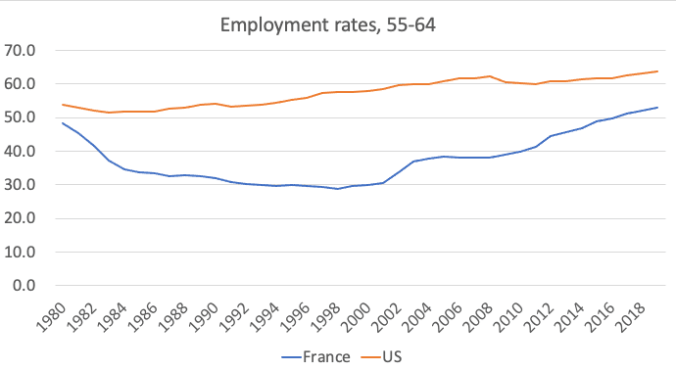
It’s not because incentives don’t matter. Clearly, they do. France’s high taxes haven’t led to low employment of prime-age adults, but generous benefits for those who retire early have led to low employment among near-seniors:
The French are a retiring people. Credit…OECD
How, then, can we explain the lack of clear responses (other than tax avoidance) to changes in the tax rate on top incomes?
One answer, which I suspect is relevant in the uppermost strata of the income distribution, is that at that level people don’t seek more money so they can afford more things, since they’re already able to afford far more luxury than anyone can enjoy. Instead, it’s about keeping score; that is, their goal is to make as much or more than the people they compare themselves with. And raising taxes on rich people in general doesn’t eliminate the race to out-earn one’s rivals.
Even to the extent that the rich seek income for what it can buy, however, it’s not clear that cutting their taxes will lead to greater effort. Indeed, it could lead to reduced effort, because it becomes easier for them to afford what they want.
Readers who took economics probably realize that I’m talking about income effects as opposed to substitution effects, a distinction that plays a crucial role in understanding how wages affect labor supply.
As most intro econ texts including the best one explain, higher wages have two effects on workers. They have an incentive to work more, because an extra hour gets them more stuff. But they’re also more affluent, which lets them consume more — and one of the things they might choose to consume is more leisure, i.e., they might choose to work less.
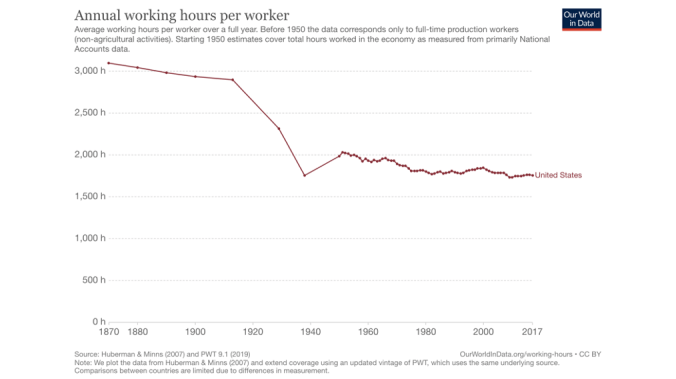
Historically, in fact, higher wages have generally led to reduced working hours. Wages have increased enormously over the past century and a half, but the workweek has gotten a lot shorter:
Wages up, hours down. Credit…Our World in Data
So if tax cuts for the rich are like a wage hike, they could lead to less rather than more effort.
But wait: the top tax rate is a marginal rate, not an average rate. Individuals making, say, $600,000 a year pay 37 percent on the last dollar they earn, but most of their income is taxed at substantially lower rates — and those rates won’t be affected if President Biden succeeds in raising the top rate back to 39.6 percent. So you might think that raising or lowering the top rate is not, in fact, much like changing affluent Americans’ wages.
But here’s the thing: most of the earned income accruing to people in the top tax bracket is, in fact, taxed at the top rate. (Capital gains etc. are a different story.) Why? Because the distribution of income at the top is itself very unequal: there are huge disparities even within the economic elite. According to estimates by Thomas Piketty and Emmanuel Saez, almost half the income of the top 1 percent accrues to the top 0.1 percent, a category that begins at around three times as high a threshold.
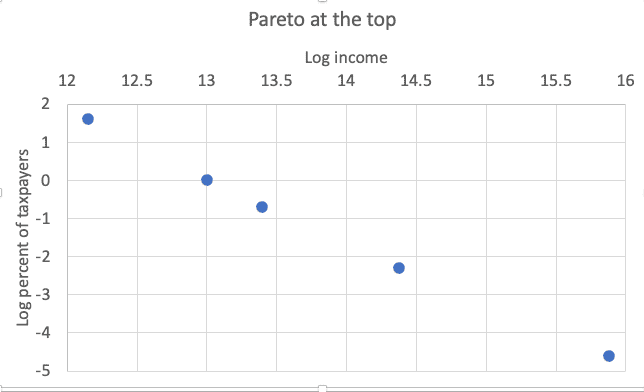
Now, high incomes closely follow a Pareto distribution, indeed to an eerie extent. Here’s a plot of high incomes versus the percentage of taxpayers with incomes above that level, both expressed in natural logs:
A weirdly exact relationship. Credit…Piketty and Saez
In such a distribution, the top .05 percent is to the top 0.5 percent what the top 0.1 percent is to the top 1 percent, so what is true of the distribution of income within the 1 percent is also true of the distribution within the roughly 0.5 percent of Americans subject to the top tax rate. This means that, as I said, most of the income accruing to that group is taxed at the top rate. And this in turn means that cutting that top rate is more like an across-the-board wage rise for the elite than you might think — and wage rises don’t tend to increase work effort.
Or to put it a bit differently, while tax cuts for the rich may offer an incentive to work harder, they’re also a big giveaway that encourages the elite to work less.
Of course, the fact that tax cuts at the top are a big giveaway is precisely the reason that belief in the immense economic importance of low taxes is such an unkillable zombie. As Upton Sinclair famously said, it’s difficult to get a man to understand something when his salary depends on his not understanding it.
Krugman is right that resistance to taxation – whether motivated by ideology or pure self-interest – is a stubbornly persistent phenomenon here in the US. For all the reasons we’ve been discussing, a lot of people just don’t trust the government to make good use of their tax dollars, so they don’t want to give up any of their hard-earned wealth to support it. Why should they support an institution that’s just going to throw their money away on wasteful bureaucracy and inefficient regulations? The irony here, though, is twofold: First, of course, is the basic point that we’ve been coming back to throughout this post, which is that the existence of government regulation and bureaucracy is the very thing that enables markets to function well enough for taxpayers to earn their incomes in the first place – so although it might not always be perfectly efficient, putting a fraction of those earnings back into the government can’t exactly be called a waste of money. But the second irony, which we haven’t really discussed yet, is that to the extent that government actually is sometimes hampered by needless bureaucracy and inefficiency, this is often precisely because people treat it with so much mistrust, so it’s therefore forced to tie itself in knots making sure that all its i’s are dotted and t’s are crossed. Alexander explains, quoting commenter deiseach:
Also, the idea of the maverick coming in and tearing up the rule book and saving the day with his or her bold new thinking outside the box of the stuffy bureaucrats is great in the movies, but in real life – it doesn’t work like that.
I don’t know if it’s the same in America, but here in Ireland I can tell you one reason why the principle of “cover your ass” is implemented: because politicians love to make campaign promises of cutting public spending, reducing waste and inefficiency in the public service, and saving taxpayers’ money. And the public loves those promises, because who wants to pay more tax?
Which means that the civil service and local government gets entangled in rules and limitations about what they can spend, how they can spend it, when they can spend it, and on what they can spend it. Which means that if you can’t account down to the last fifty cents on the invoices to the auditors who arrive in every year to examine the accounts, you are in genuine trouble. I did an evening course in computerised accounts to upskill last year, and most of those on the course were all in local government/town council work. One of the students told the course tutor that she had trouble reconciling her accounts – she was out something around €5,000.
The tutor, who came from private industry, told her not to worry, that this was within acceptable limits for business. The rest of the class laughed hollowly and explained to him that, if we were out €5 on accounts in the public service, the auditors would haul us over the coals. He was astonished that we had so little autonomy, but that’s what happens when the decisions have to be kicked upstairs to the Minister because every penny has to be accounted for, because it’s cheap and easy PR for a government representative to raise a question about public spending in parliament to make it sound to his constituents as if he’s a watchdog on the spending of the taxes.
This resonated with me because it was part of the reason I find libertarians actively dangerous. I didn’t view libertarianism as dangerous because it would create a small government and that would be bad – libertarians have never been remotely successful in creating a small government, and if they did maybe that would be good.
The problem with libertarians is that they don’t make government smaller, they just make it more defensive.
Accuse government officials of bias and corruption, point to their lack of documentation as proof of their guilt, then accuse them of being paper-pushing bureaucrats who prefer forms to efficiency when they start obsessively documenting everything they do. Make the police fill out endless forms before going to catch a criminal because the criminal’s rights might be violated; then when the police have to break the rules in order to keep order, say that their dishonest ways prove they need more limitations and surveillance. Take a research agency, cut the funding it needs to do good research because it’s a parasitic leech and the government just wastes all its money anyway, and then when it can’t do good research with the remainder, pat yourself on the back for predicting its inevitable failure. Criticize every single government decision for nepotism or racism or idiocy, then when the government switches to doing everything according to a single standard procedure in some manual, accuse them of being inhuman and unable to react to changes in the situation.
What Alexander’s saying here, in short, is that accusations of government waste and inefficiency can often become self-fulfilling prophecies. The more pressure government institutions are put under to provide maximum accountability while also cutting costs as much as possible, the less freedom and flexibility they have to do their jobs. And the ultimate result is often the kind of “compromise” that ends up pleasing no one. As commenter PostalPenguin observes:
Congress generates compromises that are worse than either party’s own idea.
It’s like building a house. Democrats want a complete house while Republicans block the installation of a roof and windows because of “cost”. So in a year the house is falling apart and requires more money for repairs just to keep from falling down. Even then the house doesn’t really accomplish what a house is supposed to do: keep you safe and out of the elements. Republicans sit back and say “Look at that POS house the Democrats are wasting your taxpayer money on!”
Of course, as undesirable as these kinds of results are at the object level, PostalPenguin is right to point out that on a more strategic level, they can actually be good for anti-statists – because the more wasteful and incompetent the government appears to be, the more it feeds into their narrative and undermines the credibility of government itself as an institution. Any time there’s some kind of big crisis over, say, debt ceiling negotiations, and it’s unclear if the government is even going to be able to continue to function at all, or if it’s all going to go to hell in a handbasket, this is actually the opposite of a crisis for anti-statists – because after all, keeping the government from being able to accomplish anything is exactly what they want; that’s the whole goal of their ideology. So they have every incentive to try and create such messes, not avoid them; as far as they’re concerned, the more they can weaken the potency of Big Government, the better. As commenter philasurfer puts it:
One of the reasons Republicans can always come across as in control is because they have no investment in government. What I mean by that is, the more government appears dysfunctional, the more it plays into Republican arguments about the failures of government. So Republicans always have the nuclear option in their pocket. They can shut down government, defund things, basically sabotage the government.
Democrats do not have that luxury. They need government to function well in order for their arguments to succeed. As a result, [they] are forced to concede a lot of ground to Republicans in order to keep government functioning and working. Democrats are basically always negotiating with terrorists who are willing to kill the hostage.
In other words, Republicans have the ironic advantage of being able to achieve their goals precisely by screwing everything up; to paraphrase P.J. O’Rourke, they can run for office on the platform that government doesn’t work, and then prove it once they’re elected.
Mike Lofgren, a former long-time Republican staffer in Washington, attests to the accuracy of this point:
A couple of years ago, a Republican committee staff director told me candidly (and proudly) what the method was to all this obstruction and disruption. Should Republicans succeed in obstructing the Senate from doing its job, it would further lower Congress’s generic favorability rating among the American people. By sabotaging the reputation of an institution of government, the party that is programmatically against government would come out the relative winner.
A deeply cynical tactic, to be sure, but a psychologically insightful one that plays on the weaknesses both of the voting public and the news media. There are tens of millions of low-information voters who hardly know which party controls which branch of government, let alone which party is pursuing a particular legislative tactic. These voters’ confusion over who did what allows them to form the conclusion that “they are all crooks,” and that “government is no good,” further leading them to think, “a plague on both your houses” and “the parties are like two kids in a school yard.” This ill-informed public cynicism, in its turn, further intensifies the long-term decline in public trust in government that has been taking place since the early 1960s – a distrust that has been stoked by Republican rhetoric at every turn (“Government is the problem,” declared Ronald Reagan in 1980).
The media are also complicit in this phenomenon. Ever since the bifurcation of electronic media into a more or less respectable “hard news” segment and a rabidly ideological talk radio and cable TV political propaganda arm, the “respectable” media have been terrified of any criticism for perceived bias. Hence, they hew to the practice of false evenhandedness. Paul Krugman has skewered this tactic as being the “centrist cop-out.” “I joked long ago,” he says, “that if one party declared that the earth was flat, the headlines would read ‘Views Differ on Shape of Planet.’”
Inside-the-Beltway wise guy Chris Cillizza merely proves Krugman right in his Washington Post analysis of “winners and losers” in the debt ceiling impasse. He wrote that the institution of Congress was a big loser in the fracas, which is, of course, correct, but then he opined: “Lawmakers – bless their hearts – seem entirely unaware of just how bad they looked during this fight and will almost certainly spend the next few weeks (or months) congratulating themselves on their tremendous magnanimity.” Note how the pundit’s ironic deprecation falls like the rain on the just and unjust alike, on those who precipitated the needless crisis and those who despaired of it. He seems oblivious that one side – or a sizable faction of one side – has deliberately attempted to damage the reputation of Congress to achieve its political objectives.
This constant drizzle of “there the two parties go again!” stories out of the news bureaus, combined with the hazy confusion of low-information voters, means that the long-term Republican strategy of undermining confidence in our democratic institutions has reaped electoral dividends. The United States has nearly the lowest voter participation among Western democracies; this, again, is a consequence of the decline of trust in government institutions – if government is a racket and both parties are the same, why vote? And if the uninvolved middle declines to vote, it increases the electoral clout of a minority that is constantly being whipped into a lather by three hours daily of Rush Limbaugh or Fox News. There were only 44 million Republican voters in the 2010 mid-term elections, but they effectively canceled the political results of the election of President Obama by 69 million voters.
I talked earlier about how one of the things that makes democracy work is voters having the ability to notice when they’re dissatisfied with their representatives’ performance and replace them with someone else. But when one party is able to create a bunch of dysfunction in government and then mislead voters into thinking it’s the other party’s fault (or that it’s just an inherent problem with government itself), this can short-circuit that whole process and undermine democracy’s ability to properly function. Thankfully, this tactic can only be pushed so far before voters catch on to what’s really happening – but in the meantime, all it accomplishes is to needlessly waste a bunch of time and energy and resources that could be better spent on something actually useful.
And creating a bunch of internal disruption to stir up anti-government sentiment isn’t the only way anti-statist politicians can thwart government’s ability to function, either. Another more subtle approach, as Krugman explains, is to cut its legs out from under it by depriving it of funding, and then using that lack of funding as a pretext to gut various programs in the name of “fiscal responsibility”:
Ever since Reagan, the G.O.P. has been run by people who want a much smaller government. In the famous words of the activist Grover Norquist, conservatives want to get the government “down to the size where we can drown it in the bathtub.”
But there has always been a political problem with this agenda. Voters may say that they oppose big government, but the programs that actually dominate federal spending — Medicare, Medicaid and Social Security — are very popular. So how can the public be persuaded to accept large spending cuts?
The conservative answer, which evolved in the late 1970s, would be dubbed “starving the beast” during the Reagan years. The idea — propounded by many members of the conservative intelligentsia, from Alan Greenspan to Irving Kristol — was basically that sympathetic politicians should engage in a game of bait and switch. Rather than proposing unpopular spending cuts, Republicans would push through popular tax cuts, with the deliberate intention of worsening the government’s fiscal position. Spending cuts could then be sold as a necessity rather than a choice, the only way to eliminate an unsustainable budget deficit.
By using this more roundabout technique to target popular government programs – passing huge unfunded tax cuts, then pointing to the resulting budget deficits as evidence that the country can’t afford to keep those programs – Republicans have at various points managed to successfully deprive many such programs of the resources they need to function. As Krugman goes on to point out, though, because those programs are still so popular among voters, merely depriving them of resources hasn’t actually been enough to eliminate them outright; all it’s done is make them worse and less effective. So again, all we’re left with is a government that’s still doing the same things as before, but just doing them worse – like the proverbial half-built house with no roof or windows that ends up being a bigger waste of money than a fully-built house would have been. Government hasn’t actually been stopped; it’s just been stopped from doing anything useful.
Needless to say, this isn’t exactly an optimal model for effective governance. Sure, it’s good and healthy to have some critics within government who can scrutinize its spending decisions and make sure it’s not wasting taxpayers’ money on unworthy causes. And it’s also good to allow room for disagreement and debate about which causes actually are the most appropriate ones for government to get involved in and which aren’t. That’s what democracy is all about. But crude attempts to just wreck the whole thing are no substitute for actually engaging in this democratic process and trying to address areas of disagreement in a straightforward and constructive way. Simply trying to “burn it all down,” while it may be ideologically cathartic for some anti-statists, is hardly ever an actual solution to anything. Commenter geerussell puts it this way:
[It’s] kind of like starving your dog because he had an accident on the carpet. Well, OK that does solve one problem but if you liked having a dog, if you needed a dog for any particular purpose… it’s probably not a smart solution.
If you want better government, however you happen to define “better” … fiscal handcuffs aren’t a shortcut to it. Starving the beast doesn’t make it smarter or better trained, just weaker in the performance of its duties. There’s no avoiding the long, detailed slog of improving policies and process. If we want fewer wars, we have to do the hard work of putting real legal constraints in place. If we want fewer bailouts, we have to do the hard work of building and regulating an improved financial system … and so on across the spectrum of policy.
It’s true that government, like any large institution, can sometimes be inefficient and/or ineffective. Waste and corruption are problems that really do exist and always have to be guarded against, just as they do in any big company or organization. That being said, though, the fact that public institutions don’t always work perfectly doesn’t justify their outright abolition, any more than the fact that private institutions don’t always work perfectly justifies their abolition. Sure, many of us have had frustrating experiences with the DMV or the IRS – but many of us have had equally frustrating experiences with our phone companies, cable companies, credit card companies, insurance companies, and so on, and nobody’s arguing that those sectors should therefore be wiped out of existence. Even after the collapse of the banking sector brought down the entire economy and cost us hundreds of billions of dollars as a country, nobody argued that banks should therefore no longer exist. We all recognize that sectors like banking and phone service, despite having their share of issues, are overall positives for our society. And the same is true of government. A genuinely democratic system of government, when implemented properly, can provide benefits that no private-sector institution can provide. So when we do run into problems within the government, we ought to try to improve it, not dispense with it altogether. To repeat Atcheson’s line from earlier, the solution to bad government is good government, not no government. Corruption and inefficiency obviously ought to be rooted out wherever they do exist – I don’t think any reasonable person would argue otherwise – but trying to resolve such issues by doing away with government entirely is like trying to solve a headache with a guillotine. Sure, it technically solves your immediate problem – but it doesn’t exactly do so in a way that leaves you better off in any kind of broader sense.
 N.W. Rains