Of course, having just made the case that we should make sure everyone’s basic needs are met even if it makes the economy as a whole less productive, I’ll now reveal that I don’t actually consider this to be all that much of a dilemma – because in reality, I don’t think these two goals actually oppose each other at all (or at least, they don’t necessarily have to); if implemented in an effective way, I think that having a strong social safety net ultimately makes an economy more healthy and productive. Sure, it might mean that the richest people aren’t quite as rich (albeit not enough to make any perceptible difference in their quality of life) – but at the level of the broader society, it seems clear that the positives more than outweigh the negatives. As commenter Crapfter puts it:
When other people have a better life, you personally have a better life too. You don’t even have to have empathy to support this stuff, you just have to not want to actively support other people’s misery. All things being equal, people would support this stuff for selfish reasons.
Because even when you don’t personally know a single one of the people who benefit from all these things, when more people are happy and healthy and wealthy and educated, the crime rate drops. Suicide drops. There’s less contagious disease. The economy is healthier. The natural environment benefits. You’re less likely to be a victim of violent crime, property crime, or terrorist attacks. People who vote in the same elections as you are casting their votes with better educations and more awareness of the issues. Your government spends less money on policing and prisons and has more left over to repair pot holes and improve your library or community center. More people are working on cures for whatever diseases you’ll eventually develop. I could go on and on.
This goes back to our earlier discussion of positive externalities; when people are healthy and educated and generally doing well in life, they aren’t the only ones who benefit. The secondary effects are contagious, because when people are doing well themselves, they’re able to more easily make things better for others in turn. What this means, then, is that a strong social safety net isn’t just a drain on society – it’s an investment in it. And sure enough, the numbers bear this out; according to a study by Jorge Luis García, James J. Heckman, Duncan Ermini Leaf, and María José Prados, for instance (as summarized by commenter smurfyjenkins), “every dollar spent on high-quality, early-childhood programs for disadvantaged children returned $7.3 over the long term. The programs led to reductions in taxpayer costs associated with crime, unemployment and healthcare, as well as contributing to a better-prepared workforce.” This is an incredible return on investment, to say the least. But really, is it all that surprising? After all, we can imagine coming at the issue from the opposite angle and asking what kind of outcomes we might expect if we made children more deprived and disadvantaged; do we think this would somehow produce better results overall? As Krugman puts it:
The evidence suggests that welfare-state programs enhance social mobility, thanks to little things like children of the poor having adequate nutrition and medical care. And conversely, of course, when such programs are absent or inadequate, the poor find themselves in a trap they often can’t escape, not because they lack the incentive, but because they lack the resources.
I mean, think about it: Do you really believe that making conditions harsh enough that poor women must work while pregnant or while they still have young children actually makes it more likely that those children will succeed in life?
The same question applies to social programs for adults as well as those for children; as Holmes and Sunstein write, quoting Smith:
What about the commonplace that a “right to welfare” discourages productive labor? This sounds rather plausible at first hearing. But an argument on the other side, formulated by Adam Smith, also has a certain weight: “That men in general should work better when they are ill fed than when they are well fed, when they are disheartened than when they are in good spirits, when they are frequently sick than when they are generally in good health, seems not very probable.”
The truth is, if a government chooses not to invest in social programs to keep its people safe and healthy and well-educated and so on, it’ll still end up having to spend money on them regardless – it’s just that instead of spending it in ways that empower them to contribute positively, it’ll have to spend it on cleaning up the messes that inevitably result from their decreased productivity and increased propensity for crime and so on – hiring more police to deal with the increased indigent population, building more prisons to contain the increased criminal population, etc. The government will still be having to pay steep costs – it just won’t get any benefits. And ironically, the more it denies people their most basic needs, the less of an incentive it’ll give them to want to avoid prison in the first place – since as John Stuart Mill points out, prison will be the only place left where they actually can get guaranteed food and shelter:
Since the state must necessarily provide subsistence for the criminal poor while undergoing punishment, not to do the same for the poor who have not offended is to give a premium on crime.
In light of the fact that the government is going to have to spend money to take care of its people’s basic needs either way, then, why wait until after they’ve been driven to criminality and locked away in prison to do so? Why not ensure that their needs are met early on, and thereby prevent all the social deterioration and crime from ever materializing in the first place? This is one area where it seems clear that an ounce of prevention is worth a pound of cure.
Of course, despite this logic, anti-statists will still often insist that giving the government any authority at all to implement this kind of mass-scale redistribution is a bridge too far; they’ll say that by granting it the power to seize citizens’ resources and use them for whatever it decides is best, we’re opening the floodgates to the kind of government overreach that inevitably descends into tyranny. But Alexander points out the empirical failure of this argument:
[Q]: I’m on board with doing things that have the best consequences. And I’m on board with the idea that some government interventions may have good consequences. But allowing any power to government is a slippery slope. It will inevitably lead to tyranny, in which do-gooder government officials take away all of our most sacred rights in order to “protect us” from ourselves.
History has never shown a country sinking into dictatorship in the way libertarians assume is the “natural progression” of a big-government society. No one seriously expects Sweden, the United Kingdom, France, or Canada to become a totalitarian state, even though all four have gone much further down the big-government road than America ever will.
Those countries that have collapsed into tyranny have done so by having so weak a social safety net and so uncaring a government that the masses felt they had nothing to lose in instituting Communism or some similar ideology. Even Hitler gained his early successes by pretending to be a champion of the populace against the ineffective Weimar regime.
Czar Nicholas was not known for his support of free universal health care for the Russian peasantry, nor was it Chiang Kai-Shek’s attempts to raise minimum wage that inspired Mao Zedong. It has generally been among weak governments and a lack of protection for the poor where dictators have found the soil most fertile for tyranny.
The same is true when it comes to the specific issue of taxation as well. Although anti-statists will often decry taxation as something that can only ever be used as a tool of government oppression, the truth is that the worst governments nowadays are typically the ones that have the least need for taxation and can instead rely on other sources of revenue (like natural resources) that don’t require them to be accountable to taxpayers. As Fukuyama puts it:
Alternative sources of fiscal support [besides taxes], such as natural resource rents or foreign aid, […] permit governments to bypass their own citizens. The struggle between the king and parliament over taxation could not play out in an oil-rich country, which is perhaps why so few of them are democratic.
Wealth in natural resources hinders both political modernization and economic growth. Two Harvard economists, Jeffrey D. Sachs and Andrew M. Warner, looked at ninety-seven developing countries over two decades (1971–89) and found that natural endowments were strongly correlated with economic failure. On average the richer a country was in mineral, agricultural, and fuel deposits, the slower its economy grew—think of Saudi Arabia or Nigeria. Countries with almost no resources—such as those in East Asia—grew the fastest. Those with some resources—as in western Europe—grew at rates between these two extremes. There are a few exceptions: Chile, Malaysia, and the United States are all resource rich yet have developed economically and politically. But the basic rule holds up strikingly well.
Why are unearned riches such a curse? Because they impede the development of modern political institutions, laws, and bureaucracies. Let us cynically assume that any government’s chief goal is to give itself greater wealth and power. In a country with no resources, for the state to get rich, society has to get rich so that the government can then tax this wealth. In this sense East Asia was blessed in that it was dirt poor. Its regimes had to work hard to create effective government because that was the only way to enrich the country and thus the state. Governments with treasure in their soil have it too easy; they are “trust-fund” states. They get fat on revenues from mineral or oil sales and don’t have to tackle the far more difficult task of creating a framework of laws and institutions that generate national wealth (think of Nigeria, Venezuela, Saudi Arabia). A thirteenth-century Central Asian Turkish poet, Yusuf, put this theory simply and in one verse:
To keep the realm needs many soldiers, horse and foot; To keep these soldiers needs much money. To get this money, the people must be rich; For the people to be rich, the laws must be just. If one of these is left undone, all four are undone; If these four are undone, kingship unravels.
A version of this theory holds that any state that has access to easy money—say, by taxing shipping through a key canal (as with Egypt) or even because of foreign aid (as with several African countries)—will remain underdeveloped politically. Easy money means a government does not need to tax its citizens. When a government taxes people it has to provide benefits in return, beginning with services, accountability, and good governance but ending up with liberty and representation. This reciprocal bargain—between taxation and representation—is what gives governments legitimacy in the modern world. If a government can get its revenues without forging any roots in society, it is a court, not a state, and its businessmen courtiers, not entrepreneurs. The Saudi royal family offers its subjects a different kind of bargain: “We don’t ask much of you economically and we don’t give much to you politically.” It is the inverse of the slogan of the American Revolution—no taxation, but no representation either.
This is not to say that countries should hope to be poor in natural resources. Many poor countries become neither democratic nor capitalist. Political institutions, leadership, and luck all matter. Similarly, some countries develop even though they are rich—just as some trust-fund kids turn out well. Most European countries began democratizing when they were better off than the rest of the world. But […] Europe had unique advantages. Its long history of battles between church and state, Catholics and Protestants, and kings and lords created liberal institutions and limited state power. Some non-European countries have had variations of these struggles. For example, the political diversity of India, with its dozens of regions, religions, and languages, might actually secure its democratic future rather than threaten it. Polish democracy has been strengthened by a strong and independent church. In general it is fair to conclude that although certain historical and institutional traits help, capitalist growth is the single best way to overturn the old feudal order and create an effective and limited state.
Regimes that get rich through natural resources tend never to develop, modernize, or gain legitimacy. […] Easy money means little economic or political modernization. The unearned income relieves the government of the need to tax its people—and in return provide something to them in the form of accountability, transparency, even representation. History shows that a government’s need to tax its people forces it to become more responsive and representative of its people.
The trouble is that once a state profits from mineral wealth, it is unlikely to democratize. The easiest way to incentivize the leader to liberalize policy is to force him to rely on tax revenue to generate funds. Once this happens, the incumbent can no longer suppress the population because the people won’t work if he does.
If we want to see which countries are the most equitable and prosperous and successful, we won’t find them among those that do the least taxation and redistribution; on the contrary, the most successful countries today are the ones that provide the strongest social safety nets for their populations and use high taxes to fund them. It has become a cliché in conversations like this for liberals to inevitably bring up the Nordic countries of Northern Europe (Finland, Sweden, Norway, Iceland, and Denmark) as exemplars of government done right – but frankly, they’re right to do so, because these countries really are doing it better than anyone else out there at the moment. As Bernie Sanders explains:
In Denmark, social policy in areas like health care, child care, education and protecting the unemployed are part of a “solidarity system” that makes sure that almost no one falls into economic despair. Danes pay very high taxes, but in return enjoy a quality of life that many Americans would find hard to believe. As the ambassador [Peter Taksoe-Jensen has] mentioned, while it is difficult to become very rich in Denmark no one is allowed to be poor. The minimum wage in Denmark [set through collective bargaining agreements] is about twice that of the United States and people who are totally out of the labor market or unable to care for themselves have a basic income guarantee of about $100 per day.
Health care in Denmark is universal, free of charge and high quality. Everybody is covered as a right of citizenship. The Danish health care system is popular, with patient satisfaction much higher than in our country. In Denmark, every citizen can choose a doctor in their area. Prescription drugs are inexpensive and free for those under 18 years of age. Interestingly, despite their universal coverage, the Danish health care system is far more cost-effective than ours. They spend about 11 percent of their GDP on health care. We spend almost 18 percent.
When it comes to raising families, Danes understand that the first few years of a person’s life are the most important in terms of intellectual and emotional development. In order to give strong support to expecting parents, mothers get four weeks of paid leave before giving birth. They get another 14 weeks afterward. Expecting fathers get two paid weeks off, and both parents have the right to 32 more weeks of leave during the first nine years of a child’s life. The state covers three-quarters of the cost of child care, more for lower-income workers.
At a time when college education in the United States is increasingly unaffordable and the average college graduate leaves school more than $25,000 in debt, virtually all higher education in Denmark is free. That includes not just college but graduate schools as well, including medical school.
In a volatile global economy, the Danish government recognizes that it must invest heavily in training programs so workers can learn new skills to meet changing workforce demands. It also understands that when people lose their jobs they must have adequate income while they search for new jobs. If a worker loses his or her job in Denmark, unemployment insurance covers up to 90 percent of earnings for as long as two years. Here benefits can be cut off after as few as 26 weeks.
In Denmark, adequate leisure and family time are considered an important part of having a good life. Every worker in Denmark is entitled to five weeks of paid vacation plus 11 paid holidays. The United States is the only major country that does not guarantee its workers paid vacation time. The result is that fewer than half of lower-paid hourly wage workers in our country receive any paid vacation days.
Recently the Organization for Economic Cooperation and Development (OECD) found that the Danish people rank among the happiest in the world among some 40 countries that were studied. America did not crack the top 10.
As Ambassador Taksoe-Jensen explained, the Danish social model did not develop overnight. It has evolved over many decades and, in general, has the political support of all parties across the political spectrum.
Naturally, as Sanders points out, all these social programs require considerably higher levels of taxation than we have here in the US – so you might wonder if they can really be that popular among the population. After all, according to many conservatives, if US taxes were any higher than they are now, it would at the very least make the highest earners not want to live here anymore, and would prompt them to flee the country en masse, taking their wealth with them and leaving the country worse off. For this reason and others, these conservatives say, such high tax rates would be unsustainable. But if they really believe this, they must not be familiar with how things work in the Nordic countries, where taxes actually are considerably higher than in the US, and yet people are still perfectly happy to stay and continue paying them. In these countries, people are willing to accept their tax bills even if the taxes are higher than they’d be in other countries, because the quality of life they enjoy as a result is also higher than what it’d otherwise be. Sure, their after-tax income may be lower; but they don’t actually need as much after-tax income in the first place, since so many of their biggest would-be expenses (healthcare, education, etc.) are covered by the state – and generally at a much lower cost than if they were having to pay for them themselves out of their own pockets. In other words, they’re getting more for their money by paying more of it to the government – not just because it allows them to live in communities that are safe and clean and healthy, but because it allows them to enjoy the simple peace of mind that comes from knowing they’ll never have to worry about not being able to afford their children’s preschool, or not being able to pay for healthcare, or not having enough money to go to college, or not having enough savings to retire, or any of the countless other such things that produce a constant baseline of stress and anxiety for so many Americans. In fact, not to put too fine a point on it, it’s not uncommon to hear Nordic political commentators use the phrase “American conditions” as a scare term for the kind of dysfunction and economic insecurity that would result from changing to a more “everyone for themselves” type of system – severe inequality, high crime, haphazard provision of healthcare, and so on. Pretty ironic, considering how much conservative American commentators like to warn about the dangers of turning “socialist” and ending up like Europe.
The fact of the matter is that thanks to their robust social programs, Nordic countries routinely outperform the US in practically all areas – education and literacy, healthcare, crime prevention, employment, overall quality of life, and more. But surely there must be a major downside to all this social stability in terms of their overall economic performance, right? Surely these countries must be taxing themselves so much that they’re suffering from a severe lack of dynamism and entrepreneurship and all those sorts of things?
Actually, the opposite is true; Nordic countries maintain elite levels of economic competitiveness, and they routinely place near the top of global competitiveness rankings (often ahead of the US). They’re widely considered some of the best places in the world to create wealth – with their most famous companies including household names like Volvo, IKEA, Spotify, Maersk, Ericsson, Skype, H&M, Lego, Saab, and Nokia – and in fact, they even produce more billionaires per capita than the US does. (See Harald Eia’s TED Talk on the subject here.)
How can it be that these countries with their high taxes and robust social safety nets are also so good for business? Well, it’s really not all that unbelievable if you think about it; after all, there’s no reason why having high taxes and robust safety nets should mean that a country can’t also have lots of business freedom. In fact, in a very real sense, these countries’ generous social programs are what enable them to have such pro-growth business environments in the first place; as commenter solomute notes:
The most prosperous and peaceful societies in the world, “socialist utopias” like Denmark and Sweden, are actually regarded as the most capitalist societies on the planet. The problem with capitalism in America is that there are too few capitalists. The folks running around burning shit don’t have an ownership stake in society, no investment in its success, and that’s why they don’t care if it burns. A robust social safety net, universal health care, government-funded paternity and maternity leave, debt-free postsecondary education, and other “socialist” policies free people to take risks, make investments, and start their own businesses.
Even something as simple as workers having healthcare coverage that’s not needlessly tied to their private-sector jobs can make a big difference in terms of the dynamism of the labor market, as commenters ConstantinesRevenge and 2pactopus point out in their discussion of the American system:
Employers shouldn’t be responsible for individual employee healthcare contributions. Decoupling this would encourage more free movement of labor.
[…]
And [it would help get] people who are actually fit for the job into these positions.
I don’t know how many times I’ve heard people say something along the lines of “Yeah, I don’t like the job all that much but hell, it pays the bills and the health benefits are nice while my kids are still in school.”
Creativity is brewed from passion, not from people grasping for a pay raise they desperately need.
Unfortunately for Americans, the US still hasn’t quite figured this out yet – so as strong as its economic performance generally is, it’s still much less efficient than it could be. Nordic countries, on the other hand, give their citizens a far greater ability to pursue the careers where they can have the greatest impact – and when you combine this with the fact that they also give their citizens access to free higher education and quality job training (as opposed to charging them tens or hundreds of thousands of dollars like the US does), it’s no surprise at all that these countries are thriving as much as they are in terms of innovation and entrepreneurship. As I wrote previously (and again, you can skim past this part if you already read the last post – you know the drill by now), these countries thrive because their strong markets and their strong social safety nets don’t conflict with each other, but actually reinforce each other and help each other to function even more effectively. The safety nets give firms and individuals the freedom to take risks and pursue their market advantages without worrying that they’ll be utterly ruined if they fail, and the wealth that those people subsequently produce as a result of that risk-taking (along with a relative lack of regulatory interference) ensures a healthy enough tax base to keep the safety nets strong and well-funded. Businesses fail and people lose their jobs all the time – and the government allows this to happen without trying to impede it – but it’s okay, because the government also helps the people who’ve lost their jobs or businesses to get right back on their feet again, thereby making the economy as a whole that much more dynamic. As Kathleen Thelen and Cathie Jo Martin explain:
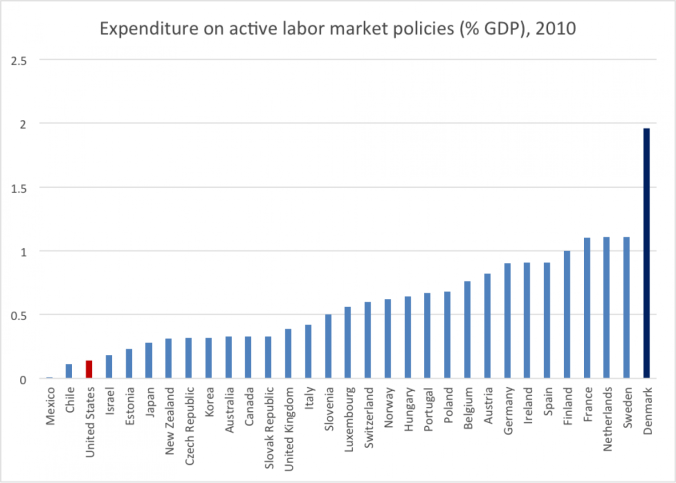
When people think of the “Danish model” they tend to think first about the country’s generous social policies, and assume that the point of all of this is to protect people from the market. This is wrong: Danish labor markets are very flexible. The difference with the United States is that [Danish] labor market policies are precisely designed to move the unemployed into training programs that enhance their marketable skills. This helps them reenter the labor market as soon as possible and is the core of the country’s famous “flexicurity” model — high flexibility in the labor market combined with extensive state support for skill development. Denmark spends more on active labor market policies than other OECD countries, far and away more than the United States, which is a laggard in this respect, as the graph below shows.
[…]
Denmark is the most egalitarian country in the world, but in December 2014, Forbes (once again) ranked Denmark as the best country in the world to do business. (The U.S. ranking was 18th.) The country’s formula for growth is a high level of workforce skills and extensive cooperation among employers and workers to support labor market flexibility.
[…]
The most important institutions underpinning this flexible approach are those that help both young people and adults develop skills. Denmark has an extremely well developed system for initial vocational education and training (for youth) – well supported both by employers and the state. This is one reason why Denmark’s “NEET” rate (the number of young people Not in Employment, Education or Training) is comparatively low. Beyond this, though, the government also supports ongoing skill development for adults, as well – and not just for the unemployed. Denmark is a leader in adult education – providing training courses that are easily accessed, generously supported by the state and widely available to anyone who wishes to enhance his or her own skills. This is why Denmark has one of the highest rates of participation in adult education and training in the world. Rapid technological change makes it important for all adults to be able to upgrade their skills flexibly and throughout their working lives. This is not big brother socialism. This is really smart capitalism.
[…]
Retraining and vocational training policies both support “flexicurity,” [retooling] workers whose skills are becoming outdated with changing economic conditions. Workers may be easily laid off from their jobs but the government will quickly move them into training programs and then back into the workforce. For example, in 2011 Denmark spent about five percent of its GDP on training, compared to the U.S., which spent less than one percent.
Most people assume the United States is the most [market-friendly] country. Not so.
[…]
The Wall Street Journal and Heritage Foundation produce an annual Index of Economic Freedom. They rate countries for their respect for property rights, freedom from corruption, business freedom, labor freedom, monetary freedom, trade freedom, investment freedom, financial freedom, fiscal freedom, and government spending. Hong Kong, Singapore, Australia, New Zealand, Switzerland, Canada, Chile, Mauritius, and Ireland have higher overall scores than the United States.
… Australia, New Zealand, the United Kingdom, Canada, and Switzerland have higher levels of economic freedom. Many of the Scandinavian countries—which Americans often call “socialist”—beat the US on many central aspects of economic freedom.
[…]
We should regard Denmark in particular as economically freer than the United States. Yes, Denmark has high tax rates, but on almost every measure of economic freedom, it trounces the US.
Denmark ranks much higher than the United States on property rights, freedom from corruption, business freedom, monetary freedom, trade freedom, investment freedom, and financial freedom. Luxembourg, the Netherland, the United Kingdom, and many other countries beat the US on these measures as well. Thus, many other European countries might reasonably be considered more economically libertarian than the US.
[…]
Denmark also rates 99.1 in business freedom, 90.0 in investment freedom, and 90.0 in financial freedom. In comparison, the US scores 91.1, 70.0, and 70.0 respectively on these measures.)
Denmark and Switzerland have remarkably effective welfare states, but that doesn’t make them [socialist]. Rather, think of them as free market countries with strong, well-functioning social insurance programs.
The above quotations point to Denmark as the archetypal example of how strong markets and strong safety nets can bolster each other, and for good reason. But this isn’t just a Danish thing; the same is true across all the Nordic countries. Of all those famous Nordic companies I listed a moment ago, for instance, most of them are Swedish. And Max Chafkin wrote a whole big piece about how it works in Norway; here’s an excerpt:
Norway, population five million, is a very small, very rich country. It is a cold country and, for half the year, a dark country. (The sun sets in late November in Mo i Rana. It doesn’t rise again until the end of January.) This is a place where entire cities smell of drying fish—an odor not unlike the smell of rotting fish—and where, in the most remote parts, one must be careful to avoid polar bears. The food isn’t great.
Bear strikes, darkness, and whale meat notwithstanding, Norway is also an exceedingly pleasant place to make a home. It ranked third in Gallup’s latest global happiness survey. The unemployment rate, just 3.5 percent, is the lowest in Europe and one of the lowest in the world. Thanks to a generous social welfare system, poverty is almost nonexistent.
Norway is also full of entrepreneurs like Wiggo Dalmo. Rates of start-up creation here are among the highest in the developed world, and Norway has more entrepreneurs per capita than the United States, according to the latest report by the Global Entrepreneurship Monitor, a Boston-based research consortium. A 2010 study released by the U.S. Small Business Administration reported a similar result: Although America remains near the top of the world in terms of entrepreneurial aspirations — that is, the percentage of people who want to start new things—in terms of actual start-up activity, our country has fallen behind not just Norway but also Canada, Denmark, and Switzerland.
If you care about the long-term health of the American economy, this should seem strange—maybe even troubling. After all, we have been told for decades that higher taxes are without-a-doubt, no-question-about-it Bad for Business. President Obama recently bragged that his administration had passed “16 different tax cuts for America’s small businesses over the last couple years. These are tax cuts that can help America—help businesses…making new investments right now.”
Since the Reagan Revolution, which drastically cut tax rates for wealthy individuals and corporations, we have gotten used to hearing these sorts of announcements from our leaders. Few have dared to argue against tax cuts for businesses and business owners. Questioning whether entrepreneurs really need tax cuts has been like asking if soldiers really need weapons or whether teachers really need textbooks—a possible position, sure, but one that would likely get you laughed out of the room if you suggested it. Or thrown out of elected office.
Taxes in the U.S. have fallen dramatically over the past 30 years. In 1978, the top federal tax rates were as follows: 70 percent for individuals, 48 percent for corporations, and almost 40 percent on capital gains. Americans as a whole paid the ninth-lowest taxes among countries in the Organization for Economic Cooperation and Development, a group of 34 of the largest democratic, market economies. Today, the top marginal tax rates are 35 percent, 35 percent, and 15 percent, respectively. (Even these rates overstate the level of taxation in America. Few large corporations pay anywhere near the 35 percent corporate tax; Warren Buffett has famously said that he pays 18 percent in income tax.) Only two countries in the OECD—Chile and Mexico—pay a lower percentage of their gross domestic product in taxes than we Americans do.
But there is precious little evidence to suggest that our low taxes have done much for entrepreneurs—or even for the economy as a whole. “It’s actually quite hard to say how tax policy affects the economy,” says Joel Slemrod, a University of Michigan professor who served on the Council of Economic Advisers under Ronald Reagan. Slemrod says there is no statistical evidence to prove that low taxes result in economic prosperity. Some of the most prosperous countries—for instance, Denmark, Sweden, Belgium, and, yes, Norway—also have some of the highest taxes. Norway, which in 2009 had the world’s highest per-capita income, avoided the brunt of the financial crisis: From 2006 to 2009, its economy grew nearly 3 percent. The American economy grew less than one-tenth of a percent during the same period. Meanwhile, countries with some of the lowest taxes in Europe, like Ireland, Iceland, and Estonia, have suffered profoundly. The first two nearly went bankrupt; Estonia, the darling of antitax groups like the Cato Institute, currently has an unemployment rate of 16 percent. Its economy shrank 14 percent in 2009.
Moreover, the typical arguments peddled by business groups and in the editorial pages of The Wall Street Journal—the idea, for instance, that George W. Bush’s tax cuts in 2001 and 2003 created economic growth—are problematic. The unemployment rate rose following the passage of both tax-cut packages, and economic growth during Bush’s eight years in office badly lagged growth during the Clinton presidency, before the tax cuts were passed.
And so the case of Norway—one of the most entrepreneurial, most heavily taxed countries in the world—should give us pause. What if we have been wrong about taxes? What if tax cuts are nothing like weapons or textbooks? What if they don’t matter as much as we think they do?
[…]
Norwegians don’t think about taxes the way we do. Whereas most Americans see taxes as a burden, Norwegian entrepreneurs tend to see them as a purchase, an exchange of cash for services. “I look at it as a lifelong investment,” says Davor Sutija, CEO of Thinfilm, a Norwegian start-up that is developing a low-cost version of the electronic tags retailers use to track merchandise.
Sutija has a unique perspective on this matter: He is an American who grew up in Miami and, 20 years ago, married a Norwegian woman and moved to Oslo. In 2009, as an employee of Thinfilm’s former parent company, he earned about $500,000, half of which he took home and half of which went to the Kingdom of Norway. (The country’s tax system is progressive, and the highest tax rates kick in at $124,000. From there, the income tax rate, including a national insurance tax, is 47.8 percent.) If he had stayed in the U.S., he would have paid at least $50,000 less in taxes, but he has no regrets. (For a detailed comparison, see “How High Is Up?”) “There are no private schools in Norway,” he says. “All schooling is public and free. By being in Norway and paying these taxes, I’m making an investment in my family.”
For a modestly wealthy entrepreneur like Sutija, the value of living in this socialist country outweighs the cost. Every Norwegian worker gets free health insurance in a system that produces longer life expectancy and lower infant mortality rates than our own. At age 67, workers get a government pension of up to 66 percent of their working income, and everyone gets free education, from nursery school through graduate school. (Amazingly, this includes colleges outside the country. Want to send your kid to Harvard? The Norwegian government will pick up most of the tab.) Disability insurance and parental leave are also extremely generous. A new mother can take 46 weeks of maternity leave at full pay—the government, not the company, picks up the tab—or 56 weeks off at 80 percent of her normal wage. A father gets 10 weeks off at full pay.
These are benefits afforded to every Norwegian, regardless of income level. But it should be said that most Norwegians make about the same amount of money. In Norway, the typical starting salary for a worker with no college education is a very generous $45,000, while the starting salary for a Ph.D. is about $70,000 a year. (This makes certain kinds of industries, such as textile manufacturing, impossible; on the other hand, technology businesses are very cheap to run.) Between workers who do the same job at a given company, salaries vary little, if at all. At Wiggo Dalmo’s company, everyone doing the same job makes the same salary.
The result is that successful companies find other ways to motivate and retain their employees. Dalmo’s staff may consist mostly of mechanics and machinists, but he treats them like Google engineers. Momek employs a chef who prepares lunch for the staff every day. The company throws a blowout annual party—the tab last year was more than $100,000. Dalmo supplements the standard government health plan with a $330-per-employee-per-year private insurance plan that buys employees treatment in private hospitals if a doctor isn’t immediately available in a public one. These benefits have kept turnover rates at Momek below 2 percent, compared with 7 percent in the industry.
But it takes more than perks to keep a worker motivated in Norway. In a country with low unemployment and generous unemployment benefits, a worker’s threat to quit is more credible than it is in the United States, giving workers more leverage over employers. And though Norway makes it easy to lay off workers in cases of economic hardship, firing an employee for cause typically takes months, and employers generally end up paying at least three months’ severance. “You have to be a much more democratic manager,” says Bjørn Holte, founder and CEO of bMenu, an Oslo-based start-up that makes mobile versions of websites. Holte pays himself $125,000 a year. His lowest-paid employee makes more than $60,000. “You can’t just treat them like machines,” he says. “If you do, they’ll be gone.”
If the Norwegian system forces CEOs to be more conciliatory to their employees, it also changes the calculus of entrepreneurship for employees who hope to start their own companies. “The problem for entrepreneurship in Norway is it’s so lucrative to be an employee,” says Lars Kolvereid, the lead researcher for the Global Entrepreneurship Monitor in Norway. Whereas in the U.S., about one-quarter of start-ups are founded by so-called necessity entrepreneurs—that is, people who start companies because they feel they have no good alternative—in Norway, the number is only 9 percent, the third lowest in the world after Switzerland and Denmark, according to the Global Entrepreneurship Monitor.
This may help explain why entrepreneurship in Norway has thrived, even as it stagnates in the U.S. “The three things we as Americans worry about—education, retirement, and medical expenses—are things that Norwegians don’t worry about,” says Zoltan J. Acs, a professor at George Mason University and the chief economist for the Small Business Administration’s Office of Advocacy. Acs thinks the recession in the U.S. has intensified this disparity and is part of the reason America has slipped in the past few years. When the U.S. economy is booming, the absence of guaranteed health care isn’t a big concern for aspiring founders, but with unemployment near double digits, would-be entrepreneurs are more cautious. “When the middle class is shrinking, the pool of entrepreneurs is shrinking,” says Acs.
We have a tendency here in the US to get so swept up in our own domestic issues that we forget that it’s possible to live in any way other than how we’re currently living. When liberals argue that it should be possible for us to live in a country with widespread prosperity and a strong social safety net and universal healthcare and top-tier education and so on, conservatives will often dismiss the idea out of hand as an absurd utopian fantasy, insisting that there would simply be no way to pay for it, and adding that liberals’ inability to recognize this obvious fact only demonstrates their lack of intellectual seriousness. That kind of conservative dismissiveness might be more defensible if the US really were the only country in the world and we had no way of knowing what other kinds of systems were possible. But it’s a lot harder to defend when liberals can refute it by simply pointing to the Nordic countries and saying, “No, actually, we know that the kind of system we want is possible, because it literally already exists and is being successfully implemented in these other countries; all we’re proposing is for the US to simply copy what they’re doing.” At that point, all conservatives can do is fall back on the rationalization that there must just be some unique deficiency in America’s culture or demographics or whatever that would prevent it from being able to successfully copy the Nordic system – but needless to say, I don’t think that argument has met its burden of proof yet. Certainly, I can see how there might be some unique parts of American culture that have up to this point prevented us from wanting to try a more Nordic kind of system – rugged individualism and all that – but that’s not the same thing as saying that if we did ever give it a try, it would be impossible for us to implement successfully. That latter point seems like it’s usually just flatly asserted without any actual empirical support behind it.
Now, there is one other strategy that conservatives might employ here, which is to accept the premise that it’s possible to find examples of foreign countries that are better off than the US because they’ve adopted superior policies, but to then contend that liberals are wrong about which countries those are – that the countries that are actually best off are those that have adopted conservative policies, like having extremely low taxes and being extremely business-friendly. In actuality, of course, the conservatives who make this argument will usually just have one country that they want to name as their example – specifically Singapore (or maybe Hong Kong if they’re reaching). But the irony of this is that Singapore actually is one of those countries whose wealth is largely due to a combination of factors that are specific to it and wouldn’t be generalizable as a universal model for all countries (hence why conservatives tend to have such a hard time naming other countries where it’s working). As Alexander explains:
Reactionaries are never slow to bring up Singapore, a country with some unusually old-fashioned ideas and some unusually good outcomes. But as I have pointed out in a previous post, Singapore does little better than similar control countries, and the lion’s share of its success is most likely due to it being a single city inhabited by hyper-capitalist Chinese and British people on a beautiful natural harbor in the middle of the biggest chokepoint in the world’s most important trade route.
In particular, he notes how Singapore’s role as a regional financial hub puts it in a unique position that can’t just be straightforwardly copied by every other country – recall this point from earlier:
[Being a] small financial [hub] like Singapore, Dubai, or Switzerland […] is good work if you can get it, but it really only works for one small country per region; you can’t have all of China be “a financial hub”. In the 1980s, everyone was so impressed with Singapore and Hong Kong that they became the go-to models for development, and people incorrectly recommended liberal free market policies as the solution to everything. But the Singapore/Hong Kong model doesn’t necessarily work for bigger countries, and most of the good financial hub niches are already filled by now.
Singapore and Hong Kong are especially unique cases because, as Alexander mentions, they’re basically just single cities, with functionally 0% of their populations employed in sectors like agriculture and mining, and 100% of their land being urban. Only a handful of city-states like this exist in the world, and all of them are able to organize their economies in ways that other countries simply can’t, precisely because their small size allows them to so effectively hyper-specialize. Commenter idio3 provides a tongue-in-cheek example of an even more pronounced instance of this to illustrate the point:
There’s an even better example! Monaco. 0% income tax. 0% unemployment. Maybe we should all move to a casino and Formula One Grand Prix based economy? Seems legit to me.
In other words, while city-states can produce genuinely impressive results (Monaco is in fact the richest country in the world on a per-capita basis), they don’t provide scalable models that the rest of the world can copy; their success fundamentally depends on the fact that they are so small and specialized.
At any rate, Singapore isn’t really a great example for conservatives regardless, because a lot of the things they like so much about it – the business freedom, the low taxes, etc. – aren’t actually as unambiguously conservative as they want to claim they are. Having lots of business freedom, for instance, is something that countries with strong social safety nets can achieve just as readily as countries without them, if not more so – as we just saw with the Nordic countries (and as we can also see with other countries across the world, from Europe to East Asia) – so it’s not really an argument against them. As for low taxes, it’s true that Singapore’s personal income tax rates (along with its levels of overall government spending) are relatively low. But as Vanessa Snodgrass-Chong points out, one partial reason for this is the fact that the size of its taxpaying workforce, which is considerably inflated by a massive population of migrant workers, is so large relative to that of its non-working population (i.e. children, retirees, and others who are more likely to need government benefits):
[Singapore has a] relatively small population of retirees, [so compared to other countries,] the dependency ratio is much more favorable for Singapore. Singapore has a workforce of about 3.9 million workers supporting 678,100 people over 65. This works out to about 5.7 workers to each person over 65 in Singapore. The figure for most other countries is around 3. [See also the global rankings here.] Singapore can do this because it has a very large foreign workforce. About 45 percent of the work force comprises non-residents. So, the tax burden is spread over a much larger base of workers in Singapore.
What’s more, while all those migrant workers contribute to the tax base and help reduce the burden of paying for government services for native-born Singaporeans, they’re excluded from receiving many of those government services and social programs themselves, which reduces government expenditures further still (and therefore reduces the need for taxes to fund them). Native-born Singaporeans, in other words, enjoy their low taxes at least in part because foreign workers are helping foot the bill.
But even when it comes to the taxes that native-born Singaporeans do pay, there are still other reasons why their individual income tax rates are so low – probably the most obvious of these being the simple fact that the government has other means of collecting revenue from the population aside from just that one tax. As commenter user18 explains, the Singaporean state has all kinds of other taxes and fees that it uses to make up for its low income taxes, including unconventional ones like extreme taxes on car ownership:
One unusual revenue source deserves commentary: car taxes, including the so-called Certificate of Entitlement (COE). The COE is simply a piece of paper that entitles you to own a car. This recent news story [from 2016] mentions how the COE price hit a 5-year low, at “only” S$45,002 (≈ US$31,600) for small cars. [By late 2023 it had risen back up to around US$80,000.]
These COEs (“Vehicle Quota Premiums”) make up 6.0% of government revenue.
Besides this very expensive piece of paper, a car-owner still has to pay all the other usual taxes (GST, road taxes) and insurance, plus a lot of unusual fees (e.g. Electronic Road Pricing – an idea which London borrowed). A lot of these flow to government coffers. Together, these make Singapore easily the most expensive place in the world to own cars.
On top of this, the Singaporean government gets a major share of its revenue from the fact that it flat-out owns and controls massive portions of the economy, including nearly all the land, the vast majority of housing, and a sizeable fraction of the country’s corporations. As Bruenig explains:
In the Heritage Foundation’s Index of Economic Freedom, Singapore ranks as the second most “economically free” country in the world just behind Hong Kong. Since many use this index as a shorthand for “most capitalist” countries, a lot of prominent people end up saying some really weird things about Singapore. For instance, in his Liberty Con remarks, Bryan Caplan claimed Singapore was one of the closest countries to the capitalist ideal.
It is true of course that Singapore has a market economy. But it’s also true that, in Singapore, the state owns a huge amount of the means of production. In fact, depending on how you count it, the Singaporean government probably owns more capital than any other developed country in the world after Norway.
The Singaporean state owns 90 percent of the country’s land. Remarkably, this level of ownership was not present from the beginning. In 1949, the state owned just 31 percent of the country’s land. It got up to 90 percent land ownership through decades of forced sales, or what people in the US call eminent domain.
The Singaporean state does not merely own the land. They directly develop it, especially for residential purposes. Over 80 percent of Singapore’s population lives in housing constructed by the country’s public housing agency HDB. The Singaporean government claims that around 90 percent of people living in HDB units “own” their home. But the way it really works is that, when a new HDB unit is built, the government sells a transferable 99-year lease for it. The value of that lease slowly declines as it approaches the 99-year mark, after which point the lease expires and possession of the HDB unit reverts back to the state. Thus, Singapore is a land where almost everyone is a long-term public housing tenant.
Then there are the state-owned enterprises, which they euphemistically call Government-linked Companies (GLCs). Through its sovereign wealth fund Temasek, the Singaporean government owns a large share (20% or more) of 20 companies (2012 figure). Together these companies make up 37% of the market capitalization of the Singaporean stock market. The state also owns a large share of 8 real estate investment trust (REIT) companies (2012 figure), which they call GLREITs. The value of the GLREITs make up 54% of the country’s total REIT market.
The sovereign wealth fund Temasek doesn’t just own domestic assets. It also is invested broadly throughout the world, especially in other Asian countries. In March of last year, Temasek had a net portfolio value of S$275 billion, which is equal to around 62% of the country’s annual GDP. To put this figure in more familiar terms, Temasek’s total holdings are equivalent to if the US government built a $12.4 trillion wealth fund.
Call me old-fashioned, but I don’t generally associate state ownership of the means of production with capitalism. One way to see whether libertarians or conservatives actually think Singapore’s system is uber-capitalistic is to imagine how they would respond to someone who ran a campaign in the US aimed at bringing the country up to the Singaporean ideal.
In this campaign, the candidate would say that the state should expropriate nearly all of the land in the country, build virtually all of the housing in the country, move almost everyone into public housing leaseholds, become the largest shareholder of more than a third of the country’s publicly-traded companies (weighted by market capitalization), and build out a sovereign wealth fund that holds tens of trillions of dollars of corporate assets. Would this campaign meet with a warm libertarian embrace or perhaps be derided as a bit socialistic?
When a government has this much ownership of the economy, it’s no surprise that it won’t have as much need for extra tax revenue on top of all this. Conservatives may like to point to Singapore as an example of limited government – and in some ways, it certainly is – but in other ways, it’s exactly the opposite. And this brings us to one last tax-related point. It’s true that despite all the caveats, Singapore is a country that keeps its taxing and spending relatively low; and it’s also true that aside from all the other factors I’ve listed here, one of the biggest reasons for this is that it really doesn’t provide all that many “government handouts” to its citizens. Compared to other wealthy countries with their robust state-funded social safety nets, Singapore doesn’t offer nearly as much in terms of things like healthcare, unemployment benefits, pensions, etc. Instead, it relies on a compulsory savings program known as the CPF, which requires citizens to set aside a portion of their earnings in specially designated accounts, then pay for their own expenses using those funds. (These are more akin to individual personal accounts than to a universal fund that the government collects from everyone, pools together, and then redistributes according to need.) It’s ostensibly a less government-heavy approach, since the government isn’t directly controlling how and when each individual’s funds are spent – hence why American conservatives tend to think so highly of it. But this is far from saying it’s a system that has “gotten government out of the picture,” as those conservatives might want to claim, and we should be under no illusion that this is the case. The government is still very much intervening in the private sector to dictate how much of people’s earnings must be set aside for social welfare purposes – it’s just that instead of directly handling the spending of those funds itself, it does so by mandate; instead of pooling the funds together to build a universal social safety net, it compels people to build their own individual safety nets (while still providing more traditional safety nets for its poorest citizens on a strict means-tested basis). In a sense, the Singaporean system is simultaneously “further to the left and further to the right” than the American system, as Matt Miller puts it. But in any event, it’s still using government coercion to achieve its ends – and in fact, in many ways its use of government power is actually considerably less constrained than ours is.
To be clear, the fact that Singapore (or any country) has a strong and capable government can be a very good thing when it comes to providing for its citizens’ welfare; the whole point of this post, after all, has been to argue that government can be good, and historians will attest that in Singapore’s case in particular, its government has been a major factor in its economic success. With that being said, though, we should be wary of American conservatives’ arguments that because of its economic achievements, we should therefore consider the Singaporean government a role model for our own government – because the flip side of Singapore’s economic successes story is that its government also uses its power in ways that aren’t just economically conservative, but are right-wing in more extreme and disturbing ways that often infringe on basic human rights. Here we’re moving beyond purely economic matters, so this is somewhat of a separate conversation from the one we’ve been having so far – but we’d be remiss not to at least acknowledge the fact that, for instance, Singapore’s ruling party controls the press, curbs political opposition, and doesn’t allow free assembly, among other things. As a recent State Department report summarizes:
Significant human rights issues [in Singapore have] included credible reports of: preventive detention by the government under various laws that dispense with regular judicial due process; monitoring private electronic or telephone conversations without a warrant; serious restrictions on freedom of expression and media, including the enforcement of criminal libel laws to limit expression; serious restrictions on internet freedom; and substantial legal and regulatory limitations on the rights of peaceful assembly and freedom of association.
In addition to this, the Singaporean government is infamous for imposing extreme punishments like caning, imprisonment, and crippling fines for minor infractions like littering and graffiti. If you smuggle chewing gum into the country, you may be arrested, jailed, and fined thousands of dollars. And if you bring drugs into the country, you may be flat-out executed; capital punishment (specifically death by hanging) is mandatory for many crimes, including some drug offenses. As Connor Kilpatrick sardonically points out, it isn’t exactly what we’d consider a “limited government” kind of regime:
Ah, Singapore: a city-state near the very top in the world when it comes to “number of police” and “execution rate” per capita. It’s a charming little one-party state where soft-core pornography is outlawed, labor rights are almost nonexistent and gay sex [was only decriminalized in 2022; gay marriage and adoption remain illegal]. Expect a caning if you break a window. And death for a baggie of cocaine.
But hey: no capital gains tax! (Freedom!)
Most relevant to our economic discussion, this kind of authoritarianism even extends into areas like poverty and homelessness. Conservatives will often approvingly cite Singapore’s low homelessness rate as a sign of its economic health – but a major part of the reason why there’s so little homelessness there is that the Singaporean government has functionally made it illegal to be homeless; anyone found sleeping rough can be forcibly institutionalized, and anyone caught begging can be jailed and fined thousands of dollars. In other words, it’s not that Singapore has solved the problem of homelessness; it’s just that it has forbidden anyone from living there unless they can afford a home. Anyone who can’t is forced to either live outside its borders (remember, Singapore is basically just a single city) or risk being locked away. And while that’s certainly one way to reduce homelessness rates, it’s not exactly a humane one – and it’s definitely not one that could be generalized to every country in the world. If we actually want to solve problems in a way that’s humane and constructive, we can’t just have an authoritarian government declare those problems illegal; we actually have to do the work of building a universal system of social support that makes sure everyone’s most basic human rights are respected.
 N.W. Rains
