Anti-statists’ main argument is that people have a fundamental right to their own property, and that the government therefore can’t claim any of that property for itself without unjustly coercing them. It’s a pretty straightforward premise as far as it goes. But it does raise some even more basic questions that are worth considering: What exactly does it mean to say that someone is entitled to the property that they own? And for that matter, what does it even mean to say that someone owns property in the first place?
Let’s stick with the island analogy for a moment: Imagine that you and a bunch of other people are shipwrecked on an uncharted island (or a whole other planet, if you really want to take the thought experiment to the extreme) and have to start an entirely new civilization from scratch. How would you handle the question of property rights and who owns what? If someone just marched over to the eastern side of the island, for instance, and declared that the whole eastern half of the island belonged exclusively to them and that no one else could use it without their permission, would you be automatically obligated to respect that claim as a legitimate one? Would it be unjust and coercive to ignore their assertion and say that they had to share at least some of the island with everyone else?
The reason why these questions are important is because this scenario isn’t actually an entirely hypothetical one. When we think about how the concept of land ownership originally came about here in the real world, we can see that it would have essentially been the same kind of situation. In the initial state of nature, way back before anybody owned anything, the entire earth was a common-pool resource – which is to say, it “belonged” to everybody. Generations later, here in modern times, land is owned by specific people who enjoy the exclusive rights to it, while everyone else is forbidden to use it or access it without the owners’ permission. How did we get from Point A to Point B? Well, if you ask a modern-day landowner where their exclusive entitlement to their land came from, they’ll probably tell you that they bought it fair and square from the previous owner; and if you ask that previous owner the same question, they’ll probably give you the same answer; and you can keep going like that for centuries back into the past, with each owner buying the right to the land from the previous owner. But what about when you reach the very beginning of that chain? How did the very first owners of that land come to acquire it? Well, by all accounts, there wasn’t any kind of formalized process to it at all; they simply went over and asserted that they were now the exclusive owners of the land, and that everyone else would be excluded, by force if necessary. That is, it wasn’t a matter of mutually contracting with everyone else or obtaining unanimous consent from the community; they just seized the land from the commons and declared their willingness to fight off anyone who would challenge them on it. In those days before laws and governments became widespread, to say that a piece of property was “owned” by somebody simply meant that it was something they were willing and able to hold by force. In other words, their exclusive entitlement to the land they held wasn’t some kind of natural right bestowed upon them by God or whatever; it was something they were actively forcing the rest of the population to give up to them without consent.
Needless to say, this is a bit awkward for the anti-statists’ position that private property must be regarded as completely inviolable because coercing people to give it up would be unjust. Their argument is that taxing private property is wrong because it constitutes a kind of “theft” – but in this case, the property itself is the product of a kind of theft from the commons; so how can it really be the case that someone who seizes it from the rest of the community in this way should be regarded as the only one rightly entitled to its fruits?
The philosopher Pierre-Joseph Proudhon was the first one to really bring this point into the mainstream political discourse, inverting the “Taxation is theft” slogan with his equally pithy assertion that, actually, “property is theft.” But he wasn’t the only one to have noticed this issue, which has since become known as “the problem of initial acquisition.” In fact, as Matt Bruenig argues, he was just following the logic of the situation to its natural conclusion:
In Proudhon’s period, the animating assumption of essentially all works on property was that God created the earth and gave it to mankind in common to use. This was the long-standing Christian view, which was notably reflected in Thomist thought and even received a ringing endorsement from John Locke. The Christianist idea of the common ownership of all of the earth is Proudhon’s starting point.
From there, a question arises: if God initially gave the entire earth to mankind to own in common, then how can you ever have individual property? Or, to borrow a line from Locke, since the earth is given to mankind in common, “it seems to some a very great difficulty, how any one should ever come to have a property in any thing.” The correct answer to this question, reached by Proudhon but not Locke, is that the only way to move from universal common ownership to individual private ownership is through theft. When an individual appropriates pieces of the earth (e.g. land) out of the commons and into private ownership, that individual steals from everyone else. Everyone else’s ownership share in that piece of the earth is taken from them, violently and without their consent.
[…]
At this point, someone might try to get out of this outcome by saying that they don’t believe in initial common ownership. But that’s not really crucial to the argument.
Even under the hypothetical stories libertarians tell (“fact-defective potential explanations” in [Robert] Nozick’s parlance) about how property can originate, the fact is that at the initial point in time, everyone can access and use every single piece of the earth at their will. There are no restrictions. You can move about the world freely. Nobody can stop you. You truly have negative liberty in the sense that it would be wrong to interfere with your bodily movements.
But then something curious happens. Somehow (regardless of how it’s justified), individuals are permitted to appropriate pieces of the world privately. The upshot of such appropriation is that everyone else’s previously-existing ability to access and use the appropriated piece of the world is stolen from them without their consent. Those who do not go along with having their access and use stolen from them are met with violence. This is theft. Access and use, both valuable things, are taken from people at the barrel of a gun.
It’s often argued that philosophies like libertarianism and anarchism can be boiled down to a simple attitude of “You leave me alone, I’ll leave you alone.” But the fundamental problem with this idea, according to Proudhon, is that simply by claiming to be the sole owner of a piece of land or some other natural resource, you aren’t leaving others alone; you’re actively taking from them without their permission. As commenter dominosci puts it:
Even libertarian anarchists are inconsistent. The problem is that they claim to both
Oppose the initiation of force.
Support the institution of private property.
These two are in direct opposition. When someone claims private property they are claiming the right to exclude others by force. This “right” was not contractually acquired. They did not enter into an agreement with anyone. Rather, they seek to force this obligation (to give up access to the property) on others without their consent.
To be clear: I support private property. But a moral justification for property cannot be rooted the kind of contractual framework libertarians (anarchist or not) claim to adhere to.
If you really want to argue that it’s right and just for someone to own a piece of property, you have to provide some legitimate reason why they’re the ones who should be solely entitled to it, aside from just “Might makes right.” If the property in question is something that they’ve created entirely through their own labor, for instance, then that might give you a good argument for why they should be entitled to the full value of what they’ve created. But land and other natural resources aren’t created by anyone’s labor; the only way of acquiring them is by taking them from the commons. So for that reason, it’s hard to come up with a compelling reason why anyone should be able to claim the right to exclude everyone else from their use without providing them with any kind of compensation. In fact, as David Friedman notes, even if landowners could somehow demonstrate that all their land had initially been appropriated from the commons in a just and fair way, that still wouldn’t even come close to proving that here in the modern day, centuries later, the distribution of this land was still just and fair, since our species’ history of perpetual war and conquest and theft would practically guarantee that it would have been unjustly seized from its rightful owners by force (and thereby become illegitimately-held property) at some point along the way:
[One] difficulty with moral accounts of rights, in particular of property rights, is the degree to which the property rights that people actually respect seem to depend on facts that are morally irrelevant. This difficulty presents itself in libertarian accounts of property as the problem of initial acquisition. It is far from clear even in principle how unowned resources such as land can become private property. Even if one accepts an account, such as that of Locke, of how initial acquisition might justly have occurred, that account provides little justification for the existing pattern of property rights, given the high probability that any piece of property has been unjustly seized at least once since it was first cleared. Yet billions of people, now and in the past, base much of their behavior on respect for property claims that seem either morally arbitrary or clearly unjust.
As Michael Sandel writes (citing Nozick), the question of whether a piece of private property can be considered legitimate fundamentally comes down to a simple two-part test:
Nozick […] argues that distributive justice depends on two requirements—justice in initial holdings and justice in transfer.
The first asks if the resources you used to make your money were legitimately yours in the first place. (If you made a fortune selling stolen goods, you would not be entitled to the proceeds.) The second asks if you made your money either through free exchanges in the marketplace or from gifts voluntarily bestowed upon you by others. [Only] if the answer to both questions is yes [are you] entitled to what you have.
But by Proudhon’s reasoning, all instances of privately-held land and natural resources fail this test. So what are the implications of this? Should we just abolish all private ownership of land and natural resources and completely return everything to the commons? This seems like a bad idea, for all the reasons I laid out in my last post. Having said that, though, it also seems clear that if we’re going to allow people to take resources away from the rest of the population, they should at least be required to provide some kind of compensation for the resources they’re taking away – because otherwise they really would just be committing flat-out theft. As commenter Glory2Hypnotoad puts it:
Land is unique in that it’s not something you can just make; it can only be taken from the commons. So it makes sense that when a person takes a public resource and turns it into private property, they should give something back to the commons.
If we actually care about people’s right not to have their property forcefully taken away from them without their consent – the thing that anti-statists point to as the absolute foundation of their philosophy – then we should want to ensure that those whose property is taken away from them should be reimbursed for what they’ve lost, and that those who took the property should be the ones to provide that reimbursement – even if they have to be coerced into doing so – simply as a matter of basic justice. But what this means, ironically enough for the anti-statist position, is that taxing privately-held land and natural resources and redistributing their value to the broader population might not actually constitute theft at all, but on the contrary, might be a legitimate corrective measure rectifying the actual theft, and returning the value to those who were rightly entitled to it all along. In other words, it would be the precise opposite of theft. As DePonySum writes:
According to the non-aggression principle one should never interfere with the person or legitimate property of another without their permission, unless they have initiated aggression against one first. The non-aggression principle is sometimes taken to be a master argument for libertarian views against the redistribution of money or property – e.g., left wing proposals to redistribute money from the rich to the poor. I won’t argue either for or against the principle of nonaggression, as there are far more pressing ethical issues. Instead I’ll be contending that the non-aggression principle tells us nothing, at least directly, about the topic of redistribution.
In the definition of the non-aggression principle I insisted that the non-aggression principle applies to legitimate property. I’m not trying to smuggle anything especially controversial in here, by insisting on the term legitimate I’m simply insisting that you actually have to rightfully own the thing in question, it’s not enough to simply proclaim that one owns it. A moment’s reflection will show that this stipulation is necessary, if one owned everything one proclaimed one owned then many things would have multiple inconsistent ownership claims.
Consider the case of Bob. Bob passionately claims that he owns the Atlantic Ocean, he actually seems to believe this, and insists that no one should cross the Atlantic without his permission. When asked to justify this, he responds by saying that crossing his ocean without his permission is aggression, and everyone should accept an ethical norm against aggression. When confronted with this argument, there is no need to say anything for or against the non-aggression principle, one simply has to say that the Atlantic Ocean is not actually Bob’s, therefore no aggression against Bob has occurred.
This is where the champion of the non-aggression principle as a basis for libertarianism hits a problem. The supporter of redistributive taxation typically does not accept that the goods and monies to be redistributed are, in fact, the legitimate property of those they are being taken from. They hold, on the basis of a differing theory of distributive justice than that held by the libertarian, that they are the rightful property of someone else.
The libertarian will respond by insisting that, yes, the prior owner is the legitimate owner of the goods or monies in question, but notice that the argument has now strayed beyond the issue of non-aggression into a debate about who owns what. Our point is simple then, non-aggression tells us nothing about redistribution unless we assume that redistribution is a process of removing something from its rightful owner and giving it to someone else but this is part of what is under dispute in debates about distributive justice. The debate is really about who is the rightful owner of what, and unless one can win this debate, one might as well be Bob insisting that he owns the Atlantic. Just as there is no aggression against Bob implicit in sailing across the Atlantic Ocean and ‘breaching’ his sovereignty over that ocean, so perhaps there is no aggression in ‘taking’ money off [a rich person] to pay for redistribution, if the recipients of that redistribution are already the rightful owners of that money.
Put simply, taking your stuff is not aggression unless it actually does rightfully belong to you, and the whole project of the advocate for redistribution is to try and prove that, in some cases, it doesn’t.
In fact if the supporter of redistribution is correct about who rightfully owns what, then in the non-aggression principle would imply that action resisting redistribution is impermissible, as it would be a form of aggression.
Now of course the libertarian has responses to the advocate for redistribution. They can critique the arguments in favour of redistribution and propound their own theories of who owns what that do not allow much of a role for redistribution, for example, as Nozick does in Anarchy, State, and Utopia. However such arguments are not primarily appeals to non-aggression, rather they are total theories of who owns what. Nonaggression simply doesn’t cut at the difference between the libertarian and the redistributivist.
[…]
I think it’s useful to take a breath and clear our mind when we think about property. A lot of people imagine property as somehow metaphysically tied to a specific owner by intangible golden threads, and it’s worthwhile to remind ourselves that this is not so.
Never forget that ultimately there are just objects. Tables, chairs, parts of land, and people, which are a special kind of object. What is property then? Property is a kind of social arrangement giving certain people certain bundles of permissions regarding certain objects, and denying those permissions to everyone else. In the final analysis then, like all permissions and refusals, property is a collection of threats of social sanction, including violence.
It seems deeply unlikely to me that we will ever be free of property understood in this way, or that this is even desirable. Even a communist state wouldn’t want people trespassing in the nuclear power reactor without the right expertise – and what is the right to collectively exclude all people who lack special permission from a site but a kind of collective property?
Essential though it may be, re-framing property as the threat of sanction and violence, and not some metaphysical linkage, brings it into a new perspective. From this standpoint there is nothing especially ‘non coercive’ about, say, anarcho-capitalism, unless you take it as given that the claims it makes about who is entitled to what are ethically just.
To their credit, the libertarians and anarcho-capitalists are right about one thing: Given a particular distribution of wealth and natural resources, the free market really is a remarkably effective mechanism for enabling the people who own that wealth to transact with each other in such a way that they’re all made better off than they would have been otherwise. What the market doesn’t guarantee, though, is that the original distribution of that wealth will have been allocated fairly or justly in the first place. And even a passing familiarity with the history of land ownership here in the real world makes it abundantly clear that our original allocation of property most certainly did not meet that standard. Historically speaking, the distribution of property rights over land and other natural resources was largely just decided by whoever was the most powerful and dangerous and could seize the most of it for themselves by force. And even by the anti-statists’ own standard, such forcible seizure of property can’t rightly be regarded as legitimate. As commenter Deonatus puts it, “The idea that someone simply claims something as theirs first and therefore it’s theirs to protect by force seems pretty arbitrary.” We can easily see how obvious this is in the above example of Bob claiming to own the Atlantic Ocean; but as bluerepublik points out (harking back to our island analogy from earlier), it’s just as true of the land as it is of the sea and the air and the sky:
As a thought experiment… imagine you were on a sinking ship, and managed to swim to an island. 10 meters in front of you is another swimmer, and he reaches the island before you. By the time you get there, he tells you to stop and turn around. “The land is mine, I own it now. Go drown in the sea.” Is this fair, that he is able to stake a permanent and exclusionary right to land simply by arriving on it 30 seconds before you? What about a few hours? What about a year? 10 years? At what point does a man have the right to decide the earth is his forever, and that all who trespass upon it lose all of their own rights?
While obviously this is an extreme example, and not one we expect to see regularly in our own lives, the basic moral principle on negative rights holds true. You are demanding that others not exist on a certain portion of the earth. All Georgists say is that if you want such exclusionary rights, you need to pay a tax – no nationalization, not public ownership, just a tax on the rent; the scarcity of the land (and have the rents given back [to the rest of the population]).
That term “Georgist” near the end there, by the way, is referring to Henry George, the 19th-century political economist who was most responsible for popularizing this idea of a land tax. But although he’s the one whose name has become most associated with the concept, it’s an idea with a long history here in the US; and in fact, as a general principle, it goes as far back as the founding itself. Here, for instance, is Thomas Jefferson on the subject:
Whenever there are in any country uncultivated lands and unemployed poor, it is clear that the laws of property have been so far extended as to violate natural right. The earth is given as a common stock for man to labor and live on. If for the encouragement of industry we allow it to be appropriated, we must take care that other employment be provided to those excluded from the appropriation.
And here’s Thomas Paine, who was especially outspoken on the matter:
It is a position not to be controverted that the earth, in its natural, cultivated state was, and ever would have continued to be, the common property of the human race. In that state every man would have been born to property. He would have been a joint life proprietor with rest in the property of the soil, and in all its natural productions, vegetable and animal.
But the earth in its natural state […] is capable of supporting but a small number of inhabitants compared with what it is capable of doing in a cultivated state. And as it is impossible to separate the improvement made by cultivation from the earth itself, upon which that improvement is made, the idea of landed property arose from that parable connection; but it is nevertheless true, that it is the value of the improvement, only, and not the earth itself, that is individual property.
Every proprietor, therefore, of cultivated lands, owes to the community ground-rent (for I know of no better term to express the idea) for the land which he holds.
[…]
In advocating the case of the persons thus dispossessed, it is a right, and not a charity, that I am pleading for.
Paine insisted that [taxing land to fund government benefits for the rest of the population] did not represent an abandonment of his principles of private property and free markets. Individualist to the last, Paine justified his social insurance system on strict Lockean property principles. Revenues for social insurance would come from an inheritance tax, which in his day amounted to a land tax. This was just, because landowners, in enclosing a part of the earth that was originally held in common by all, had failed to compensate everyone else for their taking. Even if they had mixed their labor with the land in the original appropriation, this entitled them only to the value their labor added to the land. They could not claim to deserve the value of the raw natural resources, or the value of surrounding uses that enhanced the market price of land. Each member of society was entitled to their per capita share of these values. So, landowners still owed a rent to everyone else. By this reasoning, Paine justified social insurance as a universal right, not a charity.
And like I said, Paine was far from alone in his views. Commenter Lbuntu provides a nice list of quotations here from all kinds of prominent thinkers expressing support for land value taxation on the same basis – from free-market economists like Adam Smith and Milton Friedman, to liberals like Joseph Stiglitz and Ralph Nader, to heads of state like Winston Churchill and Franklin Roosevelt, to various other luminaries like Albert Einstein, Aldous Huxley, Leo Tolstoy, Mark Twain, Henry Ford, Bertrand Russell, and Frank Lloyd Wright.
Alexander condenses the whole premise into this simple summary:
Capitalists deserve to keep the value they create, but they also owe rent on common resources which they enclose and monopolize (eg land, raw materials). That rent gets paid to the State (as representative of the people who are denied use of the commons) in the form of taxes. The State then redistributes it to all the people who would otherwise be able to enjoy the monopolized resources – eg everybody. I think this process where businesses pay off the government for their raw materials is pretty similar to the process where they pay off the investors for their seed money, and that the whole thing fits within capitalism pretty nicely.
Now, at some point along the way here, a couple of potential objections might have occurred to you. First, you might think, “Wait a minute, this all sounds fine if we’re talking about taxing the people who first appropriated the land from the commons hundreds of years ago – but those people are long dead now, and the people who currently own the land are a whole other set of people; so how would any of these considerations still apply to them? Are we expecting them to be the ones to pay back the full value of the land even though they aren’t the ones who originally appropriated it?” But as those last few quotations above indicate, this isn’t really the right way to understand what a land value tax is. It’s not so much that the people who currently own land are in possession of property that was never paid for, and so they now have to foot the entire bill themselves; rather, it’s that land was never truly the legitimate property of anyone other than the community in the first place – it always rightfully belonged to the community even when it was solely being occupied by one person – and so rather than making a one-time lump-sum payment for the entire purchase price of the land, those who were holding it should have been paying rent on it to the community for that entire span of time. Unfortunately, the people who controlled the land back in pre-taxation times managed to get away with never paying the rent that they rightfully owed to the community. But those who own it today can pay the rent on it; that is, they can pay an annual tax based on the rental value of the land (as opposed to the full selling price) in exchange for being allowed to continue having exclusive rights over that land for another year.
Naturally, one logical consequence of this is that the higher a particular piece of land’s rental value is, the more its owners will be expected to pay their community in taxes. But it makes perfect sense that this should be the case – because after all, the reason why some pieces of land are more valuable than others in the first place has much less to do with whatever improvements their private owners might make to them than with what kind of value is added by the communities in which they’re located. That is, the reason why pieces of property in San Francisco and Manhattan are so much more valuable than those in the middle of nowhere is not because the landowners have built such nice buildings on top of them; in fact, the owners of the less valuable land might just as well have built identical buildings on their own properties, and those properties still wouldn’t be worth a fraction as much. (The buildings would increase the value some, of course, but they wouldn’t be the main factor.) Rather, the reason why the properties in thriving cities are so much more valuable than those in rural backwaters is precisely because they’re located in such attractive communities, which not only have all the important necessities like accessible roads, reliable utilities, well-equipped police and fire departments, etc., but also offer access to the best available schools, hospitals, restaurants, bars, movie theaters, parks, libraries, and opportunities for employment, dating, networking, and social life (not to mention, for business owners, proximity to customers, suppliers, and other businesses). For landowners in these cities, all these things increase their property values irrespective of whether they’ve actually done anything at all themselves to increase them. As George points out, someone could move out onto some land in the middle of nowhere, with no one else around for hundreds of miles, and that property would initially be worth very little – but if a few more people eventually moved in nearby and built (say) a grocery store, a drugstore, and a gas station, suddenly the land would be worth quite a bit more; and if still more people started moving in and making still more improvements to the budding community, the value of the land would increase further still; and it could keep on increasing like that as the area grew more and more developed until eventually the land was worth a fortune – and yet none of this would have required any contribution or effort whatsoever from the landowner, who could have just been sitting on their hands the entire time. The value that was created, in other words, would have had nothing to do with their own labor, but would have been created solely by those in the community around them – and so, because people are entitled to the value that they create by their own labor, that means that the members of community would be the ones entitled to the additional land value that was produced, not the landowner themselves. As a matter of basic justice and fairness, then, it would only be right for the landowner to pay them a tax reflecting that value.
Taxes on windfall gains arising through no effort are popular and just. The tax system should target windfalls, not work, whenever possible. This is the aim of the land value tax. […] It targets [an] annual windfall that at present is hardly taxed at all. The lion’s share of this goes to powerful and privileged freeloaders who fight tooth and nail to keep every penny. In doing so they harm the economy and […] damage the environment.
Who are these freeloaders? Nobody has explained this better than Winston Churchill in a speech in 1909: “Roads are made, streets are made, railway services are improved, electric light turns night into day, electric trams glide swiftly to and fro, water is brought from reservoirs a hundred miles off in the mountains – and all the while the landlord sits still… To not one of these improvements does the land monopolist as a land monopolist contribute, and yet by every one of them the value of his land is sensibly enhanced.”
Churchill knew that landowners cannot change the value of a plot of land. Its value depends only on location and size. Is it near a station? A park? Good schooling? All of these factors are determined by the community, not the landowner. The landowner can increase the value of the property, by building on it, or extending existing structures. But any increase in the value per square foot of the plot on which the buildings stand is a free ride, and any profit made from this is pure freeloading on the efforts of the community.
Again, it’s worth noting that under a true Georgist land value tax, landowners would still be entitled to any value that they created through their own efforts, like any crops they might grow or any buildings they might construct on the land. Everyone would still be entitled to the fruits of their own labor. The taxes they were paying would simply represent the rent that they owed to the rest of the community for occupying the land in the process of earning that income; in other words, they’d only be giving up the portion of their wealth that they hadn’t earned themselves, as is only fair.
(Note: I’m hoping to write a whole separate post on Georgism here eventually – but in the meantime, if you want to read more about it, you can check out Lars A. Doucet’s rundown here.)
But this brings us to the second potential objection that might have occurred to you, which is that the land value tax, as reasonable as it might sound, isn’t actually the kind of tax that most governments currently impose on their citizens. I initially framed this discussion as a question of how taxation might be justified in a hypothetical scenario where we were starting completely from scratch on an uninhabited island – and okay, sure, talking about why a land value tax would be justifiable might make sense in that context – but if we actually want to defend taxation in the real world, don’t we need to justify a bunch of other taxes, like income taxes and sales taxes and so on? Here in real life, people are taxed on all kinds of things other than just the land and natural resources that they use – so merely justifying land taxes alone won’t really cut it, will it?
Well, to some extent this is kind of a moot point, since in the broadest strokes, this whole assortment of other taxes tends to roughly approximate the effects of a land value tax, with rich people who have lots of assets and properties generally paying more in taxes, and poor people generally paying less. So it’s not like we can plausibly insist that none of the tax revenue currently being collected by these governments can be considered legitimate, since the bulk of it would still be collected under a land value tax anyway. Still though, the overlap is far from perfect; there are a lot of people out there right now paying considerably more in taxes than they would be if land value taxes were the only form of taxation around, and a lot of other people paying considerably less. So all those other taxes still need some kind of justification if we’re going to argue that they should continue existing, right?
I don’t think it’s too hard to find fairly strong justification for most such taxes simply on the basis of things like the “consent through acceptance of benefits” rationale mentioned earlier, as well as more straightforwardly utilitarian considerations, which I’ll get into momentarily. Having said that, though, I should also say that as it happens, I’m not entirely convinced that all our current taxes necessarily should be defended; I think that in all likelihood, we really would be better off if we got rid of a lot of them and replaced them with land value taxes instead. But what does this really mean? How many kinds of taxation could actually be replaced in this way, exactly? Well, funny you should ask – because believe it or not, there’s reason to think that the answer might in fact be as many of them as we want. According to some economists, the revenue generated by a land value tax, even if it were the only tax in effect, would actually be sufficient to fund all government services entirely on its own – so in theory, if we were ever able to phase out our current grab bag of assorted taxes while simultaneously phasing in a universal land value tax, that might be the only tax we’d need to justify having at all. (It’s why George’s original version of the land value tax was just called the “single tax.”) Stiglitz developed an economic proof in the 1970s showing just how this would be possible (which came to be known, appropriately enough, as the “Henry George theorem”), and the idea has since been condensed into the modern acronym ATCOR – “All Taxes Come Out of Rents” – which, in short, says that reducing taxes on things other than land increases land values, and conversely, increasing them reduces land values, so that ultimately, one will always end up perfectly displacing the other. I’m not an economist myself, so I can’t claim to have personally confirmed all the math behind this assertion or anything like that (although Stiglitz is a Nobel Prize winner, for whatever that’s worth) – but I will say that it does make sense to me just in basic logical terms. Imagine, for instance, if there was a particular city or state you were considering moving to, and you were willing to pay $20,000 per year to live on a piece of land there. If that jurisdiction one day decided to change its laws such that you’d have to pay an additional $5,000 per year in sales taxes or income taxes, the prospect of living in that jurisdiction would now be $5,000 less attractive to you – in other words, the rental value of the land there would have decreased to $15,000 per year. And conversely, if the jurisdiction lowered your income taxes or sales taxes by $5,000 per year, living there would now be $5,000 more attractive to you, so the rental value of the land would now have increased to $25,000. What this means, then, is that if the jurisdiction completely did away with its income taxes and/or sales taxes, and replaced them outright with a full land value tax, it would end up with exactly as much tax revenue as before, since the two would completely offset; eliminating the old taxes would increase the land rent by a particular amount, then that amount would be collected by the government as a land value tax. The only difference would be that unlike the old taxes, which would have inevitably created various market inefficiencies – decreasing people’s incentive to create value and earn money, for instance, by taxing them on sales and income – a land value tax wouldn’t create any such market inefficiencies at all. As Doucet explains:
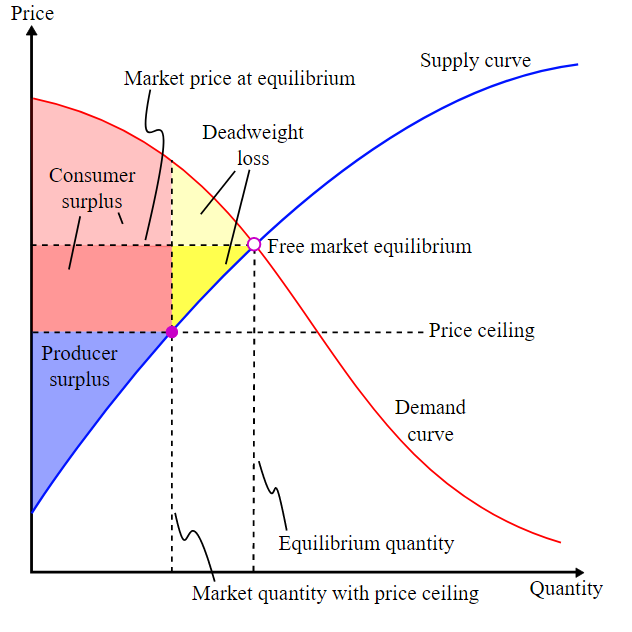
Today land value tax is widely considered to be the only tax that doesn’t suffer from Deadweight Loss.
Deadweight Loss is the lost economic activity or value caused by some policy. It’s often summarized by the phrase “If you want less of something, tax it.”
The place where the demand curve (red) and supply curve (blue) meet is the equilibrium point that the market naturally tends towards. But if we impose a price control lower than what the market will bear, the yellow area of the curve shows economic activity that can’t happen. If you put price controls on gasoline, for instance, you’ll get shortages because there’s more demand than supply, and supply can’t profitably rise to meet the extra bit of demand that’s willing to pay a little more.
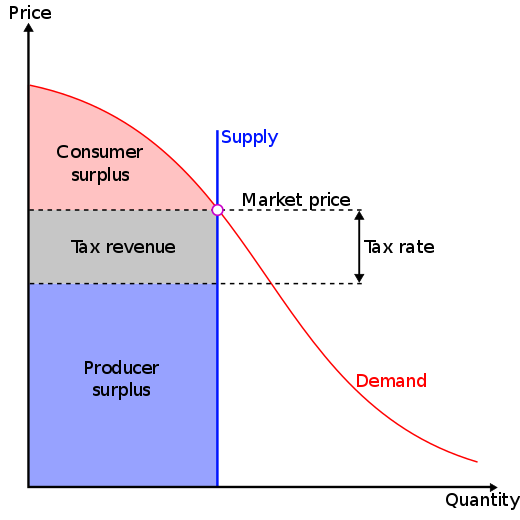
But here’s how things look with a land value tax, notice that the supply curve is vertical – that’s weird, what does that mean?
A vertical supply curve means no matter what the price of land is, the same amount will always be supplied. This is because you can’t make land – the supply is effectively fixed.
[…]
The supply of land being fixed has some really interesting properties. By contrast, consider oil, the supply of which is not fixed. If we tax oil, some of the more marginal wells will be too expensive to operate and make a profit, so producers shut those down and the supply of oil decreases. Deadweight loss comes from a producer’s ability to change the amount of product they supply in response to price signals. You’ll notice the above graph of land tax has no deadweight loss at all!
Since nobody produces land, it’s the one thing you can tax without getting less of it. This drives out speculators entirely. Speculators can no longer distort rents by bidding up the price of land and holding it out of use, and can no longer compete with those who actually intend to use the land. This restores the proper balance of land, labor, and capital.
Now if you work harder, or invest more capital, you can actually expect to see an increasing return without it all being gobbled up by ever-increasing rent.
If you think about it this way, land value tax has negative deadweight loss, because it eliminates the speculative distortion that is the unearned privilege of landownership.
Okay, but won’t the landlords just pass the land tax on to their tenants?
By George, no. Rent is a price, and price is governed by supply and demand. Supply of land is fixed, so land value tax has no effect on supply. What about demand? Except in cases where it causes the economy to boom (a good thing), land value tax won’t increase land value – what it always does, however, is reduce the demand for land by speculators. If it costs nothing to hold on to land, of course I’m going to want to grab some and [hold it]. If the rent I could hope to gain is taxed away, I won’t bother.
Consider the case of oil again, where a tax reduces the supply. Reduced supply, given unchanged demand, causes a rise in price. And you’ll find the increase in price tracks very closely with the amount of tax.
Land value tax is just about the only kind of tax that can’t be passed off to someone else. For more on deadweight loss and the land value tax, see Welfare Economics of the Land Value Tax by BlueRepublik.
So does this mean there can never be profitable landlords ever again? Of course not – they just have to earn their living honestly like everyone else. Remember, we don’t tax the improvements, just the “ground rent.” So [a landlord who actually works to improve and maintain the properties she manages] still gets paid for all her honest work and judicious investments, but [a landlord who makes no such efforts] doesn’t make a dime until he gets off his lazy butt and does something productive.
This is really important, because aside from speculation, the principal cause of land value increase is the productivity of your neighbors. An empty lot in the middle of nowhere is worthless, but an otherwise identical empty lot in the middle of New York City is priceless. As they say in real estate – “location, location, location.” The reason location is valuable is because of the activity and contributions of the community, and yet the landlord claims the right to seize it all as rent.
Modern economists have some interesting things to say about George’s ideas, too. In 1977 Joseph Stiglitz demonstrated that land rents have a tendency to almost perfectly equal the value of investment in public goods. He called this the Henry George Theorem. Milton Friedman famously called land value tax the “Least Worst” tax.
But one of my all-time favorite endorsements will always be that one time the economist Ramin Shokrizade unwittingly re-derived land value tax from first principles to (successfully!) fix recessions in EVE Online.
For all the reasons we’ve discussed, it seems clear that the land value tax has the strongest philosophical grounding of any tax, just in terms of being able to justify it as legitimate and fair and just and so on – which is why it’s incredibly convenient and satisfying that it also seems to be the one that creates the least inefficiency and the fewest distortions in the broader economy. What’s more, if the ATCOR principle really is true, it would mean that we could have the land value tax be the only tax we collected at all, if we were so inclined. But does all this mean that it’s therefore the only tax we should collect? Is it the only tax we should even bother trying to justify? That’s a whole other question – and the answer to that question, in my opinion, is no. Doucet talked about how land value taxes are not only non-distortive, but could in a sense be considered anti-distortive, since they effectively counteract the distortions that would otherwise occur as landowners claimed unearned wealth at their communities’ expense. But landownership isn’t actually the only area where this kind of thing can happen; in fact, there are quite a few circumstances in which some individuals can impose costs on others without their consent – and in such cases, as with land value taxation, it can make sense to impose taxes in order to offset these distortions. So what kinds of situations are we talking about, exactly? Well, let’s consider a few examples.
 N.W. Rains

