I – II – III – IV – V – VI – VII – VIII – IX – X – XI – XII – XIII – XIV – XV – XVI – XVII – XVIII – XIX – XX – XXI – XXII – XXIII – XXIV – XXV – XXVI – XXVII – XXVIII – XXIX
[Single-page view]
Now, at this point it’s probably worth backing up for a minute to explain in more depth how exactly the price mechanism works to create the outcomes that it does, so that we aren’t just blindly saying “trust the market” and not going any further than that. For starters, we can address yet another version of the “markets are exploitative” argument that’s often put forward by critics – namely, that high prices must always be the result of pure corporate greed, and that whichever firms charge the most for their products must therefore be the most greedy and exploitative. As Bryan Caplan points out, this line of thinking is based on a fundamental misunderstanding of how market pricing works:
[This] story makes no sense. If gas prices rise because “oil companies are trying to increase their profits,” why do gas prices ever fall? Do oil companies feel generous and decide to cut their profits? Basic economics, in contrast, has an elegant explanation: If the cost of inputs falls, so does the profit-maximizing price.
And Taylor adds:
Prices are determined by the market, not by a producer. In everyday conversations, you’ve probably heard someone make a comment such as “my landlord raised my rent” or “those big oil companies raised fuel prices” or “the banks raised my interest rate.” But when, say, gasoline prices drop, you probably don’t hear anyone say, “Oh, those generous oil companies. So nice of them to give us hardworking folks a break!” Or when interest rates are low, people don’t say, “Those generous banks—how sweet of them to give me more for my money.” To an economist, the basic premise behind both the blame and the praise in these statements is faulty. Economists certainly agree that landlords and gas companies and bankers are greedy and are trying to make the most money they can, but they’re greedy all the time. They raise rents and prices and rates not because they want to—they always want to—but because market conditions of supply and demand shift in a way that allows them to do so.
To understand how market pricing actually works, then, let’s dive in with an introductory rundown from Sowell:
PRICES AND COSTS
Prices in a market economy are not simply numbers plucked out of the air or arbitrarily set by sellers. While you may put whatever price you wish on the goods or services you provide, those prices will become economic realities only if others are willing to pay them—and that depends not on whatever prices you have chosen but on how much consumers want what you offer and on what prices other producers charge for the same goods and services.
Even if you produce something that would be worth $100 to a customer and offer it for sale at $80, that customer will still not buy it from you if another producer offers the same thing for $70. Obvious as all this may seem, its implications are not at all obvious to some people—those who blame high prices on “greed,” for example, for that implies that a seller can set prices at will and make sales at those arbitrary prices. For example, a front-page newspaper story in The Arizona Republic began:
Greed drove metropolitan Phoenix’s home prices and sales to new records in 2005. Fear is driving the market this year.
This implies that lower prices meant less greed, rather than changed circumstances that reduce the sellers’ ability to charge the same prices as before and still make sales. The changed circumstances in this case included the fact that homes for sale in Phoenix remained on the market longer before being sold than during the year before, and the fact that home builders were “struggling to sell even deeply discounted new homes.” There was not the slightest indication that sellers were any less interested in getting as much money as they could for the houses they sold—that is, that they were any less “greedy.”
Competition in the market is what limits how much anyone can charge and still make sales, so what is at issue is not anyone’s disposition, whether greedy or not, but what the circumstances of the market cause to happen. A seller’s feelings—whether “greedy” or not—tell us nothing about what the buyer will be willing to pay.
Resource Allocation by Prices
We now need to look more closely at the process by which prices allocate scarce resources that have alternative uses. The situation where the consumers want product A and don’t want product B is the simplest example of how prices lead to efficiency in the use of scarce resources. But prices are equally important in more common and more complex situations, where consumers want both A and B, as well as many other things, some of which require the same ingredients in their production. For example, consumers not only want cheese, they also want ice cream and yogurt, as well as other products made from milk. How do prices help the economy to determine how much milk should go to each of these products?
In paying for cheese, ice cream, and yogurt, consumers are in effect also bidding indirectly for the milk from which these products are produced. In other words, money that comes in from the sales of these products is what enables the producers to again buy milk to use to continue making their respective products. When the demand for cheese goes up, cheese-makers use their additional revenue to bid away some of the milk that before went into making ice cream or yogurt, in order to increase the output of their own product to meet the rising demand. When the cheese-makers demand more milk, this increased demand forces up the price of milk—to everyone, including the producers of ice cream and yogurt. As the producers of these other products raise the prices of ice cream and yogurt to cover the higher cost of the milk that goes into them, consumers are likely to buy less of these other dairy products at these higher prices.
How will each producer know just how much milk to buy? Obviously they will buy only as much milk as will repay its higher costs from the higher prices of these dairy products. If consumers who buy ice cream are not as discouraged by rising prices as consumers of yogurt are, then very little of the additional milk that goes into making more cheese will come from a reduced production of ice cream and more will come from a reduced production of yogurt.
What this all means as a general principle is that the price which one producer is willing to pay for any given ingredient becomes the price that other producers are forced to pay for that same ingredient. This applies whether we are talking about the milk that goes into making cheese, ice cream, and yogurt or we are talking about the wood that goes into making baseball bats, furniture, and paper. If the amount of paper demanded doubles, this means that the demand for wood pulp to make paper goes up. As the price of wood rises in response to this increased demand, that in turn means that the prices of baseball bats and furniture will have to go up, in order to cover the higher costs of the wood from which they are made.
The repercussions go further. As the price of milk rises, dairies have incentives to produce more milk, which can mean buying more cows, which in turn can mean that more cows will be allowed to grow to maturity, instead of being slaughtered for meat as calves. Nor do the repercussions stop there. As fewer cows are slaughtered, there is less cowhide available, and the prices of baseball gloves can rise because of supply and demand. Such repercussions spread throughout the economy, much as waves spread across a pond when a stone drops into the water.
No one is at the top coordinating all of this, mainly because no one would be capable of following all these repercussions in all directions. Such a task has proven to be too much for central planners in country after country.
Incremental Substitution
Since scarce resources have alternative uses, the value placed on one of these uses by one individual or company sets the cost that has to be paid by others who want to bid some of these resources away for their own use. From the standpoint of the economy as a whole, this means that resources tend to flow to their most valued uses when there is price competition in the marketplace. This does not mean that one use categorically precludes all other uses. On the contrary, adjustments are incremental. Only that amount of milk which is as valuable to ice cream consumers or consumers of yogurt as it is to cheese purchasers will be used to make ice cream or yogurt. Only that amount of wood which is as valuable to the makers of baseball bats or furniture as it is to the producers of paper will be used to make bats and furniture.
Now look at the demand from the consumers’ standpoint: Whether considering consumers of cheese, ice cream, or yogurt, some will be anxious to have a certain amount, less anxious to have additional amounts, and finally—beyond some point—indifferent to having any more, or even unwilling to consume any more after becoming satiated. The same principle applies when more wood pulp is used to make paper and the producers and consumers of furniture and baseball bats have to make their incremental adjustments accordingly. In short, prices coordinate the use of resources, so that only that amount is used for one thing which is equal in value to what it is worth to others in other uses. That way, a price-coordinated economy does not flood people with cheese to the point where they are sick of it, while others are crying out in vain for more ice cream or yogurt.
Absurd as such a situation would be, it has happened many times in economies where prices are not used to allocate scarce resources. Pelts were not the only unsalable goods that were piling up in Soviet warehouses while people were waiting in long lines trying to get other things that were in short supply. The efficient allocation of scarce resources which have alternative uses is not just some abstract notion of economists. It determines how well or how badly millions of people live.
Again, […] prices convey an underlying reality: From the standpoint of society as a whole, the “cost” of anything is the value that it has in alternative uses. That cost is reflected in the market when the price that one individual is willing to pay becomes a cost that others are forced to pay, in order to get a share of the same scarce resource or the products made from it. But, no matter whether a particular society has a capitalist price system or a socialist economy or a feudal or other system, the real cost of anything is still its value in alternative uses. The real cost of building a bridge is whatever else could have been built with that same labor and material. This is also true at the level of a given individual, even when no money is involved. The cost of watching a television sitcom or soap opera is the value of the other things that could have been done with that same time.
Economic Systems
Different economic systems deal with this underlying reality in different ways and with different degrees of efficiency, but the underlying reality exists independently of whatever particular kind of economic system happens to exist in a given society. Once we recognize that, we can then compare how economic systems which use prices to force people to share scarce resources among themselves differ in efficiency from economic systems which determine such things by having kings, politicians, or bureaucrats issue orders saying who can get how much of what.
During a brief era of greater openness in the last years of the Soviet Union, when people became more free to speak their minds, […] two Soviet economists [named Nikolai Shmelev and Vladimir Popov] wrote a book giving a very candid account of how their economy worked, and this book was later translated into English. As Shmelev and Popov put it, production enterprises in the Soviet Union “always ask for more than they need” from the government in the way of raw materials, equipment, and other resources used in production. “They take everything they can get, regardless of how much they actually need, and they don’t worry about economizing on materials,” according to these economists. “After all, nobody ‘at the top’ knows exactly what the real requirements are,” so “squandering” made sense—from the standpoint of the manager of a Soviet enterprise.
Among the resources that were squandered were workers. These economists estimated that “from 5 to 15 percent of the workers in the majority of enterprises are surplus and are kept ‘just in case.’” The consequence was that far more resources were used to produce a given amount of output in the Soviet economy as compared to a price-coordinated economic system, such as that in Japan, Germany and other market economies. Citing official statistics, Shmelev and Popov lamented:
To make one ton of copper we use about 1,000 kilowatt hours of electrical energy, as against 300 in West Germany. To produce one ton of cement we use twice the amount of energy that Japan does.
The Soviet Union did not lack for resources, but was in fact one of the most richly endowed nations on earth—if not the most richly endowed in natural resources. Nor was it lacking in highly educated and well-trained people. What it lacked was an economic system that made efficient use of its resources.
Because Soviet enterprises were not under the same financial constraints as capitalist enterprises, they acquired more machines than they needed, “which then gather dust in warehouses or rust out of doors,” as the Soviet economists put it. In short, Soviet enterprises were not forced to economize—that is, to treat their resources as both scarce and valuable in alternative uses, for the alternative users were not bidding for those resources, as they would in a market economy. While such waste cost individual Soviet enterprises little or nothing, they cost the Soviet people dearly, in the form of a lower standard of living than their resources and technology were capable of producing.
Such a waste of inputs as these economists described could not of course continue in the kind of economy where these inputs would have to be purchased in competition with alternative users, and where the enterprise itself could survive only by keeping its costs lower than its sales receipts. In such a price-coordinated capitalist system, the amount of inputs ordered would be based on the enterprise’s most accurate estimate of what was really required, not on how much its managers could persuade higher government officials to let them have.
These higher officials could not possibly be experts on all the wide range of industries and products under their control, so those with the power in the central planning agencies were to some extent dependent on those with the knowledge of their own particular industries and enterprises. This separation of power and knowledge was at the heart of the problem.
Central planners could be skeptical of what the enterprise managers told them but skepticism is not knowledge. If resources were denied, production could suffer—and heads could roll in the central planning agencies. The net result was the excessive use of resources described by the Soviet economists. The contrast between the Soviet economy and the economies of Japan and Germany is just one of many that can be made between economic systems which use prices to allocate resources and those which have relied on political or bureaucratic control. In other regions of the world as well, and in other political systems, there have been similar contrasts between places that used prices to ration goods and allocate resources versus places that have relied on hereditary rulers, elected officials or appointed planning commissions.
When many African colonies achieved national independence in the 1960s, a famous bet was made between the president of Ghana and the president of the neighboring Ivory Coast as to which country would be more prosperous in the years ahead. At that time, Ghana was not only more prosperous than the Ivory Coast, it had more natural resources, so the bet might have seemed reckless on the part of the president of the Ivory Coast. However, he knew that Ghana was committed to a government-run economy and the Ivory Coast to a freer market. By 1982, the Ivory Coast had so surpassed Ghana economically that the poorest 20 percent of its people had a higher real income per capita than most of the people in Ghana.
This could not be attributed to any superiority of the country or its people. In fact, in later years, when the government of the Ivory Coast eventually succumbed to the temptation to control more of their country’s economy, while Ghana finally learned from its mistakes and began to loosen government controls on the market, these two countries’ roles reversed—and now Ghana’s economy began to grow, while that of the Ivory Coast declined.
Similar comparisons could be made between Burma and Thailand, the former having had the higher standard of living before instituting socialism, and the latter a much higher standard of living afterwards. Other countries—India, Germany, China, New Zealand, South Korea, Sri Lanka—have experienced sharp upturns in their economies when they freed those economies from many government controls and relied more on prices to allocate resources. As of 1960, India and South Korea were at comparable economic levels but, by the late 1980s, South Korea’s per capita income was ten times that in India.
India remained committed to a government-controlled economy for many years after achieving independence in 1947. However, in the 1990s, India “jettisoned four decades of economic isolation and planning, and freed the country’s entrepreneurs for the first time since independence,” in the words of the distinguished London magazine The Economist. There followed a new growth rate of 6 percent a year, making it “one of the world’s fastest-growing big economies.” From 1950 to 1990, India’s average growth rate had been 2 percent. The cumulative effect of growing three times as fast as before was that millions of Indians rose out of poverty.
In China, the transition to a market economy began earlier, in the 1980s. Government controls were at first relaxed on an experimental basis in particular economic sectors and in particular geographic regions earlier than in others. This led to stunning economic contrasts within the same country, as well as rapid economic growth overall.
Back in 1978, less than 10 percent of China’s agricultural output was sold in open markets, instead of being turned over to the government for distribution. But, by 1990, 80 percent was sold directly in the market. The net result was more food and a greater variety of food available to city dwellers in China, and a rise in farmers’ income by more than 50 percent within a few years. In contrast to China’s severe economic problems when there was heavy-handed government control under Mao, who died in 1976, the subsequent freeing up of prices in the marketplace led to an astonishing economic growth rate of 9 percent per year between 1978 and 1995.
While history can tell us that such things happened, economics helps explain why they happened—what there is about prices that allows them to accomplish what political control of an economy can seldom match. There is more to economics than prices, but understanding how prices function is the foundation for understanding much of the rest of economics. A rationally planned economy sounds more plausible than an economy coordinated only by prices linking millions of separate decisions by individuals and organizations. Yet Soviet economists who saw the actual consequences of a centrally planned economy reached very different conclusions—namely, “there are far too many economic relationships, and it is impossible to take them all into account and coordinate them sensibly.”
Knowledge is one of the most scarce of all resources, and a pricing system economizes on its use by forcing those with the most knowledge of their own particular situation to make bids for goods and resources based on that knowledge, rather than on their ability to influence other people in planning commissions, legislatures, or royal palaces. However much articulation may be valued by intellectuals, it is not nearly as efficient a way of conveying accurate information as confronting people with a need to “put your money where your mouth is.” That forces them to summon up their most accurate information, rather than their most plausible words.
Human beings are going to make mistakes in any kind of economic system. The key question is: What kinds of incentives and constraints will force them to correct their own mistakes? In a price-coordinated economy, any producer who uses ingredients which are more valuable elsewhere in the economy is likely to discover that the costs of those ingredients cannot be repaid from what the consumers are willing to pay for the product. After all, the producer has had to bid those resources away from alternative users, paying more than the resources are worth to some of those alternative users. If it turns out that these resources are not more valuable in the uses to which this producer puts them, then he is going to lose money. There will be no choice but to discontinue making that product with those ingredients.
For those producers who are too blind or too stubborn to change, continuing losses will force their businesses into bankruptcy, so that the waste of the resources available to the society will be stopped that way. That is why losses are just as important as profits, from the standpoint of the economy, even though losses are not nearly as popular with businesses.
In a price-coordinated economy, employees and creditors insist on being paid, regardless of whether the managers and owners have made mistakes. This means that capitalist businesses can make only so many mistakes for so long before they have to either stop or get stopped—whether by an inability to get the labor and supplies they need or by bankruptcy. In a feudal economy or a socialist economy, leaders can continue to make the same mistakes indefinitely. The consequences are paid by others in the form of a standard of living lower than it would be if there were greater efficiency in the use of scarce resources.
In the absence of compelling price signals and the threat of financial losses to the producers that they convey, inefficiency and waste in the Soviet Union could continue until such time as each particular instance of waste reached proportions big enough and blatant enough to attract the attention of central planners in Moscow, who were preoccupied with thousands of other decisions.
Ironically, the problems caused by trying to run an economy by direct orders or by arbitrarily-imposed prices created by government fiat were foreseen in the nineteenth century by Karl Marx and Friedrich Engels, whose ideas the Soviet Union claimed to be following.
Engels pointed out that price fluctuations have “forcibly brought home to the individual commodity producers what things and what quantity of them society requires or does not require.” Without such a mechanism, he demanded to know “what guarantee we have that necessary quantity and not more of each product will be produced, that we shall not go hungry in regard to corn and meat while we are choked in beet sugar and drowned in potato spirit, that we shall not lack trousers to cover our nakedness while trouser buttons flood us in millions.” Marx and Engels apparently understood economics much better than their latter-day followers. Or perhaps Marx and Engels were more concerned with economic efficiency than with maintaining political control from the top.
There were also Soviet economists who understood the role of price fluctuations in coordinating any economy. Near the end of the Soviet Union, two of these economists, Shmelev and Popov, whom we have already quoted, said: “Everything is interconnected in the world of prices, so that the smallest change in one element is passed along the chain to millions of others.” These Soviet economists were especially aware of the role of prices from having seen what happened when prices were not allowed to perform that role. But economists were not in charge of the Soviet economy. Political leaders were. Under Stalin, a number of economists were shot for saying things he did not want to hear.
Wheelan sums up:
How much are you going to pay for that doggie in the window? Introductory economics has a very simple answer: the market price. This is that whole supply and demand thing. The price will settle at the point where the number of dogs for sale exactly matches the number of dogs that consumers want to buy. If there are more potential pet owners than dogs available, then the price of dogs will go up. Some consumers will then decide to buy ferrets instead, and some pet shops will be induced by the prospect of higher profits to offer more dogs for sale. Eventually the supply of dogs will match the demand. Remarkably, some markets actually work this way. If I choose to sell a hundred shares of Microsoft on the NASDAQ, I have no choice but to accept the “market price,” which is simply the price at which the number of Microsoft shares for sale on the exchange exactly equals the number of shares that buyers would like to purchase.
Most markets do not look quite so much like the textbooks. There is not a “market price” for Gap sweatshirts that changes by the minute depending on the supply and demand of reasonably priced outerwear. Instead, the Gap, like most other firms, has some degree of market power, which means very simply that the Gap has some control over what it can charge. The Gap could sell sweatshirts for $9.99, eking out a razor-thin profit on each. Or it could sell far fewer sweatshirts for $29.99, but make a hefty profit on each. If you were in the mood to do calculus at the moment, or I had any interest in writing about it, then we would find the profit-maximizing price right now. I’m pretty sure I had to do it on a final exam once. The basic point is that the Gap will attempt to pick a price that leads to the quantity of sales that earn the company the most money. The marketing executives may err either way: They may underprice the items, in which case they will sell out; or they may overprice the items, in which case they will have a warehouse full of sweatshirts.
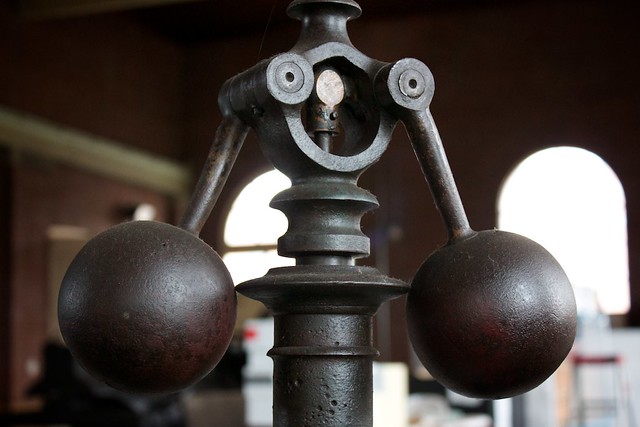
The whole beauty of this system is that despite whatever good or bad decisions might be made by the individuals comprising it (and in fact, because of their individual decisions), the system as a whole is self-correcting, in a way that a command economy can’t be. As Henry Hazlitt explains with an analogy:
The private enterprise system, then, might be compared to thousands of machines, each regulated by its own quasi-automatic governor, yet with these machines and their governors all interconnected and influencing each other, so that they act in effect like one great machine. Most of us must have noticed the automatic “governor” on a steam engine. It usually consists of two balls or weights which work by centrifugal force. As the speed of the engine increases, these balls fly away from the rod to which they are attached and so automatically narrow or close off a throttle valve which regulates the intake of steam and thus slows down the engine. If the engine goes too slowly, on the other hand, the balls drop, widen the throttle valve, and increase the engine’s speed. Thus every departure from the desired speed itself sets in motion the forces that tend to correct that departure.
It is precisely in this way that the relative supply of thousands of different commodities is regulated under the system of competitive private enterprise. When people want more of a commodity, their competitive bidding raises its price. This increases the profits of the producers who make that product. This stimulates them to increase their production. It leads others to stop making some of the products they previously made, and turn to making the product that offers them the better return. But this increases the supply of that commodity at the same time that it reduces the supply of some other commodities. The price of that product therefore falls in relation to the price of other products, and the stimulus to the relative increase in its production disappears.
In the same way, if the demand falls off for some product, its price and the profit in making it go lower, and its production declines.
He elaborates further on the particular role that profits play in all this:
In a free economy, in which wages, costs and prices are left to the free play of the competitive market, the prospect of profits decides what articles will be made, and in what quantities—and what articles will not be made at all. If there is no profit in making an article, it is a sign that the labor and capital devoted to its production are misdirected: the value of the resources that must be used up in making the article is greater than the value of the article itself.
One function of profits, in brief, is to guide and channel the factors of production so as to apportion the relative output of thousands of different commodities in accordance with demand. No bureaucrat, no matter how brilliant, can solve this problem arbitrarily. Free prices and free profits will maximize production and relieve shortages quicker than any other system. Arbitrarily fixed prices and arbitrarily limited profits can only prolong shortages and reduce production and employment.
The function of profits, finally, is to put constant and unremitting pressure on the head of every competitive business to introduce further economies and efficiencies, no matter to what stage these may already have been brought. In good times he does this to increase his profits further, in normal times he does it to keep ahead of his competitors, in bad times he may have to do it to survive at all. For profits may not only go to zero, they may quickly turn into losses; and a man will put forth greater efforts to save himself from ruin than he will merely to improve his position.
Contrary to a popular impression, profits are achieved not by raising prices, but by introducing economies and efficiencies that cut costs of production. It seldom happens (and unless there is a monopoly it never happens over a long period) that every firm in an industry makes a profit. The price charged by all firms for the same commodity or service must be the same; those who try to charge a higher price do not find buyers. Therefore the largest profits go to the firms that have achieved the lowest costs of production. These expand at the expense of the inefficient firms with higher costs. It is thus that the consumer and the public are served.
Profits, in short, resulting from the relationships of costs to prices, not only tell us which goods it is most economical to make, but which are the most economical ways to make them. These questions must be answered by a socialist system no less than by a capitalist one; they must be answered by any conceivable economic system; and for the overwhelming bulk of the commodities and services that are produced, the answers supplied by profit and loss under competitive free enterprise are incomparably superior to those that could be obtained by any other method.
I have been putting my emphasis on the tendency to reduce costs of production because this is the function of profit-and-loss that seems to be least appreciated. Greater profit goes, of course, to the man who makes a better mousetrap than his neighbor as well as to the man who makes one more efficiently. But the function of profit in rewarding and stimulating superior quality and innovation has always been recognized.
It’s a simple truism that everyone in an economy, firms and workers alike, will want to make as much money as they can (within whatever legal and moral limits they might be bound by). This is a reality that, under the wrong incentive structures, naturally has a lot of potential to produce bad outcomes; but under the right incentive structures, it also has a lot of potential to produce good ones. In command economies, unfortunately, this positive potential goes largely untapped, since firms and individuals are given no autonomy to decide for themselves which goods and services to sell. But in a market economy, they’re free to actually listen to what the market tells them – and by doing so, they can maximize their contributions to the economy as a whole. As Wheelan writes:
One powerful feature of a market economy is that it directs resources to their most productive use. Why doesn’t Brad Pitt sell automobile insurance? Because it would be an enormous waste of his unique talents. Yes, he is a charismatic guy who could probably sell more insurance policies than the average salesman. But he is also one of a handful of people in the world who can “open” a movie, meaning that millions of people around the world will go to see a film just because Brad Pitt is in it. That is money in the bank in the risky Hollywood movie business, so studios are willing to pay handsomely to put Brad Pitt in a starring role—about $30 million a film. Insurance agencies would also be willing to pay for the Pitt charisma—but more like $30,000. Brad Pitt will go where he is paid the most. And he will be paid the most in Hollywood because that is where he can add the most value.
Generalize this dynamic across the entire economy, and the result is a well-oiled machine designed to meet people’s economic demands as efficiently as possible, as Alexander describes:
The market economy is very good at what it does, which is something like “exploit money-making opportunities” or “pick low-hanging fruit in the domain of money-making”. If you see a $20 bill lying on the sidewalk, today is your lucky day. If you see a $20 bill lying on the sidewalk in Grand Central Station, and you remember having seen the same bill a week ago, something is wrong. Thousands of people cross Grand Central every week – there’s no way a thousand people would all pass up a free $20. Maybe it’s some kind of weird trick. Maybe you’re dreaming. But there’s no way that such a low-hanging piece of money-making fruit would go unpicked for that long.
In the same way, suppose your uncle buys a lot of Google stock, because he’s heard Google has cool self-driving cars that will be the next big thing. Can he expect to get rich? No – if Google stock was underpriced (ie you could easily get rich by buying Google stock), then everyone smart enough to notice would buy it. As everyone tried to buy it, the price would go up until it was no longer underpriced. Big Wall Street banks have people who are at least as smart as your uncle, and who will notice before he does whether stocks are underpriced. They also have enough money that if they see a money-making opportunity, they can keep buying until they’ve driven the price up to the right level. So for Google to remain underpriced when your uncle sees it, you have to assume everyone at every Wall Street hedge fund has just failed to notice this tremendous money-making opportunity – the same sort of implausible failure as a $20 staying on the floor of Grand Central for a week.
In the same way, suppose there’s a city full of rich people who all love Thai food and are willing to pay top dollar for it. The city has lots of skilled Thai chefs and good access to low-priced Thai ingredients. With the certainty of physical law, we can know that city will have a Thai restaurant. If it didn’t, some entrepreneur would wander through, see that they could get really rich by opening a Thai restaurant, and do that. If there’s no restaurant, we should feel the same confusion we feel when a $20 bill has sat on the floor of Grand Central Station for a week. Maybe the city government banned Thai restaurants for some reason? Maybe we’re dreaming again?
Seeing a clear market demand go completely unmet might not be too surprising in a command economy, for all the reasons we’ve discussed. In a market economy, though, meeting customer demand is the entire name of the game – and the result of this, when things are working properly, is that both customers and sellers benefit.
 N.W. Rains