Whether in the realm of immigration or free trade or domestic commerce, there’s a lot to be said for a government that’s capable of simply staying out of the way when that’s the right thing to do. In fact, if I could sum up this entire post in one line, that would probably be it. Sure, if you could somehow hypothetically guarantee that a government would always be perfectly competent and would always ensure that goods and services were optimally allocated throughout the economy, then maybe there’d be no problem with letting it exercise its control over every different part of the system. But of course, no government is ever perfectly competent or right in its actions – and the more imperfect a government is, the more damage it’s liable to do if given significant power. That’s why things like absolute dictatorships and command economies have such atrocious track records; when there’s only one body responsible for making all the decisions, that means there’s only one potential point of failure, which, if anything whatsoever goes wrong, can bring down the entire system. By contrast, in a free market system where the government largely allows the market to allocate goods and services without trying to control the whole process itself, this “single point of failure” problem is avoided; the government can be led by a brilliant visionary or a complete buffoon, and the economy will still hum along on its own regardless, because it isn’t wholly dependent on that one person’s policy choices.
And to be clear, this doesn’t mean that the government should stay out of the economy altogether. There are plenty of areas where the government can and should get involved, because the market mechanism just isn’t sufficient on its own – areas like accounting for externalities, providing public goods, regulating natural monopolies, and so on. There are plenty of goods and services that can and should be provided by government, and we’ll get into what all those are in the next post. Having said that, though, when it comes to everyday consumer goods and services like electronics and groceries and haircuts and so on, it seems fair to say that the market mechanism has proven itself to be superior; so in those cases, the best thing the government can do is just stand aside and let the market do its thing.
How, then, can we strike the best balance between market freedom and government support? Ashwin Parameswaran has an interesting take on this question. He notes that within this debate, the strongest conservative criticisms of government tend to focus on its scope – i.e. how many areas it needlessly extends its tentacles into – whereas the strongest liberal arguments tend to focus on its scale – i.e. how much more it needs to be doing in the few key areas where it’s really necessary. He proposes that an approach which increased the scale of government but reduced its scope – i.e. a government that limited itself to a narrow core domain of public goods and services but was very active within that narrow domain – might be one that both sides would agree was an improvement over the status quo. In other words, the best solution might be to give the market as much free rein as possible, and to let the forces of creative destruction exert their full effects even if it means that jobs and businesses are constantly being created and destroyed – but, crucially, to also have a robust government-funded safety net ready to catch anyone whose job or business has fallen victim to this creative destruction, and to quickly re-equip them to bounce back again as smoothly as possible. In Parameswaran’s words:
A robust safety net is as important to maintaining an innovative free enterprise economy as the dismantling of entry barriers and free enterprise are to reducing inequality.
And judging from the examples of different economies around the world, it really seems like there’s something to this idea. When we look at which countries have achieved the most impressive economic outcomes – we’ve already mentioned Denmark as a particularly notable example, not just in terms of raw GDP but also in terms of poverty levels and overall quality of life and so on – they tend to be countries that have both strong markets and strong government supports. And rather than conflicting with each other, their markets and their governments reinforce each other and help each other to function even more effectively; the government safety net gives firms and individuals the freedom to take risks and pursue their market advantages without worrying that they’ll be utterly ruined if they fail, and the wealth that they subsequently produce as a result of that risk-taking (along with a relative lack of regulatory interference) ensures a healthy enough tax base to keep the safety net strong and well-funded. Businesses fail and people lose their jobs all the time – and the government allows this to happen without trying to impede it – but it’s okay, because the government also helps the people who’ve lost their jobs or businesses to get right back on their feet again, thereby making the economy as a whole that much more dynamic. As Kathleen Thelen and Cathie Jo Martin explain:
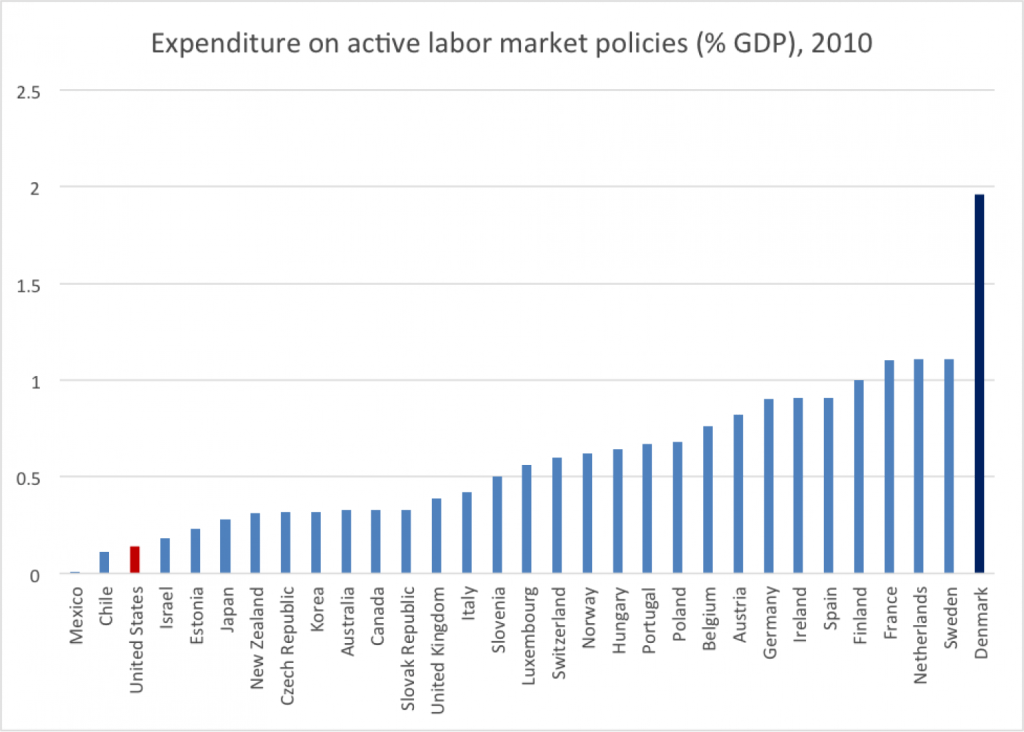
When people think of the “Danish model” they tend to think first about the country’s generous social policies, and assume that the point of all of this is to protect people from the market. This is wrong: Danish labor markets are very flexible. The difference with the United States is that [Danish] labor market policies are precisely designed to move the unemployed into training programs that enhance their marketable skills. This helps them reenter the labor market as soon as possible and is the core of the country’s famous “flexicurity” model — high flexibility in the labor market combined with extensive state support for skill development. Denmark spends more on active labor market policies than other OECD countries, far and away more than the United States, which is a laggard in this respect, as the graph below shows.
[…]
Denmark is the most egalitarian country in the world, but in December 2014, Forbes (once again) ranked Denmark as the best country in the world to do business. (The U.S. ranking was 18th.) The country’s formula for growth is a high level of workforce skills and extensive cooperation among employers and workers to support labor market flexibility.
[…]
The most important institutions underpinning this flexible approach are those that help both young people and adults develop skills. Denmark has an extremely well developed system for initial vocational education and training (for youth) – well supported both by employers and the state. This is one reason why Denmark’s “NEET” rate (the number of young people Not in Employment, Education or Training) is comparatively low. Beyond this, though, the government also supports ongoing skill development for adults, as well – and not just for the unemployed. Denmark is a leader in adult education – providing training courses that are easily accessed, generously supported by the state and widely available to anyone who wishes to enhance his or her own skills. This is why Denmark has one of the highest rates of participation in adult education and training in the world. Rapid technological change makes it important for all adults to be able to upgrade their skills flexibly and throughout their working lives. This is not big brother socialism. This is really smart capitalism.
[…]
Retraining and vocational training policies both support “flexicurity,” [retooling] workers whose skills are becoming outdated with changing economic conditions. Workers may be easily laid off from their jobs but the government will quickly move them into training programs and then back into the workforce. For example, in 2011 Denmark spent about five percent of its GDP on training, compared to the U.S., which spent less than one percent.
Most people assume the United States is the most [market-friendly] country. Not so.
[…]
The Wall Street Journal and Heritage Foundation produce an annual Index of Economic Freedom. They rate countries for their respect for property rights, freedom from corruption, business freedom, labor freedom, monetary freedom, trade freedom, investment freedom, financial freedom, fiscal freedom, and government spending. Hong Kong, Singapore, Australia, New Zealand, Switzerland, Canada, Chile, Mauritius, and Ireland have higher overall scores than the United States.
… Australia, New Zealand, the United Kingdom, Canada, and Switzerland have higher levels of economic freedom. Many of the Scandinavian countries—which Americans often call “socialist”—beat the US on many central aspects of economic freedom.
[…]
We should regard Denmark in particular as economically freer than the United States. Yes, Denmark has high tax rates, but on almost every measure of economic freedom, it trounces the US.
Denmark ranks much higher than the United States on property rights, freedom from corruption, business freedom, monetary freedom, trade freedom, investment freedom, and financial freedom. Luxembourg, the Netherland, the United Kingdom, and many other countries beat the US on these measures as well. Thus, many other European countries might reasonably be considered more economically libertarian than the US.
[…]
Denmark also rates 99.1 in business freedom, 90.0 in investment freedom, and 90.0 in financial freedom. In comparison, the US scores 91.1, 70.0, and 70.0 respectively on these measures.)
Denmark and Switzerland have remarkably effective welfare states, but that doesn’t make them [socialist]. Rather, think of them as free market countries with strong, well-functioning social insurance programs.
It’s no coincidence that countries like Denmark, which have strong government safety nets but are extremely pro-market at the same time, also tend to be the most successful and enjoy the highest quality of life in the world. If a government is functioning properly, it will empower its citizens to make the most of their freedom to transact with each other in the market; and in turn, a healthy and productive market economy will lead to even better government. The strength of one bolsters the other; and where one is weak or ineffective, the other can cover up its failings. We’ve spent this post talking all about where government’s weaknesses lie, and how the market mechanism can provide an effective counterbalance to those weaknesses. In the next post, then, we’ll switch things around and discuss all the areas where markets fail, and how government can help remedy those failures. To jump right into it, click here. ∎
 N.W. Rains